
Idea 1
Choosing to Be Awesome Instead of Average
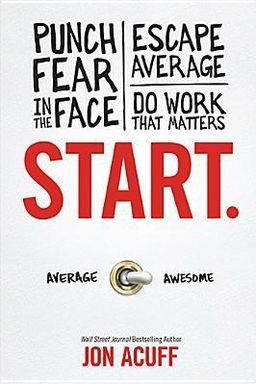
What if the most dangerous thing you could do with your life wasn’t failing—but settling? In Start: Punch Fear in the Face, Escape Average, and Do Work That Matters, Jon Acuff presents a simple but radical argument: the biggest threat to an awesome life isn’t poverty, rejection, or lack of opportunity. It’s comfort, complacency, and coasting toward mediocrity. Average is easy, but awesome requires deliberate effort. The difference, Acuff insists, comes down to whether you start.
Drawing on his own rollercoaster career—from cubicle worker to bestselling author and speaker—Acuff maps out the five stages every awesome life travels through: Learning, Editing, Mastering, Harvesting, and Guiding. These stages traditionally follow chronological age, but Acuff argues that today’s world has changed. Digital tools, social media, and new cultural values make it possible to accelerate this journey at any point in life. Whether you’re 22 or 52, you can start again and become more awesome, more often.
Why “Starting” Matters More Than Planning
Acuff opens with a powerful metaphor: a map is useless if you don’t know your starting point. Before setting big goals, you have to ask, “Where am I right now?” He learned this lesson in Vietnam, when his travel guide reminded him that even the most detailed map is worthless without a “You Are Here” marker. The same is true for life—you can’t plot your way to awesome unless you’re brutally honest about your starting point.
Acuff contrasts two life paths: the path of average and the path of awesome. The average path coasts downhill; it’s wide, familiar, and safe. You don’t have to decide much—just keep aging. It feels fine until you reach the end and realize you’ve simply grown old, not awesome. The awesome path is narrow, unpredictable, and occasionally dangerous. It’s filled with dragons—fear, doubt, and discomfort—but also joy, creativity, and meaning.
The Five Stages of an Awesome Life
According to Acuff, every awesome life progresses through five predictable stages, similar to a map:
- Learning: When you’re exploring, experimenting, and making mistakes that teach you who you are.
- Editing: When you focus, clarify, and discard distractions to refine what truly matters.
- Mastering: When your chosen skills or passions begin to bear real fruit through disciplined work.
- Harvesting: When you reap the rewards of earlier effort—financially, relationally, or creatively.
- Guiding: When you reach a point of helping others walk their own road to awesome.
Traditionally, these stages track with each decade of life—20s for learning, 30s for editing, 40s for mastering, 50s for harvesting, 60s for guiding. But Acuff argues the Internet has made it possible to compress time. You can start again in any stage or age because technology, opportunity, and connection have democratized success. “Life,” he writes, “is now less about how old you are and more about when you decide to live.”
The New Rules of Work and Meaning
Acuff calls out three modern forces that have changed the nature of personal growth: retirement is dead, hope is boss, and anyone can play. Long-term job security has vanished; meaning now matters as much as money; and digital platforms have flattened hierarchies, opening doors to anyone with hustle. No matter your status, you can contribute, create, and connect—if you’re willing to start small.
That word—start—is the heartbeat of Acuff’s philosophy. Fear, he says, is schizophrenic: it will tell you both to do nothing (“You’re not ready”) and to do everything (“You have to do it all at once”). The only antidote is to start with what you can control: the starting line. The finish line will come later.
“The starting line is the only line you completely control. The finish? That’s months, if not years away. But the start? That’s yours.”
Recovering Your Childlike Sense of Awesome
Acuff makes one more striking point: you were once awesome. As a child, you believed anything was possible. You turned sticks into swords and cardboard boxes into castles. But over time, teachers, parents, or bosses convinced you that your imagination belonged in storage. The older you got, the louder your left-brain logic became, stamping out the wonder that fuels creativity.
The good news? You can recover it. Being childlike isn’t naivety; it’s refusing to let cynicism smother courage. When Acuff’s daughter compared her imagination to Roald Dahl’s, she wasn’t arrogant—she was connected to her innate potential. Adults can do that too; they just have to grant themselves permission.
The Choice That Defines Everything
Ultimately, Start is a manifesto about agency. You can wait for permission from someone else, or you can start right where you are. You can drift through life on the comfortable, predictable road of average, or you can take the narrower, harder, but infinitely more rewarding road to awesome. The one thing you can’t do is stand still. “You’re the boss of the start,” Acuff writes, “and starting is the most powerful thing you can ever do.”