
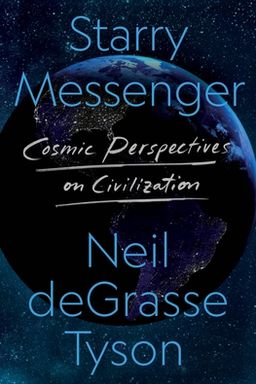
Starry Messenger cover

Starry Messenger

by Neil deGrasse Tyson

Neil deGrasse Tyson''s ''Starry Messenger'' invites readers to adopt a cosmic perspective, offering transformative insights into life''s challenges. By viewing human existence within the vast universe, this book reveals new ways to approach unity, exploration, and cultural understanding, helping us live more meaningfully on our exceptional planet.

Seeing Humanity Through a Cosmic Lens

What would you realize if you could see Earth from the Moon? In Starry Messenger, astrophysicist Neil deGrasse Tyson urges you to do just that—not literally, but philosophically. He argues that applying a cosmic perspective to our daily lives can cure many of the dysfunctions afflicting civilization. Tyson contends that most of humanity’s struggles—over politics, religion, identity, race, and truth—come from seeing the world through a narrow Earth-bound lens. But when you zoom out and look at the planet as astronauts do, boundaries dissolve and everything changes.

The book’s central message is a wake-up call: science and rational thinking are the surest guides to truth, and the cosmic viewpoint offers humility and clarity in the face of dogma and tribalism. Tyson takes Galileo’s 1610 Sidereus Nuncius, or Starry Messenger, as the metaphorical spark. Galileo’s discovery that Earth is not the center of the cosmos shattered human ego; Tyson’s version seeks to shatter our self-importance again, using cosmic awareness to reveal how petty our divisions truly are.

Science as Civilization’s Compass

Tyson frames science as humanity’s best antidote to confusion and hatred. He reminds readers that the scientific method’s essence—“do whatever it takes to avoid fooling yourself”—can transform not only laboratory work but personal and political life. Through historical figures like Ibn al-Haytham, Leonardo da Vinci, and Galileo, he traces the lineage of self-skeptical inquiry that birthed modern civilization. If only our public debates followed this model—trading data, not opinions—our disagreements would shrink dramatically.

Science, Tyson says, also self-corrects without needing external policing. Wrong data eventually die when replicated experiments fail. This built-in humility contrasts sharply with political partisanship or ideological certainty that resists evidence. He warns that cherry-picking pre-consensus science to fuel cultural battles undermines democracy itself. Real progress demands taking nobody’s word for it—echoing the Royal Society’s 1660 motto.

The Overview Effect and Cosmic Perspective

Drawing from astronaut accounts like Apollo 14’s Edgar Mitchell, Tyson introduces the life-altering “overview effect”: viewing Earth from space produces an instant sense of global unity and dissatisfaction with petty politics. From that vantage, the planet’s beauty overshadows its conflicts. Tyson wants all of us, metaphorically, to experience that effect—to see ourselves not as factions, but as species members inhabiting one fragile, shared orb. When you do, you realize humanity supports not many tribes, but only one—the human tribe.

This cosmic outlook doesn’t make life cold or impersonal; Tyson insists science is profoundly human because its results enhance health, wealth, and security worldwide. The key is not merely knowing facts but thinking scientifically. By applying evidence-based reasoning, you cultivate empathy, curiosity, and perspective—all essential to sustaining civilization.

Why It Matters

Tyson’s argument is not academic—it’s urgent. In an era of misinformation and polarization, he urges you to reclaim objective truth over personal belief. He contrasts personal truths (what you feel) and objective truths (what evidence proves), warning that confusing the two breeds dictatorships and division. The cosmic perspective acts as humanity’s ego check: it centers facts, not feelings, and invites cooperation where conflict once reigned. The universe, he reminds us, doesn’t care about our opinions—but it grants us the tools of science to unveil reality.

Throughout the book, Tyson journeys across topics like beauty, exploration, politics, gender, race, law, risk, and even death, showing how a universal lens can illuminate each. From the dazzling physics behind sunsets to the moral insights of space travel, Starry Messenger merges astrophysics and philosophy, urging readers to see truth and humanity through starlight. In doing so, Tyson challenges you not just to look up—but to rethink what it means to be human in the cosmos.


Truth, Beauty, and Scientific Clarity

Tyson opens with a timeless puzzle: what is truth, and why do beautiful things often feel true? He explores how humans confuse aesthetics, belief, and fact—then distinguishes three varieties of truth that shape civilization: objective, personal, and political. Objective truths, discovered through science, don’t care what we believe. The Sun is hot. DNA between humans and chimps is 98 percent identical. Gravity exists. These truths remain solid even if ignored or denied; they’re measurable anywhere, anytime.

Personal and Political Truths

Personal truths, Tyson warns, arise from faith or emotion—what you want to be true even without evidence. He gives examples spanning religion and culture: Is Jesus your savior? Should government feed the poor? These shape identity but easily spark conflict when enforced by coercion. Political truths, meanwhile, weaponize repetition and propaganda until unverified ideas feel factual. He invokes Nazi Germany’s indoctrination of Aryan supremacy as the dire consequence of “belief over evidence.” The fewer facts an ideology has, he notes, the more willing its believers become to die—or kill—for it.

The Science of Beauty

Beyond truth, Tyson celebrates the beauty woven into objective reality itself—from sunsets to equations. He contrasts humanity’s obsession with artificial beauty—cosmetics, hair dye, height—that washes off in the shower—with nature’s effortless splendor. Knowing the physics of sunsets or the chemistry of water doesn’t diminish their charm; it deepens it. The elegant equations—Einstein’s E = mc², Newton’s F = ma, or pi’s endless digits—embody what Tyson calls “facts that glisten” because simplicity and symmetry are nature’s art forms. Physics, math, biology, even chemistry, he insists, can be beautiful.

Beauty Amid Chaos

Still, truth includes ugliness. Volcanoes, hurricanes, and mass extinctions are destructive, yet breathtaking in scale. Earth isn’t a benevolent mother—it kills more species than have survived. Tyson flips our green-romantic notion of nature: not all that’s natural is beautiful; not all that’s beautiful is natural. Even astronomical devastation—comet Shoemaker-Levy 9 smashing into Jupiter—was, to astrophysicists, sublime. The cosmic perspective turns terror into wonder, viewing catastrophe as part of creation itself.

The Poetic End

To reconnect science and art, Tyson closes the chapter with poetry—from Joyce Kilmer’s “Trees” to the simple awe of a sunset—to remind that beauty prompts gratitude, and gratitude prompts stewardship. For him, the ultimate beauty lies not in any one object, but in the universe’s intelligibility: it’s knowable at all. No divine command required it to be so—it just is. That fact, he says, makes truth itself the most beautiful thing in existence.


Exploration and Discovery: Humanity’s Double Helix

Tyson sees curiosity as civilization’s DNA—intertwined twin strands of exploration and discovery driving progress. When critics argue space exploration wastes funds better spent fixing Earth, he flips the logic: humanity always improved the “cave” by venturing beyond its door. Whether astronauts, Polynesian navigators, or cave dwellers, exploration reveals new resources, medicines, and perspectives that solve old problems. He calls it folly to think we must fix Earth before we explore; without exploration, we’d still shiver in caves.

Thinking Beyond Linear Limits

Our brains, Tyson notes, evolved for linear thinking: walk twice as far, get twice as many berries. But modern reality runs on exponentials. A penny doubled daily beats $5 million in a month. Knowledge, he shows using his Princeton library measurement of The Astrophysical Journal, doubles roughly every 15 years. Patents double, technologies multiply, discoveries compound. When we misjudge exponential systems—like mortgages or viruses—we flirt with disaster. Understanding exponentials, Tyson says, is essential for navigating the future.

History’s Doubling Curve

Tyson leads a whirlwind tour of technological evolution: railroads (1870–1900), airplanes (1900–1930), spaceflight (1930–1960), electronics and civil rights (1960–1990), internet and smartphones (1990–2020). In each 30-year window, life became “unrecognizable” to the previous generation. He spotlights prophetic errors—like 1900’s George H. Daniels predicting no advances beyond steam engines—to show how linear thinking blinds us to exponential change. Every era believes it lives in special times, Tyson laughs, yet exponential growth ensures everyone is right.

The Future That Awaits

Predictions for 2050, Tyson confesses, will fail—but he offers rationally optimistic ones: curing mental illness, regrowing limbs, perfect antiviral serums, DNA-customized medicine, AI as helper not overlord, full space industry funded by tourism. He defends scientific investment as the seedbed of civilization—linking physics breakthroughs like relativity and quantum mechanics to modern GPS, electronics, and material science. Civilization’s exponential climb, he insists, means “it’s all new under the Sun, Moon, and stars.” For Tyson, exploration isn’t luxury—it’s how we evolve.


Earth and Moon: Seeing Ourselves from Afar

From Earth orbit to lunar distance, Tyson explores the transformative power of looking back at our planet. He reminds you that most astronauts never travel farther than a centimeter above a school globe—but even that view makes national borders vanish. From space, famine, faith, and politics disappear; what remains is a single shimmering biosphere. Tyson recounts astronaut Mike Massimino’s realization while repairing the Hubble Space Telescope: “This must be the view from Heaven—no, this is what Heaven looks like.”

Earth from the Moon

Apollo missions elevated that perspective. Earthrise, the 1968 photo from Apollo 8, showed our home as a fragile marble suspended in black space. Tyson calls it civilization’s “firmware upgrade.” That image seeded global environmentalism—it made people care not just about local rivers, but Earth itself. He traces such awakenings to policy leaps: the Clean Air Act, Earth Day, the EPA, unleaded gas, and catalytic converters—all born, he argues, under the spell of lunar missions.

The Moon’s Lessons

Tyson also debunks moon myths with scientific humor: full moons don’t cause more births or werewolves; moonlight is just sunlight. Gravity from the Moon doesn’t turn you insane—its tidal force across your skull is smaller than your pillow’s pressure. The real miracle, he says, is that the Sun and Moon appear the same size, creating perfect eclipses—“a match made in heaven.” Through this lens, even superstition becomes an opportunity to teach cosmic reasoning.

From Earthrise to Pale Blue Dot

Tyson connects Earthrise to Carl Sagan’s “Pale Blue Dot,” calling both corrective mirrors to human arrogance. From the Moon or deep space, Earth looks fragile, alone, and sacred—not because it’s blessed, but because it’s finite. That perspective can save civilization if we internalize it. Viewed from space, humanity’s conflicts—Israel vs. Gaza, North vs. South Korea—become absurd contrasts of light and dark pixels. For Tyson, cosmic humility is not philosophy—it’s survival.


Conflict and Resolution: Science as Peacemaker

Why do civilizations fight? Tyson suggests it’s because our Paleolithic brains still crave tribalism. Political and religious conflicts stem from our instinct to form in-groups and demonize outsiders. Science, he argues, may be civilization’s only reliable peacemaker because it transcends personal truth: equations and data remain the same across languages and nations. Pi doesn’t change at a border crossing.

Science Beyond Politics

Tyson recounts cooperation amid planetary rivalry—from the Apollo-Soyuz docking, where Americans spoke only Russian and Russians only English, to his own Cold War-era meetings in Star City with cosmonauts. Scientists bond instantly around shared curiosity, not ideology. He calls this camaraderie “friendship forged in space,” reminding that nations once at war now cooperate aboard the International Space Station. If humanity could bring that rational unity back down to Earth, many conflicts would dissolve.

Reason at the Political Center

On Earth, Tyson illustrates how rational debate, not ideological labeling, reveals truth. Appointed by President George W. Bush to two White House commissions, despite leaning liberal, he discovered the power of meeting midway. Standing at the center, he saw both left and right’s blind spots—and realized thinking for oneself means rejecting tribal labels altogether. Rational inquiry doesn’t erase disagreement; it makes people disagree less strenuously.

From Partisanship to Humanity

Across red-blue tropes—family values, science denial, racism, taxes—Tyson exposes hypocrisy and bias on both sides, inviting readers to ground politics in data rather than emotion. He repeatedly shows how facts transcend ideology: conservatives fund science more than expected; liberals reject GMOs and vaccines more than admitted. His verdict is simple: moral superiority rarely correlates with reality. Adopting cosmic objectivity lets each tribe see its contradictions. Only then, Tyson concludes, can the human tribe unite.


Risk, Reward, and Rational Decision-Making

Tyson reveals how probability and statistics—mathematics humanity learned last—are the keys to understanding risk. Yet because evolution trained us to flee lions, not calculate odds, we misjudge danger everywhere. Casinos, lotteries, and even public policy exploit this flaw. Tyson’s favorite example: when 4,000 physicists held a conference at Las Vegas’s MGM Grand, casino profits hit record lows—not because they rigged the tables, but because scientists simply didn’t play.

The Mathematics of Chance

Humans think randomness carries meaning—“There are no coincidences,” we say. But a cosmic perspective dissolves magical thinking. Tyson’s coin-flip experiment shows how media celebrates the lucky winner who gets ten heads in a row while forgetting the 999 who didn’t—demystifying stock market “genius.” He humorously compares gambler odds to real statistics: you’re 300 times likelier to be killed by lightning than to win Powerball, yet millions play weekly.

Understanding Comparative Risk

Tyson contrasts emotional versus rational risk assessment using glyphosate panic over Ben & Jerry’s ice cream: trace amounts of herbicide were far less lethal than sugar itself. “You’d die of sugar after twenty pints, not glyphosate after four hundred million,” he quips. The point: statistical literacy saves lives and democracy alike. He shows how media inflates fear by citing percentage increases (like cancer risk) without context for base rates—making small bumps sound catastrophic.

Emotions vs. Data

From smoking to mass shootings to self-driving cars, Tyson dissects how feelings override evidence. He even acknowledges his social media misfires—rational posts misunderstood as cold in tragedies—explaining that data feels heartless only when we refuse to see its compassion: statistics save future lives. He retells moral dilemmas—like reintroducing cougars to cut deadly deer collisions—to show how logic clashes with sentiment. Rationality, Tyson concludes, doesn’t mean rejecting emotion; it means informing it, letting feeling coexist with truth.


From Meat to Morality: What We Eat Reveals Us

Food, Tyson argues, is philosophy served daily. Comparing meatarians and vegetarians, he dissects not diet but worldview. Humans, he notes, conveniently call themselves omnivores yet rarely confront the moral hierarchy of eating sentient life. The “industrial miracle” of meat production—billions of animals processed efficiently—sits uneasily atop ecological and ethical contradictions. He provokes activists with one tweet: cattle are “biological machines turning grass into steak.” Both vegans and carnivores exploded. For Tyson, that reaction reveals how emotion, not reason, dominates moral discourse.

Ethics and Ecology

He explores how dominion theology, drawn from Genesis, gave humans divine permission to exploit animals, until modern philosophy reframed it as stewardship. PETA’s founder Ingrid Newkirk’s conversion—from intending to cook snails to founding an animal rights movement—illustrates how empathy emerges from personal experience. Yet Tyson also exposes “speciesism”: caring for dolphins while devouring tuna, saving puppies but exterminating ticks. Every moral cutoff—which life we protect versus eat—is arbitrary from a cosmic view.

The Plants Strike Back

Expanding empathy further, Tyson humorously accuses vegetarians of “mobility bigotry” (echoing Chuck Lorre’s satire): they kill the motionless. Trees that bleed sap, plants that communicate through mycelium networks, and photosynthetic organisms that might possess proto-consciousness challenge our moral simplicity. From this angle, eating a salad looks as violent as eating a chicken. The cosmic perspective erases moral privilege—you kill something every meal. Milk and honey, he concludes, are humanity’s only non-lethal diet.

Ultimately, Tyson’s ethical stance isn’t prescriptive—it’s observational. The universe shows no preference for plant or animal life. We alone care, but caring without data creates dogma. Whether you eat steak or tofu, he wants you aware: every bite connects you to starstuff. Understanding that interdependence, not judgment, defines morality in a cosmic civilization.


Human Identity: Beyond Gender and Race

Tyson argues human identity—gender, sexuality, skin color—is a continuum, not a set of boxes. Nature itself despises binaries: water’s triple point exists simultaneously as solid, liquid, and gas; particles act as both waves and matter. So why do we insist humans be male or female, gay or straight, black or white? To categorize, he says, is to escape ambiguity, yet ambiguity defines the universe.

Gender as a Spectrum

In exploring gender, Tyson compares fluid identity to quantum bits—qubits that hold combinations of 0 and 1. Just as quantum computing thrives on uncertainty, so might humanity. He reviews history: Deuteronomy’s ban on cross-dressing, Joan of Arc’s execution, tomboys from West Side Story, and modern LGBTQ+ designations, tracing evolution from binary repression to rainbow acceptance. To him, the pride flag’s many colors symbolize nature’s continuous spectrum, not discrete lanes.

Race on a Continuum

Turning to race, Tyson applies astrophysics literally. Using “albedo”—light reflectivity—he shows skin color follows latitude and ultraviolet radiation, not divine hierarchy. Race, he insists, is a continuum of reflected sunlight, not a justification for oppression. He dismantles racist science—from Jefferson to Galton to eugenics—by inverting it: if Black anthropologists had judged White Europeans, they’d find plenty of “ape-like” features. From this reversal, Tyson delivers his most human insight: superiority is an illusion built from ignorance.

Cosmic Equality

Finally, he reminds that all humans share ancestry—scientifically confirmed pedigree collapse funnels billions into one genetic tree rooted in Africa. We are, biologically, kin. So whether you’re tall or small, pale or dark, binary or nonbinary, the universe sees only carbon-based patterns. Tyson’s call: judge by the content of character, not by wavelength or chromosome. When seen from space, he affirms, “all humans are indistinguishable”—and that’s not cold; it’s cosmic compassion.


Law, Reason, and the Idea of Rationalia

Civilization, Tyson argues, depends on rule of law—but law should orbit reason, not passion. Quoting Aristotle’s “Law is reason free from passion,” he surveys justice evolving from trial by fire or water—where survival “proved innocence”—to modern juries. Yet even today, verdicts often hinge on emotion, not evidence. Tyson, twice dismissed from jury duty for valuing data over testimony, notes that eyewitness accounts are notoriously unreliable—a fact science recognized long before courts did.

Science vs. Sentiment in Justice

Through historical examples—the Code of Hammurabi, the Magna Carta, the Blackstone ratio—Tyson shows progress toward fairness while warning that if lawyers win cases by passion, justice remains unscientific. The Innocence Project’s DNA exonerations prove that bias, misidentification, and narrative manipulation still dominate. A truly rational courtroom, he says, would prefer evidence to rhetoric.

The Dream of Rationalia

At the 2016 Starmus science festival, Tyson proposed a one-line constitution for a virtual nation: “All policy shall be based on the weight of evidence.” The idea of Rationalia triggered outrage—critics called a science-based country “terrible.” Tyson replied that morality itself can evolve through reason, that evidence informs ethics better than dogma. In Rationalia, people could be irrational personally but never legislate irrationality publicly—a framework for governance grounded in curiosity, compassion, and data.

For Tyson, Rationalia isn’t utopia—it’s trajectory. Science already seeds justice by identifying wrongful convictions and refining forensic tools. The next step is cultural: replacing emotional politics with an evidence-driven worldview. Only then can law protect civilization as surely as gravity protects planets.


Life, Death, and Cosmic Continuity

Tyson ends with the most universal question: what makes life precious? He invites readers to contemplate mortality scientifically, rejecting denial. Each birth and death are rare, common miracles—four babies born every second, two people dying at the same rate. Evolution and entropy dance eternally, and Earth, far from nurturing, is “a giant killing machine.” Yet existence itself—a consciousness formed from stardust—remains the ultimate cosmic lottery win.

The Science of Mortality

When you die, Tyson explains, you cease metabolizing and cool to room temperature. Cremation sends your molecular energy as infrared photons into space; burial returns nutrients to Earth’s cycle so worms and plants reclaim them. Religion imagines heaven; science shows continuity of matter. You’re recycled starstuff, not vanished existence. Consciousness ends where oxygen fails, but life continues in the cosmos through energy exchange. As he puts it, “Let the worms and microbes dine upon my flesh; they’ll be the next shepherds of civilization.”

The Meaning of Finite Life

For Tyson, immortality would rob life of urgency: death gives meaning. Flowers that never wilt, dogs that live forever, would lose beauty and devotion. Mortality compels creation, compassion, and wonder. Accepting finitude makes every sunrise sacred. Each of us, statistically, represents an infinitesimal fraction of possible human DNA combinations—so rare we’re practically cosmic originals. “We won the lottery,” Tyson writes, “only once.”

A Call to Cosmic Gratitude

Tyson closes with educator Horace Mann’s challenge: “Be ashamed to die until you have won some victory for humanity.” Life, in the cosmic account, isn’t about escaping death but earning meaning before it arrives. His final reminder: our urge to look up—to wonder at stars—may be stronger than our urge to fight. Understanding ourselves as temporary stewards of civilization transforms death from fear into purpose. In the end, he leaves you humbled yet uplifted: life’s brevity makes the universe all the more precious.

Dig Deeper

Get personalized prompts to apply these lessons to your life and deepen your understanding.

Go Deeper

Get the Full Experience

Download Insight Books for AI-powered reflections, quizzes, and more.