
Idea 1
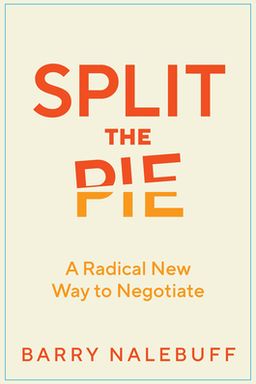
Split the Pie: A Radical Rewrite of How We Negotiate
What if every negotiation—from buying a car to settling a multimillion-dollar merger—could be transformed from a battle of power into an exercise in fairness? In Split the Pie, Barry Nalebuff argues that most negotiators misunderstand what’s truly at stake, making deals harder, slower, and less rewarding for everyone. His radical claim is simple but revolutionary: negotiation isn’t about dividing the total; it’s about evenly dividing the extra value created by the agreement itself—what he calls “the pie.”
That distinction changes everything. Most people fixate on the total outcome, looking at what each party ends up with—how many slices of pizza, which percentage of revenues, which share of cost. Nalebuff contends that this lens hides the real structure of a negotiation. What really matters is the incremental gain—the value that didn’t exist until the two sides agreed to work together. If you and I can only create that extra value together, we have equal power inside the negotiation, even if one of us looks bigger outside it.
Reframing Fairness and Power
Nalebuff opens with a metaphor that doubles as a miniature revolution: a pizza at New Haven’s famous Pepe’s. Alice and Bob must agree how to split a 12-slice pie. Without a deal, Alice gets 4 and Bob gets 2. Should they divide the full 12 slices equally (6 and 6)? Or in proportion to their fallback options (8 and 4)? Nalebuff demonstrates that both approaches miss the point. The negotiation is about the extra six slices—the 12 total minus the 6 they’d get otherwise. That six-slice increase is the pie, and both are equally responsible for creating it. So each gets half of that pie—three slices—on top of their fallback. Alice ends with 7, Bob with 5. Fairness isn’t about total equality; it’s about equal power over incremental gain.
This deceptively simple example lays the foundation for Nalebuff’s larger argument: every two-party negotiation is inherently symmetric. The only reason it happens is because both sides are needed to create more value together than apart. That means each is equally powerful in creating the pie, even if one has more money, size, or leverage beyond the table. Power outside doesn’t translate to power inside.
From Hard Bargaining to Principled Fairness
Nalebuff’s framework moves negotiation from a game of bluffing and intimidation to one of reasoning and principle. He builds his case through vivid real-world stories: buying a domain name from a troll, selling Honest Tea to Coca-Cola, or solving a landlord-tenant dispute over a broken lease. Across each story, the same logic applies—the pie defines what’s at stake, fairness means equal power, and principled reasoning triumphs over arbitrary tactics.
Under this logic, games like “split the difference” or “meet halfway” turn hollow. Splitting halfway between arbitrary offers doesn’t yield fairness—it creates new unequal ground between arbitrary points. The pie approach anchors fairness to objective reasoning. As he puts it, “halfway between arbitrary and fair is still arbitrary.”
Why This Matters
Negotiations shape careers, contracts, and relationships—but they’re often fueled by illusion. Bigger players act powerful; smaller ones feel weak. The pie framework cuts through those illusions, showing why even a small company negotiating with a giant like Coca-Cola still wields equal power. Nalebuff’s own experience illustrates this: Honest Tea’s partnership with Coke created huge value through distribution and branding synergy. Coke’s trucks and Tea’s product were equally essential to create the extra sales—and thus, the pie. Recognizing that equality led to a deal that benefitted both sides and expanded the market.
He contrasts his framework with the “power” and “fairness” approaches that dominate business practice and negotiation literature. The power view says whoever can walk away gets more; the fairness view splits totals evenly. Both miss the core logic because they focus on the entire pie instead of what’s newly created. Nalebuff’s approach merges ethical fairness with practical efficiency—when people see their equal role in creating the pie, they cooperate to make it larger rather than fighting over fixed slices.
What You’ll Learn in This Summary
Across the chapters, you’ll see how this single idea reshapes everything we assume about negotiation. You’ll learn why having a weak BATNA (Best Alternative to a Negotiated Agreement) doesn’t make you powerless; how fairness can be precisely measured; how objective criteria like market value often confuse rather than clarify; and how trust, empathy, and allocentrism—the art of seeing the other side’s perspective—grow the pie even bigger.
In later chapters Nalebuff builds on the mechanics: teaching how to measure the pie, convince others of its logic, deal with uncertainty and multiple parties, and prepare so you can educate and influence the other side. By the end, “split the pie” becomes both a negotiation strategy and an ethical stance—a commitment to fairness grounded in shared creation, not dominance. As he concludes, solving how to divide the pie unlocks the trust needed to create a bigger one. It’s a radical yet rational call to rethink every negotiation as a joint optimization problem rather than an adversarial fight over who gets more.