
Idea 1
Another Kind of Love Story
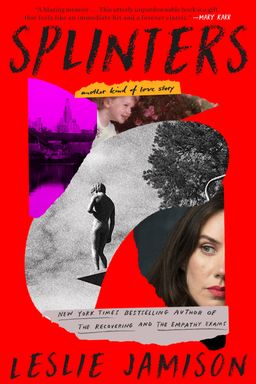
How do you carry love forward when the vessel that once held it—marriage, certainty, youth—has cracked? In Splinters, Leslie Jamison argues that love doesn’t vanish when its first container breaks; it recomposes itself in fragments—mother-love, friend-love, art-love, self-love—demanding new forms of ritual, attention, and responsibility. She contends that the story you can live with after rupture is not a clean arc or a single redemption but a mosaic: vivid shards of newborn nights and divorce papers, museum benches and courtroom elevators, prayer and Prozac-era sobriety, a toddler’s two-finger lullaby and a co-parent’s fury.
At heart, the book is a memoir of motherhood and marriage’s end, but its subtler ambition is to teach you an ethics of attention. Jamison proposes that paying close attention—to an infant’s breath, to a chastened afternoon light on Coney Island, to an old photograph or a difficult ex—becomes a spiritual practice that turns chaos into meaning. The practice doesn’t fix life; it makes life bearable, even beautiful, while remaining honest about harm. If Maggie Nelson’s The Argonauts braided theory and new motherhood, and Rachel Cusk’s A Life’s Work named its ambivalences, Jamison’s Splinters insists on both/and: solemn love and feral hunger, care and art, devotion and desertion.
What she argues
Jamison insists that love survives in pieces. Her marriage to “C”—a relationship that starts with a high-velocity Vegas elopement and glows with loyalty, tattoos, and grief’s afterimage—ends in anger and court filings. Yet love doesn’t end there. It splinters into the nightly liturgy of reading to a daughter (Ione), into gratitude for the caregiver Soraya in Crown Heights, into the way a stuffed Minnie travels in a brown paper bag between two apartments, and into the stubborn practice of seeing beauty at the Brooklyn Museum or beside the toxic shimmer of the Gowanus Canal. She argues that attention isn’t a consolation prize you collect after failure; it’s a technology for living with contradiction—and for making art inside a life of diapers, deadlines, and drop-offs.
The canvas: three acts that rhyme with our lives
The book moves through three sections—Milk, Smoke, Fever—that mirror phases many of us recognize. Milk is the vertigo and plenitude of early motherhood: the hospital “Billy lights,” latch classes, a mesh-underwear body and a newborn who only sleeps on your chest. Smoke is divorce and desire: custody calendars, an order-of-protection vocabulary you never planned to learn, an affair with a tattooed musician who texts from Scottish ferries and Phoenix freeways, and the humbling discovery that wanting doesn’t make a life sustainable. Fever is the pandemic crucible: single parenting with COVID in an apartment lit by sirens, teaching on Zoom after bedtime, tastes and smells returning one by one like long-lost cousins.
Across these acts, Jamison threads the two great apprenticeships of the book—mothering and making—and keeps refusing a false choice between them. She writes while pumping in faculty bathrooms, fact-checks from a hospital bed after a C-section, and remembers how Lea Lublin once installed a crib in a Paris museum—motherhood, displaced into art, and art, displaced back into life. She visits Judy Chicago’s The Dinner Party while pushing a sleeping infant in endless loops, and she sits with Garry Winogrand’s color slides until their ordinary people become her cathedral of the everyday.
Why it matters now
If you’ve navigated a breakup while parenting, co-parented through bitterness, or tried to keep faith with your work when the calendar belongs to a toddler and a dean, Splinters will feel like someone finally wrote your inner life in full sentences. Its gift is not tidy advice but usable truths: that harm and care can sit side by side; that your child’s joy doesn’t absolve you, but it can save you; that your attention expands to meet what you love; and that the ordinary is not what’s left after wonder—it’s where wonder waits.
A small credo
“Sometimes the solution has nothing to do with the problem.” The book returns to this recovery wisdom again and again—beauty beside rage, sturdiness beside shame, a museum bench beside a custody hearing.
What this summary will cover
You’ll first enter early motherhood’s strange abundance and its apprenticeship to attention. Then you’ll trace the arc from doubt to Vegas vows to divorce and co‑parenting, and how anger becomes both hazard and shield. You’ll meet the village that makes a single mother’s life possible and the museum rooms that turn seeing into prayer. You’ll walk through desire after divorce—the musician with Safeway roses at Sky Harbor, the ex‑philosopher with a rooftop Jacuzzi—and learn what these dead ends teach about hunger and boundary. Finally, you’ll open the pandemic chapter where illness, work, and love are forced to coexist inside one apartment—and why that pressure clarifies what endures.
Jamison’s wager is modest and radical: your life will never be free from contradiction, but your attention can make a home big enough to hold it. That home might look like two apartments and a brown paper bag carrying Minnie Mouse back and forth. It might look like a mother kneeling at the Gowanus fence while her toddler pushes a twig into a poisoned canal and calls it an airplane. Either way, love goes on—splintered, yes, but no less luminous for its fractures.