
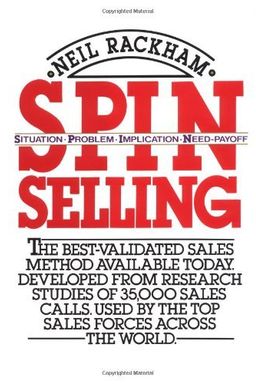
SPIN Selling cover

SPIN Selling

by Neil Rackham

SPIN Selling by Neil Rackham offers a transformative sales strategy based on 12 years of research and 35,000 sales calls. It challenges traditional methods, focusing on strategic questioning to transform client needs into actionable solutions, especially for larger sales. This book is essential for anyone looking to enhance their sales performance and close more significant deals.

Mastering High-Value Sales Through the SPIN® Framework

Have you ever wondered why some salespeople effortlessly close multimillion-dollar deals while others struggle to sell even modest offerings? Neil Rackham’s The SPIN® Selling Fieldbook offers a clear answer grounded not in sales “tricks” but in rigorous behavioral research. Drawing from over ten years and 35,000 observed sales calls across 27 countries, Rackham discovered a profound truth: the techniques that work in small sales can doom you in large, complex ones. His SPIN® model—Situation, Problem, Implication, and Need-payoff—revolutionized sales behavior by transforming the process from manipulative persuasion into strategic consultation.

Rackham argues that traditional sales training, with its emphasis on closing techniques, objection handling, and “open vs. closed” questioning, fails in high-value contexts. These old methods originated in the 1920s, when sales were single-call and transactional. But when the sales cycle stretches across weeks, months, or years, customers’ psychology shifts dramatically. Buyers become risk-averse, decisions involve multiple stakeholders, and credibility outweighs charisma. The SPIN® model helps you adapt—by guiding the buyer through the thinking process that converts vague dissatisfaction into clearly defined, actionable needs.

From Traditional Sales to Consultative Selling

Rackham’s story begins when a Fortune 100 vice president asked his research team to find out why his company’s highly trained salespeople were underperforming. Everyone assumed good salespeople closed hard, handled objections, and asked lots of open-ended questions. Yet after analyzing 35,000 calls, Rackham discovered the opposite. In high-value sales, the best salespeople asked fewer “closing” questions, encountered fewer objections, and instead focused on uncovering and developing buyer needs. They didn’t sell by pushing—they sold by investigating.

Thus emerged the SPIN® questioning framework, which outlines a natural sequence of discovery. Rather than “pitching” early, top performers guide buyers through increasingly meaningful questions: they start with understanding the situation, move to identifying problems, explore their implications, and finally help the buyer articulate the payoff of solving them. By doing this, they turn implicit concerns into explicit, eager desires—the psychological tipping point that leads to commitment.

Why Large Sales Demand a Different Approach

The book emphasizes that large or complex sales differ from small ones in five critical ways:

  • They require longer selling cycles and multiple calls.
  • Customer commitment is higher, involving greater financial and psychological risk.
  • Ongoing relationships matter as much as the immediate deal.
  • The salesperson becomes inseparable from the product in the client’s mind.
  • Mistakes are more visible—and therefore more feared—by buyers.

In this environment, buyers can’t be “closed” in one meeting. Instead, sales must evolve through a series of Advances—clear, buyer-led actions that move the process forward, such as agreeing to a demo or scheduling a meeting with other decision-makers. The mark of success is progress, not pressure.

The Four Stages of Every Sales Call

Every effective sales call, Rackham discovered, unfolds through four stages: Opening, Investigating, Demonstrating Capability, and Obtaining Commitment. Traditional teaching overemphasized the last stage, but research showed that Investigating—learning about the buyer’s world—is far more predictive of success. Skilled salespeople use questions strategically to help customers think differently, much like a good therapist helps patients uncover their own motivations.

Rackham separates questioning into four types—each serving a specific purpose within the Investigating stage. The rest of the book serves as a masterclass in using them: Situation questions collect context, Problem questions reveal dissatisfaction, Implication questions magnify urgency by exploring consequences, and Need-payoff questions invite buyers to describe the benefits of a solution themselves. The genius lies not in their formula but in their sequence.

A Fieldbook for Implementation

Unlike the original SPIN® Selling, which presented the research and principles, the Fieldbook focuses on practice. It’s full of self-assessments, exercises, planning templates, and case studies. Rackham compares the process to learning music scales—skills must be rehearsed repeatedly before they feel natural. He challenges readers to write out question plans, revisit tough selling moments, and even record themselves to self-analyze their behavior. (This mirrors deliberate practice principles also emphasized by Anders Ericsson in his research on mastery.)

Ultimately, Rackham reframes selling as a consultative partnership grounded in empathy, analysis, and value creation. Rather than manipulating buyers into saying “yes,” you help them understand why saying “yes” serves their best interests. The sales call becomes a process of discovery—one that leads both sides toward clarity and commitment. If you can learn to master that journey, Rackham argues, you'll not only sell more—you'll sell with integrity.


Redefining Success in Large Sales

Rackham begins by dismantling one of sales’s most sacred cows: the belief that success depends on superior persuasion, objection handling, and closing techniques. In smaller retail settings—a car lot, for instance—those tactics may produce results. But as sales grow larger, these same methods backfire. A pushy salesperson may get an impulse buy, but in multi-stakeholder corporate deals, pressure erodes trust and eliminates future engagement.

The Psychology of Large Sales

In a major sale, buyers face heightened personal risk: financial loss, public embarrassment, or career damage from a bad decision. These factors make buyers more analytical and slower to decide. They also highlight the necessity of building perceived value. The seller’s goal shifts from merely describing features to increasing the customer’s internal justification for purchasing.

Rackham’s story of the Buffalo copier salesman illustrates this perfectly. The seller, confident in his product knowledge, recited every feature of a five-figure copier to a hesitant office manager. She refused. Why? She simply didn’t perceive enough value. Knowledge alone couldn’t create a compelling argument—only a deeper understanding of the buyer’s fears and motivations could.

Risk and the Relationship

Large sales establish long-term partnerships. Rackham contrasts two sales in one day: buying a projector from an unpleasant vendor (a one-off transaction) and evaluating a $70,000 accounting system requiring months of collaboration. The insight: a good product can compensate for a bad seller in a simple sale, but in high-value deals, the seller becomes part of the product. Trust, credibility, and likability are essential forms of value.

The implication is profound. Selling in complex environments demands a style that builds lasting relationships, not quick wins. The successful salesperson is less a talker and more an advisor—one who understands that buyer trust and risk reduction are two sides of the same coin.


The Four Stages of Every Sales Call

Every sales interaction, whether lasting five or fifty minutes, follows a consistent rhythm. Rackham introduces four stages—Opening, Investigating, Demonstrating Capability, and Obtaining Commitment. Understanding which stage you’re in helps you stay focused on the right objective instead of rushing to close.

Opening: The Purpose Isn’t to Pitch

The first few minutes of a conversation set the tone, but not in the way most salespeople think. Rackham warns against beginning with a polished sales story or benefit statement—this immediately shifts attention to your product, not the client. In long sales cycles, such openings often create premature objections (“We’re not interested,” “That’s too expensive”). Instead, use the opening to gain permission to ask questions and establish credibility by centering on the buyer’s goals.

Investigating: The Engine of Success

This is the heart of consultative selling. Research proved that effective investigating correlates with the largest performance increases. In fact, Rackham cites data showing that improving investigating skills can raise total sales volume by over 20%. Investigating means systematically uncovering needs—not with random questions, but through structured exploration. This is where the SPIN® sequence comes alive.

Demonstrating Capability and Obtaining Commitment

After the buyer articulates strong Explicit Needs, you demonstrate how your product meets them. Rackham distinguishes between Features (facts), Advantages (uses), and Benefits (matching the buyer’s stated desires). Only Benefits persuade in large sales. The final step, Obtaining Commitment, no longer means pressure—it's guiding toward a realistic Advance: a next step that moves both sides closer to agreement.

“The mark of success in a major sale isn’t a signature; it’s progress.”

The best sellers, Rackham notes, plan their call objectives around getting these Advances and celebrate movement, not manipulation.


The SPIN® Model: Mastering Investigative Questioning

SPIN® is both acronym and process—a lens for understanding how human decision-making unfolds. Situation, Problem, Implication, and Need-payoff questions build logically on each other like rungs of a ladder. Each type of question serves a distinct psychological purpose, moving the conversation from mild curiosity to commitment.

Situation Questions: Build Context, Not Fatigue

Situation questions gather facts: “How many employees do you have here?” or “What systems are you using?” They are necessary but low-value. Overuse signals poor preparation. Rackham recommends doing homework first to minimize them and to phrase each one in a buyer-centered way. Skilled sellers use no more than a few Situation questions to establish credibility, then pivot smoothly to the next stage.

Problem Questions: Reveal Dissatisfaction

These questions move from facts to feelings—uncovering friction points that motivate change. For example: “Are you satisfied with your current turnaround time?” or “What challenges are you facing with data accuracy?” Problem questions invite the buyer to express Implied Needs—statements of dissatisfaction or difficulty. In high-value sales, these needs are the raw material for stronger Explicit Needs.

Implication Questions: Build Urgency and Value

Once problems surface, the seller magnifies their consequences. “What impact does that delay have on your delivery schedule?” or “Could that increase your costs over time?” These questions make problems feel larger and more costly, transforming mild concern into motivation. They are the hardest questions to master but most correlated with sales success. (The practice mirrors psychologist Daniel Kahneman’s insight that people are more motivated by avoiding losses than by gaining benefits.)

Need-Payoff Questions: Let Buyers Tell You the Benefits

The final stage flips the dynamic: instead of describing your solution, you ask the buyer to articulate the benefits of solving the problem. “If you could shorten your processing time by 20%, what would that mean for your team?” By making buyers verbalize these outcomes, they psychologically own the solution. Rackham’s research found that top performers ask up to ten times more Need-payoff questions than average sellers.

SPIN® questioning isn’t a script—it’s a mindset. Successful sellers use it flexibly, weaving between question types as the buyer’s responses evolve. The sequence transforms selling from presentation into collaborative problem-solving.


Focusing on Buyer Needs, Not Product Features

In traditional selling, you’re taught to list product features and hope one resonates. Rackham flips that script. Buyers don’t start with needs—they start with vague dissatisfactions, or what he calls Implied Needs. The salesperson’s job isn’t to pitch features but to expand those dissatisfactions until they become strong, Explicit Needs—clear desires the buyer openly expresses.

From Dissatisfaction to Action

Needs evolve along a simple but powerful continuum: satisfaction → mild dissatisfaction → recognition of a problem → desire for a solution → decision to act. Your goal is to guide this progression with the right questions. In small transactions, even weak dissatisfaction can trigger a sale (“This pen feels cheap, I’ll buy another”). But in large decisions, buyers act only when problems feel serious enough to outweigh cost and risk. Hence the Value Equation: perceived problem size must exceed perceived solution cost.

Working the Value Equation

Rackham’s examples—from early computer adoption to high-cost industrial purchases—show the same psychological rule: until urgency surpasses risk, no sale occurs. Skilled sellers use Implication and Need-payoff questions to balance this equation, magnifying the pain of inaction and clarifying the value of resolution. The moment buyers see the scales tip, closing becomes natural.

In short, major sales hinge not on the elegance of your pitch but on your ability to develop need strength. As Rackham quips, “The world’s best solution will fail if the buyer doesn’t feel the need strongly enough to buy.”


Demonstrating Capability and Preventing Objections

Once buyers recognize their needs, the next step is proving that your solution fits—and doing so without triggering resistance. Rackham separates three levels of describing capability: Features, Advantages, and Benefits. Most sellers stop at Advantages (“because we have X, you’ll get Y”). But in large sales, only statements that directly meet the buyer’s expressed needs—true Benefits—drive commitment.

From Features to Benefits

A Feature is what something is (facts). An Advantage is what something does (function). A Benefit is what something means to the buyer. Rackham gives a vivid car-selling analogy: merely listing features (“This car has halogen headlights and lumbar support”) makes the buyer see rising cost. But linking them to stated needs (“You mentioned eyestrain and back pain—this model’s headlights and seat reduce both”) transforms them into Benefits. Benefits prevent objections before they start because they feel personal and relevant.

Prevent, Don’t Handle, Objections

Contrary to most sales folklore, top performers receive fewer objections—not because they are smoother, but because they develop needs thoroughly beforehand. Objections arise when sellers propose solutions prematurely. To handle resistance, Rackham offers two types of strategies: for “Can’t” objections (where you truly lack capability), acknowledge the limitation but reemphasize other valued benefits; and for “Can” objections (where the buyer doubts your capability), demonstrate evidence and provide proof. Prevention, though, is always superior to repair.

In high-value sales, every statement should echo something the buyer has already said. As Rackham concludes, “A Benefit isn’t what you think is good about your product—it’s what the buyer told you they want.”


Planning, Practice, and Continual Improvement

For Rackham, mastery is less about charisma than discipline. Just as professional musicians rehearse scales, expert sellers plan every call. The Fieldbook functions like a workbook: you’re urged to scribble notes, test methods, and reflect on your progress. Rackham repeatedly reminds readers that practice creates sales skill, not inspiration.

Three Habits of Top Performers

  • Get on the buyer’s side of the table. Sell with empathy, not pressure. See the world from the customer’s perspective, asking more to understand and telling less to persuade.
  • Invest in planning. Successful salespeople map each call’s “Advance”—the clear action they want next—and plan what to ask, not what to say. Rackham’s SPIN® Call Plan template emphasizes realistic steppingstones rather than grand closing gambits.
  • Check yourself regularly. Record your calls, categorize each question by SPIN type, and analyze patterns. Like a coach reviewing game footage, this habit reveals blind spots and prevents backsliding into old habits.

Rackham admits he once fell into the same trap—after years of teaching SPIN®, he rewatched a recorded sales call and realized he had reverted to “telling instead of seeking.” His humility reinforces the book’s message: sales excellence is a lifelong practice, not a permanent status.

Finally, Rackham encourages two developmental paths beyond solo practice: finding mentors who can review calls and engage in coaching, and using “two-way coaching” with peers to exchange feedback. He also advises caution when seeking quick-fix sales seminars; real learning demands structure, self-assessment, and sustained effort. In essence, the SPIN® Fieldbook isn’t just about selling—it’s about professionalizing the craft of selling.

Dig Deeper

Get personalized prompts to apply these lessons to your life and deepen your understanding.

Go Deeper

Get the Full Experience

Download Insight Books for AI-powered reflections, quizzes, and more.