
Idea 1
Reading at the Speed of Thought: Reclaiming the Mind’s Natural Power
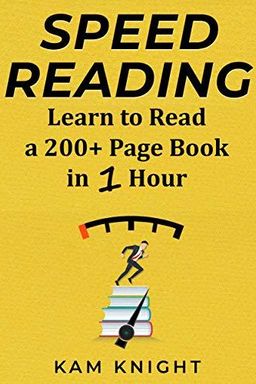
Have you ever wished you could read an entire book in an hour—not just skim it, but actually understand and remember it? In Speed Reading: Learn to Read a 200+ Page Book in 1 Hour, Kam Knight argues that this is not a stunt but a reclaiming of what the human brain and eyes were designed to do. He contends that humans possess extraordinary perceptual and cognitive abilities that have been dulled by poor reading habits, outdated educational methods, and unexamined assumptions about how reading should work. The book’s central premise is simple yet radical: you can read and comprehend drastically faster by aligning your natural visual and mental systems with efficient reading techniques.
Knight begins by pointing out that our eyes and brain already process images in the world instantly—we identify faces, objects, and entire environments without consciously decoding them piece by piece. Reading, however, is taught as a slow, word-by-word, sound-by-sound activity. The book teaches readers to move away from this artificial slowness and toward reading as swift visual comprehension. Through deliberate training, anyone can shift old habits, reduce mental friction, and read at a rate measured in ideas per second, not just words per minute.
The Logic Behind Speed Reading
Knight grounds his methods in science and psychology. The human eye, he notes, contains over 12 million photoreceptors and works in direct cooperation with the brain, which dedicates roughly 65% of its resources to processing visual information. If our visual hardware is capable of this sophistication, then slow reading is not a limitation of biology—it’s a learned inefficiency. Habits like subvocalization (saying every word in your head), fixation (stopping too long at each word), and regression (rereading text unnecessarily) form invisible bottlenecks. By loosening these habits and expanding peripheral vision, readers can process groups of words as single visual units—just as we perceive the world around us.
Reprogramming Old Habits
The challenge, Knight explains, isn’t intellectual—it’s habitual. Much like athletes drilling new muscle memory, readers must retrain their eyes and minds through repetition. Each chapter ends with short, practical drills designed to build the neural and physical reflexes that make quick comprehension effortless. The emphasis is on practice over theory, because understanding a technique is not the same as internalizing it. “Old habits die hard,” Knight says, so he provides exercises that integrate purpose, pacing, and focus into an automatic reflex.
The Structure of Acceleration
The book unfolds in five sections that mirror the process of transformation. Section I, Pre-Reading, establishes foundation: readers learn to define a clear purpose before reading, preview material for mental mapping, and adapt reading styles to content and difficulty. Section II, Speed Reading Techniques, introduces the methods that directly increase speed—Space Reading® (looking at spaces between words rather than the words themselves), chunking (grasping word groups as single meaning units), and eliminating subvocalization. Section III, Enhancing the Techniques, covers refinement, teaching how to shorten fixations, avoid regression, and expand visual range. Section IV, Improving Comprehension, focuses on understanding—recognizing main ideas, topic sentences, and developing vocabulary. Finally, Section V, Additional Tips, explores retention (recall and review), visualization to sustain focus, and eye health to maintain performance.
Why These Ideas Matter
Knight’s argument goes beyond mere efficiency. In a world of information overload, reading faster isn’t about speed for speed’s sake; it’s about empowerment. The faster you read with deep comprehension, the more ideas you can assimilate, synthesize, and use. By the end, the reader is not just a faster reader, but a deeper learner—someone who consciously determines reading goals, filters distractions, and remembers information long after finishing. Knight’s approach ultimately reframes reading as a whole-brain performance—an act of mental fitness rather than academic duty.
Just as meditation strengthens focus and exercise improves endurance, speed reading trains your cognitive muscles. The promise of reading a 200-page book in an hour is less a gimmick than a guiding metric: the real goal is to rediscover what your mind could always do when freed from the drag of outdated habits.