
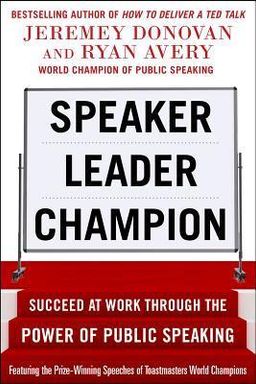
Speaker, Leader, Champion cover

Speaker, Leader, Champion

by Jeremy Donovan and Ryan Avery

Unlock the secrets of top public speakers with ''Speaker, Leader, Champion.'' Whether you''re a novice or experienced speaker, this book offers actionable tips to enhance your public speaking abilities, boosting your career and personal confidence.

The Power of Public Speaking as a Career Catalyst

Have you ever watched a confident speaker captivate a room and thought, “I wish I could do that”? In Speaker, Leader, Champion: Succeed at Work Through the Power of Public Speaking, Jeremey Donovan and Ryan Avery assert that public speaking is not an optional skill—it’s a transformative force that can reshape your career, build your confidence, and expand your leadership potential. The authors draw on their own journeys through Toastmasters International—a global public speaking and leadership organization—to show that great speakers are made, not born. Their central claim: mastering communication is the single most powerful way to accelerate your success at work and in life.

Donovan and Avery argue that speaking well does more than polish your image. It improves your ability to lead, persuade, and inspire teams—skills that organizations rank higher than technical expertise. You don’t need celebrity charisma or innate talent; you need discipline, structure, and feedback. The book combines the science of communication, the art of storytelling, and lessons from 11 World Champions of Public Speaking to help you progress from anxious novice to magnetic communicator.

Why Public Speaking Matters More Than Ever

According to a National Association of Colleges and Employers survey, the ability to verbally communicate is the most desired skill for employees. In an era where automation and technology handle much of the technical work, your voice—how you present ideas, persuade clients, or motivate teams—has become your most marketable asset. Donovan and Avery illustrate this with their own experiences: Jeremey, an engineer turned executive, credits Toastmasters for helping him overcome social anxiety and transition into leadership; Ryan, a millennial who became the youngest World Champion of Public Speaking at 25, used these skills to move from unemployment to global recognition.

They emphasize that improvement comes from deliberate practice in feedback-rich settings like Toastmasters. It’s a safe, structured environment where you learn through repetition, honest evaluation, and emotional vulnerability. The organization teaches that you must both learn to speak and to lead, because leadership and communication are inseparable.

The Structure of Transformation

The book is organized into a step-by-step toolkit mirroring the speaker’s journey. Each chapter provides practical “tips”—concise, actionable lessons—supported by examples from renowned speakers. The progression follows the public speaker’s growth path:

  • Content Development: Choosing topics, structuring your talk, telling compelling stories, and weaving humor that connects.
  • Delivery Mastery: Using voice, gesture, and movement to amplify authenticity and emotional impact.
  • Design: Crafting effective visual aids and persuasive messages.
  • Mindset: Managing fear and performance anxiety, and nurturing the discipline of ongoing refinement.

It’s a developmental arc: from speaker (technical craft) to leader (influence) to champion (inspires change). Each stage deepens your ability not just to communicate, but to connect authentically.

Learning from the World’s Best

Donovan and Avery analyzed speeches from champions like David Brooks, Mark Brown, and Craig Valentine, extracting patterns of what consistently wins hearts and minds. They found that great speeches are often seven-minute masterpieces of emotional storytelling that reveal vulnerability, universal truth, and a clear call to action. The champions’ insights—like Mark Brown’s “Be yourself” or Lance Miller’s “It’s not about you; it’s about the audience”—translate directly into workplace principles. The art of persuasion on stage becomes the art of leadership in the boardroom.

Why This Book Matters

The methods in Speaker, Leader, Champion are not theatrical tricks; they are frameworks for influence in every sphere of life. Whether you’re pitching a project, leading a team meeting, or giving a keynote, your authenticity, structure, and emotional range determine your success. Donovan and Avery show how you can engineer these traits into habit. Their message isn’t about perfection but progress through practice: you don’t need to be perfect to connect—you need to be present, prepared, and passionate. Ultimately, this book is an invitation to see public speaking not as performance but as service: using your words to make an impact, one audience at a time.


Finding and Framing a Powerful Message

Before you ever set foot on stage, you must decide what matters most: why are you speaking? Donovan and Avery emphasize that selecting your topic is not about what interests you—it's about how you can serve your audience’s needs, values, and emotions. Great speeches start with the intersection of three things: what the audience values, what you deeply know, and what you are passionate about. This mirrors advice from purpose‑driven thinkers like Jim Collins or Simon Sinek (who argues in Start With Why that inspiration begins with purpose).

Purpose First, Topic Second

A powerful message grows from a clear general purpose: to inform, to persuade, to entertain, or to inspire. The authors explain that while many workplace speeches are informational, the most meaningful ones are persuasive or inspirational—they move the audience to change. Lance Miller’s 2005 championship speech, “The Ultimate Question,” illustrates this principle. His purpose was to inspire listeners to validate the good in others, a universal theme he expressed through humor and humility. The clarity of purpose made every line of his talk resonate.

Crafting a Core Message

Once you know your purpose, define a single core message: what do you want your audience to think, feel, or do? Many novice speakers overcomplicate their talks with multiple ideas. Champions simplify. Miller’s core message was clear—“Validate the good in others.” Ed Tate’s was simpler still—“Be kind; compassion changes the world.” Every story, joke, and gesture reinforces that message.

The authors provide a formula to keep you focused: “I will [purpose] my audience to [core message] so that [impact].” If you're giving a sales presentation, it might read, “I will persuade our team to adopt the new CRM software so that we close deals faster.” This framework ensures every speech has an audience-centric benefit.

Speak from Experience and Authenticity

Authenticity is the credibility of modern speaking. Donovan and Avery argue that you can only sound convincing if you speak about subjects you personally understand and believe in. Mandela’s 1964 courtroom defense was powerful because it was rooted in lived experience; the same principle applies to you pitching a business case with moral conviction. The authors advise you to talk about what you know, research what you don’t, and never fake enthusiasm. False passion is as off-putting as flat monotone.

Ultimately, building a great talk is an act of service and self-discovery. By clarifying your purpose, distilling your message, and grounding it in authentic experience, you transform your knowledge into a gift for your audience. The best speakers, the book insists, do not crave attention—they crave connection.


Structuring Speeches That Stick

Ideas alone don’t persuade—structure does. Donovan and Avery show that organizing your speech is the hidden architecture that makes your message memorable. Listeners can’t rewind you; they need a clear roadmap. The framework begins with an engaging introduction, a focused body, and a satisfying conclusion—a pattern echoed by Aristotle’s rhetoric and modern TED Talk design.

Opening with Impact

Modern audiences decide within seconds whether to listen. Champions grab attention fast—sometimes with a question, shock, or personal story. Jock Elliott’s “Just So Lucky” began by contrasting digital friendship with true human connection: “If I joined Facebook, I could have hundreds of new friends—but how many would roll out of bed at three in the morning to help me?” That question pulled listeners into his theme of genuine friendship. Similarly, speakers can open with striking data, a relatable anecdote, or even silence to create curiosity.

Designing the Body: Logical and Emotional Flow

Most world‑class speeches use a three‑part structure for harmony and rhythm—three stories, three principles, three challenges. Transitional phrases like “First… second… finally” orient the audience, while repetition reinforces memory. Elliott grouped friendship into “friends of my blood, friends of my times, and friends of my heart,” a simple but elegant triad the audience could follow. Other frameworks—like the persuasive “situation‑complication‑resolution” used in business settings—mimic storytelling arcs. The key is progression and emotional escalation: build momentum toward the climax, not sideways repetition.

Ending with Purpose

Conclusions should do three things: summarize the key points, tie back to the opening (a “callback”), and issue a call to action. Elliott’s speech ended where it began—“These are the people who’d roll out of bed at three in the morning for you.” That circular structure satisfies emotional closure. In persuasive or professional settings, your call to action turns inspiration into commitment: to vote, to change habits, or to adopt a new vision.

When your speech feels like a journey—clear start, escalating middle, and heartfelt destination—your audience doesn’t just remember your words; they remember the experience. Structure turns good ideas into unforgettable narratives.


The Science and Soul of Storytelling

Humans are wired for stories, not statistics. Donovan and Avery explain that storytelling is what transforms information into meaning. Citing neuroscience research from Washington University, they note that stories engage the same brain regions as lived experience. As listeners visualize what a speaker describes, they mirror emotions and internalize lessons—essential for leadership and persuasion.

Relive, Don’t Retell

Instead of recounting events like a historian, relive them like a participant. Ed Tate’s “One of Those Days” didn’t describe a travel incident; he acted it out, re‑creating dialogue and emotion. When he said, “Sir, take your time, I’m in no hurry,” his empathy toward the airline clerk turned a mundane encounter into a redemptive lesson on kindness. Dialogue, body language, and realistic details make listeners feel as if they’re inside the scene. As Craig Valentine says, “Invite them into your re‑living room.”

The Hero’s Journey in Seven Minutes

Every great story, from Odysseus to Pixar films, follows a version of the hero’s journey: a protagonist faces a conflict, learns through trials, and returns transformed. This applies to short speeches too. In Tate’s story, he began flawed (impatient traveler), met mentors (a kind clerk), confronted an obstacle (rude customer), risked himself to intervene, and emerged morally renewed. That transformation gave his message credibility. Your own “ordinary world to transformation” arc means your audience learns by living your change.

Show, Don’t Tell

Emotions drive attention. Instead of saying “I was scared,” show it: trembling hands, quivering voice, the moment you paused. Vivid sensory language—smells, textures, sounds—anchors authenticity. Whether you share a failure, an everyday lesson, or a personal revelation, story builds empathy. The moral should arise naturally from the story’s climax, not lecture the audience. In short, stories aren’t decoration—they’re delivery systems for truth.


Humor As the Gateway to Connection

Laughter is not just comic relief—it’s emotional glue. Donovan and Avery dissect humor as both psychology and technique. They argue that a speaker’s first laugh breaks tension and builds rapport, immediately increasing likability. Darren LaCroix’s winning speech “Ouch!” demonstrates this perfectly: within 20 seconds, he literally fell flat on his face, generating empathy through surprise and humility. That vulnerability turned fear into friendship.

Three Theories of Laughter

The authors identify three forces behind humor: superiority (we laugh at incongruity or human folly), surprise (the unexpected twist), and release (relieving tension). Great speakers often combine all three. Self‑deprecating jokes are powerful because they blend superiority (“We’re better than the speaker—momentarily”) with surprise (“Wait, even the expert messes up”). Humor lowers defenses so serious messages can enter without resistance, echoing psychologist Victor Borge’s dictum that “laughter is the shortest distance between two people.”

Humor with Purpose

Every laugh should advance your message. Recycled jokes or detached punchlines feel fake. Authentic humor is situational: it comes from your missteps, your children’s candor, your workplace mishaps. For instance, in “Ouch!” LaCroix’s string of failures—from a Subway sandwich shop bankruptcy to dying on stage as a comedian—built toward his lesson: progress comes from taking the next step after embarrassment. The laugh carried the learning.

Timing and Stillness

Silence is humor’s secret weapon. Speakers often ruin jokes by rushing; audiences need a second to laugh. Masters like Bill Cosby and Jerry Seinfeld (and LaCroix on the Toastmasters stage) freeze in character while laughter rolls, amplifying it through restraint. Practice pausing and staying present. When laughter fades, resume your rhythm. Humor is not about being funny—it’s about being human. When your audience laughs with you, they’re open to changing because of you.


Creating Emotional Texture

Emotion is the fuel of persuasion. Donovan and Avery urge speakers to take audiences on an emotional journey, not just a logical one. Drawing on research by Paul Ekman and Robert Plutchik, they highlight seven universal emotions that must appear across a powerful speech: anger, disgust, fear, happiness, love, sadness, and surprise. These aren’t random feelings—they are milestones of human connection.

The Full Spectrum of Feeling

Randy Harvey’s “Lessons from Fat Dad” exemplifies emotional range. Within seven minutes, he took audiences from laughter at a teenage car crash to tears at his father’s passing, ending in the warmth of love and gratitude. By contrasting light moments with profound ones, Harvey deepened emotional texture—the highs made the lows hit harder. As the authors state, “Emotion without contrast is monotone.”

Authenticity and Control

Authentic emotion is essential, but losing control is risky. You must feel emotion without letting it overwhelm coherence. Sadness can silence both you and your audience if unchecked. Emotional expression must remain in service of connection. Harvey’s calm tenderness while speaking of his mother’s death allowed listeners to grieve with dignity, not discomfort. The advice: feel deeply, but lead compassionately.

Master speakers balance pathos with poise. When your voice, face, and gestures align with real feeling—when love sounds loving, anger carries purpose, and joy radiates through tone—you achieve what the book calls “authentic congruence.” That’s when audiences remember not what you said, but what they felt with you.


Mastering Words and Voice

Great communicators don’t need big words—they need clear ones. Donovan and Avery’s chapter on language and verbal delivery teaches you to make every syllable count. Championship speeches, they reveal, average a fifth‑grade reading level. Simplicity breeds connection; complexity breeds distance.

Speak Simply, Speak Powerfully

David Brooks’s “Silver Bullets” (1990) is the textbook case. Using short sentences and plain language, he revived forgotten virtues—honor, integrity, self‑respect—through nostalgia and vivid imagery. Instead of flowery prose, he created rhythm through rhetorical devices: repetition (“It’s the matter of respect”), lists of three, and callbacks. His sensory details—the rumble of tanks in Tiananmen Square—made ideas tangible. Words that feel real make listeners feel something.

Vocal Variety and Pauses

Your voice is the instrument of persuasion. The authors advise amplifying—not altering—your natural tone. Vary speed, volume, pitch, and rhythm to match content: slow and soft comforts; fast and loud energizes. Mark Brown, for instance, used tempo shifts in “A Second Chance” to mirror emotion—hushed during reflection, booming in his call to fight intolerance. And as comedian Jack Benny said, “It’s not so much knowing when to speak—it’s knowing when to pause.” Silence magnifies meaning.

Authenticity in Accents and Clarity

For non‑native speakers, the authors stress clarity over conformity. Champions like Vikas Jhingran won with accents intact by slowing down and enunciating. An accent can even make audiences listen more carefully. The goal isn’t imitation; it’s inclusion. Authentic voice is the bridge between language and humanity.


Body Language and Presence

If voice conveys emotion, the body broadcasts confidence. Donovan and Avery detail the choreography of great delivery: from your stance before the first word to your final step off stage. While verbal mastery captures ears, nonverbal mastery captures hearts.

Confidence Starts Before Speaking

Harvard’s Amy Cuddy famously demonstrated that “power posing” for one minute—standing tall, open, expansive—boosts confidence and lowers stress hormones. The authors confirm this science: adopt strong posture before walking on stage to project authority. Then enter with purpose. World Champion Ryan Avery began his winning speech “Trust Is a Must” by trotting onstage with poised energy and a genuine smile. The silent moments before you speak often speak loudest.

Movement with Meaning

Every step should serve the story. Random pacing distracts; purposeful positioning clarifies. Avery used stage “blocking” to designate times and places—childhood moments at stage right, adulthood at stage left. This helped audiences visualize time passing as he walked his story. Eye contact, held for three to five seconds with individuals, transforms monologue into dialogue. Gestures should feel natural extensions of thought: broad for excitement, still for seriousness.

Dress to Relate, Not Impress

Donovan and Avery warn against over‑polish. Overly formal attire, like an ornate three‑piece suit, can alienate modern audiences. Instead, dress one step above your listeners—a symbol of respect, not superiority. When paired with grounded stillness and calm eye contact, your presence signals confidence that doesn’t need decoration.

Your body language is the vessel for authenticity. When your stance, eyes, and gestures harmonize with your words, your presence becomes persuasion itself.


Overcoming Fear and Finding Flow

Even world champions tremble. Donovan and Avery insist that fear is not a flaw—it’s fuel. Anxiety releases adrenaline, sharpening focus if harnessed correctly. The goal isn’t eradication but empathy: turning nerves into energy that connects rather than constrains.

Accept Fear, Don’t Fight It

LaShunda Rundles’s winning speech “Speak!” captures this philosophy. As a child, she was forced onstage by her mother until she learned to sing despite shaking knees. Years later, she used that same story to show others how to speak through fear into purpose. Her line—“You’re not ready”—became both literal and metaphorical; courage wasn’t the absence of fear, but the decision to rise despite it. Audiences loved her because she didn’t hide her nerves—she transformed them into vulnerability.

Prepare, Practice, and Control Variables

Confidence grows from preparation. The authors advise eliminating logistical uncertainty: visit the venue, test equipment, know the audience. Ryan Avery famously rented his competition room days before his semifinal to rehearse every movement. That foresight quieted his mind during performance. Physical calm—slow breathing, good rest, warm body posture—restores control when adrenaline surges.

Mindfulness and Presence

Finally, they describe a “speaking zone”—a headspace where preparation meets present-moment awareness. Once the lights dim, perfection fades—only presence remains. Fear dissipates when focus shifts from self to service. As Craig Valentine tells himself before each speech: “Forget myself. Remember my message. Touch my audience.” In that moment, anxiety becomes artistry.

Dig Deeper

Get personalized prompts to apply these lessons to your life and deepen your understanding.

Go Deeper

Get the Full Experience

Download Insight Books for AI-powered reflections, quizzes, and more.