
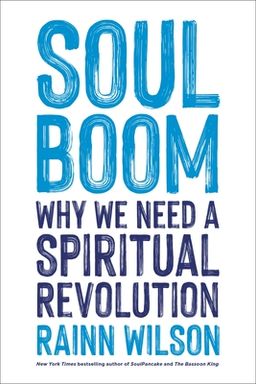
Soul Boom cover

Soul Boom

by Rainn Wilson

Soul Boom by Rainn Wilson delves into how spirituality can address today''s global issues. Blending humor with profound insights, Wilson advocates for a spiritual revolution to foster healing, unity, and a more compassionate world.

Why We Need a Spiritual Revolution

What if the crises we face—loneliness, polarization, addiction, inequality—aren’t just social or political failures, but spiritual ones? In Soul Boom: Why We Need a Spiritual Revolution, Rainn Wilson argues that humanity’s next great leap forward isn’t technological or economic—it’s soulful. He proposes a compassionate uprising rooted in meaning, unity, and sacred purpose, one that could heal both personal despair and global dysfunction. Drawing on his Baha’i faith, his wild upbringing in a bohemian, dysfunctional household, and a lifetime of wrestling with anxiety and meaning, Wilson invites you to reimagine spirituality as a practical force for hope and healing—not a set of dogmas, but a toolbox for human flourishing.

Wilson’s central claim is audacious yet simple: only by uniting inner transformation with outer social action—a balance of what he calls the Kung Fu path and the Star Trek path—can we build the world we long for. The core of the book explores how spirituality can help us confront what he calls “a plethora of pandemics”: racism, sexism, materialism, ecological destruction, economic injustice, and despair. These ills, Wilson contends, are symptoms of a deeper spiritual disease—the illusion of separateness and the worship of ego over empathy.

Throughout the book, Wilson blends humor and humility with serious spiritual inquiry. The result is what he calls a “Soul Boom”—an explosion of human consciousness at both the personal and species level. He merges pop culture with the profound: from Kung Fu to Star Trek, from Baha’i teachings to brain science, from beets to theology. It’s a conversational yet deeply earnest guide for anyone disillusioned with religion but still hungry for transcendence.

Spirituality Beyond Religion

Wilson insists that spirituality is not church attendance, crystal healing, or self-help—it’s the quality of being concerned with the human soul rather than material success. He distinguishes genuine spiritual development from hollow “woo-woo” trends. To him, spirituality means cultivating the inner meaning of being human: compassion, humility, purpose, and faith in something larger than consumption or individual gratification.

His purpose isn’t to preach religion, but to show that the world’s sacred teachings—from Jesus’s “love thy neighbor” to the Buddha’s call to end suffering to the Baha’i vision of global unity—share a set of moral technologies we can apply to heal our planet. These shared spiritual principles, he argues, are practical, unifying, and urgently needed in modern life.

Inner Transformation and Social Transformation

The book’s structure mirrors Wilson’s twofold moral purpose—a concept drawn from the Baha’i Faith. One purpose is internal: personal growth, self-mastery, and virtue. The other is collective: improving society and healing the world. The 1970s shows Wilson worshiped as a child—Kung Fu and Star Trek—become symbols of these two directions. Kung Fu represents the inner journey of discipline, humility, and overcoming ego; Star Trek embodies the societal journey toward unity, compassion, and justice.

Together, they reveal Wilson’s thesis: without inner peace, we perpetuate chaos; without outer service, our spirituality becomes self-indulgence. Our challenge is to evolve individually and collectively at the same time—to meditate and to march, to pray and to build.

From Personal Struggle to Universal Search

Wilson’s own life story anchors this perspective. Raised in a household steeped in art, spirituality, and dysfunction, he inherited both creative openness and emotional confusion. His father’s stories about the Baha’i “Build-It-Yourself Kingdom of God” metaphor shaped his conviction that goodness must be lived, not enforced. As an adult, fame and success could not mask his mental health battles—anxiety, depression, and addiction—which pushed him toward spiritual and therapeutic healing. His experience echoes millions of seekers today: materially comfortable, yet existentially starved.

In one of the book’s most moving insights, he admits that if not for “tools, concepts, and teachings” learned through spiritual search, he might not have survived adulthood. His vulnerability becomes the bridge between celebrity memoir and spiritual manifesto. Like Viktor Frankl’s Man’s Search for Meaning or Eckhart Tolle’s A New Earth, Soul Boom redefines faith for anxious modern minds: not an ideology, but a way of seeing ourselves as intertwined souls on an evolving planet.

Why It Matters Now

Wilson’s message lands in a time of profound fragmentation: the isolation of social media, political rancor, declining trust, and epidemic loneliness. His diagnosis is stark: humanity is having a mental, emotional, and spiritual breakdown. But his prescription is hopeful: a new kind of spirituality—post-religious but deeply sacred—is the medicine. This “soul revolution” must be joyful, diverse, and worldly, not sanctimonious or exclusive. It must blend science and faith, humor and reverence, and embrace both suffering and beauty as teachers.

“Perhaps the key to healing the world’s chaos and pain lies on a spiritual path… perhaps a spiritual metamorphosis is required for us not only to thrive but to survive.” —Rainn Wilson

This opening idea plants the seed for the rest of the book: a sweeping exploration of pandemics of despair, the reimagining of God as a loving great mystery, the rediscovery of sacredness in everyday life, the reformation of religion itself, and the vision of a world built on compassion, unity, and virtue. Each chapter that follows deepens the same call: wake up your soul so we can wake up the world.


The Twofold Path: Kung Fu and Star Trek

Wilson’s first chapter turns martial arts and space travel into a universal spiritual metaphor. By contrasting the 1970s shows Kung Fu and Star Trek, he shows that the human journey is both inward and outward—a dance between enlightenment and evolution. These TV parables become surprisingly profound models for how you can balance personal serenity with collective service.

Walking the Kung Fu Road

In Kung Fu, the monk Kwai Chang Caine, a half-Chinese, half-white wanderer, embodies the inner spiritual discipline—the kung fu of calm mastery over anger, lust, and ego. His teacher’s lesson, “When you can snatch the pebble from my hand,” becomes a metaphor for self-conquest. For Wilson, this symbolizes the personal side of spirituality: walking the path of humility, detachment, and compassion amid chaos. Like the Buddha or Jesus, Caine meets cruelty not with vengeance but with grace.

Wilson urges that you see yourself the same way: as a spiritual warrior-monk navigating traffic jams, debts, and difficult people instead of bandits and cowboys. The tests are different, but the struggle is the same—responding to hostility with awareness, choosing serenity over reactivity. He calls this our “twofold moral purpose”: to master self and uplift the world.

The Star Trek Horizon

Then Wilson swaps robes for starships. Star Trek becomes the outer dimension of spirituality—the evolution of humanity itself. In Gene Roddenberry’s utopian vision, war, poverty, and greed are gone. Technology like the “replicator” ends need, money disappears, and people live “to better themselves and humanity.” Captain Kirk and Spock demonstrate reason, empathy, and curiosity—the virtues of a civilization that has outgrown ego-driven competition.

Wilson sees this as our collective destiny: a planetary species working together to overcome prejudice and injustice. He connects this to Baha’u’llah’s teaching—“Let your vision be world-embracing rather than confined to your own selves.” It’s the Star Trek principle: diversity without division, progress through understanding. He quotes Spock’s ultimate ethical law: “The needs of the many outweigh the needs of the few.”

Balancing Inner and Outer Revolutions

The genius of Wilson’s metaphor is that he refuses to pick one path over the other. Too much inward focus leads to complacency; too much activism leads to burnout. The monk and the captain, introspection and imagination, must hold hands like yin and yang. As he puts it, “What good is a spiritual path that only enriches your own inner peace while millions go hungry?”

For you, this means spirituality isn’t escape—it’s equipment. It trains you to rise above pettiness while fighting for justice, to stay grounded while boldly going outward. In Wilson’s world, meditation and moral courage are both engines of a united human future.


A Plethora of Pandemics

In what he humorously calls “the least uplifting chapter,” Wilson diagnoses the global sickness afflicting our civilization. Beyond COVID-19, he lists six deeper, interwoven pandemics: mental health crises, racism, sexism, materialism, economic injustice, nationalism and war, and climate change. These aren’t separate plagues—they’re symptoms of a shared spiritual disease: disconnection from ourselves, one another, and the divine.

The Crisis of Meaning

He begins with what he calls “deaths of despair.” Between 2005 and 2019, seventy thousand Americans died annually from suicide, alcohol, or drugs. Loneliness equals smoking fifteen cigarettes a day in health damage. Social media amplifies isolation while pretending to connect us. Students fill courses on friendship and happiness because they no longer know how to make friends. His point is blunt: we’re dying for lack of meaning and connection.

The Spiritual Nature of Social Disease

Racism, sexism, and materialism, Wilson argues, aren’t purely political flaws—they’re spiritual ones. Racism springs from “the disease of otherness,” sexism from the suppression of the divine feminine, and materialism from confusing survival with greed. Economic inequality, nationalism, and environmental collapse stem from the same egoic hunger for domination rather than empathy. “The world’s eight richest men owning as much as four billion poor,” he writes, “isn’t just unjust—it’s unsustainable.”

The Spiritual Remedy

Wilson insists that legislation alone cannot cure these pandemics because the roots are not political but spiritual. A racist heart won’t change through policy alone; it changes through compassion, humility, and love. Quoting the Buddha, Jesus, Muhammad, Baha’u’llah, and Rabbi Hillel, he shows that every faith tradition prescribes the same remedy: see your neighbor as yourself, turn love into an action, and build “the Kingdom of God on Earth.”

Spirituality, he argues, must leave yoga mats and temples to address real-world injustice. “The solutions aren’t found in the halls of government but in human hearts.” This perspective aligns Wilson with moral philosophers like Martin Buber and contemporary writers like Gabor Maté, who link healing the self to healing society.


Death and How to Live It

Wilson’s chapter on death is startlingly personal and surprisingly life-affirming. When his father died, he found himself in a Wenatchee, Washington Target store frantically searching for a bowl to ceremonially wash the body. That comic yet sacred moment becomes an existential epiphany: death clarifies who we are, what we value, and what we’re made for. “This body,” he realizes, “is just a suit I once wore.”

The Mystery of Consciousness

He challenges materialist science to explain consciousness—the “hard problem” of why neurons produce awareness at all. Love, memory, and creativity, he argues, can’t be reduced to chemistry. Consciousness, like light or gravity, hints at an unseen dimension—the soul. His reflections echo neuroscientist David Chalmers and physicist Max Planck, who both saw mind as fundamental to reality.

Life as a Soul School

Drawing from Baha’i teachings, Wilson reframes existence as a “soul-enriching factory.” The physical world, like a womb, develops organs we’ll need for the next life—virtues like love, patience, and compassion. Our trials are spiritual training. He quips that Milton Bradley’s board game The Game of Life measures success by money, but the real “game of life” is measured by virtue cards, not cash.

Living with Mortality

From Buddhist meditations on corpses to Mexico’s Day of the Dead, Wilson shows that remembering death (“memento mori”) grants freedom. It pushes you to love fiercely and focus on what lasts. His TV project My Last Days—interviews with people near death—taught him that those facing mortality care only about connection, gratitude, and joy. Death, ironically, is the best teacher of how to live.


The Notorious G.O.D.

In one of the book’s liveliest chapters, Wilson rebrands God with irreverent affection as “The Notorious G.O.D.”—a divine force too vast for literalism, too loving for fear. He jokes that TV networks rejected his documentary about God as “too controversial,” yet he insists that exploring God isn’t dangerous—it’s essential. His journey traces a move from punitive Sky-Daddy images toward the experiential, unnameable mystery behind creation.

From Sky-Daddy to Great Mystery

Raised in the Baha’i concept of an “Unknowable Essence,” Wilson learned that divine manifestations (Jesus, Muhammad, Baha’u’llah) are guides to an infinite Creator beyond time and space. As a young atheist in New York, he rejected that God, seeing only hypocrisy. Later, mental illness drove him to rediscover the sacred through study and humility. For him, God is not a being but “Being itself”—the consciousness of the universe.

Atheists, Science, and the Sacred

Wilson praises atheists for their skepticism, calling blind faith “intellectual laziness.” He sees science and spirituality as complementary lenses, not enemies: science studies the how of reality, faith the why. The “simulation hypothesis” (we live in a vast cosmic program) mirrors ancient ideas like Hindu maya. To him, God is less a programmer than the code itself—the energy of love, order, and artistry animating existence.

God as Conscious Love

He concludes that God is like the internet: everywhere, invisible, connecting all nodes of consciousness. Using indigenous wisdom—Lakota’s Wakan Tanka (“Great Mystery”)—he expands God into nature’s living web: “The mysterious power of the seven directions: north, south, east, west, sky, earth, and heart.” God isn’t a remote father; God is the pulse running through everything that loves, learns, and grows. To know this is to serve and create in harmony with it.


Rediscovering the Sacred

After God comes sacredness—the lost art of reverence. Wilson describes his pilgrimage to the Baha’i Shrine of Bahji in Israel, where he prayed barefoot among jasmine and birdsong. The experience, like Bashō’s haiku or Thich Nhat Hanh’s mindfulness, revealed holiness as a condition of perception. The sacred isn’t found only in temples—it’s found wherever you pause and see with awareness.

He contrasts that with America’s desacralized culture of consumerism and cynicism. To conservatives, he says, the sacred is family and flag; to liberals, it is human rights and authenticity. But the deepest truth is that everything is sacred—the mundane as much as the mystical. Quoting Black Elk and Luther Standing Bear, he recalls indigenous reverence for rivers and cottonwoods, where “even the slightest breeze is the tree’s prayer.”

For Wilson, reclaiming sanctity means restoring attention, humility, and awe. Your morning coffee, your child’s laughter, your grief—all can become shrines. “In the sunlight of awareness,” he quotes Thich Nhat Hanh, “everything becomes sacred.”


Religion, Schmeligion: The Case for Faith 2.0

Wilson faces religion’s bad reputation head-on. Visiting Jerusalem’s overlapping holy sites—where monks literally fistfight over cleaning schedules—he marvels at humanity’s capacity for both devotion and division. Still, he insists that religion, at its best, remains the world’s greatest social technology: our original operating system for belonging, moral growth, and service. The problem isn’t faith—it’s what we’ve done to it.

The Good, the Bad, and the Busted

Organized religion has inspired charity and art—but also war and oppression. Modern secularism has provided science and freedom—but also loneliness and consumer emptiness. Between institutions and “spiritual but not religious” individualism, Wilson calls for a balance: religion without rigidity, spirituality with structure. Just as Joseph Campbell saw myth as humanity’s moral framework, Wilson sees faith as scaffolding for compassion, not control.

The Rise of the “Nones”

Today, millions identify as “Nones”—spiritual but religiously unaffiliated. Wilson doesn’t dismiss them; he worries they’ve lost community. Prayer without people or meditation without service, he warns, risks becoming narcissistic self-care. The ideal spiritual life should “make the world better, not just make me feel better.” Borrowing from Thich Nhat Hanh and Twelve-Step wisdom, he argues for inner surrender leading to outer service.

Ultimately, religion’s root—religare, to bind together—is his rallying cry. True religion is not belief but belonging. Its purpose is connection—to people, to truth, to love. And in that sense, Wilson says, we can’t afford to throw religion away—we just need to rebuild it.


Building SoulBoom: A Blueprint for Modern Faith

Because no one else was doing it, Wilson imagines building a prototype religion from scratch: SoulBoom™, a playful yet sincere blueprint for what faith could look like in the twenty-first century. Its rules? No dogma, no clergy, no patriarchy, no pretending we have all the answers. Its mission: to unite people through compassion, service, and joy.

Ten Fundamentals

SoulBoom borrows the best of world religions—faith in a higher power, belief in life after death, reverence for prayer, transcendence, community, morality, love, compassion, service, and purpose—then updates them for modern life. Heaven and hell become psychological states, not eternal punishments. Rituals revolve around mindfulness, music, nature, and potlucks rather than liturgy. Even dogs and Klingons would be welcome.

Ten More Principles

Wilson adds modern upgrades: no clergy (“everyone’s interpretation counts”), diversity and gender equality, harmony of science and faith, environmental stewardship, social justice, lifelong service, virtue education, and humility. His cheerfully utopian manifesto ends with a wink: “There will be no SoulBoom without potlucks.” Humor aside, his model embodies Erich Fromm’s vision of a “religion of universal humanism” built on love instead of dogma.

The point isn’t to literally start a church—it’s to brainstorm what spiritual community we’d invent if we cared more about connection than correctness. SoulBoom becomes a metaphor for cultural evolution: religion rebooted for an anxious, pluralistic, post-institutional world.


The Seven Pillars of a Spiritual Revolution

In his final chapters, Wilson distills his vision of transformation into seven “pillars”—practical ways to spark a global spiritual renaissance. He moves from critique to construction, echoing Buckminster Fuller’s advice: “Don’t fight old systems; build new ones that make the old obsolete.”

  • Create a new mythology: Rewrite humanity’s story around cooperation rather than conquest. Our biggest “idea” so far has been money; our next must be meaning. Like Suzanne Simard’s “Mother Tree” networks, Wilson calls for narratives of connection, not competition.
  • Celebrate joy, defeat cynicism: He recalls director André Gregory warning, “Don’t give in to cynicism—it’s how they win.” Hope isn’t naive; it’s defiance. Joy, he argues, is resistance against despair.
  • Replace adversarial systems: Politics, education, and business depend on conflict. Drawing on Baha’i elections—silent, prayerful, nonpartisan—he imagines governance based on character, not charisma.
  • Build, don’t just protest: Outrage alone changes nothing. Like MLK’s meticulously organized civil rights strategy, activism must create sustainable alternatives, not just dismantle injustice.
  • Systematize grassroots movements: Social healing, he insists, grows locally. Neighborhood conversations and small acts of service ripple outward. (Think Parker Palmer’s idea of “circles of trust.”)
  • Invest in virtues education: Teach kids not just algebra but empathy, integrity, and resilience. Aristotle called virtue “doing the right thing, in the right way, for the right reason.” Wilson wants schools to cultivate character as intentionally as academics.
  • Practice radical compassion: Beyond empathy—feel with and act for those suffering. Compassion, he says, is the ultimate technology of unity: “the muscle of the soul.”

His revolution ends not in ideology but intimacy. Humanity, he concludes, is like a body—diverse organs serving one pulse. Disease comes from separation; health comes from collaboration. “The greatest illusion in this world,” he quotes Einstein, “is the illusion of separation.” The cure begins with seeing every person, every creature, as part of one living soul.

Dig Deeper

Get personalized prompts to apply these lessons to your life and deepen your understanding.

Go Deeper

Get the Full Experience

Download Insight Books for AI-powered reflections, quizzes, and more.