
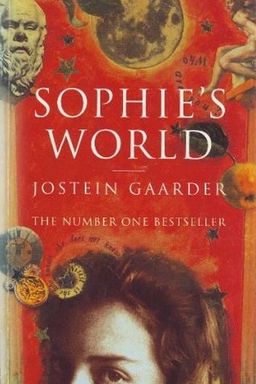
Sophie''s World cover

Sophie''s World

by Jostein Gaarder

Sophie''s World takes readers on an enchanting journey through the history of philosophy, seen through the eyes of a curious teenage girl. Guided by mysterious letters, Sophie explores life''s deepest questions and discovers the wonders of philosophical inquiry from ancient Greece to modern existentialism.

Philosophy as the Awakening of Wonder

What does it mean to be alive and alert in a world that has become ordinary? Sophie’s World begins with this question, for Jostein Gaarder’s novel is both a mystery and a history of philosophy disguised as an initiation into curiosity. When Sophie receives two anonymous notes—“Who are you?” and “Where does the world come from?”—her education begins not with facts but with astonishment. Gaarder argues that philosophy is not a set of doctrines but an act of recovery: you must learn to be amazed again by what you already know.

The book’s structure mirrors this insight. Sophie’s correspondence with her secret teacher, Alberto Knox, takes you through the whole history of Western thought, from mythic consciousness to modern existentialism. Yet its deeper purpose is pedagogical—to teach you how philosophy evolves from wonder into analysis and then returns, finally, to self‑knowledge. You move from the child’s question to the adult’s discipline and then back again to the freedom of insight.

From Myth to Reason

Gaarder first shows how human beings explained the world through stories. Myths, like the Norse tale of Thor’s hammer, personify nature; rain becomes divine action. The Greeks break this spell by asking natural questions: Thales wonders whether water is the primordial substance; Heraclitus says everything flows. That pivot—from gods to causes—is philosophy’s birth. You learn that intellectual progress is not rejection of wonder but its refinement: you still ask “why,” but now you look for reasoned answers rather than sacred drama.

The Turn to the Human

From cosmology, inquiry moves inward. Socrates brings philosophy from the sky to the street, arguing that the unexamined life is not worth living. His questioning method exposes ignorance to make room for moral knowledge. Plato transforms this into the theory of Forms: eternal truths behind transient appearances. His Allegory of the Cave dramatizes the ascent from illusion to enlightenment. In Sophie’s lessons you experience this vividly—the identical cookies, the shadowed cave, the philosophical mentor who is partly unseen. Philosophy becomes a journey of liberation.

Order, Faith, and Renaissance

Aristotle grounds Plato’s abstractions in the material world, teaching that form exists in things and that understanding requires classification, logic, and purpose. When Christianity fuses Greek reason with Semitic faith, the philosophical quest gains an ethical horizon: history now has direction, and meaning resides in personal relation to the divine. Later, the Renaissance reopens the world to observation and experiment—Galileo’s inclined plane and Newton’s law of gravitation return wonder to the realm of measurable nature.

Modern Doubt and Reconstruction

Descartes doubts everything until only “I think” remains certain; Spinoza answers with unity—God or Nature as one substance. Empiricists like Locke, Berkeley, and Hume turn knowledge into the study of perception, while Kant rebuilds it by arguing that mind actively shapes experience through categories like space, time, and causality. Romanticism and Hegel then reassert feeling and history: knowledge is not static but evolving. Existentialists such as Kierkegaard remind you that truth must be lived, not merely known. Marx and Darwin show that material and biological forces drive change; Freud uncovers the unconscious theater within.

Why It Matters

Through Sophie’s awakening, Gaarder invites you to join philosophy’s grand experiment. The purpose is not to memorize ideas but to see how each thinker redefines the human condition. To philosophize is to resist the closure of habit, to climb back to the rim of the rabbit’s hat and look the magician in the eye. By the novel’s end, when Sophie suspects that her world may itself be the dream or story of another mind, you realize the recursion at philosophy’s heart: the thinker always becomes the thought. Wonder, lost to routine, is restored as the truest form of knowledge.


From Myths to Logic

The first historical movement in Sophie’s course is the transition from mythic imagination to rational explanation. Myths once offered coherence when empirical data were scarce; they turned nature into narrative. But early Greek thinkers—Thales, Anaximander, and Anaximenes—introduced a revolutionary idea: nature could be explained by natural causes rather than divine will. Philosophy thus begins as humanity’s first attempt to replace story with structure.

The Birth of Natural Philosophy

You meet the pre‑Socratics not only as names but as question‑types. Thales observes that water sustains life and reasons upward: perhaps everything originates from it. Anaximander posits the “boundless,” escaping the limits of one substance. Parmenides asserts that change is impossible—reason forbids “nothingness”—whereas Heraclitus says life is perpetual flux. Their conflict inaugurates philosophy’s central tension: the war between stability and change, reason and perception. Empedocles mediates with four roots and two forces (Love and Strife). Democritus closes the chapter with atomism, which prefigures modern physics.

The Methodological Shift

This sequence is more than historical trivia; it models how you can think. Instead of asking which god caused lightning, you look for its mechanism. In doing so, you shift from mythic belonging to analytical curiosity. Albero teaches Sophie to analyze Lego bricks and rainstorms the same way the pre‑Socratics analyzed nature—through reasoned pattern recognition. Science and philosophy share this impulse: wonder organized by logic.

The Permanent Lesson

The moral of this early journey is humility before explanation. Myths supplied meaning; philosophy adds method. When Sophie contrasts Thor’s hammer with Thales’s water, you see humanity becoming self‑conscious—moving from fear of gods to curiosity about principles. This rational wonder will drive every later system, from Aristotle’s biology to Newton’s mechanics. The first philosophers teach you that freedom begins when you dare to ask why without invoking mystery as the final answer.


Socrates to Aristotle: The Human Turn

With Socrates, Plato, and Aristotle, thought turns from cosmology to anthropology—from what the world is to how you should live within it. Their combined legacy defines philosophy’s classical heart: inquiry into knowledge, virtue, and order.

Socrates and the Ethics of Dialogue

Socrates brings philosophy to the agora. His method—asking probing questions—reveals contradictions and exposes ignorance. “One thing only I know, that I know nothing,” becomes a moral stance: wisdom is confession of incompleteness. His trial and death dramatize philosophy’s cost; truth demands conscience over conformity. For you, Socrates models courage to question your society’s assumed certainties.

Plato’s World of Forms

Plato extends Socrates’ quest by positing two realms—the changing sensory world and the immutable world of Forms. Equality, justice, and beauty exist as perfect patterns; material instances merely imitate them. His Allegory of the Cave captures your own educational journey: moving from shadows of opinion to the light of the good. In the novel, Plato’s videos and parables push Sophie (and you) to recognize that learning is recollection—the soul recalling truths it somehow already knows.

Aristotle’s Ordered Cosmos

Aristotle, Plato’s student, grounds ideas in the concrete. Forms exist within substances, not beyond them. He invents logic, biological classification, and the doctrine of the four causes—material, formal, efficient, and final. In his view, everything moves toward its purpose (telos). Humanity’s purpose is rational activity in accordance with virtue, which lies in the Golden Mean between extremes. Sophie learns this when she tidies her room and notebooks—Aristotle’s intellectual discipline mirrored in everyday order.

From Cosmos to Ethics

Across these thinkers, philosophy acquires its backbone. Knowledge and virtue intertwine; the examined life replaces survival as the measure of humanity. The dialogue between Plato’s ideals and Aristotle’s naturalism remains the template for every later debate—mind and matter, reason and experience, faith and science. Studying them through Sophie’s eyes invites you to see how reason can be simultaneously analytical and moral, descriptive and prescriptive. Philosophy here becomes a way of life.


Faith, Reason, and the Birth of Modernity

After Aristotle, Gaarder guides you through the grand fusion and friction of two intellectual heritages: Greco‑Roman vision and Judeo‑Christian hearing. Their encounter produces Western consciousness itself. Christianity emerges as the bridge—absorbing Greek reason while interpreting Hebrew revelation. Paul’s preaching on the Areopagos, addressing philosophers in their own idiom, symbolizes this synthesis: logos meets faith. The result is a civilization built on both rational inquiry and moral hope.

Medieval Continuity to Renaissance Rebirth

Through centuries, theology becomes philosophy’s steward. Yet the Renaissance reopens the conversation. Humanism exhorts, “Go back to the sources.” Printing, navigation, and art revive curiosity; experiment replaces scholastic commentary. Galileo’s inclined‑plane tests and Newton’s laws reveal a mathematically ordered universe. The world becomes a mechanism open to human comprehension—a revival of ancient naturalism with modern precision.

Descartes and Methodical Doubt

René Descartes pushes inquiry inward once more. By doubting everything that can be doubted, he finds one certainty: “I think, therefore I am.” From this he rebuilds knowledge on clear and distinct ideas, separating thinking mind from material extension. His rational dualism defines modern philosophy’s first phase—the search for indubitable foundations. Spinoza counters him, identifying God with Nature, turning dualism into monism: everything that exists is a mode of one infinite substance. Freedom lies in understanding necessity, not escaping it.

Empiricism and Idealism

The British empiricists—Locke, Berkeley, Hume—shift focus to perception. Locke’s blank slate yields Berkeley’s immaterialism (“to be is to be perceived”). Hume divides impressions and ideas, dismantles the notion of necessary causation, and relocates ethics in sentiment rather than reason. Kant then revolutionizes thought by arguing that the mind supplies the lenses—space, time, and causality—through which all experience is structured. Knowledge, he says, is collaboration between world and mind.

This panorama leads you to modern awareness: reality is both discovered and constructed. You perceive not a passive world but one filtered through conceptual frameworks. The age of faith shifts to the age of analysis, yet the hunger for meaning persists beneath the instruments of science.


Romanticism, History, and the Self

When reason becomes arid, feeling returns. Romanticism rebels against Enlightenment calculation, placing imagination and emotion at philosophy’s center. In Sophie’s World, this revival unfolds through art, myth, and the rediscovery of nature’s soul. Novalis’s “blue flower” becomes the emblem of longing—for unity, for the absolute that logic cannot capture. Folk tales and national languages reemerge as vessels of collective spirit. Nature transforms from mechanism to organism, from machine to living mind.

From Schelling to Hegel

Schelling bridges art and science by claiming that matter is slumbering intelligence and that the artist awakens it through creation. Every act of imagination mirrors divine creativity—a theme Gaarder literalizes when Hilde’s father writes Sophie’s world into being. Hegel then organizes Romantic intuition into dialectic: thesis, antithesis, synthesis. History, for him, is Reason unfolding, the world spirit coming to know itself. Progress is conflict reconciled.

Kierkegaard and Existential Decision

Søren Kierkegaard resists Hegel’s grand system with a single demand: reclaim individuality. Objective truth, he says, does not save; only lived truth does. He maps three modes of life—the aesthetic (pleasure), the ethical (duty), and the religious (faith). The decisive act is a leap, not a deduction. Anxiety is the doorway to authenticity. For Sophie—and for you—this marks the arrival of existentialism: philosophy as choice, not concept.

History and Art as Living Spirit

Romanticism and Hegel together teach you to see culture as a living organism. Art, myth, and history express the world mind evolving through contradiction. The novel itself mirrors this: as Hilde’s father writes, his characters grow self‑aware and begin to resist him. Creation becomes rebellion—a Romantic metaphor for human freedom inside divine design. You come to feel that ideas, too, have lives, each generation rewriting the meaning of wonder in its own image.


Modern Science, Society, and the Unconscious

The nineteenth and twentieth centuries bring philosophy into contact with new sources of transformation: economy, biology, and psychology. Marx, Darwin, and Freud anchor the final stretch of Sophie’s education, showing that human existence is molded by forces deeper than moral will or abstract reason.

Marx and Material History

Karl Marx translates Hegel’s dialectic into material terms. Economic base shapes cultural superstructure—property relations produce beliefs, laws, and art. History, he says, is the story of class struggle: slaves and masters, workers and owners. In capitalist societies, labor becomes alienated from its product; exploitation hides behind profit. Gaarder dramatizes this with scenes of poverty and indifference, turning economic theory into ethical encounter. Philosophy returns to the street where Socrates began, demanding justice instead of speculation.

Darwin and Natural Selection

Charles Darwin extends evolutionary thinking to life itself. Variation and selection, not design, explain adaptation. The same principle that shapes finches also shapes minds: survival favors flexible understanding. Evolution erases sharp boundaries between nature and humanity. In Gaarder’s retelling, Darwin and Marx share the same dream—an intelligible, dynamic world where change arises from internal tension, not external decree.

Freud and the Depths of Mind

Sigmund Freud dives inside, discovering conflict not in class or species but within the psyche. The id, ego, and superego enact their own dialectic: instinct, reality, and conscience. Dreams translate wish into disguise; slips reveal repression. Creativity and neurosis emerge from the same hidden energies. When Alberto vows to infiltrate Hilde’s father’s unconscious, Gaarder fuses theory and plot: even the author’s mind can be analyzed as the source of his creations. You are asked to see freedom as insight into your unseen motives.

The Modern Legacy

These modern thinkers dissolve old absolutes—God, soul, essence—into systems of matter, history, and desire. Yet their common thread is continuity with philosophy’s beginning: to understand the hidden mechanisms behind what appears. In their wake, philosophy becomes self‑critical and interdisciplinary, blending with science and art. For Sophie, as for you, the challenge is to integrate these truths without surrendering wonder—to see that knowledge of causes need not extinguish awareness of mystery.

Dig Deeper

Get personalized prompts to apply these lessons to your life and deepen your understanding.

Go Deeper

Get the Full Experience

Download Insight Books for AI-powered reflections, quizzes, and more.