
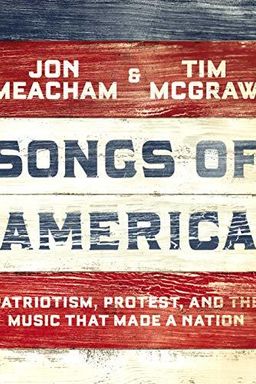
Songs of America cover

Songs of America

by Jon Meacham, Tim McGraw

Songs of America delves into the profound impact of music on American history, from revolutionary anthems to protest songs that shaped social change. Authors Jon Meacham and Tim McGraw explore how music has mirrored and influenced national identity, offering a rich cultural tapestry spanning three centuries.

The Sound of American Memory

What if you could hear the sweep of American history—the musket fire at Lexington, the spirituals whispered underground, the anthems shouted in stadiums? Historian Jon Meacham argues that you can. In his exploration of America’s musical past, Meacham reveals that the nation’s conscience and contradictions have always been audible. Music, he shows, is not a backdrop to history but one of its main narrators: it teaches, protests, mourns, and exalts. From the Revolution to the present, each generation has turned to song to declare who it is and what it believes America might yet become.

Music as moral memory

You can think of American music as the country’s moral archive. Early leaders like Jefferson and Washington already recognized its civic influence, ordering military corps to keep good bands because melody unified where argument often divided. Meacham begins with this premise: that every beat, hymn, or chorus carries moral history. A patriotic song is not just celebration—it is a plea. The Overture of his narrative sets this frame through Elias Nason’s line that a patriotic song is “an enchanted key to memory’s deepest cells.” Through that key, listeners connect emotion to principle, love of country to critique of its failures.

Unity, dissent, and the democratic ear

For Meacham, you cannot separate patriotism from protest. The same country that sings “God Bless America” will also cheer a raucous “Fortunate Son.” Patriotism, he suggests, is less about obedience and more about participation: to sing along is to claim membership in an argument about the meaning of freedom. Thus, music has always embodied America’s doubleness—its soaring ideals and its stubborn injustices. Even the Revolutionary hymns that bound colonists together often borrowed British melodies, hinting that cultural independence came more slowly than political revolution.

The living chorus of change

Across more than two centuries, Meacham traces how music evolves into both mirror and engine of social change. Revolutionary singers turn pamphlets into choruses; enslaved people use spirituals as survival codes; soldiers in the Civil War and world wars chant themselves toward courage. The 20th century sees the same pattern magnified: “Lift Every Voice and Sing” becomes a hymn of endurance, “We Shall Overcome” turns suffering into strategy, and Bob Dylan, Nina Simone, and Sam Cooke transform personal feeling into public vow. Even Elvis Presley’s fusion of blues, gospel, and country functions as cultural reconciliation—an aural version of a pluralistic dream that both borrows and renews.

Listening as civic practice

Meacham ultimately invites you to reimagine listening as a civic act. He encourages you to ask, whenever you encounter an American song: who made it, for whom, and to what use? A star-spangled anthem at a game, a freedom song sung in jail, or a post-9/11 elegy each reveals what a people feels obligated to remember. Music, then, is not decoration on democracy—it is part of democracy’s dialogue, capable of both consoling and confronting. The enduring challenge, Meacham suggests, is to hear not just melodies but meanings—and to let those meanings draw us closer to the country’s unfinished harmony.


Revolutionary Choruses and National Beginnings

When you step into the soundscape of the 1770s, you step into politics set to music. Meacham shows that musical life in the colonies was not mere diversion but democratic rehearsal. In taverns, parades, and public squares, songs like John Dickinson’s “The Liberty Song”—paradoxically fitted to the British tune “Heart of Oak”—gave ordinary people a way to perform unity. You could be illiterate in political theory and still chant “By uniting we stand, by dividing we fall.” Music turned abstraction into experience.

From debate to anthem

Joseph Hopkinson’s “Hail Columbia” in 1798 aimed to cool partisan heat, offering a melody both Federalists and Jeffersonians might share. Though briefly successful, the era quickly devolved into musical factionalism—“Adams and Liberty” for elites, “Jefferson and Liberty” for opponents. Meacham interprets these dueling songs as proof that the republic’s earliest battles were fought not only in Congress but also in choruses. Words and melody created identity faster than newspapers could.

The flag and the anthem

By the War of 1812, patriotism found a visual and sonic twin in the flag and Francis Scott Key’s verses. Watching the bombardment at Fort McHenry, Key’s poem inspired by Mary Pickersgill’s huge flag redefined loyalty as sight and sound: the flag that endured under fire proved, symbolically, that the nation did too. The transformation from “liberty” to “banner” signaled a shift—America came to view itself less as an argument among equals and more as an image to be defended. Meacham reminds you that the anthem was unofficial until 1931, meaning that cultural belief canonized it long before law did. The songs of this period fuse emotion, imagery, and civic purpose into the first notes of national identity.


Slavery’s Songs and Freedom’s Echo

If the Revolution gave America its anthems, slavery gave it its soul music. Meacham highlights the spiritual as both survival and subversion. Enslaved people fashioned a hidden code of faith and flight: hymns like “Go Down, Moses” spoke of biblical deliverance and also of geographic escape. Frederick Douglass remembered these songs as “testimony against slavery.” Harriet Tubman used them as signals. The sorrow song is thus paradoxical: it lamented bondage yet kept freedom alive in memory’s mouth.

Masking and meaning

Under watchful eyes, “masking”—singing one thing, meaning another—became an art of resistance. A line about crossing Jordan might name not only heaven but Ohio. Meacham reads this double language as one of the earliest American inventions: a form of poetic ambiguity that allowed hope to survive censorship. These songs made literacy unnecessary; they were oral newspapers, emotional GPS, and communal prayer.

From sorrow to concert hall

After emancipation, the Fisk Jubilee Singers took that coded repertoire to the world stage, reframing sorrow as art. Their tours in the 1870s introduced audiences to spirituals as high culture and raised funds for education. In the transition from field to concert hall, Meacham sees the birth of a civic genre—a way for the formerly enslaved to narrate the republic’s failure and potential. The “sorrow songs” evolved into seeds for gospel, blues, and protest music, proving that beauty could carry memory farther than rhetoric ever could.


War, Sacrifice, and the Music of Resolve

America’s wars have always demanded a soundtrack. Meacham follows the pattern from abolition to Allied victory, showing how music rallies emotion, interprets duty, and sometimes questions authority. Julia Ward Howe’s “Battle Hymn of the Republic,” rewritten from “John Brown’s Body,” transformed the Civil War into a moral crusade. By contrast, Confederate favorites like “Dixie”—ironically penned in the North—revealed nostalgia wrapped in rebellion. Each side sang its conviction of righteousness, proving that music gives each army not only rhythm but theology.

From “Over There” to swing abroad

In the world wars, music again mobilized feeling under banners of unity. George M. Cohan’s “Over There” turned duty into melody; Irving Berlin’s “God Bless America,” revived by Kate Smith, baptized national optimism against fascism. Glenn Miller modernized the military band, blending jazz and patriotism in a style both crusading and comforting. Meacham underscores that wartime music always does three things: it comforts personal fear, clarifies public purpose, and converts morale into motion.

The cost of harmony

Yet the very anthems that unite can conceal fissures. The Civil War’s “Battle Hymn” spoke of righteous sacrifice but ignored Black suffering. World War II’s sing-alongs celebrated liberty abroad even as segregation persisted at home. Meacham wants you to notice these dissonances: every chorus of unity rests on unresolved chords of inequality. Still, without music’s unifying illusion, he suggests, no democracy could summon courage long enough to confront itself.


Anthems of Equality and Protest

From the suffragist stage to civil rights marches, reformers have always sung justice into being. Susan B. Anthony and her allies parodied popular tunes like “Marching Through Georgia,” turning them into suffrage hymns such as “Give the Ballot to the Mothers.” James Weldon Johnson’s “Lift Every Voice and Sing” expanded this model into a Black national hymn—a song proud of progress yet fierce about promises unkept. Meacham treats it as bridge: patriotic enough to belong in civic ritual, critical enough to be prophetic.

Freedom songs and the movement’s pulse

By the 1950s and 1960s, “We Shall Overcome” emerged as the moral grammar of nonviolent protest. Its lineage stretched from church pews to union halls to the Highlander Folk School, where singers like Zilphia Horton and Pete Seeger helped standardize its refrain. Lyndon Johnson echoed it during his 1965 Voting Rights Act address, acknowledging song as legislation’s forerunner. Meanwhile, artists such as Bob Dylan, Joan Baez, and Mahalia Jackson fused folk and gospel into emotional arguments for equality; Nina Simone and Sam Cooke added rage and lament where patience had worn thin.

Music as moral movement

For Meacham, these songs do more than accompany protest—they create moral instruction. They teach strategy (“which side are you on?”), endurance, and empathy. When Martin Luther King Jr. improvised “I Have a Dream,” after Jackson’s musical prompting, speech and song fused into sacrament. The civil-rights soundtrack proved that a tune could open hearts when laws could not yet open doors.


Division, Rock, and the Counter-Song

The Vietnam era shattered musical unity. Meacham contrasts Barry Sadler’s “Ballad of the Green Berets,” a soldier’s solemn march of honor, with Creedence Clearwater Revival’s searing “Fortunate Son,” an anthem of anger at class privilege. Pete Seeger’s censored “Waist Deep in the Big Muddy” mocked blind obedience, while in the field, weary soldiers clung to songs like “We Gotta Get Out of This Place.” Music no longer spoke with one national voice; it revealed the split between pride and protest, duty and disillusionment.

Woodstock and reinterpreting patriotism

At Woodstock, Jimi Hendrix and Joan Baez reimagined responsibility itself. Hendrix’s feedback-drenched “Star-Spangled Banner” collapsed the distance between bomb and anthem, protest and prayer. Audiences heard the nation’s promise wailing through distortion. Meacham interprets that performance as the period’s crucial paradox: the same music that once unified now questioned whether unity was still deserved. The era’s final notes—Neil Young’s “Ohio,” Crosby, Stills, Nash & Young’s protest after Kent State—turned mourning into indictment.

Festival to fracture

By the early 1970s, patriotic songs had become performative fault lines: one crowd chanting along to Kate Smith’s “America the Beautiful” as another booed from across the mall. The U.S. was literally singing in counterpoint. Meacham’s message is sobering: when a nation stops hearing itself across musical difference, it risks forgetting that disagreement need not mean division.


Identity, Ideology, and the Modern Anthem

In the late twentieth century, American music became both ideological mirror and personal confession. Elvis Presley’s rise fused Black and white traditions into one volatile body, proving that culture often changes faster than politics. His “American Trilogy” attempted musical reconciliation between North and South, slavery and salvation—a metaphor, Meacham notes, for a country trying to harmonize history’s dissonances.

Reagan’s stage and Springsteen’s stage

The 1980s offered a new contest. Bruce Springsteen’s “Born in the U.S.A.”, often mistaken for triumph, in fact laments neglected veterans—a patriotic ache rather than celebration. Ronald Reagan and George F. Will misread its defiance as endorsement, prompting Springsteen’s gentle correction. Meanwhile, Lee Greenwood’s “God Bless the U.S.A.” crystallized conservative optimism. The contrast illustrated two coexisting Americas: one proud without irony, one wounded but devoted. Hip-hop soon joined the fray, with Run-D.M.C., N.W.A., and Tupac giving urban realism and racial injustice their own beat-driven scripture.

Post-9/11 solace and schism

After September 11, 2001, mourning and militancy shared the airwaves. Alan Jackson and Bruce Springsteen offered elegy; Toby Keith offered vengeance. The Dixie Chicks’ backlash—sparked by a single remark about the president—proved how thin national solidarity can stretch. Music again mapped emotion onto conflict: what began as communal grieving became argument over who owned patriotism. Through it all, Meacham observes, Americans kept turning to song not because it resolved differences but because it gave voice to what speech could not bear.


Art, Listening, and the Possibility of Harmony

The book closes where politics and art literally meet—in the White House. The 1965 Festival of the Arts, convened by Lyndon Johnson, dramatized the uneasy dance between power and creativity. When poet Robert Lowell declined his invitation in protest of Vietnam and others signed petitions on the lawn, Johnson responded: art, he said, is not a weapon but a bridge. Meacham seizes on that remark as the book’s coda: music can open hearts even when policies close minds.

The civic power of listening

Marian Anderson’s voice and Duke Ellington’s orchestra at that festival embodied what Meacham calls the republic’s better harmony—moments when the arts remind leaders to serve humanity, not ego. He argues that America’s ongoing symphony depends less on what is sung than on whether citizens listen to one another’s songs. To listen, in Meacham’s moral vocabulary, is to recognize shared aspiration despite dissonance. Music will not fix division, but it can tune empathy.

The enduring cadence

Through centuries of anthems and protests, Meacham’s ultimate insight rings clear: the American story is scored in major and minor keys. Each generation must decide whether to sing harmony or to shout alone. To hear those melodies together—to understand “Lift Every Voice” and “The Star-Spangled Banner” as parts of one score—is the work of citizenship itself.

Dig Deeper

Get personalized prompts to apply these lessons to your life and deepen your understanding.

Go Deeper

Get the Full Experience

Download Insight Books for AI-powered reflections, quizzes, and more.