
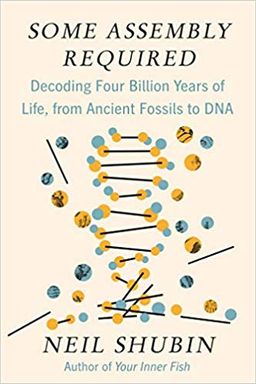
Some Assembly Required cover

Some Assembly Required

by Neil Shubin

In ''Some Assembly Required,'' Neil Shubin explores the intricate journey of evolution through the lens of fossils and DNA. This engaging narrative uncovers the unexpected twists and turns that led to the diversity of life today, offering profound insights into our own existence.

Life’s Grand Pattern: Evolution as Repurposing

What if evolution isn’t about constantly inventing from scratch but about remixing what already exists? In Some Assembly Required, paleontologist Neil Shubin challenges our assumption that each great evolutionary leap—the first animals on land, the rise of birds, or even the emergence of humans—was a sudden act of creation. Instead, he argues that life’s innovations come from a long, ingenious tradition of repurposing. Nature is the ultimate tinkerer, recycling old parts for new purposes. Wings come from arms, hands from fins, and much of our DNA is derived from ancient viruses.

Shubin contends that evolution advances not through brand-new inventions but through what Darwin once called a “change in function.” The same idea—proposed in the sixth edition of On the Origin of Species—becomes the book’s unifying principle. Whether in fossil discoveries or genetic revolutions, Shubin reveals a recurring theme: every organ, gene, and tissue carries the history of something that came before it.

From Rocks to DNA: The Fossil Finder Who Turns to Genes

Shubin first became famous for discovering Tiktaalik roseae, the transitional fish with wrists and elbows that bridged water and land. But here, he turns from rocks to genomes. He argues that fossils tell us when transitions occurred, while DNA tells us how they happened. The twist: the story written in our genes often contradicts our expectations. Feathers didn’t evolve for flight, lungs didn’t appear to help animals live on land, and hands didn’t begin as tools for grasping. All of these features existed long before they served their current purpose.

To make this case, Shubin blends centuries of discovery—from 18th-century anatomists and 19th-century embryologists to 20th-century geneticists. He resurrects forgotten heroes like Félix Vicq d’Azyr, who saw repeated patterns in animal anatomy, and Susumu Ohno, who recognized gene duplication as evolution’s hidden engine. By weaving their discoveries together, Shubin gives us not just a history of evolution but a history of how we came to understand it.

Evolution’s Toolkit: Duplicates, Copies, and Mutations

The concept that drives Shubin’s narrative is biological recycling. Like a clever engineer, evolution builds new systems by copying old blueprints. When genes duplicate, one copy preserves its original job while the other experiments with something new. From these genetic “copycats,” new eyes, limbs, and even brains have evolved. Much of what makes humans unique—like our expanded cortex or complex pregnancy—is due to duplicated or hijacked genes from past lineages.

A striking irony underpins the book: most of our genome isn’t human invention at all. Roughly two-thirds of our DNA consists of repeated or viral elements that once invaded our cells. Far from being junk, these genetic stowaways became sources of creativity. Mammalian placentas and even memory-forming proteins in our brains trace back to ancient viruses.

Why Repurposing Matters Today

Shubin’s message isn’t only about ancient fossils—it’s about seeing yourself as a biological mosaic. Every ability you have—speaking, seeing color, healing, or thinking—is a collage of ancient adaptations. Our genomes are wired by history, filled with echoes of creatures that came before us. By understanding how nature reuses its material, you gain perspective on human creativity itself. Just as evolution builds using old tools, our inventions—wheels, computers, and ideas—evolve by borrowing, remixing, and recombining.

Ultimately, Some Assembly Required argues that life’s greatest revolutions—the ones that brought lungs to fish, feathers to dinosaurs, and thought to apes—didn’t require starting over. They required, in Darwin’s words, “a change of function.” Shubin invites you to view life like a vast, collaborative work-in-progress—one that’s been running its grand experiment of copying, repurposing, and reinventing for four billion years.


Darwin’s Five Words That Changed Everything

In the 1872 edition of On the Origin of Species, Charles Darwin added a new phrase—“often accompanied by a change of function.” Those five words, which he wrote in response to his critic St. George Jackson Mivart, lie at the heart of Shubin’s argument. Mivart had challenged Darwin’s theory by asking how half-formed wings or incomplete lungs could ever be useful. Darwin’s simple answer: because early forms often served a different purpose.

Lungs Before Land

Shubin explores how 19th-century anatomists like Étienne Geoffroy Saint-Hilaire discovered lung-like organs inside fish long before they climbed onto land. These weren’t primitive versions—they were functioning lungs, used to gulp oxygen from air when water became depleted. The Australian lungfish, for example, could breathe across both worlds. As Shubin explains, “lungs didn’t evolve to let animals live on land—they evolved to help fish breathe better underwater.” Later descendants would repurpose this feature to survive on land.

Feathers Before Flight

The same repurposing explains one of nature’s most famous mysteries: how birds took to the skies. Feathers didn’t originally arise for flying. Early feathered dinosaurs like Archaeopteryx or its Chinese cousins sported plumage for heat regulation or display—essentially reptilian fashion statements. Only later did feathers become aerodynamic. Across time, hollow bones, extendable limbs, and feathers combined into a system capable of powered flight. The result wasn’t a miraculous leap, but an evolutionary remix of preexisting parts.

(Note: This echoes Stephen Jay Gould’s notion in The Panda’s Thumb that evolution works as a tinkerer, not an engineer—cobbling new designs from old materials rather than starting anew.)

Nature’s Core Principle: Repurpose and Redeploy

By following Darwin’s phrase across millions of years of life, Shubin shows a remarkable pattern. Evolution isn’t a ladder climbing toward perfection; it’s a web of borrowed solutions. Limbs, feathers, lungs, and even mental functions evolved because structures built for one job found new applications. Once you grasp this principle, you see evolution not as a tale of chance mutations alone but as an ongoing story of adaptation through redistribution—the biological version of creative recycling.


Embryos: The First History Books

Before DNA sequencing or fossil digs, the greatest clues to evolution came from embryos. Shubin revives the forgotten experiments of 19th-century scientists such as Karl Ernst von Baer and Christian Pander, who discovered that all animal embryos share three tissue layers that form every organ of the body. The insight—fish, birds, and humans all begin with the same blueprint—helped scientists realize that embryonic development mirrors evolutionary history.

Haeckel’s Bold (and Flawed) Vision

Ernst Haeckel famously declared, “Ontogeny recapitulates phylogeny,” claiming that embryos replay their species’ entire evolutionary past. Though this isn’t strictly true, it inspired generations of biologists to study development as a window into evolution. Shubin emphasizes that while embryos don’t literally retrace history, they preserve hidden traces of it. Each heartbeat, nerve, and limb follows patterns inscribed deep in time.

Larvae That Changed the World

Biologist Walter Garstang later built on this idea with his concept of heterochrony—small shifts in developmental timing that create major evolutionary changes. His verse about salamanders (axolotls) captured this in poetry: when development pauses early, water-born larvae remain forever aquatic instead of transforming into land adults. Shubin calls this “evolution’s time machine.” The same process likely produced early vertebrates from sea-squirt larvae—creatures whose juvenile forms resembled the simplest backboned animals.

From Cells to Species

Julia Platt’s groundbreaking work later showed that a single new cell type—the neural crest cell—could transform animal evolution. These cells migrate through embryos to form the head, nerves, and facial bones unique to vertebrates. In Shubin’s telling, embryos act like living fossils: by studying how they form, we can reconstruct the evolutionary inventions that brought our ancestors to life.


Genes, Switches, and the Molecular Maestro

In the mid-20th century, scientists cracked another ancient code—the double helix of DNA. Shubin recounts how Francis Crick and James Watson’s 1953 breakthrough reshaped biology: genes are strings of chemical letters that encode proteins. But genes alone don’t explain why humans and chimps look different or why flies and frogs have similar body patterns despite millions of years of distance.

Unlocking Evolution’s Control Room

Shubin introduces Jacob and Monod’s bacterial experiments of the 1960s, which revealed that gene activity depends on nearby molecular switches—short DNA sequences that determine when and where genes turn on. These switches explain how organisms with similar genes can look dramatically different. Like composers controlling an orchestra, they determine whether a gene plays for milliseconds or minutes, creating endless variations on the same theme.

The Case of the Six-Toed Cats

One of Shubin’s favorite tales involves Ernest Hemingway’s famous polydactyl cats—born with extra toes due to a mutation in a switch far from its gene. In one study, this same “remote control” sequence lay nearly a million bases away from the gene it influenced, Sonic hedgehog, which sculpts our fingers and toes. Evolution, it turns out, often rewires these switches—flipping the control panel without rewriting the genes themselves.

This discovery overturned the belief that evolution relies only on new genes. As Shubin notes, “Sometimes the story isn’t about new notes—it’s about new timing.” Small changes in developmental switches can create profound differences, from the long necks of giraffes to the brain size of humans.


Monsters, Flies, and the Blueprint of Bodies

From the 18th-century fascination with two-headed calves to the 20th-century fruit fly labs, Shubin traces how genetic “monsters” helped scientists uncover life’s body plan. Thomas Hunt Morgan’s Fly Room at Columbia University—air thick with the smell of rotting bananas—became the birthplace of modern genetics. Mutant flies with double wings or legs on their heads revealed that body segments are guided by genes arranged like beads along a string.

Edward Lewis and the Hox Revelation

Decades later, Edward Lewis deciphered that these “segment genes” were organized in the same order as the body parts they built: head genes at one end, tail genes at the other. Later discoveries showed that the same genes—Hox genes—exist in every animal, from worms to humans. They are ancient blueprints reused across millions of years. When Nipam Patel later used CRISPR editing to shift gene activity in crustaceans, he could literally make limbs swap positions, turning one species into another’s mirror image of evolution.

The Hidden Symphony of Form

Shubin likens this discovery to uncovering a universal musical score. Every embryo plays the same melody but changes tempo and instrumentation. The one-bone–two-bone–digit pattern of vertebrate limbs, whether in whales or humans, mirrors how Hox genes orchestrate growth: same notes, different arrangements. Evolution didn’t rewrite the score—it changed how it’s performed.


Copycats: Duplicating for Innovation

One of Shubin’s most exhilarating chapters, “Copycats,” celebrates an unsung biological artist: duplication. Nature copies itself shamelessly, from genes to organs. The French physician Félix Vicq d’Azyr once observed that human limbs mirror each other in repeating one bone, two bones, and digits. Two centuries later, geneticist Susumu Ohno proved this repetition exists in our DNA. His experiments cutting out, staining, and weighing chromosomal photos from different species led to a revelation—different mammals have vastly different chromosome counts but nearly identical total genetic material. Evolution works by making copies, not adding mass.

The Power of Redundancy

When genes duplicate, one maintains its function while the other mutates freely. It’s nature’s R&D department. Duplicated genes gave rise to keratins in hair, opsins in color vision, and olfactory receptors that help dogs detect thousands of smells humans can’t. Even the genes that guide body architecture—the Hox and Pax families—grew through duplication. Humans have four times as many as flies, translating into vastly more intricate bodies.

When Copies Go Wild

But copying can also misfire. Bridges’ mutant fruit flies with extra wings and humans born with chromosomal duplications (like Down syndrome) show how excess copies reshape bodies dramatically. Still, most biological progress relies on this “plagiarism.” As Shubin quips, “Nature is the greatest copyright violator in history.” Duplications, duplications of duplications—even within proteins—form the raw material for evolution’s endless invention.


Viruses, Jumping Genes, and Evolution’s Dark Art

Not all creative forces are benevolent. Shubin reveals that our DNA is a battleground teeming with parasitic sequences—jumping genes—first discovered by Barbara McClintock in her corn fields. These self-copying elements can insert themselves anywhere in the genome, sometimes breaking or hijacking genes. For decades, scientists dismissed this as junk. But as Shubin shows, these genetic trespassers became unlikely sources of evolutionary innovation.

Pregnancy: A Viral Invention

Vinny Lynch’s research on decidual stromal cells—critical for pregnancy—suggests that viruses helped mammals evolve the ability to gestate internally. He found that hundreds of pregnancy-related genes are controlled by switches derived from jumping genes. Even more astonishing: the vital placental protein Syncytin traces back to an ancient viral infection. Mammalian pregnancy, one of evolution’s greatest feats, was born from domesticated viral DNA.

Memory from a Virus

Our most human trait—memory—also has viral roots. Jason Shepherd’s studies on the Arc gene revealed that it acts like a retrovirus, forming capsules that transfer genetic messages between neurons. Evolution literally hacked an ancient infection to build intelligence. Shubin marvels at the irony: humanity’s mind was carved out of viral machinery once meant to destroy.

In this vision, the genome becomes a living ecosystem of conflict and cooperation. Jumping genes, viruses, and host defenses wage molecular wars whose weapons—mutations, duplications, and regulatory hacks—create new possibilities for life.


The Mergers That Made Us

Shubin ends with one of life’s most profound transformations: when independent cells merged to form the complex cells that compose every animal and plant. This idea, now accepted but once ridiculed, was championed by Lynn Margulis. She proposed that mitochondria and chloroplasts—the energy factories inside our cells—were once free-living bacteria that took up residence within other cells. Her theory of endosymbiosis redefined individuality: each cell is a community of former microbes working as one.

The Origins of Bodies

Bill Schopf’s hunt for ancient fossils in Australian rocks pushed the clock of life back over three billion years, revealing microbial mats that changed the planet’s atmosphere. When oxygen filled the air, Margulis’s merged cells turned that energy into complex life. Later, multicellular organisms arose when single cells learned to stick together and specialize. Shubin calls this the ultimate act of teamwork: individual microbes sacrificing autonomy to build something larger—a body.

Evolution as Collaboration

From bacterial mergers to viral bargains, every stage of life’s history reveals a pattern of sharing and synthesis. Our mitochondria are borrowed, our genomes invaded, our organs reused. “We are confederations,” Shubin writes, “spirals of old identities woven into new.” The story of evolution is not a march of progress, but a symphony of ancient alliances constantly remixed to create new ways of being alive.

Dig Deeper

Get personalized prompts to apply these lessons to your life and deepen your understanding.

Go Deeper

Get the Full Experience

Download Insight Books for AI-powered reflections, quizzes, and more.