
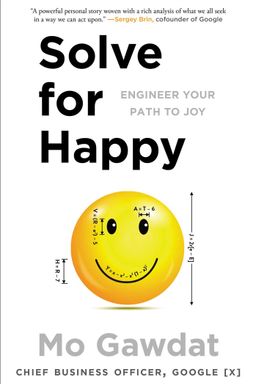
Solve for Happy cover

Solve for Happy

by Mo Gawdat

In ''Solve for Happy'', Mo Gawdat, former Chief Business Officer of Google X, embarks on a quest to decipher happiness. By blending analytical thinking with spiritual teachings, he crafts a practical formula to achieve joy. This book challenges readers to rethink their perceptions, embrace present moments, and cultivate unconditional love for a more fulfilled life.

Solving for Happiness in an Imperfect World

Why is happiness so elusive even in a world where comfort, wealth, and opportunities are more abundant than ever? In Solve for Happy, Mo Gawdat—a former Chief Business Officer at Google [X]—argues that happiness isn’t something to pursue or acquire. It’s our natural default state—a calm, peaceful joy that exists when nothing disturbs our mental balance. The problem, he claims, is that modern life and flawed thinking overwrite our mental code, creating illusions and blind spots that prevent us from seeing clearly what truly is.

After enduring the unbearable loss of his son, Ali, Gawdat turned his grief into a mission to understand joy scientifically and practically. As an engineer, he approached the problem of human happiness as a system that can be defined, tested, and replicated. The result is the Happiness Equation: Happiness = Your perception of events – Your expectations of how life should behave. When life meets or exceeds expectations, you’re happy. When it doesn’t, you suffer. Yet Gawdat insists that the events themselves rarely cause suffering; it’s how we think about them—the stories in our heads—that do.

The Engineering of Joy

Mo Gawdat’s unique contribution is his ability to explain emotional realities with the precision of an engineer. He distills happiness into quantifiable components. His method begins by identifying six “grand illusions” that distort reality, seven “blind spots” that warp your perception, and five “ultimate truths” that anchor you in peace. Together, these create a repeatable system—known as the 6-7-5 Model—for recovering the natural joy we had as children before ego and fear took over. The same thinking that made Gawdat successful in building moonshot technologies at Google becomes the operating system for solving one of humanity’s oldest problems.

Ali’s Legacy and the Power of Acceptance

This framework didn’t emerge from academic speculation. It was tempered through the fire of personal tragedy. In 2014, Gawdat’s 21-year-old son Ali died during a routine surgical procedure because of medical error. Rather than allow grief to destroy him, Gawdat applied his happiness model to the most extreme pain possible. He discovered that even loss and death could be addressed through truth and acceptance. As his wife asked in their moment of crisis, “Will it bring Ali back?” This question became a compass pointing to what’s real. Anything—thought, story, blame—that doesn’t reflect truth only prolongs suffering. For Gawdat, peace begins the moment you choose to stop resisting reality.

What the Book Explores

Across four parts, Solve for Happy examines the mental illusions that prevent contentment: the illusions of self, thought, time, control, knowledge, and fear. It then exposes the seven blind spots of the brain that distort our interpretations—filters, assumptions, memories, labels, emotions, exaggerations, and predictions. The book concludes with foundational truths about the nature of life—such as the reality of death, love, change, and design—that bring lasting peace when understood. Each truth serves as a “thought debug” to correct false expectations.

Gawdat pairs ancient wisdom traditions with modern science. Quantum physics, Buddhist mindfulness, neuroscience, and Stoic philosophy coexist in his argument. Like Viktor Frankl in Man’s Search for Meaning, he believes happiness is not the absence of pain but the freedom to interpret pain truthfully. And like Eckhart Tolle in The Power of Now, he teaches presence as the antidote to overthinking. But what distinguishes Gawdat is his pragmatism—he turns transcendent ideas into mental checklists, reflection tests, and daily practices.

Why It Matters

If you have ever felt trapped between ambition and emptiness, or peace and loss, Gawdat argues that the solution isn’t in control, consumption, or even success. It lies in understanding how your brain works against you—and reclaiming your ability to see life as it really is. By removing illusions and confronting truth, joy becomes inevitable. The tragedy that inspired Solve for Happy became its proof: even in unimaginable pain, happiness remains possible because truth never leaves us. Life will contain both suffering and love, gain and loss, but peace is found in accepting all as part of the design.

Through rational frameworks and intimate storytelling, Solve for Happy invites you to debug your thoughts, surrender your illusions, and choose joy—not as fleeting pleasure but as your permanent default setting. It’s both a father’s promise to his son and a practical manual for anyone willing to take responsibility for their own happiness.


The Happiness Equation

At the heart of Mo Gawdat’s philosophy lies a deceptively simple formula: Happiness = Perception of Events – Expectations of Life. This equation reframes happiness from a mystical state into a solvable problem. It invites you to carefully examine both sides of the equation: not what life gives you, but how you evaluate it.

Shifting from Events to Perception

Events by themselves are neutral—what causes suffering is the story you attach to them. Consider Gawdat’s story of losing his luxury car. When his wife crashed their Saab convertible, he felt grateful because the same event that could have caused anger instead confirmed that his wife was alive and unharmed. If she had been safe while the car was parked and later damaged by a stranger, that gratitude might have turned into resentment. The difference wasn’t in the event but in perception. This example exposes how unhappiness is constructed in your mind, not enforced by reality.

The Expectation Trap

Modern life corrupts the equation by inflating expectations. Society trains you to chase success, status, and recognition, promising happiness afterward. But Gawdat shows that success doesn’t lead to happiness—rather, happiness leads to success (supported by studies at the University of Warwick). When your expectations are misaligned with life’s nature—when you believe things “shouldn’t” change or “shouldn’t” hurt—you trap yourself in an equation that can never balance. Lowering expectations to align with truth doesn’t mean giving up; it means letting go of the illusion that life will always behave the way you want.

Decoding Pain and Suffering

According to Gawdat, pain and suffering are not the same. Pain is an objective signal—helpful, temporary, and part of survival. Suffering, however, is what happens when your thoughts linger on pain and multiply it. The mind replays a memory or fear until it becomes unbearable. When his son died, Gawdat didn’t try to erase pain; he simply refused to let false thoughts (“life is unfair,” “I could have prevented it”) dominate. As long as you align perception with truth, life’s inevitable pains won’t become suffering.

Restoring the Default State

Gawdat reminds you that you were born happy. Like a smartphone fresh from the factory, your mind’s default settings include peace, curiosity, and joy. The “malware” of false beliefs and cultural illusions—competition, control, fear—corrupts these original settings. The journey to happiness, therefore, isn’t adding new behaviors but deleting faulty code. By debugging your expectations, you return to that childlike default: happiness as the baseline when nothing is wrong.

When life meets your expectations, you feel peace. When it doesn’t, you suffer. But the formula gives you agency—you can adjust expectations, challenge perceptions, and reframe reality. Gawdat’s equation transforms happiness from a mystery into a skill: one you can learn, test, and apply daily.


The Six Grand Illusions

In Solve for Happy, Gawdat argues that six “grand illusions” are the main reasons we miscalculate our Happiness Equation. These illusions distort your reality, making life seem unfair, unpredictable, or painful. By exposing them one by one, you align your expectations with truth and bring reality back into focus.

1. The Illusion of Thought

You are not the voice in your head. Most of your thoughts are repetitive noise generated by your brain—a safety mechanism designed for ancient survival, not modern peace. When you learn to observe thoughts rather than identify with them, as in mindfulness or Stoic detachment, you reclaim control. Gawdat compares it to taming a quacking duck in your mind: ‘You can’t stop it from quacking, but you can tell it to quiet down.’

2. The Illusion of Self

The ego convinces you that you are your body, career, or reputation, creating endless anxiety about preserving identity. Gawdat deconstructs the “Russian doll” of masks we wear—roles, beliefs, possessions—until only awareness remains. You are not what you have, think, or feel; you are the observer of all these. Once ego dissolves, comparisons fade and peace emerges.

3. The Illusion of Knowledge

Humans think they know much, but most knowledge is partial or temporary. From Newton to Einstein, every scientific truth was overturned by a new discovery. This arrogance (“I’m right”) fuels conflict and suffering. True wisdom, he says, lies in humility—knowing the limits of what can be known and choosing beliefs that serve joy rather than fear.

4. The Illusion of Time

Time is not linear—it’s an illusion of the mind. You never experience the past or future, only the present moment. Yet your brain’s addiction to “time-stamped thoughts” keeps you anxious and rushed. By training your focus on now, you dissolve worry and regret. Gawdat uses Einstein and Buddhist thought to show that eternity isn’t a long time; it’s timelessness.

5. The Illusion of Control

Humans crave control as security, but life is inherently unpredictable. The 2008 financial crash and Ali’s death are reminders that black swans—rare, unpredictable events—govern life. You control only two things: your actions and your attitude. ‘Tie your camel, then surrender,’ Gawdat quotes from Islamic tradition, a perfect summary of what he calls “committed acceptance.”

6. The Illusion of Fear

Fear, he says, is the master illusion—the root of all others. Your brain generates fear as a precaution, exaggerating threats to avoid pain. But most fears are thoughts about non-existent futures. Gawdat walks you through dismantling fear by confronting it, asking: “What’s the worst that could happen? So what? How likely is it?” Facing fears reveals they’re rarely fatal—and freedom lies on the other side.

Seeing through these illusions doesn’t change life’s events; it changes your relationship with them. You stop demanding that the world behave differently and start seeing it as it is. Illusions break, expectations align, and happiness naturally returns.


The Seven Blind Spots of the Brain

Even after breaking illusions, your brain still misreads reality through seven built-in flaws called “blind spots.” Gawdat explains these as survival mechanisms that once protected prehistoric humans but now distort perception, multiplying unnecessary suffering.

1. Filters

Your brain filters most of reality, letting in only what seems relevant. Like selective attention—the gorilla experiment in psychology—it misses crucial details while obsessing over potential threats. You see what confirms your fears, not what’s true. The antidote is curiosity: asking, “What’s missing from this picture?”

2. Assumptions

This is how the brain fills gaps with stories. You see an expression and assume anger; you lose a job and assume disaster. Mo demonstrates with optical illusions: your brain alters reality to fit its narrative. The fix? Replace assumptions with observation—see, don’t suppose.

3. Predictions

The mind constantly forecasts imaginary futures. Yet every prediction is pure fiction. When his son’s loss tempted Gawdat’s mind to predict endless misery (“I’ll never be happy again”), he countered with truth: “Is that true?”—a question he learned from Byron Katie’s The Work.

4. Memories

Memory lies. It’s not a videotape but a story edited by emotion. By mixing the past with present perspective, your brain contaminates objective truth. Understanding this makes forgiveness easier—you realize the past is just thought, not reality.

5. Labels

Your mind names everything: “good,” “bad,” “ugly,” “mine.” Each label generalizes and prevents fresh seeing. Ali refused to live by labels—neither “Western” nor “Eastern,” just “himself.” Removing labels restores innocence and curiosity, letting life simply be.

6. Emotions

Emotions are powerful guides but poor masters. Anger, pride, or envy color perception, making neutral events seem personal. Awareness doesn’t suppress emotion but lets it pass like weather. You are not the storm—you are the sky.

7. Exaggeration

To keep you alert, your brain magnifies threats (“the whole world is against me”). This negativity bias protected cave dwellers but exhausts modern humans. Counter exaggeration with evidence and gratitude: list what’s going right, and the lens widens.

Recognizing these blind spots helps you ask the critical debugging question, “Is it true?” This single inquiry—paired with compassion—restores clear vision and rewires your brain for peace.


Facing Fear and Surrendering Control

Control and fear are twin illusions that generate almost all modern unhappiness. The more you try to control life, the more fear you invite, because every unpredictable change threatens your illusion of safety. Gawdat’s antidote is what he calls committed acceptance.

The Futility of Control

Imagine, he suggests, sitting in a cockpit with millions of knobs representing all variables of life—weather, traffic, politics, biology. Turning one switch changes hundreds of others. Exhaustion and chaos follow. This is how most of us live: endlessly tweaking circumstances to avoid left turns, ‘black swans,’ or loss. Yet the world is driven by trillions of butterfly effects beyond our reach. Control is mathematically impossible.

Committed Acceptance

Instead of control, choose committed acceptance—a fusion of responsibility and surrender. Act with diligence (“tie the camel”) but release attachment to outcomes (“then trust God”). Only two forces remain within your control: your actions and your attitude. When everything else changes—and it will—these are your stabilizers. As Gawdat learned after losing Ali: all the planning in the world couldn’t guarantee another day; only his attitude could transform tragedy into service.

Courage Over Fear

Gawdat dissects fear psychologically. Most fears are conditioned—not innate. Like the experiment of Watson’s “Little Albert,” your childhood learned to associate neutral events with pain. As adults, we expand them into fear of rejection, failure, or death. To dismantle fear, face it directly and interrogate it: “What’s the worst that can happen? So what if it does? Can I recover?” Most of the time, the answers reveal freedom hiding behind illusion.

Once you release the need to control and the reflex to fear, life unfolds easily. You act responsibly but not anxiously; you trust life’s rhythm instead of wrestling with it. For Gawdat, this surrender isn’t weakness—it’s mastery: the point where peace replaces panic.


The Truth of Death and the Continuum of Life

Of all truths, death is the one we resist most—and yet, as Mo Gawdat writes, it can be life’s greatest teacher. Having lost his son, he treats death not as a tragedy to overcome but as reality to understand. By facing mortality, you learn how to live.

Debunking Myths About Death

Western culture treats death as a catastrophic event—an enemy to fight, postpone, or deny. But Gawdat reminds us: death isn’t an event; it’s a process. You began dying the moment you were born. Cells perish by the millions each second. And death fuels life—your body will nurture grass and trees someday. Rejecting death is rejecting your part in life’s continuity.

Death as a Coach

Death teaches three essential lessons. (1) It’s inevitable—so stop waging unwinnable wars against it. (2) Life is now—the only page that matters is the one you’re writing. (3) Life is a rental—everything you have, including your body and relationships, is borrowed and must be returned. Accepting these lessons removes fear and invites peace.

The Continuity of Life

Drawing from quantum physics and mystic philosophy, Gawdat posits that life doesn’t end. Consciousness—the observer—exists outside space-time. Birth and death are portals between levels of a continuous game. His analogy comes from playing video games with his son. In the game, when the avatar dies, the player remains unharmed. The real you—the observer—simply moves to the next level. Death, therefore, is not loss but transition.

From Grief to Gratitude

With this perspective, grief transforms. Gawdat recounts how his wife, standing over Ali’s body, whispered, “Habibi, you’re finally home.” Their peace came from truth: nothing—anger, blame, investigation—could bring him back. So they chose gratitude for having had him rather than sadness he was gone. This shift—from what’s missing to what was given—is the essence of acceptance.

In accepting death as natural, you no longer fear it; you fear wasting life. You look at every moment as a gift, not a guarantee. Death, paradoxically, becomes a reminder to live joyfully.


Love, Connection, and the Design of Life

Eventually, all illusions collapse into one truth: love. In his later chapters, Gawdat explores love not as sentiment but as the fabric of reality—the force that connects all beings and evidences a grand design. He distinguishes conditional love (driven by thought) from unconditional love (rooted in being).

Conditional vs. Unconditional Love

Conditional love says, “I love because…” and depends on reciprocity, pleasure, or possession. Such love brings suffering when its reasons vanish. Unconditional love simply says, “I love.” It needs no cause and expects no return. This love, like gravitational law, holds the universe together. It’s what a mother feels for her child, or what Gawdat feels for Ali—a love undiminished by death.

The Economics of Love

Like energy, love is conserved—it changes form but cannot be destroyed. The more you give, the more returns multiply. Gawdat calls this the “law of conservation of love.” Giving love, even to strangers, expands the system of kindness that inevitably circles back. Studies from Harvard Business School back him up: spending money or care on others increases happiness more than spending on oneself.

The Grand Design

Finally, Gawdat approaches the most debated question: is there a designer? His engineering logic argues yes. The complexity and harmony of the universe make randomness mathematically improbable. From protein folding to black holes, every law reflects intelligence. He separates this designer from religion’s dogma, seeing it instead as the benevolent architect of the cosmic equations that define life. Once you accept design, you stop resisting life’s rules and start admiring their elegance.

Love, then, is both evidence of this design and our way to align with it. When you love unconditionally, you act in harmony with the structure of life itself. Gawdat closes with a quotation from the Beatles: “Love is all you need.” For him—and for Ali—that is not poetry; it’s physics.

Dig Deeper

Get personalized prompts to apply these lessons to your life and deepen your understanding.

Go Deeper

Get the Full Experience

Download Insight Books for AI-powered reflections, quizzes, and more.