
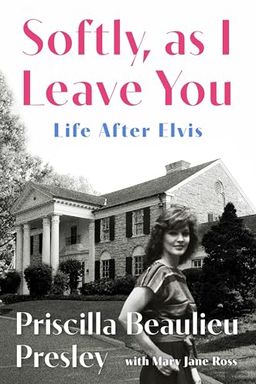
Softly, As I Leave You cover

Softly, As I Leave You

by Priscilla Beaulieu Presley With Mary Jane Ross

Presley recounts her tribulations and search for identity after spending a decade with Elvis.

Love, Identity, and Stewardship in Public Life

How do you reclaim a self inside a love story that belongs to the world—and then protect the pieces of that world after it breaks? In this memoir, Priscilla Presley argues that the arc of her life moves through three interlocking quests: reclaiming identity from an all-consuming relationship, reinventing a public career without surrendering privacy, and transforming grief into stewardship for a family and cultural legacy. She contends that love and self-preservation are not opposites; they coexist uneasily within systems—celebrity, marriage, motherhood, media—that can erode agency unless you build practical tools, ethical boundaries, and enterprise out of the ruins.

You watch Priscilla leave Elvis not because affection is gone but because autonomy is missing. You then follow her as she experiments with business, acting, and advocacy to build a life that is hers, not a footnote to his. Along the way, you see the complexity of co-parenting a child, Lisa Marie, in a world with golf carts, late-night cake, a Memphis Mafia, and paparazzi—where protection and visibility clash. Later, you face the weight of bereavements—Elvis, then Benjamin, then Lisa—each loss both intimate and public, each requiring ritual, narrative control, and unglamorous logistics. The book’s deeper claim is that stewardship—of a child, a memory, a house, or a brand—is creative labor that blends business sense with moral courage.

Leaving as an act of love and survival

The early chapters detail how Southern gender scripts and the orbit of fame shape a marriage. Raised to please, coached in charm, and folded into a male kingdom at Graceland, Priscilla learns that acquiescence keeps the peace—and erodes the self. The image you remember is a Palm Springs mailbox crammed with explicit fan letters, a tangible proof that rumor is real. Karate lessons with Mike Stone open a door to physical confidence and a world beyond Graceland. Leaving, at twenty-seven and as a mother, is not a rejection of love; it is the only way to keep dignity and give her daughter a predictable home.

Reinvention as iterative craft

After divorce, reinvention becomes hands-on. Style shifts—lighter makeup, different hair—serve both discovery and camouflage. Opening Bis and Beau with Olivia Bis turns taste into business. Acting classes with Milton Katselas turn fear into technique and auditions into wins: Dallas, Those Amazing Animals, and later The Naked Gun. She learns to say no—declining Charlie’s Angels—to shape a brand that reflects agency, not ornament. Years later she applies the same selectivity to guest roles, Dancing with the Stars at sixty-two, and even risky creative projects like the animated Agent Elvis.

Parenting where privilege and peril meet

You see two households, two philosophies. At Mommy’s house: rules, baths, school, bedtimes. At Daddy’s kingdom: indulgence, late nights, near-limitless yeses. Priscilla builds routines, shields privacy, and intervenes when the world encroaches—boarding schools, tutors, Narconon when drugs appear, and later structured supports via Scientology’s Celebrity Centre (note: experiences of Scientology vary widely; Priscilla frames it as a practical toolkit). The hardest scenes involve legal guardianship and custody when addiction enters the family; integrity requires refusing perjury even when it costs relationship.

Grief, addiction, and the work of ritual

Elvis’s decline is a case study in medicalized enabling—prescriptions that look legitimate and feel like healing while feeding dependence. His death turns personal agony into a national ritual as Priscilla navigates a televised funeral at Graceland. Years later, the family meets new devastations: Benjamin’s suicide, Lisa’s sudden death after a small-bowel obstruction. Private details—a body at home on dry ice, a mother signing life-support decisions—sit alongside public eulogies and livestreams. Rituals help; they do not fix. But they let a family keep moving.

Stewardship as enterprise and memory

The house nearly breaks the family finances until Priscilla rejects selling and opens Graceland to the public with Jack Soden (after early counsel from Peter Ueberroth and a lost ally, Morgan Maxfield). Operational choices matter: rope off the second floor, keep longtime staff, preserve dignity while building revenue. Decades later, when Lisa sells 85 percent of her inheritance to Authentic Brands and Joel Weinshanker becomes majority owner, Priscilla grieves the loss of control. She answers with cultural projects—Royal Philharmonic Orchestra albums like If I Can Dream, the HBO doc The Searcher with Thom Zimny and Jon Landau, and public rituals like the USPS Forever stamp and Elvis Week—to shape how the world remembers Elvis.

Compassion scaled: animals and people

Advocacy threads through the story: rescuing dogs and horses, lobbying to protect California’s Hayden Law, opposing soring, and partnering with Last Chance for Animals to push reform in South Korea. She turns Graceland stables into sanctuary, proving legacy spaces can carry humane values. This ethic mirrors her human caregiving during addiction crises—on-call nursing for Navarone’s fentanyl withdrawal—and her insistence on lawful, loving protections for grandchildren during custody turbulence.

Key idea

The throughline is agency under pressure: you reclaim it through honest exits, deliberate reinvention, structured parenting, truthful testimony, ritualized grief, and entrepreneurial stewardship—small pragmatic steps that, over time, hold a life together in the spotlight.


Leaving Without Unloving

Priscilla shows you how leaving can be an act of self-respect rather than a verdict on love. She grows up in a 1960s milieu that trains girls to please—beauty as duty, deference as norm—habits that fit neatly into Elvis’s orbit. At Graceland, the Memphis Mafia forms a male cocoon around a superstar; intimacy is never just two people. Even breakfast expects six places. After Lisa’s birth, Elvis’s physical distance compounds emotional solitude. You feel how a loving marriage can still deprive a young woman of a self.

Cultural scripts and the male kingdom

The book is sharp about structure. Southern etiquette and celebrity logistics make submission seem like harmony. Elvis is rarely alone; schedules invert normal life; the entourage blurs public and private. When the only woman in the house is also the hostess, the caregiver, and the audience, dissent feels like betrayal. This context matters, because it explains why rumors of infidelity can be minimized for years: the system rewards denial.

The mailbox and the martial art

Then evidence arrives literally at the door: a Palm Springs mailbox stuffed with explicit letters for Elvis. Physical proof breaks the spell. Karate lessons with Mike Stone give Priscilla a different identity—one that is measured, strong, and her own. The friendship becomes an affair, but the book is careful: Mike is a catalyst, not a cause. The marriage has been hollowing out for years; karate merely builds the muscles to do what must be done.

Choosing departure with care

Leaving is practical, compassionate, and firm. She times it with Lisa’s needs in mind, considers Grandma Minnie Mae’s feelings, and refuses to demonize Elvis. By age twenty-seven, she sees that being mother by day and companion to a nocturnal schedule by night is incompatible. She exits gently, takes responsibility for her own choices, and claims a future. This is a blueprint: name the cultural scripting, map the power dynamics, locate a concrete inflection point (the mailbox), build capacity (karate, work), and act.

What it asks of you

If you are considering leaving an identity that confers status but not autonomy—a company, a relationship, a movement—the book encourages you to weigh love against self-erasure. You can respect a partner’s gifts and still refuse an arrangement that keeps you small. The lesson is not abandonment but alignment: you leave so that both people can live honestly. (Note: memoirs like Glennon Doyle’s Untamed or Joan Didion’s essays also frame departure as moral clarity; Priscilla adds how entourage culture and the economics of fame complicate that clarity.)

Aftershocks and steadiness

The decision costs her: public astonishment, risk of financial instability, and the possibility of being forever defined by a man she no longer lives with. But the tone is steady, not vindictive. She refuses a tabloid script. In later pages—at Elvis’s death, then through decades of legacy work—you see that leaving does not end care. It simply resets the terms, giving both love and self room to breathe.

Key idea

You can walk away with compassion, document your reasons, build new strength, and keep honoring what was beautiful. That is not disloyalty; it is adulthood.


Reinvention, Not Replacement

Reinvention in this book is iterative and practical. It begins in the mirror and ends in the marketplace, passing through classrooms and soundstages. You watch Priscilla consciously decouple her image and opportunities from Elvis’s preferences and the public’s projections. She does not try to out-shock the tabloids; she out-works them by choosing projects, partners, and platforms aligned with her values and bandwidth as a mother.

Appearance as agency and privacy

She drops the signature black liner and bouffant that screamed 1960s and experiments with 1970s softness: lighter makeup, middle parts, new colors. The change both expresses freedom and reduces instant recognizability—a strategic cloak in a culture that treats her face as public property. Style becomes a sandbox to prototype identity without press releases.

From boutique to boardroom skills

Co-founding Bis and Beau with Olivia Bis turns taste into P&L literacy. She learns fabrics, tailoring, curation, client service, and when to exit before the shop becomes a spectacle. Small wins—a flattering profile in Ladies’ Home Journal—become confidence fuel for bigger arenas. This is a career staircase: low-risk experiments that build competencies you can compound. (Note: this echoes the career advice of designers-turned-entrepreneurs who start niche before scaling.)

Acting as exposure therapy

Milton Katselas’s acting classes force vulnerability—hopping, skipping, heavy scenes—until fear shrinks. She chooses roles carefully: educational TV (Those Amazing Animals) ties to animal advocacy, Dallas anchors dramatic chops alongside Patrick Duffy and Larry Hagman, and The Naked Gun unlocks comedy. She says no to Charlie’s Angels to avoid being a mannequin. Brand is a series of no’s that make the yeses coherent.

Selective visibility later in life

Years on, she embraces guest roles (Melrose Place, Touched by an Angel, Spin City) that fit parenting, and then chooses a high-vulnerability platform—Dancing with the Stars at sixty-two. Live TV, judges, public votes: it is a gauntlet that proves age is not a governor on reinvention. She also experiments with business ventures (linens with Bruno Schiavi, a fragrance line), learning the hard lesson that celebrity is not a distribution strategy; you need marketing muscle.

Owning the narrative

Two late-career projects show narrative control. Agent Elvis, a one-season animated experiment, merges Elvis’s love of comic books with pop satire; it is playful and polarizing, but it stretches the legacy into new genres. Her touring event, An Evening with Priscilla Presley, flips the usual media dynamic: she shares home movies, answers questions, and connects directly with fans. The lesson for you: reinvention is less about rebranding than about making platforms where your story cannot be flattened by others.

Key idea

Build skill in small, safe rooms, translate it to public work that matches your values, and accept that some bets will fail. The point is not to replace a past identity but to add chapters only you could write.


Parenting Under a Spotlight

Parenting in celebrity culture means you juggle two incompatible worlds: a child’s need for structure and the public’s appetite for spectacle. Priscilla illustrates the daily mechanics of protection—routines, boundaries, and logistics—and the ethical calls that test family bonds when addiction, law, and custody collide. You see a mother who is both ordinary (homework, baths, bedtimes) and extraordinary (security, paparazzi, legal monitors) at once.

Two homes, two operating systems

At Priscilla’s, mornings look like yours: alarms, school runs, chores. At Graceland, nights stretch late with golf carts and chocolate cake. Neither parent is a villain; each loves Lisa differently. But inconsistency confuses a child. Priscilla counters by coaching teachers to introduce her simply as Lisa, shielding tabloids at home, and insisting on privacy norms. She normalizes discipline without shaming joy.

Safety without the wall of men

At Elvis’s, the Memphis Mafia doubles as family and security—armed, vigilant, omnipresent. Outside that bubble, safety becomes parental vigilance: school choices, supervised play, and controlled exposure. Priscilla anticipates predatory attention and kidnapping risk, erring on the side of caution. The book documents the paradox: to give a child a normal life, you must act in abnormal ways.

Intervention as love in action

When adolescence and fame intersect, risk multiplies. Priscilla deploys tools: boarding school for distance, tutors for stability, and later Narconon when substances appear. She introduces Scientology’s Celebrity Centre as a structured support for confronting grief and trauma, describing auditing as a method to own choices and discharge pain (note: she acknowledges others report very different experiences). The frame is pragmatic: try what helps, monitor outcomes, adjust.

Custody, ethics, and painful integrity

The most wrenching chapters concern Lisa’s divorce from Michael Lockwood. Pressured to sign a deposition alleging abuse she did not witness, Priscilla refuses perjury. The cost is immediate: estrangement, rage, and a fracture that never fully heals. When child protective services removes the twins, Priscilla steps in as temporary guardian, coordinating court monitors, supervised visits, and the everyday grind of care. Protection requires paperwork as much as hugs.

What you can use

If you are co-parenting under strain, this playbook helps: stabilize routines, control exposure, intervene early, and hold ethical lines even when they cost you. Remember that a firm no, delivered with love, may preserve a child’s safety and your own integrity. And when public narrative turns your private pain into content, choose measured statements and anchor your family in small rituals—letters read aloud, mementos tucked into hands—that restore dignity to the moment.

Key idea

Parenting well in the spotlight means doing ordinary things with extraordinary consistency, and making legal, ethical choices that may be misunderstood now but protect the child later.


Grief, Addiction, and Agency

The memoir’s darkest current is a generational tangle of grief and addiction. You see how medicalized dependence disguised as treatment accelerates Elvis’s decline, how shock becomes ritual at his death, and how later losses—Benjamin’s suicide, Lisa’s sudden passing—reshape a family’s life. Running alongside is a brutal education in opioids and fentanyl through Lisa and Navarone’s struggles, where recovery demands medical, psychological, and spiritual tools—not just resolve.

Elvis: medical enabling and the veil of legitimacy

Late-1970s Elvis is ill, medicated, and enabled. Doctors prescribe Dilaudid, Demerol, Percodan, quaaludes, and amphetamines; a traveling physician gives legal gloss to dangerous patterns. Elvis distinguishes illegal drugs from medication, a mental firewall that keeps denial intact. When he dies, Priscilla receives the call no one can absorb; minutes later she is managing a national vigil. The private and the public fuse: an open-casket line through Graceland’s front hall, National Guard support, candlelight rituals that will repeat for decades.

Benjamin and Lisa: grief compounds grief

Benjamin’s suicide shatters the family. Priscilla shares details that strip away abstraction: a coffin where the back of his head is damaged but his face intact, a body kept on dry ice for months by a mother unable to let go. When Lisa dies years later—medically from small-bowel obstruction after bariatric surgery, spiritually from a broken heart—the hospital scene collapses the difference between celebrity and parent. Danny performs CPR; doctors retrieve a faint pulse; Priscilla signs the withdrawal papers no mother wants to see. Public ceremonies at Graceland mix frozen grass and livestreams with sacred quiet in the Meditation Garden.

Addiction as biology and environment

Lisa’s vulnerabilities show up after childbirth when postoperative opioids act like a key in a genetic lock. Navarone’s path moves from experimentation—pot, LSD, cocaine—to heroin laced with fentanyl. His cold-turkey detox is a horror story: twenty-two days of hallucinations, blood-soaked sheets, relentless vomiting, and Priscilla’s sleepless caregiving. You learn why fentanyl is catastrophic: potency multiplies the danger, withdrawal amplifies suffering, and relapse risk is high. Secrecy and shame compound it; fame incentivizes hiding.

Tools that help—and their limits

Priscilla frames Scientology as practical spirituality: auditing to confront pain, a bridge of steps that makes responsibility feel actionable, programs like Narconon for recovery. She is clear that her experience is positive even as she acknowledges others report harm (note: investigative reporting and memoirs offer divergent accounts). Her lesson is agnostic: when addiction and grief are present, you need structure, community, and repeatable practices. Some days they work; some days they simply get you to the next day.

Caregiving as marathon

Family members become first responders: staging interventions, refusing to lie in court, sitting vigil through withdrawals that break bodies and tempers. Recovery, when it comes for Navarone, arrives only after near-death and an internal turn toward sobriety. The moral is unsentimental: you can do everything right and still lose people you adore. You keep doing the work—rituals, honesty, boundaries—because it is the only way to honor them and survive yourself.

Key idea

Treat grief and addiction as systems problems: address biology and belief, medicine and meaning, secrecy and shame. Agency returns not as a feeling but as a set of repeatable actions.


Legacy as Enterprise and Ethics

Stewardship in this book is not nostalgia—it is operations, strategy, and storytelling. When Priscilla becomes trustee after Vernon, the numbers are dire: about five hundred thousand dollars remain while taxes and upkeep soar. An accountant proposes selling Graceland; Priscilla refuses. She assembles expertise, absorbs blows, and turns a house into a sustainable cultural engine without trivializing the private life it once held.

Rescue through design and discipline

Early counsel from Peter Ueberroth and a partnership with Morgan Maxfield point to opening Graceland; after Maxfield’s fatal plane crash, she recruits Jack Soden to execute. Operational choices matter: tours fund preservation, but the second floor stays roped off to honor privacy; longtime staff keep their jobs to retain dignity and memory continuity. Within a month of opening, costs are repaid; over time the estate grows past $100 million. It is a case study in aligning revenue with reverence.

The heartbreak of losing control

In 2005, Lisa Marie sells 85 percent of her inheritance—including much of Elvis Presley Enterprises—to Authentic Brands; Joel Weinshanker becomes majority owner. Priscilla describes feeling gutted, as if her emotional home has been privatized. She also worries about the lost annuity that had supported the family. This is legacy’s paradox: you can build a fortress and still lose the keys. Her response is to double down on cultural authorship rather than corporate control.

Curating the music and the myth

Priscilla executive-produces orchestral albums with the Royal Philharmonic Orchestra—If I Can Dream and The Wonder of You—realizing Elvis’s long-frustrated wish to perform with a live orchestra (Colonel Parker would not fund it). Recorded at Abbey Road, the first album debuts at number one in the UK with 1.6 million sales in year one, proving curation can renew relevance. She invests seven years in The Searcher with Thom Zimny and Jon Landau to reshape the story: Elvis as artist and seeker, not caricature. Public rituals—the 2015 Forever stamp, Elvis Week, candlelight vigils—maintain communal memory.

Extending legacy into ethics: animal advocacy

Stewardship also means reflecting the values you want the name to stand for. Priscilla uses her platform to rescue dogs and horses, lobby for California’s Hayden Law, oppose soring of Tennessee Walking Horses, and push reform in South Korea with Last Chance for Animals. Graceland’s stables become sanctuary for rescue horses and a testament that heritage sites can embody humane commitments, not just display artifacts.

What stewardship asks of you

If you inherit a brand, a house, or a story, the job is tri-fold: protect the sacred (privacy, dignity), fund the mission (sound operations, new products), and tell the truth (documentaries that correct myth). Expect to lose some battles—ownership shifts, projects end after one season—and still make the work matter. Legacy done well is less about control than about curation and care that outlast your signatures.

Key idea

Treat legacy like a living company with a soul: design systems that pay for preservation, create art that renews relevance, and anchor it all in ethical choices that make the name mean more, not less.

Dig Deeper

Get personalized prompts to apply these lessons to your life and deepen your understanding.

Go Deeper

Get the Full Experience

Download Insight Books for AI-powered reflections, quizzes, and more.