
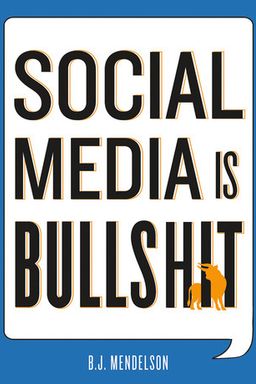
Social Media is Bullshit cover

Social Media is Bullshit

by BJ Mendelson

Social Media Is Bullshit by BJ Mendelson debunks the overhyped promises of social media marketing. It reveals how marketers profit from myths, not results, and advocates for traditional strategies that truly benefit businesses. Discover how to focus on genuine connections and proven methods to achieve real success.

The Myth of Social Media: Why It’s All Bullshit

Have you ever wondered why your social media marketing efforts fall flat—no matter how many posts, likes, or tweets you create? In Social Media Is Bullshit, B.J. Mendelson rips apart one of the most seductive myths of our time: the idea that social media has leveled the playing field and given everyone the power to build an audience, brand, or movement from scratch. His message is both provocative and liberating: the Internet is not the great democratizer we’re told it is—it’s a corporate goldmine run by marketers, media conglomerates, and tech elites who profit from illusions of empowerment.

Mendelson—himself once a true believer in social media—argues that “social media” is not only a meaningless buzzword but also a cynical marketing construct. Through sharp analysis and dark humor, he shows how the web’s biggest players—Facebook, Twitter, YouTube, and others—use your personal data and creative energy to fuel their business empires, while professional marketers sell fantasies of viral success to struggling entrepreneurs and artists. The result? A vast “Asshole-Based Economy” built on misinformation, hype, and exploitation.

Spanning personal stories, corporate case studies, and economic analysis, Mendelson sets out to expose hypocrisy at every level of the social media ecosystem—from self-declared “experts” like Chris Brogan and Gary Vaynerchuk, to corporations that trumpet fake success stories. He shows how “viral” phenomena like Old Spice, Zappos, and Justin Bieber weren’t grassroots miracles but outcomes of media manipulation, celebrity endorsement, and major marketing budgets. Beneath the myth of overnight digital fame is a structural reality: only those with vast resources, insider connections, or major media coverage ever break through.

A Web Built for the Few, Not for You

Throughout the book, Mendelson presents the Internet as a new kind of Vendorville—a digital Bentonville reminiscent of Walmart’s corporate town, where smaller players cluster and serve the needs of multi-billion-dollar corporations. He demonstrates how online spaces promised freedom and creativity but evolved into fenced-in ecosystems controlled by giants like Google and Facebook. From the dawn of blogging to the rise of “Web 2.0,” the same cycle repeats: an innovation emerges, marketers brand it with a shiny new label, analysts sell it back to corporations, and you are told that if you don’t “engage,” you’ll be left behind.

The Illusion of Influence

Mendelson takes aim at the myth of the “influencer”—a relic of Malcolm Gladwell’s The Tipping Point turned into marketing dogma. Drawing on research from network scientist Dr. Duncan Watts and others, he dismantles the idea that a few special people can drive mass changes online. Real influence, he explains, comes not from viral tweets or Klout scores but from traditional structures of power: mass media, celebrity status, and corporate resources. Social networks may amplify conversation, but they rarely change who actually holds the megaphone.

The “Asshole-Based Economy” and Its Merchants

At the heart of the book is Mendelson’s darkly comic concept of the Asshole-Based Economy—a marketplace where self-appointed experts, consultants, and “thought leaders” profit from confusion by selling buzzwords like “engagement,” “trust,” and “community.” He profiles the symbiotic relationship between Cyber Hipsters (like tech evangelists and bloggers), marketers, analysts, and corporations. Together, they feed a cycle in which myths about digital success are created, amplified by the media, and converted into speaking gigs, bestsellers, or consulting contracts—all while small businesses and creators lose their shirts chasing “viral magic.”

From Disillusionment to Real Advice

The book’s second half moves from critique to revelation. After years of failure following online marketing best practices, Mendelson shares the lesson that changed his approach: offline still matters more than online. True marketing success rests on timeless fundamentals—building good products, developing media relationships, understanding your audience, and refining your message. In one of the most startling shifts in a business book, he moves from demolishing gurus to offering witty, grounded advice rooted in common sense and personal experience.

Why This Book Matters

In an age where entrepreneurs and artists feel pressure to be everywhere online, Social Media Is Bullshit offers a sobering wake-up call: you are being sold pipe dreams. Mendelson’s message resonates because it’s both practical and moral. He invites you to question hype, call out misinformation, and refocus your energy on what truly works. In doing so, he doesn’t just debunk “social media”—he reminds you of a deeper truth: while platforms and algorithms come and go, authenticity, persistence, and genuine human connection never go out of style.


The Web Is a Corporate Playground

Mendelson shows that the Internet was never the free, democratic space we imagine—it’s a corporate playground dressed up to look like an open fair. The illusion of opportunity hides a deeply unequal structure where giant companies hold all the power, and the rest of us serve as unpaid labor. This dynamic is what he calls the digital “Vendorville,” borrowing from Walmart’s hometown model, where vendors revolve around the retailer’s demands instead of serving their own goals.

How Corporations Colonized the Web

In the early Internet era, users celebrated independence—bloggers, musicians, and small creators experimenting with self-publishing tools. But by the 2010s, the Web’s biggest spaces were owned by powerful media conglomerates. Mendelson cites how the top ten blogs listed by Technorati were all linked to giants like AOL, Time Warner, or Yahoo. He calls this consolidation the quiet corporate coup of the Internet.

Platforms such as Facebook, Google, and Twitter have become today’s Walmarts. They don’t make the goods—you do. Your posts, photos, videos, and interactions are their real inventory. As Nicholas Carr (author of The Shallows) has shown, these companies harvest our creative labor and sell it back to advertisers. Mendelson argues that this “sharecropper economy” turned millions of dreamers into digital serfs working fields they don’t own.

Web 2.0: The Rebrand of the Century

The biggest trick of all, he explains, came with the invention of “Web 2.0.” Tim O’Reilly and other tech evangelists marketed it as a revolution—an Internet of participation, community, and empowerment. But Mendelson peels back the buzz to reveal a cynical rebranding after the dot-com crash. “Web 2.0” meant new business conferences, new consulting gigs, and new chances for marketers to sell recycled ideas. Nothing about the web’s actual architecture changed; only the story did.

Selling Shovels in the Gold Rush

The same hustle continued through “social media,” “the cloud,” “big data,” and other buzzwords. Each new term became a shovel sold in the digital gold rush. A few prospectors struck it rich—people like Chris Brogan or Seth Godin—but the vast majority of users paid for empty advice, ineffective online campaigns, and meaningless “engagement metrics.” For Mendelson, the takeaway is clear: when corporations and marketers define the language of progress, they own the future—and you become their product.


The Cult of the Expert

In a world of uncertainty, we crave certainty. Mendelson argues that this natural human desire has fueled a multi-billion-dollar industry of self-declared “experts,” “gurus,” and “thought leaders.” The marketing profession has exploited this insecurity by constructing the illusion of authority around charismatic personalities who sell confidence instead of competence. The book reveals how information asymmetry—the gap between what experts know and what you don’t—creates fertile ground for exploitation.

The Chris Brogan Effect

Mendelson uses marketer Chris Brogan’s 2011 Google+ webinar as a textbook case of this manipulation. Brogan charged $47 to teach businesses how to use Google+ for networking—barely three weeks after the platform launched. He claimed to have spent 250 hours on the site, equivalent to eleven hours a day, while simultaneously running a business, writing columns, tweeting, and “playing with his kids.” It’s mathematically—and ethically—suspect. Yet hundreds of professionals paid him anyway, driven by the fear of “missing out” on the next big thing.

The Information Gap Economy

This is the heart of what economists call information asymmetry. As cited from Steven Levitt’s Freakonomics, experts often use their greater knowledge “to your detriment.” Mendelson expands this to modern digital marketing: gurus exaggerate data, fabricate success stories, and prey on small businesses desperate to keep up. They rely on titles like “New York Times bestselling author” to confer legitimacy while actively misleading clients. The irony? What sells isn’t technical mastery—it’s the illusion of being “in the know.”

The Real Cost of Belief

Mendelson’s broader point is that the cult of the expert doesn’t just waste money—it undermines your ability to think critically. When supposed professionals like Brogan or Gary Vaynerchuk tell you that failure means you’re “doing it wrong” or lack “passion,” they shift blame away from bad advice and back onto you. This keeps the industry profitable and everyone else perpetually insecure. The only antidote, he suggests, is skepticism. Ask for data. Question success stories. And never confuse charisma with credibility.


The Asshole-Based Economy

Mendelson’s funniest and most biting idea is the concept of the Asshole-Based Economy. This is the ecosystem that turns marketing charlatans, tech evangelists, and analysts into millionaires—all for selling ideas that rarely work. Like H.L. Mencken’s observation that “nobody ever went broke underestimating the intelligence of the American public,” Mendelson argues that digital culture has perfected the art of profiting from hype and gullibility.

The Seven-Link Chain of Bullshit

He maps out what he calls the “Daisy Chain of Bullshit,” the predictable path by which misinformation travels: it starts with Cyber Hipsters (tech influencers and bloggers), passes through marketers, gets rebranded by analysts, is adopted by corporations, picked up by mainstream media, sold to consumers, and then reinforced when coverage circles back to the media again. Each layer adds authority and distance from the original source, making lies sound like truths.

Cyber Hipsters and Marketer Symbiosis

Cyber Hipsters—early adopters who declare every new app revolutionary—create the raw material. Marketers like Chris Brogan or Seth Godin then transform their enthusiasm into commercial gospel. Analysts (like the Altimeter Group) package it as “research,” and corporations act on it to justify budgets. The result: paid speeches, consulting contracts, and a parade of conferences filled with self-congratulating experts. It’s less a knowledge network than a pyramid scheme of attention.

Books as Business Cards

Mendelson skewers the way marketers treat books as calling cards rather than vehicles of insight. Landing a spot on the New York Times bestseller list, he notes, can raise a speaker’s fee by 57%. Many so-called “bestsellers” aren’t runaway hits—they’re bulk purchases by corporate clients. In this ecosystem, success is manufactured, not earned. Mendelson’s warning is simple but powerful: when everyone is selling wisdom, intelligence becomes the scarcest commodity of all.


The Illusion of Influencers

One of Mendelson’s most relentless crusades is against the fantasy of the influencer—a tiny elite supposedly capable of making your product or idea go viral. He dismantles this myth with humor and data, showing that what marketers label “influence” is often just mainstream visibility repackaged in digital form.

The Tipping Point That Never Was

Marketers borrowed the influencer theory from Malcolm Gladwell’s The Tipping Point, which claimed that a few special “connectors” determine whether ideas spread. Using research by Dr. Duncan Watts, Mendelson demonstrates that this narrative collapses under scrutiny. Watts replicated the famous “Six Degrees of Separation” experiment digitally and found that extremely few messages passed through supposed influencers. In other words, influence is random, contextual, and nearly impossible to predict.

The Small World Isn’t Yours

Mendelson argues that most “viral” events—from the “Double Rainbow” video to Old Spice Guy—depend on mass media amplification, not peer-to-peer contagion. Once a celebrity or major blog picks something up, every aggregator from Reddit to BuzzFeed chases the same story, creating the illusion of grassroots momentum. If an average user mimics this, the result is usually silence. Without institutional leverage, your genius tweet might as well be written on a sticky note in a cave.

When Everyone’s Special, No One Is

Against services like Klout (which once gave users “scores” for online prestige), Mendelson jokes that real influence can’t be reduced to numbers. Social networks are like high school: loud minorities do the shouting; everyone else lurks quietly. He summarizes this as the 1 Percent Rule—90% of users consume content, 9% interact occasionally, and 1% do most of the talking. So next time someone sells you “engagement metrics,” remember: they’re measuring noise, not meaning.


Viral Myths and Corporate Fairytales

Mendelson exposes how corporate marketing success stories—hailed as proof that social media “works”—are often half-truths or outright fabrications. He walks through famous campaigns to show how they were built on traditional media muscle, not organic “social buzz.”

  • Blendtec’s “Will It Blend?” —The supposed DIY YouTube miracle was actually propelled by hand-curated features from YouTube staff, coverage by Digg and Mashable, and mainstream press exposure. The videos didn’t go viral by accident—they were strategically boosted.
  • Zappos —Celebrated as a “social media success story,” its popularity came from being added to Twitter’s Suggested User List, which inflated its follower count by hundreds of thousands of uninterested users. CEO Tony Hsieh even stated the company didn’t measure ROI in “social media.”
  • Dell —Praised for “making $3 million on Twitter,” the company omitted that $3 million was a rounding error in its $61 billion annual revenue and that most sales were recycled publicity.
  • Old Spice Guy —Hailed as proof of “engagement through conversation,” but the campaign’s reach came from Superbowl TV hits, celebrity tie-ins, and massive ad spend by Procter & Gamble. Without TV, its imitators crashed (like Cisco’s “Ted from Accounting”).

Each example proves the same point: major corporations treat social media as a loss leader or PR stunt, not a profit center. When small businesses try to mimic them, the results are disastrous. Mendelson’s advice? Stop comparing yourself to brands that can afford to fail. What looks like a “social media success” from afar is often just expensive smoke and mirrors.


Real Marketing Still Works

After demolishing illusions, Mendelson rebuilds something practical. The final chapters deliver timeless, no-bullshit marketing wisdom. He insists that while platforms change, people don’t. What has always worked—good products, smart press strategy, and persistence—still does. Social media may amplify visibility, but it doesn’t replace substance.

Press Is Power

The author outlines step-by-step how anyone can earn attention through traditional media. Start local, find “anchors” (partners or stories tied to your area), develop irresistible hooks (“Hollywood shorthand” like Welcome Back Kotter meets The Wrestler), and pitch journalists personally—not through bulk emails. As he puts it, “If your grandmother understands your pitch, so will everyone else.” Media coverage breeds more media coverage; that chain reaction holds more power than a thousand Facebook posts.

Know Your Market

Echoing Josh Kaufman’s The Personal MBA, Mendelson introduces what he calls the “Iron Law of the Market”: if people don’t want what you sell, you’re screwed. Forget chasing followers; focus on understanding your customer. Study their behavior, ask questions, gather real data. Metrics that matter are sales, time on site, and repeat engagement—not likes or page views. “It’s not about the community,” he writes, “it’s about your customer.”

Be Ready, Keep Tweaking

Mendelson ends on an optimistic note. Even in an age of hype, hard work and humility win. Quoting Mel Brooks—“Tweaking. Always tweaking.”—he encourages continuous improvement, testing, and local experimentation before scaling. The Internet, he concludes, is like Vegas: the house (media and corporations) always wins, but a few prepared players can still walk away richer. Just don’t gamble on bullshit.


The Anti-Social Media Manifesto

The closing chapter transforms the book’s argument into a call to arms. After years of failed experiments and disillusionment, Mendelson delivers his final epiphany: “social media” doesn’t exist. He learned this the hard way—on a doomed charity tour across America meant to raise $5 million through Twitter followers. He gained a million followers but only received one dollar in donations. That sobering moment in Roswell, New Mexico, became the seed of this book and its manifesto: stop believing in digital fairy tales.

Failure as Illumination

Mendelson admits his naivety: he followed every rule the gurus preached—engage constantly, build a following, post valuable content—and got nothing in return. When he confronted other marketers about this, they claimed, “That’s not how social media works.” Exactly, he realized. It doesn’t work at all. The Internet amplifies the same inequalities that exist offline: celebrities, media, and corporations dominate attention; everyone else shouts into a void.

Beyond Illusion

The author compares online hype to his disappointment visiting the International UFO Museum in Roswell—grand promises covering empty rooms. He argues that we overestimate the web’s magic because we lack alternatives; when lies get repeated often enough, they sound like truth. Mendelson’s “Anti-Social Media Manifesto” is an appeal to sanity: research before acting, question metrics, and focus on local, human, and measurable results.

Reality Over Hype

His final message is empowering—not cynical. Failure isn’t shameful; believing lies is. Real success, he says, means building something people truly care about, even on a small scale. Don’t “embrace failure,” but prepare for it. Be skeptical of experts, avoid get-rich-through-follows schemes, and prioritize authenticity and craft. As Mendelson concludes, “The web and these platforms don’t work as advertised. But the truth still does.”

Dig Deeper

Get personalized prompts to apply these lessons to your life and deepen your understanding.

Go Deeper

Get the Full Experience

Download Insight Books for AI-powered reflections, quizzes, and more.