
Idea 1
Thomas Sowell’s Challenge to the Ideology of Social Justice
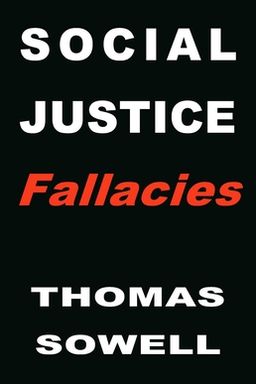
When you look around at the unequal outcomes in income, education, or success, do you ever wonder—shouldn’t life be fairer? In Social Justice: Fallacies, economist Thomas Sowell asks that question not to affirm the usual moral outrage, but to challenge the popular belief that human inequality is primarily caused by injustice. He argues that what’s often labeled “social justice” is less about justice and more about wishful thinking—a vision that fails to account for the complex realities of history, geography, and human behavior.
Sowell contends that advocates of social justice mistake statistical disparities for moral failures. They assume that unequal outcomes—between races, sexes, or nations—must stem from oppression or discrimination. But Sowell systematically dismantles this idea with decades of historical, economic, and empirical evidence, arguing instead that inequalities emerge from innumerable natural, cultural, and situational factors beyond anyone's control. These differences, he claims, are not bugs in the human condition; they’re features of a diverse, complex world.
The Heart of Sowell’s Argument
At heart, Sowell distinguishes between two ways of viewing society. One sees human beings as chess pieces to be arranged by planners or policymakers (he borrows this metaphor from Adam Smith), and the other recognizes people as agents with their own knowledge, preferences, and limitations. The first view—favored by modern advocates of social justice—leads to policies of coercion and redistribution, based on moral aspiration but without acknowledging the limits of human knowledge and the consequences of intervention. The second view, which Sowell defends, emphasizes freedom, voluntary exchange, and a respect for how decentralized knowledge works in practice.
Throughout the book, Sowell demonstrates how well-intentioned reformers misuse statistics and ignore history. He highlights examples where small environmental or geographic factors—like climate, coastal access, or the presence of draft animals—shape societies and economies over centuries. You cannot simply decree equality from above, he insists, because nature, culture, and history are stubbornly unequal.
Why These Ideas Matter Today
Sowell’s message is not just about economics—it’s about humility. In a world where moral certainty often outruns actual knowledge, he warns against the dangerous mix of good intentions and unchecked power. The pursuit of “cosmic justice”—justice applied to every result and disparity in life—inevitably leads to tyranny, since achieving it requires ruling over individual choices and circumstances that no government can possibly understand or control. His critique therefore echoes the intellectual caution of F.A. Hayek and Milton Friedman, who also warned about technocratic overreach and the seductive appeal of centralized planning (Hayek’s The Fatal Conceit and Friedman’s Free to Choose are close cousins in spirit).
By the end of the book, Sowell wants you to see inequality not as proof of injustice but as evidence of life’s complexity. He challenges you to ask: Should our goal be to make outcomes equal—or to make opportunities open? Should fairness mean manipulating results, or preserving freedom despite unequal results? His answer is clear: freedom without guarantees is vastly preferable to coerced equality that costs both liberty and truth.
Across its chapters—from “Equal Chances Fallacies” to “Racial Fallacies,” “Chess Pieces Fallacies,” “Knowledge Fallacies,” and “Words, Deeds and Dangers”—Sowell builds a cumulative case against simplistic moral crusades, using historical data, economic logic, and startling examples from around the world. He reminds readers that the world is not a level playing field—and never will be—but it is still a place where human beings can flourish through freedom, responsibility, and understanding of realities rather than ideologies. This is a book not merely about economics, but about how to think more deeply about justice itself.