
Idea 1
The Human Element in Security
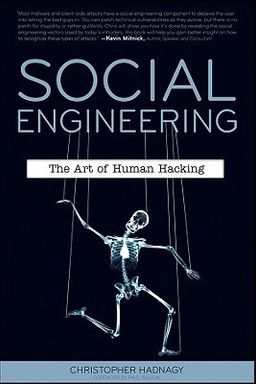
Why do smart people fall for simple traps? Christopher Hadnagy’s Social Engineering: The Art of Human Hacking begins with a provocative claim: technology doesn’t fail first; people do. He reframes social engineering as both art and science — the art of eliciting human cooperation and the science of understanding and influencing behavior. Throughout the book, Hadnagy’s thesis is consistent: security through education is the only lasting defense against manipulation.
Redefining social engineering
Hadnagy expands the idea of social engineering beyond scams and phishing. He defines it as “the science of skillfully maneuvering people to take action,” whether that’s a hacker gaining unauthorized access or a counselor guiding a client. Social engineering, he argues, is not inherently evil; it’s a neutral toolkit that influences human behavior across business, politics, and everyday life. The more you know how manipulation works, the more resistant — and ethical — your interactions become.
The book opens with real-world stories to prove how powerful human factors are. Paul Wilson’s Real Hustle story, where panic and fake authority led a woman to give up her bank PIN, illustrates the fusion of emotion and persuasion at work. Studies from Kaspersky and DarkReading highlight the same truth: social techniques outperform malware because the human vector remains the weakest link.
Education as a security weapon
Hadnagy’s mantra is that knowledge changes behavior. You cannot eliminate human curiosity or kindness, but you can structure them safely. Training that includes stories, rehearsal, and clear procedures reduces risk far more effectively than punishments or fear-based policies. (He echoes Kevin Mitnick’s sentiment in The Art of Deception: the best firewall is an informed human.)
Every story — from employees dumping sensitive blueprints to executives clicking malicious PDFs — reinforces that human awareness determines the outcome. The lesson: study how social engineers think so you can recognize and counter their patterns.
The architecture of the book
Hadnagy builds his framework methodically. First, he teaches information gathering — the reconnaissance behind every persuasion attempt. Then he explains communication modeling to craft believable messages. Next come elicitation (extracting secrets conversationally) and pretexting (inventing credible roles). Only then does he unveil the deeper psychology: rapport, influence, framing, and manipulation techniques. The final chapters connect these tactics to tools, case studies, and prevention, closing the loop between offense and defense.
Why it matters in the real world
You see social engineering everywhere: in phishing campaigns, marketing promotions, street cons, and even daily persuasion. The Real Hustle experiments, the theme park audit, and the HP pretexting scandal expose how small oversights cascade into systemic breaches. Hadnagy’s point is not to alarm but to prepare you: by understanding how emotional triggers, authority symbols, and human habits combine, you can disrupt that chain.
Ultimately, this book is a manual for awareness — the intersection of psychology and security. It invites you to see manipulation as a human constant but one that ethics and education can govern. Knowing the methods makes you less reactive and more deliberate, whether your goal is to test an organization, train a team, or protect yourself from being the next “human hack.”