
Idea 1
Mathematics of the Beautiful Game
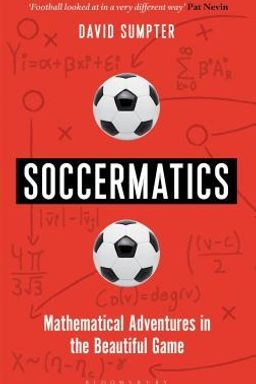
Football seems effortless and thrillingly unpredictable — a game of genius, luck and emotion. But in Soccermatics, mathematician David Sumpter argues that beneath every chaotic bounce and dazzling play runs a deep current of mathematical order. From random goals to synchronised pressing, from crowd chants to team networks, Sumpter shows that football, human behaviour, and even life itself follow patterns that mathematics can reveal.
His core claim is both humbling and empowering: mathematics doesn’t sterilise football’s beauty — it explains why beauty can emerge from complexity. When viewed through models, data and geometry, our favourite game becomes a laboratory for understanding cooperation, chance, and design. Football is not defanged by numbers; it is re-enchanted by them.
From Chaos to Pattern: Randomness and Predictability
The book begins with the surprising mathematics of randomness. Even goal scoring, which feels explosive and emotional, follows the Poisson distribution — when goals occur independently minute by minute, their totals fall into a predictable curve. This same pattern explains bus arrivals and horse accidents from 1898. The message is clear: unpredictability in the moment can still form regularity in the long run. When you marvel at a 5–5 draw, you’re witnessing a rare but predictable tail of the distribution.
This theme recurs throughout the book. Whether looking at extreme athletes like Messi or rare seasonal events, Sumpter uses extreme–value theory to quantify how “once-in-lifetime” really is. Mathematics helps you separate what’s truly exceptional from what’s simply expected randomness.
Geometry and Flow: Order from Local Rules
You then move through the geometry that creates beauty. Barcelona’s tiki-taka isn’t magic — it’s mathematics in motion. Triangles and Voronoi zones maximise passing options and control of space, while players trained under La Masia internalise simple local rules ('pass and move', 'create triangles') that generate global patterns of fluidity. The same geometry appears in Japanese slime moulds and transport networks: universal efficiency born of simplicity.
Movement is another geometric language. Using flow fields, Sumpter shows how player motion and passing evolve as vector systems. The best drills teach players to inhabit those flows, anticipating space rather than chasing the ball. This framework extends from children’s piggy-in-the-middle to professional pursuit–evasion defence models.
Data, Incentives, and Evolution of Strategy
Sumpter demonstrates that football strategy itself evolves like a biological species. The switch to three points for a win reshaped managers’ incentives, making attack statistically rational unless your opponent is more than twice as likely to beat you — the practical 'Twice' rule. Similarly, models of cooperation show why teams thrive when individual players work for collective rewards, mirroring both Hamilton’s kin theory and Lobanovskyi’s cybernetic teams where joint effort produces super-linear returns.
Just as evolutionary rules breed optimal strategy, data breeds understanding. Tactical networks, flow diagrams and positional analysis help coaches explain complex systems at a glance. Visualising passes, defensive hulls, and centrality reveals patterns invisible to intuition — an essential skill in the data-age of football.
From Teams to Crowds: Collective Behaviour
Later chapters expand from the pitch to society. Stadium chants, Mexican waves, and social media rumours all follow contagion mathematics — S-shaped growth curves of adoption and decay driven by social feedback. Even applause ends not when people tire, but when enough neighbours stop. In the stands, biology, sociology and physics merge.
Crowd safety research brings real stakes. Models of mosh pits and stop–start waves prove that fatal crushes often stem from physical crowd density, not panic. Anticipation, flow and geometry again predict outcomes. These sections remind you that understanding movement is not only aesthetic — it’s humanitarian.
Leaders, Data and Decision-Making
Sumpter’s movement-leadership analysis redefines influence. Leadership isn’t who shouts loudest or passes most but whose movement others follow. Drawing on animal research by Iain Couzin and Mate Nagy, you learn that seconds-long timing advantages can determine control both among pigeons and players. Club analysis now detects these leaders with motion-tracking data, revealing hidden hierarchies within teams.
The book closes by testing models in the real world — on betting markets, scouting and analytics. Whether evaluating odds with the Kelly criterion or identifying undervalued players like N’Golo Kanté through data metrics, Sumpter shows how mathematical thinking can guide real financial and coaching decisions while warning against overconfidence and variance.
Key takeaway
Football is a mirror of complexity itself. Randomness and structure, cooperation and contagion, individual and collective — all coexist in one living system. Mathematics gives you clear lenses to see that unfolding dance.
(Note: Sumpter’s narrative sits in the lineage of writers like Nate Silver and Steven Strogatz, bringing rigorous mathematics into everyday life. Yet Soccermatics remains uniquely grounded — its models come alive on a green rectangle watched by billions.)