
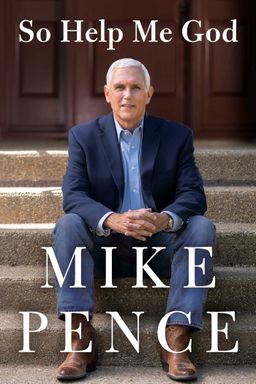
So Help Me God cover

So Help Me God

by Mike Pence

The former vice president gives an account of his career, including his time in the Oval Office and during the Jan. 6 insurrection.

Oath, Faith, and Governing in Real Time

Oath, Faith, and Governing in Real Time

How do you lead through elections, scandals, war rooms, and pandemics without losing your core? In this memoir, Mike Pence argues that a binding oath to the Constitution—rooted in a lived Christian faith—can steady you through modern politics. He contends that character and competence matter most when the stakes rise, and that conservative principles can be operationalized with pragmatic tools—data, coalitions, and public‑private partnerships—so long as you keep the oath, even when it hurts.

Formation that becomes operating system

You start in Columbus, Indiana, where a Bronze Star father (Edward J. Pence) and an immigrant‑faithful mother (Nancy Cawley) model duty and charity. Pence’s conversion at Asbury College—rain falling as he hears John 3:16—turns ritual religion into a daily practice: Bible study (John R. W. Stott), worship music (Amy Grant), and habits that later govern public life (keeping a Bible and the Constitution on his desk, quoting Jeremiah 29:11). Those private rules—no dining alone with another woman, no drinking during campaigns—create public predictability. (Note: like other faith‑inflected political memoirs—from Wilberforce to Carter—the conversion scene frames a lifelong lens.)

Ideas before party

At Hanover College, Professor George M. Curtis III shoves him into the Founders’ papers and the Twelfth Amendment. A trip to Berlin makes liberty visceral. Encounters with Russell Kirk (The Politics of Prudence), Milton Friedman, and William F. Buckley align Pence with Reagan’s fusion of free markets, strong defense, and moral order. GOPAC boot camps with Newt Gingrich turn theory into practice. He begins to see politics as the defense of constitutional limits, not a team sport.

Repentance as reset

After a bruising 1990 loss to Phil Sharp—featuring gimmicky attack ads (glowing cows, Arab sheiks)—he writes “Confessions of a Negative Campaigner,” arguing campaigns must first model decency, then debate ideas, and only then win. That public repentance resets his trajectory and anticipates his later insistence that tone is substance. It also pairs with family-first choices—years of infertility, the adoption of Michael Joseph in 1991, the births of Charlotte and Audrey—to anchor ambition to home.

Governing by diagnosis, design, and deal

As Indiana governor, he shows conservative pragmatism at work. He cuts income taxes by negotiating with Speaker Brian Bosma and Senate leaders; he launches the Management Performance Hub to Moneyball state services (infant mortality, opioids); and he expands coverage the conservative way with HIP 2.0—negotiated with Kathleen Sebelius and Sylvia Mathews Burwell, designed by Seema Verma—using health savings accounts and personal responsibility rather than open‑ended entitlements. You see the pattern: data to diagnose, practical programs to design, coalitions to close the deal.

Serving a volatile presidency

Chosen as Trump’s running mate after Bedminster meetings (golf, dinners, family time), Pence runs a compressed transition that balances loyalty and expertise—Wilbur Ross, Steven Mnuchin, Betsy DeVos, Jim Mattis, Rex Tillerson vs. Mitt Romney—while calling graybeards like Dick Cheney and Bob Dole. He lives a VP mantra on his bathroom mirror—“Be informed. Be prepared. Be of service.”—reads four newspapers, the PDB, and waits for the Oval’s nod before speaking. When Obamacare repeal collapses with John McCain’s thumbs‑down, he pivots to win the Tax Cuts and Jobs Act with Kevin Brady, Pat Toomey, Susan Collins, Bob Corker, and Jeff Flake. After shootings in Sutherland Springs, Las Vegas, and Parkland, he shows up—hospitals, listening sessions—and pushes school safety (STOP Act) and mental health.

Allies, adversaries, and rapid decisions

Abroad, “America First, Not America Alone” means reassurance plus rigor: Munich speeches calming allies, pressure for NATO’s 2% GDP, warnings over Nord Stream 2, and sanctions on Russia. With North Korea, maximum pressure and unpredictable rhetoric open a diplomatic window (DMZ visit, defectors honored, Pompeo’s prisoner releases, Singapore summit). When Turkey hits the Kurds after a US drawdown, Pence flies to Ankara and negotiates a 120‑hour cease‑fire. In the Situation Room he watches the raid that kills Abu Bakr al‑Baghdadi, then braces for Iran’s missile retaliation after Qasem Soleimani’s strike.

Storms of law, virus, and oath

The Ukraine call ignites impeachment; Pence urges transparency and better documentation in future crises. COVID then upends governance: he leads the task force, backs a January 31 China travel restriction, convenes Labcorp/Quest/Roche/Abbott to scale testing, launches Project Airbridge, leverages DPA sparingly, and green‑lights Operation Warp Speed’s parallel manufacturing that yields mRNA vaccines within months. The 2020 campaign unfolds under plexiglass and daily testing, then spirals into contested claims courts largely reject. On January 6, guided by counsel Greg Jacob and Judge J. Michael Luttig, he concludes the Twelfth Amendment gives him no power to discard electors, refuses to leave the Capitol, and reconvenes the count that night.

A guiding line

“You keep your oath, even when it hurts.” The book’s through‑line—from Columbus to the Capitol—ties faith to fidelity and principle to practice.

Finally, he argues for durable architecture: courts (Amy Coney Barrett), trade (USMCA), and space (revived National Space Council, Space Force under Gen. Jay Raymond, a moon return goal) as structural legacies that outlast one news cycle. For you, the message is practical and portable: form your core early, test it in crisis, and build institutions that endure.


Hoosier Roots to Evangelical Calling

Hoosier Roots to Evangelical Calling

To understand Pence’s governing choices, you first meet Columbus, Indiana: factories and Saarinen facades, veterans and parish volunteers, a place where J. Irwin Miller invested corporate capital to make beauty civic. In that mix, Edward J. Pence—a Korean War Bronze Star recipient—teaches his son that promises are vows, while Nancy Cawley models immigrant gratitude and charitable reflex. Early jobs—pumping gas at Ray’s Marathon, scrubbing bays late—instill Dad’s creed: “Out work ’em.” Credibility comes from staying late and checking the oil.

Conversion that rewires priorities

In Wilmore, Kentucky, rain-soaked and convicted by John 3:16, Pence goes forward and calls himself “born again.” He swaps inherited ritual for daily disciplines: Bible study with John Stott, Christian music (Amy Grant), and student‑led ministry. He’ll later place a Bible and a pocket Constitution on his desk—not as props, but as tools. Scripture becomes decision software: Jeremiah 29:11 for hope, Proverbs 31 to abstain from alcohol during campaigns, Genesis 18:19 to frame fatherhood as first vocation.

Habits that signal boundaries

Private conviction hardens into public rules. The “Pence Rule”—no dining alone with another woman—appears not as culture war but as guardrail. Weekly family prayers, multiple Bibles in offices, and simple observances (Mom’s holy water during tornadoes) mark out a life fenced by conscience. These customs do political work: they make him predictable to staff and opponents, a stabilizer in chaotic rooms. (Note: whether you share his practices, their strategic effect—reputation for boundaries—resembles Warren Buffett’s “no surprises” ethic.)

Repentance in public life

But formation isn’t linear. In 1990 he leans into negative ads—glowing green cows, cartoonish sheiks—and loses by 19 points to Phil Sharp. The cost isn’t just electoral; it’s moral dissonance. He writes “Confessions of a Negative Campaigner,” confessing the harm of personal attacks and setting a new hierarchy for campaigning: demonstrate decency, debate what matters, and then try to win. That essay seeds trust that later pays dividends on air (radio hosting) and in office (a decency brand that steadies him during storms).

Family first as strategic choice

Years of infertility end with the adoption of Michael Joseph in 1991; Charlotte and Audrey follow. He frames these gifts as God’s provision that softened grief after his father’s sudden death. The timing of offices bends toward home: he sells a D.C. house, returns to Indiana, and runs for governor when being present for Karen and the kids matters most. Karen’s initiatives—the First Lady’s Charitable Foundation, family‑centric causes—convert private priorities into public focus.

From pew to pressure cooker

On January 6, 2021, those early commitments come due. He links “so help me God” in his oath to a constitutional duty that no rally can override. He calms Secret Service (Tim Giebels) by refusing to flee, waits for the Capitol to be secured, and reconvenes the session to complete the count. The same voice that said “no” to a private dinner says “no” to overreach in public office. Rituals become resolve.

Local formation matters

“Climb your own mountain.” The Columbus grammar—duty, neighborliness, quiet excellence—scales to high office when you keep those small‑town rules under bright lights.

How you can use it

Build explicit guardrails for yourself before the crisis. Write them down. Let rituals—faith practices, family rhythms, a public ethic of decency—set predictable boundaries that colleagues and adversaries can count on. When storms come, your earlier vows do the heaviest lifting.


Ideas Over Party: Conservative Formation

Ideas Over Party: Conservative Formation

Pence does not narrate a jump from blue to red as a stunt. He describes an intellectual migration: history, travel, and mentors converge to make conservatism feel like home. At Hanover, Professor George M. Curtis III makes the Founders—Madison, Hamilton—primary sources rather than folklore. A trip to Berlin reveals tyranny’s concrete walls. Back in the States, the cadence of Reagan’s case for limited government syncs with lessons from Russell Kirk, Milton Friedman, Friedrich Hayek, and Benjamin Rogge: liberty works because people do.

Mentors and the method of learning

Kirk—asked to define “conservative”—answers, “I’m a conservative,” then mails The Politics of Prudence. Buckley shows how to argue with wit and charity; Friedman and Hayek explain markets as information systems; Rogge connects economics to human choice. GOPAC and Newt Gingrich then teach that ideas must be packaged into repeatable frames and fielded with discipline. In Pence’s telling, movement conservatism is an apprenticeship, not a catechism.

Principles that shape policy instincts

Three principles dominate. First, constitutional humility: power disperses by design; the Twelfth Amendment’s plain meaning limits the vice president’s role to counting. Second, economic freedom: growth and innovation rise when regulation is restrained and taxes are predictable (see Indiana’s tax cuts, federal TCJA). Third, moral order: social conservatism grounds liberty in responsibility (e.g., HIP 2.0’s health savings accounts that ask recipients to co‑invest in care). (Note: This synthesis echoes “fusionism” associated with Frank Meyer and the early National Review coalition.)

From doctrine to discretion

The book stresses prudence alongside principle. Instead of rejecting Obamacare’s Medicaid expansion on purity grounds, he negotiates HIP 2.0 with HHS secretaries Kathleen Sebelius and Sylvia Mathews Burwell, led by Seema Verma. Instead of austerity theater, he invests in a Management Performance Hub to target infant mortality and overdose spikes. Instead of alliances as charity, he argues for reciprocity—“America First, Not America Alone”—pressing NATO toward 2% GDP while visiting Estonia, Lithuania, and Latvia to signal resolve.

Guardrails inside your own coalition

He often resists big‑government temptations within his own party. In Congress and later as VP, that means pushing back on expansive federal schemes when they threaten limits or create dependency, favoring targeted incentives over blank checks. During the AHCA saga, he tries to bridge Freedom Caucus purists and moderates, but accepts failure when the coalition won’t hold—then channels capital into tax reform where consensus exists. The lesson is practical: hold your line on first principles, but pick winnable terrain.

Apply it yourself

If you’re clarifying political identity, audit your formation. Whose books formed you? Which trips turned abstractions into scars or gratitude? Build your own GOPAC—mentors, reading lists, practice debates—and let principles guide tactics, not the reverse.

An intellectual arc

From Hanover’s archives to Berlin’s checkpoints to Russell Kirk’s porch, Pence maps a journey where study, experience, and mentorship fuse into durable commitments.

In short, this is not team‑switching; it’s a disciplined defense of limited government, free enterprise, strong defense, and ordered liberty—applied with prudence to the messy particulars of governing.


Governor’s Playbook: Data, Deals, Dignity

Governor’s Playbook: Data, Deals, Dignity

When you translate principle into governing, you need process. In Indiana, Pence’s method is a three‑step loop—diagnose with data, design practical programs, and negotiate coalitions—wrapped in an ethic of decency. You see the loop in taxes, technology‑enabled management, and health care.

Tax relief through coalition math

He runs on a 10% income tax cut, but the House and Senate balk. In a small‑room huddle with Speaker Brian Bosma and Senate leaders—staff dismissed to clear the air—he bargains to a 5% cut plus an accelerated inheritance‑tax phaseout. The state keeps AAA ratings and strong reserves. The payoff appears in a quiet moment at the Governor’s Residence: a firefighter says, “Thanks for my tax cut, governor.” Policy connects to a household budget.

Moneyball for the Midwest

The Management Performance Hub (MPH) aggregates real‑time data—traffic, opioid overdoses, infant mortality—into dashboards for agencies and the public. Funded through private dollars and lease savings, MPH builds predictive tools: target prenatal care to zip codes at risk, pre‑position overdose responses, speed disaster recovery. This “see it to fix it” posture anticipates later pandemic dashboards in other jurisdictions and shows that conservative governance can be tech‑forward without bloating bureaucracy.

HIP 2.0: expanding coverage, preserving responsibility

Instead of rejecting Medicaid expansion, he negotiates a waiver to scale the Healthy Indiana Plan. With Seema Verma architecting the plan and HHS leaders—Kathleen Sebelius, later Sylvia Mathews Burwell, and CMS deputy Cindy Mann—at the table, Indiana expands coverage to hundreds of thousands via Health Savings Accounts and incentives that reward preventive care. It’s a conservative’s compromise: accept federal dollars, but bend delivery toward consumer choice and cost‑sharing.

Dignity as a governing value

The “Confessions of a Negative Campaigner” lesson resurfaces in office. He insists that results do not excuse contempt—toward rivals or constituents. That ethic shows up in low‑ego rituals (credit‑sharing, quiet meetings), in outreach to critics, and in family‑centered initiatives Karen Pence leads as First Lady. Decency becomes infrastructure: it lowers transaction costs because people trust the process.

What you can copy

- Build a visible data hub; publish dashboards that let citizens track progress.
- Pre‑negotiate principles (fiscal prudence, personal responsibility), then bargain on numbers, not on philosophy.
- Tie programs to faces—firefighters, prenatal patients—so your team remembers the stakes.

A policy synthesis

Limited government can still innovate: data hubs, targeted tax relief, and consumer‑driven health plans marry prudence with measurable impact.

The governor’s lesson is not glamorous but it is repeatable: diagnose precisely, design with constraints, and negotiate to closure—while treating opponents as neighbors you’ll see at the grocery store after the vote.


From Bedminster to West Wing Service

From Bedminster to West Wing Service

The path to the vice presidency reads like a chemistry test. A call from Steve Hilbert leads to Bedminster: golf with Donald Trump, dinners with Melania and the family, conversations where Trump engages Charlotte and promises an “active” VP role. Pence weighs prayer, family counsel, and the chance to steady a volatile ticket. He says yes—an act he frames as service, not celebrity.

Running the transition

As transition chair, he balances loyalty and expertise under a stopwatch. Names fly: Wilbur Ross (Commerce), Steven Mnuchin (Treasury), Betsy DeVos (Education), Gen. James Mattis (Defense), John Kelly (Homeland Security), Nikki Haley (UN). Rex Tillerson emerges for State after counsel from Condoleezza Rice, while Mitt Romney recedes. Pence cross‑checks picks with Dick Cheney, Bob Dole, Jeb Bush, and President George H. W. Bush—old‑school due diligence in a new‑media storm. The lesson: build a team that can execute, then accept that optics and loyalty will tug in opposite directions.

The VP job, demystified

He writes a mantra on his mirror—“Be informed. Be prepared. Be of service.”—and turns it into routine. He reads four newspapers (NYT, WaPo, WSJ, Washington Times), the president’s Twitter feed, then the PDB. He waits for the Oval’s wave, sits to the right, and never contradicts the president in public—following Walter Mondale’s counsel to give honest private advice once. The point isn’t deference for its own sake; it’s to preserve the one thing a deputy must have: trust.

Domestic battles: losses and wins

The fight to repeal and replace Obamacare collapses in the Senate after drama only television could choreograph—John McCain returning from cancer surgery to cast a decisive thumbs‑down. Pence details the outreach to House Freedom Caucus holdouts, moderates, and senators whose concerns ranged from Medicaid to process. He then shifts to tax reform: a coalition with Kevin Brady and Pat Toomey, calls with Susan Collins, Bob Corker, and Jeff Flake, and weekend trips to reassure skeptics. The Tax Cuts and Jobs Act passes 51–48—proof that persistence and targeted concessions can resuscitate an agenda.

Presence after tragedy

After Sutherland Springs, Las Vegas, and Parkland, Pence and Karen show up—hospital corridors, living rooms, vigils—and convert grief into policy: the STOP Act for school safety, better reporting into background checks, and support for Certified Community Behavioral Health Clinics. He also speaks with moral clarity after Charlottesville and at the March for Life, placing faith at the center without turning it into a cudgel. (Note: These scenes echo the best of “consoler‑in‑chief” traditions across parties.)

“The little things are the big things.”

Handwritten notes, weekend calls, and careful protocol accumulate into political capital you can spend in crises.

If you serve as a deputy—corporate, nonprofit, or government—this chapter functions as a manual: master the brief, honor the office, and make your boss’s decisions better by being the best prepared person in the room.


Allies, Adversaries, and Crisis Decisions

Allies, Adversaries, and Crisis Decisions

The administration’s foreign policy formula is dual: reassure friends while demanding reciprocity; confront adversaries with leverage but leave a door for talks. Pence becomes the diplomatic metronome to Trump’s cymbals, keeping rhythm with allies while signaling hard lines.

America First, Not Alone

At the Munich Security Conference, he promises continued US leadership even as he presses for NATO’s 2% defense spend. He visits the Baltics and Georgia, condemns Russia’s aggression in Crimea and threats in the Caucasus, and warns Germany about Nord Stream 2. Sanctions back the talk. Meetings with Angela Merkel and EU leaders like Charles Michel pair polite words with firm asks. The method is simple: friends contribute more; the US stays, but not as a free rider’s banker.

North Korea: pressure to parley

The arc moves from “fire and fury” to summits. Symbolism matters: Pence walks the DMZ without glass, highlights defectors like Ji Seong-ho, and honors Otto Warmbier’s parents—human stories that pierce propaganda. Sanctions squeeze; US forces posture. Kim Jong-un pauses missile tests and opens talks. Mike Pompeo shuttles to secure prisoner releases and the return of 55 Korean War remains. The Singapore summit follows—not a final deal, but a window created by resolve plus a credible willingness to talk. (Note: Hawk‑to‑talk sequences echo Reagan–Gorbachev: peace through strength before Reykjavik.)

Turkey and the Kurds: sprint diplomacy

After a US troop drawdown, Turkey attacks Kurdish SDF partners. Within 36 hours Pence is on a plane to Ankara with Pompeo. He wields carrots and sticks—threatened sanctions versus a cease‑fire—and hammers out a 120‑hour pause for Kurdish withdrawal. The episode reveals a governing truth: sometimes you have hours to translate presidential intent into binding commitments or the map redraws itself.

Counterterrorism: precision and prayer

In the Situation Room during the raid that kills ISIS leader Abu Bakr al‑Baghdadi, heads bow in prayer for operators as live feeds flicker. “Got him, one hundred percent confidence, jackpot,” the commander reports. The op is named for Kayla Mueller, signaling moral memory. Soon after, the US strikes IRGC commander Qasem Soleimani to preempt attacks; Iran fires missiles at Ayn al Asad. The room waits, counting heartbeats. No deaths—though many are later diagnosed with injuries. The point: even “clean” strikes echo with human and diplomatic costs.

Crisis cadence

Assemble experts, debate risk, decide fast, own the aftermath—then explain it in moral as well as strategic terms.

If you manage alliances or adversaries, this section gives you a template: set expectations early, use visible leverage, humanize your cause, and keep a credible off‑ramp ready.


Storms of 2019–2021: Transparency, Health, Duty

Storms of 2019–2021: Transparency, Health, Duty

The late chapters compress three upheavals: impeachment theater, a once‑in‑a‑century pandemic, and a contested election culminating in January 6. The through‑line is process: document facts early, mobilize a whole‑of‑America response, and keep your oath when pressure peaks.

Ukraine, whistleblowers, and bandwidth

Trump’s July 25 call with President Volodymyr Zelensky fuses informal style with hot‑button topics—Burisma, CrowdStrike, and military aid. Concerns about corruption and European burden‑sharing help explain an aid hold, but leaks and a whistleblower complaint outrun the administration’s messaging. Pence argues the White House should have pre‑released a readout and locked a disciplined narrative. Instead, the House—led by Nancy Pelosi and Adam Schiff—launches an impeachment that consumes attention even as foreign crises unfold. The lesson for you: in sensitive diplomacy, assume sunlight; manage records and narrative before your opponents do.

COVID: whole‑of‑America in motion

On January 31, HHS Secretary Alex Azar urges a temporary China travel suspension; Steven Mnuchin warns about economic blowback. The president acts. By late February, Pence leads the Coronavirus Task Force. He convenes CEOs of Labcorp, Quest, Roche, Abbott to expand testing, tells FDA to accelerate lab‑developed test approvals, and green‑lights Project Airbridge to airlift PPE. Automakers partner to produce ventilators; FEMA coordinates distribution; the Defense Production Act backs industry that “steps up.” Operation Warp Speed funds vaccine manufacturing in parallel with trials—so when Pfizer and Moderna report ~95% efficacy, millions of doses already exist. Weekly governor calls, the Diamond Princess evacuation, and repatriating 62,000 Americans add the human layer.

Campaigning and courts

The 2020 campaign runs under Plexiglas and daily testing—down to the meme‑worthy fly at the VP debate. After Election Day, lawsuits proliferate (Pennsylvania, Wisconsin), but Attorney General Bill Barr reports no fraud at a scale to alter outcomes; judges—including Trump appointees—dismiss most claims. Pence’s operational note: prepare legal teams early, keep messaging disciplined, and avoid elevating sweeping allegations you can’t prove in court.

January 6: constitutional clarity

Counsel Greg Jacob drafts memos; Judge J. Michael Luttig writes publicly that the vice president’s role is ministerial. John Eastman presses a rival theory; a Gohmert lawsuit seeks to anoint the VP with unilateral authority. Pence rejects the claims, refuses to recuse, and prepares a letter to Congress declaring his constitutional duty. As rioters breach the Capitol and Secret Service lead agent Tim Giebels urges evacuation, he stays on the complex, reconvenes the session, and completes the count.

Pence’s pledge

“When the Joint Session of Congress convenes today, I will do my duty ... So Help Me God.” Oath over person; Constitution over crowd.

Enduring architecture

He closes with legacies meant to outlast tempests: courts (Amy Coney Barrett’s confirmation as part of a broader judicial slate), trade (USMCA to modernize North American supply chains), and space (revived National Space Council, the US Space Force under Gen. Jay Raymond, and a moon‑return goal for “the next man and first woman”). The bet is institutional: build structures and incentives that keep working when headlines fade.

For you, the composite lesson is stark and useful: anticipate scrutiny, centralize crisis response with accountable leadership, and in constitutional gray zones, defer to design and precedent. That’s how you leave more standing than you found.

Dig Deeper

Get personalized prompts to apply these lessons to your life and deepen your understanding.

Go Deeper

Get the Full Experience

Download Insight Books for AI-powered reflections, quizzes, and more.