
Idea 1
Technology, Language, and Power in a Fractured World
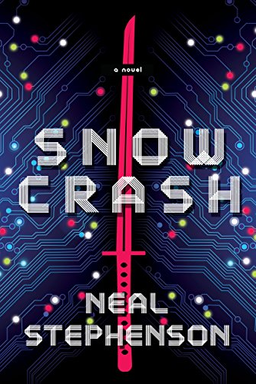
What happens when technology, language, and power fuse into one socio‑technical system? In Snow Crash, Neal Stephenson imagines a near‑future America so privatized, fragmented, and wired that both speech and code become tools of control. The novel’s premise is simple but profound: information is not neutral—it can shape minds, bodies, and societies with the precision of a drug or weapon. You live in a world of franchises, avatars, and linguistic viruses, where material and virtual infrastructures mirror and reinforce one another.
The story unfolds through Hiro Protagonist, a hacker and intelligence broker, and Y.T., a teenage courier who navigates the physical sprawl. Together, they move through a dual landscape: the chaotic streets of corporate Los Angeles and the immersive digital city of the Metaverse. Standing behind both realms are networks of power—Mafia corporations, government successors, and entrepreneurial hackers—each using data, reputation, and semiotic leverage as weapons. Stephenson’s argument is that control in such societies no longer resides in physical coercion alone; it emerges from who writes, distributes, and decodes information.
From Streets to Systems: The Economy of Franchises
At ground level, you meet the Deliverator—an elite pizza driver whose 30‑minute guarantee encapsulates this universe’s ethos: efficiency, honor, and lethal accountability. His black arachnofiber suit, armed vehicle, and tracking systems represent how service work becomes ritualized performance. Underneath lies Mafia logistics, a decentralized organization that fuses old‑world loyalty with high‑tech precision. The Deliverator’s world shows how private enterprise has supplanted civic order. Every neighborhood—a Burbclave—functions as a sovereign franchise, policed by its own security force and held together only by contracts.
Y.T.’s courier trade complements this from below. Her smartwheels and magnetic poon let her traverse city borders that citizens cannot cross legally. Through her, you see the underside of privatized mobility—a bricolage of skill, daring, and improvisation in a world defined by property lines and digital checkpoints. These scenes anchor the novel’s political economy: speed equals survival, and corporate codes replace civic rights.
The Metaverse: Code as Civilization
When Hiro logs into the Metaverse—a globe‑spanning simulation with its own architecture and zoning laws—you enter the novel’s second world. The Metaverse is both mirror and magnifier of reality. Its central boulevard, the Street, is pure protocol: 65,536 kilometers long, governed by software law, and parceled into virtual real estate. Early adopters like Hiro become landlords in a space where visibility equals capital. Avatars replace bodies; bandwidth substitutes for reputation. And because every pixel is engineered, the Metaverse becomes society’s new infrastructure, its social and economic hierarchies encoded in light.
Juanita Marquez’s invention—rendering subtle facial expressions—adds another layer. She understands that in a virtual world, trust depends on believable faces. Her technology humanizes communication while simultaneously turning emotion into currency. Yet this triumph exposes fragility: when faces become vectors of data, they can just as easily transmit viruses as empathy.
Snow Crash as Virus, Drug, and Gospel
The novel’s core threat—Snow Crash—shows what happens when linguistic theory meets biotechnological warfare. It appears simultaneously as a visual hypercard that melts a hacker’s brain, a biochemical serum distributed as a drug, and a modern echo of Sumerian myth. Dr. Emanuel Lagos discovers that ancient stories like the Tower of Babel may describe real historical events: neurolinguistic reprogramming of humanity’s cognitive substrate by a godlike scribe, Enki. His “nam‑shub” altered how humans process language, creating diversity but also immunizing them against a primal mental pathogen. Snow Crash reverses that—re‑infecting people through visual code and molecular vectors.
L. Bob Rife, the telecommunications magnate, weaponizes this discovery. Using global missionary networks, satellite radio, and biological samples, he tries to reconstruct the mother tongue—turning logos, myth, and media into one control schema. His Raft, a floating mega‑colony, embodies this ambition: a fusion of religion, exploitation, and technology aimed at rewiring mass consciousness.
Countermeasures and Human Ingenuity
Against Rife’s totalizing design stand improvisers: Hiro, who writes “SnowScan” to detect and block the digital virus; Y.T., who delivers dangerous samples through chaotic action; Juanita, who reconstructs Enki’s tablet and restores linguistic freedom; and even Uncle Enzo, whose Mafia honor culture redeems brute capitalism with personal loyalty. Their advantage lies not in centralized power but in distributed adaptability. Stephenson shows that resilience in informational ecosystems depends on diversity, improvisation, and ethical intuition—qualities that no protocol or institution can fully script.
The final collision at LAX—where code, myth, and combat converge—resolves the novel’s central paradox: language, once a means of domination, becomes a weapon of liberation. The nam‑shub that once divided humanity now protects it. In a world governed by data and spectacle, Stephenson leaves you with an unsettling insight: salvation may depend not on mastering systems but on remembering that language, technology, and culture are alive—and that their power rests in how we use them.