
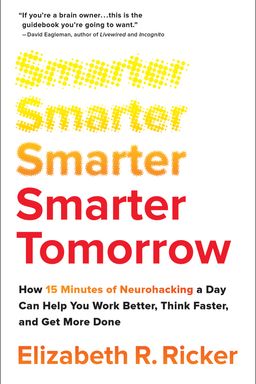
Smarter Tomorrow cover

Smarter Tomorrow

by Elizabeth R Ricker

Smarter Tomorrow delves into the world of neurohacking, offering readers practical techniques to enhance memory, creativity, and emotional regulation. Backed by neuroscience, this guide empowers you to optimize brain functionality and achieve your personal and professional goals.

Becoming the Scientist of Your Own Mind

Can self-help be evidence-based? Elizabeth R. Ricker’s book argues that it can—and should be. Instead of accepting one-size-fits-all advice, she reframes personal improvement as a process of scientific discovery. You become the scientist of your own brain, running n-of-1 experiments to see what genuinely helps you focus, learn, stay calm, and think creatively.

Ricker’s premise is simple but radical: treat personal change like an ongoing laboratory study. Define your target, measure your baseline, apply controlled interventions, and analyze the data. This approach, which she calls scientific self-help, rejects guru-driven sermons for empirical results. You don't have to trust claims—your own evidence becomes the authority.

A New Model for Personal Science

Ricker shows that much of self-help failure comes from randomness and human variability. Traditional advice assumes universality, but brain imaging reveals individuality. Your neural wiring changes by as much as 12% in 100 days, and even identical twins share only ~13% connectivity. With that uniqueness in mind, personal science becomes necessary—not optional. Each person’s mind responds differently to sleep, light, exercise, and supplements, so the goal isn’t blind emulation but careful measurement.

(Context note: Neurodiversity—a movement she supports—adds that differences like ADHD or dyslexia often correlate with unique strengths; the task is not 'fixing' yourself but identifying and enhancing what helps your goals.)

The Structure of Evidence-Based Upgrading

Ricker converts curiosity into structure through the F‑S‑T‑R ladder: Focus on a single bottleneck, Select a repeatable, low-risk intervention, Train with randomized sessions and documentation, and Reflect through graphs and interpretations. This framework supports rigorous self-experiments even without lab equipment.

Her method follows the scientific logic: run 15–30 repetitions, alternate conditions, and include “washouts” to eliminate carryover effects. Data visualization replaces gut feelings. Like Feynman’s dictum, the rule is simple: if an idea doesn’t agree with experiment, it’s wrong—no matter how appealing it sounds.

Foundations Before Fancy Tech

Before you buy gadgets or nootropics, Ricker asks you to debug the basics—sleep, nutrition, stress, breathing, and medical status. Her asthma story—where solving allergies cleared brain fog—illustrates how addressing hidden health bottlenecks often produces bigger cognitive gains than advanced interventions.

These fundamentals precede neurohacking tools like exercise (which elevates BDNF and executive function), blue light for alertness, neurofeedback for attention and calm, or game-based cognitive training. Interventions must match your goals and timescale; short bursts may sharpen focus, while multiweek habits reshape stability and resilience.

From Experiments to Community

Ricker situates self-experimenters within the larger Quantified Self and NeuroTechX movements—communities devoted to self-tracking and sharing replicable results. Neurohackers like Jeopardy! champion Roger Craig used spaced repetition to revolutionize study methods, while analyst Steven Jonas hacked his stress with heart-rate beeps. These stories prove that rigorous curiosity combined with cheap tools can lead to real, measurable improvement.

Ethics and the Emerging Frontier

As neurotech evolves—from safe at-home tDCS stimulation to future implants and CRISPR gene editing—Ricker insists on caution. Enhancement must remain ethical and equitable. The principles of informed consent, replication, and inclusivity protect personal science from reckless speed or inequality. She links this to cognitive data ownership: your brain metrics should belong to you, not corporations.

Ultimately, Ricker’s framework merges motivation, neuroscience, and self-experimentation into a unified practice. You test specifics—creativity gains from brief exercise, attention boosts from blue light, emotional regulation with biofeedback games—and organize them using the discipline of science. Over time, your lab notebook becomes a record of how you evolve. Her central message: curiosity becomes powerful when disciplined by measurement. The more you learn from your own data, the more precise your mind’s upgrades become.


Scientific Self‑Help in Practice

Scientific self-help transforms trial-and-error living into structured experimentation. Instead of guessing what works, you use controlled tests to track cause and effect. Ricker builds this approach from classic scientific principles—measure baselines, control variables, test hypotheses—but adapts them to daily life.

Turning Yourself into a Researcher

To begin, clarify your mental target: attention, emotion regulation, memory, or creativity. Then decide what success looks like—a higher Stroop score, steadier HRV, or more original ideas. Use repeatable tests, not feelings alone. Ricker advises establishing a stable baseline by testing at least five times and using the second-highest score for accuracy.

From there, you choose an intervention and a clear protocol: how long, how often, and under what conditions. You randomize sessions (using marbles in a bag or spreadsheets) to avoid bias, record context variables like sleep and caffeine, and run multiple cycles. When finished, graph your results—visual trends convey meaning faster than statistics.

Dealing with Bias and Noise

Personal science looks deceptively simple, but bias hides everywhere. Practice effects make you look better simply from repetition; carryover effects linger from previous treatments; stress schedules can distort outcomes. Ricker’s antidote is repeated randomization and washout periods—create neutral weeks between interventions to clear residual effects.

She also borrows Feynman’s pragmatism: data is the arbiter. If your graphs show no meaningful change, that’s progress—it tells you what doesn’t work and saves you from placebo illusions.

Organizing Motivation and Accountability

Designing experiments is easier than sustaining them. Ricker’s behavioral toolkit includes three accountability strategies: a lab notebook, a committed partner, and habit engineering. Partners boost success rates dramatically when you meet weekly, swap progress data, and use constructive feedback frameworks like her “sandwich” method (praise → critique → encouragement). Implementation plans define when and how you’ll act, and habit stacking (“after breakfast, run your 15-minute test”) keeps consistency automatic.

Over time, these organizational systems blend motivation and logic. They make scientific self-help realistic rather than aspirational. You start small, methodically, and end with measurable, replicable discoveries about your own brain.


Understanding and Using Neuroplasticity

Behind all of Ricker’s methods lies the principle of neuroplasticity: the ability of your brain to change structure and function through practice and experience. Once you understand that plasticity persists throughout adulthood, self-experimentation becomes not only meaningful but scientifically grounded.

Brains Rewire with Use

Studies in musicians, jugglers, and archers demonstrate that specific training reshapes neural efficiency. For example, Olympic archers use fewer brain regions after years of practice—their brains optimize processes rather than merely repeat them. Learning and therapy physically alter neurons; functional MRI captures those shifts in real time.

Individuality and Neurodiversity

No two brains are identical. Your connectome—your wiring diagram—changes constantly. Differences labeled as disorders often represent adaptively useful specializations. People with ADHD, autism, or dyslexia may outperform peers in high-stress problem-solving or pattern recognition tasks. Ricker’s principle: build from your uniqueness, not against it. Improve bottlenecks but preserve strengths.

Practical Guideline

Use experimentation to reveal which environments and interventions align with your wiring. Enhancement should mean functional harmony, not conformity.

Seeing the brain as flexible but unique reframes improvement: instead of chasing universal 'better' brains, you refine adaptive ones that serve your life goals. The scientific mindset makes that philosophy actionable.


Interventions That Actually Work

Ricker groups cognitive-improvement tools into pragmatic categories: physiological, psychological, and technological. She urges you to start with accessible, measurable methods—exercise, light, mindset training, and games—before moving into devices or supplements.

Physical and Sensory Tools

Exercise increases cognition immediately and long-term, especially moderate‑to‑hard sessions around 50–90% of your maximum heart rate. Blue light exposure regulates alertness through melatonin suppression and norepinephrine activation, equaling caffeine’s performance boost in some studies. These low-cost interventions offer repeatable, rapid metrics for experiments.

Mindset and Placebo Science

Placebo isn’t deceit—it’s physiology governed by expectation. Open-label trials show measurable benefits in mood and pain even when participants know the pill is inert. Ritual, rationale, and symbolic context trigger dopamine and endorphin pathways. Enclothed cognition demonstrates this: simply wearing clothes associated with competence enhances executive attention. You can design deliberate rituals—visualizations, scent cues, affirming language—and test them experimentally, ethically, and transparently.

Games as Training

Well-designed games produce flow—a perfect state for learning. Apps like SuperBetter improved depression symptoms by 23% in trials; Mightier reduced anger outbursts in children via HRV biofeedback; IntelliGym improved professional athletes’ decision-making by 42%. Games reinforce motivation and feedback, scaffolding practice through play. Paired with real-world tasks, they transfer gains effectively.

The insight: effective interventions mix fun, physiology, and structure. Mindset rituals, exercise, light exposure, and purposeful games are proven performance tools when you test and tailor them to your brain’s response.


Responsible Enhancement and Emerging Tech

Beyond the basics lies a frontier of neurotechnology—noninvasive devices like tDCS and tVNS, potential genetic editing tools, and hybrid human-machine interfaces. Ricker’s perspective is enthusiastic but grounded: technology should augment curiosity and wellness, not replace personal responsibility or ethics.

tDCS and Safe Modulation

Transcranial direct-current stimulation applies gentle electrical currents through scalp electrodes to modulate excitability. When paired with training, it enhances executive function and motor learning. Safe ranges are under 2 mA for less than 30 minutes. Side effects include minor flashes or headaches. Ricker’s DIY experience—seeing a phosphene when electrodes were misplaced—illustrates that precision and documentation matter.

Effects are state-dependent: stimulation during active learning yields gains, but misplaced or excessive use can cause cognitive trade-offs. So she recommends professional devices, randomization with sham sessions, and thorough self-tracking.

Future Technologies and Ethics

Photobiomodulation, vagal stimulation, and neural implants advance quickly, yet Ricker reminds readers that clinical validation must precede consumer hype. The same caution applies to CRISPR gene editing: after He Jiankui’s illegal embryo tinkering, the world learned the need for bioethics in enhancement. Responsible curiosity requires consent, replication, and governance.

Owning Cognitive Data

Wearables and brain-computer interfaces now collect unprecedented cognitive data—attention metrics, HRV, typing cadence. Ricker sees opportunity but warns of exploitation. You should own your data, encrypt it, and interpret it meaningfully. Diversity and representation matter: most neuroscience studies still use WEIRD (Western, educated) samples. Personal experimentation broadens the evidence base.

Her conclusion: enhancement technologies are valuable when used with humility, transparency, and ethics. The future promises hybrid humans, but your curiosity and measurement—not corporate tools—should guide your evolution.


Learning from Community Neurohackers

The human stories in Ricker’s book turn abstract science into accessible proof. Neurohackers are ordinary people who apply the principles of self-experimentation to their daily lives—measuring, sharing, and iterating improvement. Their experiences demonstrate how diverse motivations converge through curiosity and data.

Profiles of Practical Success

Jeopardy! champion Roger Craig used spaced repetition software (Anki) to memorize game material efficiently, applying 19th‑century psychological research in a 21st‑century format. Steven Jonas built an HRV-based alert system to manage stress in real time, turning physiological metrics into daily feedback. Mark Drangsholt cross-referenced his genetics and blood data to uncover a vascular issue causing cognitive fatigue—an example of data-first detective work.

The Neurohacker's Creed

Ricker distills their shared philosophy into four principles: design self-experiments; use valid, safe tests; never assume generalization; and collaborate within communities. These rules tie rigor with humility—each person’s results stay personal yet comparable.

Collective Learning

Groups like Quantified Self and NeuroTechX provide accountability and shared protocols. Members exchange percent-change data to protect privacy while learning together. Ethical normalization within communities helps balance innovation with responsibility.

These collective methods make self-help empirical and social: your experiments contribute to a growing informal research network. The community aspect transforms isolated tinkering into peer-supported science—with measurable human benefit.

Dig Deeper

Get personalized prompts to apply these lessons to your life and deepen your understanding.

Go Deeper

Get the Full Experience

Download Insight Books for AI-powered reflections, quizzes, and more.