
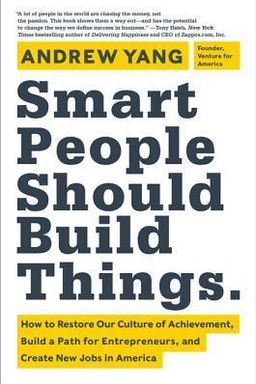
Smart People Should Build Things cover

Smart People Should Build Things

by Andrew Yang

Smart People Should Build Things by Andrew Yang delves into the trend of elite graduates pursuing predictable careers, urging a shift towards entrepreneurship to rejuvenate the US economy. By offering practical advice to budding entrepreneurs, Yang envisions a future driven by innovation and job creation.

Smart People Should Build Things: Rechanneling Talent for Impact

Have you ever wondered why so many bright, ambitious people end up working in fields that don’t actually build or create anything tangible? Andrew Yang asks exactly that in Smart People Should Build Things. He argues that America’s most talented graduates are being funneled into well-trodden paths—finance, law, consulting—rather than starting companies, joining startups, or innovating in real-world industries. As a result, our economic and social vitality suffers. Yang contends that for the nation to thrive again, its smartest people must rediscover the thrill, discipline, and hardship of building things that matter.

Yang’s core argument stems from his own journey. After earning degrees from Brown and Columbia Law School, he landed at a prestigious corporate law firm but quickly realized he was trapped in a system of analyzing rather than creating. He left to found a startup, experienced the agony of failure during the dot-com crash, rebuilt his career through entrepreneurship, and eventually founded Venture for America—a nonprofit designed to redirect talented young graduates into startups that could revitalize struggling American cities. The book is both a memoir and a manifesto: an urgent call to engineers, thinkers, and professionals to take risks, create value, and build organizations from the ground up.

Misallocation of Talent

Yang opens by dissecting what he calls the “prestige pathways”—elite educational routes that push America’s best students toward banking, consulting, law, and medicine. These industries, he notes, operate like self-reinforcing ecosystems; they spend millions recruiting at top universities and promise prestige, stability, and high pay. As a result, Harvard, Yale, Princeton, and Stanford grads largely end up in a handful of cities doing analytical work rather than building new businesses or industries. He compares this phenomenon to a “tragedy of the commons” where every firm competes for the same scarce resource—smart people—while the economy as a whole stagnates.

The problem, Yang argues, isn’t that these professions are inherently bad. Rather, their dominance creates a brain drain away from entrepreneurship, manufacturing, and innovation—the very sectors that generate jobs and long-term growth. He likens the situation to a company that invests all its resources in internal finance and legal departments while neglecting its product development teams. Eventually, that company collapses because it has stopped producing anything of real value.

Why Building Matters

Yang defines entrepreneurship not as creativity alone but as organization-building. In his words, “People focus way too much on inspiration but not enough on the months and years of thankless hard work.” Starting a business, he says, is akin to raising a child—it demands patience, sleepless nights, and relentless effort far beyond the initial burst of excitement. His own failures taught him that economic growth depends on those willing to endure uncertainty and construct new systems rather than just manage existing ones.

Drawing from examples in the book, Yang highlights the story of Charlie Kroll, a Brown graduate who founded Andera after being rejected by Morgan Stanley. By solving a small banking problem—helping regional banks open accounts online—Kroll eventually built a multimillion-dollar software company that created dozens of jobs in Providence, Rhode Island. For Yang, this illustrates the simple truth: if more smart graduates like Kroll went into building companies instead of managing them, America’s cities would prosper.

The Culture of Risk and Reward

At the heart of Yang’s message is a cultural challenge. Many of today’s brightest graduates—and their parents—have been trained to avoid failure. They choose stable careers where success feels guaranteed, even if those roles don’t contribute much to society. This pattern, Yang argues, erodes creativity, resilience, and entrepreneurship. He quotes Reid Hoffman (founder of LinkedIn), who writes that meaningful careers seldom progress linearly. True growth comes through risk, experimentation, and failure—the very things our current system discourages.

Instead of glorifying status and compensation, Yang believes the culture of achievement must once again value courage, creation, and long-term purpose. He offers Venture for America as one model: a fellowship that sends graduates to startups in cities like Detroit, New Orleans, and Cincinnati for two years. By embedding them in real entrepreneurial organizations, they learn to solve authentic business problems, not hypothetical ones. The end goal is job creation and economic revival through direct, hands-on building.

A Blueprint for National Renewal

Yang’s book isn’t just diagnosis; it’s prescription. He calls for systemic change—rethinking how universities recruit, how companies reward risk-takers, and how the nation supports entrepreneurship. Like in Start-Up Nation by Dan Senor and Saul Singer (which he frequently references), Yang suggests that America can learn from Israel’s model, where military service and shared responsibility create natural networks for entrepreneurial collaboration. In the U.S., he imagines Venture for America as a civilian equivalent—a movement to transform “prestige” from the privilege of managing capital into the honor of creating value.

Ultimately, Yang’s thesis is both simple and profound: our smartest people need to stop optimizing spreadsheets and start building machines, businesses, and communities. If we redirect even a fraction of elite talent toward real creation, the ripple effects—in innovation, employment, and civic renewal—could change the course of the nation. Smart People Should Build Things is not a critique of intelligence or ambition but an invitation to apply them where they count: in the art and struggle of building.


The Prestige Trap and Talent Drain

Andrew Yang calls the current American career structure a "prestige trap"—a system where high achievement paradoxically limits creativity and guts the economy of its entrepreneurial spirit. He vividly portrays how top students move from college campuses to law firms, investment banks, and consulting offices, not because they burn to innovate, but because those institutions recruit aggressively and offer a clear map of success. This dynamic, he argues, has turned universities into talent pipelines for professional services rather than incubators for new ideas.

The Recruitment Machine

Every fall, campus career centers at Harvard, Yale, and Princeton fill with polished recruiters promising prestige and six-figure salaries. It’s a spectacle of efficiency: the firms bring the parties, the interviews, the message that advancement is guaranteed. Students, trained from childhood to always pursue the next credential, naturally follow the path of least resistance. Yang likens this process to an algorithm—maximize status, minimize risk—and compares it to how ecosystems overconsume their own resources in a “tragedy of the commons.”

He cites data showing that at Princeton, up to 46% of graduates between 2000 and 2010 entered finance, while at Harvard over half of students pursued banking, consulting, or graduate school. Rather than questioning these choices, universities tacitly celebrate them—after all, they make great employment statistics for alumni brochures.

Why It’s a National Problem

Yang insists this isn’t just a personal issue—it’s an economic one. Financial and legal industries are “meta-industries,” dependent on companies that actually make and sell things. Without entrepreneurs crafting new products and services, there’s little for these sectors to manage or advise. Yet, paradoxically, they absorb most of the talent that could solve real-world problems. He offers the analogy of Saudi Arabia’s oil economy: the smartest citizens naturally cluster toward the wells, not toward building diverse new industries. The American equivalent, he says, is Wall Street’s dominance over ambitious youth.

A Generation of Analytical Experts

Yang’s conversations with students reveal how deeply ingrained this logic has become. Many say they’ll “do banking for two years, then figure out what they truly want.” Few ever make that shift—the comfort, salary, and prestige act like invisible handcuffs. Others view finance and consulting as training grounds for entrepreneurship, but Yang counters that analyzing value is far different from creating it. He points to one friend: a math-trained hedge fund analyst earning six figures at twenty-four but producing little genuine innovation. “He’s never hazarded anything,” Yang writes, illustrating how supposed ambition can coexist with timidity.

Breaking Free

Citing essays like Marina Keegan’s “Even Artichokes Have Doubts” from Yale and Stanford’s “Stop the Brain Drain” campaign, Yang shows that even students are questioning the system. He sees hope in movements like hackNY, created by professors Evan Korth and Chris Wiggins to steer technical talent toward startups. But for true change, Yang argues, we must make entrepreneurship as accessible and prestigious as law or consulting. Talent allocation must become a deliberate national priority, with institutions actively funneling graduates to high-impact sectors. Until then, America’s smartest people will keep building PowerPoints instead of products.


Why Building Is Hard (and Worth It)

Yang strips the glamour off entrepreneurship, revealing the relentless labor behind every company that succeeds. He describes building as “very, very hard”—a process that humbles even the most intelligent founders. Drawing from his failed startup, Stargiving.com, he walks readers through the real mechanics of creation: raising funds, designing a product, finding customers, hiring a team, and enduring failure with no safety net.

From Inspiration to Organization

Yang’s first venture, Stargiving, was built on noble intentions: pairing celebrities with charitable events through micro-donations online. His plan seemed flawless—Darius Rucker, Magic Johnson, and Anheuser Busch eventually came on board. But the dot-com crash wiped out investment interest overnight. Yang realized that intelligence and creativity weren’t enough; startups thrive not on ideas, but on execution and team-building. Entrepreneurship, he argues, isn’t about inspiration at all—it’s about organization. You need people, capital, and stamina to build something real, just as one raises a child with consistency rather than bursts of enthusiasm.

The Anatomy of Creation

He outlines the steps any aspiring founder must take, even while working full-time: researching markets, incorporating legally, building prototypes, testing ideas with customers, and planning finances. These, he says, are merely the “warm-up.” Real building starts with raising money, developing products, hiring people, and finding customers—all of which demand painful patience and resilience. Even successful brands like Five Guys or Angry Birds took years of silent struggle before achieving overnight recognition.

Failure as Formation

For Yang, failure isn’t just inevitable—it’s formative. He compares entrepreneurs like Bill Gates and Henry Ford, who both failed early ventures, to show that entrepreneurship is a learned process. “You wouldn’t expect a doctor or athlete to peak in their first years,” he writes. What distinguishes builders is their willingness to fail fast and recover faster. Experienced entrepreneurs know the value of relationships—suppliers, investors, mentors—and these networks create the invisible scaffolding of success. (Note: this echoes Nassim Nicholas Taleb’s notion in Antifragile that systems grow stronger through stress.)

The Reward of Engagement

Ultimately, Yang argues that while most startups fail, the process gives life meaning. Entrepreneurs live “a few years like most people won’t, so they can spend the rest of their lives like most people can’t.” They work with full engagement and autonomy—designing rather than being designed by systems. For those willing to endure uncertainty, building becomes both an economic act and a spiritual one: a commitment to growth, learning, and contribution. The hardest part, Yang reminds us, is not the risk of losing money—it’s the courage to start despite knowing that you might.


Learning by Apprenticeship

After losing Stargiving to the dot-com bust, Yang didn’t give up—he chose to apprentice. His time working under seasoned entrepreneurs at Crisp Wireless and MMF Systems transformed his understanding of business from theory to practice. He realized that the road to mastery isn’t paved with graduate degrees but with proximity to people building real companies. In short: the best way to become an entrepreneur is to work for one.

The Value of Apprenticeship

Working for MMF Systems’ founder Manu Capoor, Yang learned the three levers of business execution—people, processes, and technology. He saw how startups evolve from relying on individual talent to building replicable systems, and eventually to automating tasks through technology. This insight convinced him that long-term success requires scalability. Instead of romanticizing creativity, he began to respect process engineering—an idea mirrored in Eric Ries’s The Lean Startup, which also frames entrepreneurship as disciplined iteration rather than wild inspiration.

Side Projects and Hustle

Yang’s side hustle, running Ignition NYC parties, became another learning experience. He discovered universal business principles in nightlife: reciprocity builds networks, personal touches drive engagement, and consistency turns chaos into culture. These observations crystallized later into practical startup rules—“the default number of attendees is zero” became his metaphor for effort-based success. Through each experiment, he moved from learning about business to actually embodying it.

From Learner to Leader

By the time Yang became CEO of Manhattan GMAT, he had internalized that growth businesses are built brick by brick: satisfied customer by satisfied customer. Running the company refined his philosophy—paying instructors four times the market rate wasn’t charity; it was culture investment. He turned a one-tutor startup into the nation’s top test-prep firm by prioritizing excellence, trust, and long-term value over short-term margins. Apprenticeship taught him one enduring lesson: leadership isn’t inherited by title—it’s earned by building competence until others want to follow you.


Rent-Seeking vs. Value Creation

Yang introduces one of his most powerful distinctions: the difference between rent-seeking and value creation. Rent-seeking means extracting wealth from existing systems—think lobbying, speculation, or monopolizing access—without generating new value. Value creation, by contrast, means inventing goods, services, or solutions that improve people’s lives. This distinction reframes our understanding of success: not all profits are equal, and not all industries contribute meaningfully to growth.

The Resource Curse Applied to America

Borrowing from economics, Yang compares the U.S. to oil-rich countries that stop innovating because citizens flock to easy wealth. In our case, Wall Street’s finance industry acts as the new oil field. Talented people “dig into” investment banking and hedge funds, content to capture existing value instead of creating new markets. Like Saudi Arabia’s engineers heading for the ministry rather than the garage, America’s brightest end up coding trading algorithms instead of launching companies.

Creating vs. Capturing Value

Yang contrasts rent-seekers with builders. Domain squatters—people who buy website URLs and resell them at high prices—illustrate pure rent-seeking; no new product emerges. In contrast, Walker Williams, founder of Teespring, embodies value creation. Starting from a simple idea—helping people crowdsource T-shirt sales—he built a multimillion-dollar company that funded community causes and created jobs in Providence. His success wasn’t about capturing existing wealth; it expanded the pie for everyone involved.

Yang believes economic health depends on multiplying creators like Williams, not speculators trading zero-sum assets. Innovation and employment come from those adding bricks to the wall, not those counting them from afar. (Note: This echoes Joseph Schumpeter’s view of entrepreneurship as “creative destruction,” the real driver of capitalism.)

A Cultural Reversal

The challenge isn’t moralizing but reorienting incentives. Rent-seeking jobs promise predictability; value creation promises volatility with purpose. Yang’s plea is simple: if you’re smart, aim to create something new rather than extract from what exists. He sees this choice as the new civic duty—a modern patriotism grounded not in slogans but in the discipline of building things that make others’ lives better.


Venture for America: Building a Machine to Fix the Machine

Yang’s most ambitious project comes to life in Venture for America (VFA), a nonprofit modeled after Teach for America—but for entrepreneurship. After witnessing thousands of bright test-prep students paralyzed by conventional career paths, Yang envisioned VFA as a “machine to fix the machine”—channeling elite talent into startups that could revive local economies.

The Mission

VFA’s threefold mission: revitalize American cities, enable the best and brightest to create opportunities, and restore the culture of achievement to include value creation and the common good. Fellows spend two years working at startups in cities like Detroit, New Orleans, Providence, Las Vegas, and Cincinnati. They receive training, mentorship, and eventually seed funding to start their own ventures. Yang’s goal: generate 100,000 new jobs by 2025.

Building the Network

Starting with only $350,000 (including Yang’s own $120,000 contribution), he assembled an all-star board: investors like Robin Chan, founders like Dan Porter, financiers like LeRoy Kim, and innovators like Tony Hsieh of Zappos. Through countless “summits” in borrowed conference rooms, Yang transformed goodwill into funding and partnerships. By 2012, VFA was launching cohorts of graduates trained to build businesses in America’s overlooked cities.

City by City Revival

Yang’s travels to Detroit, New Orleans, and Cincinnati revealed something counterintuitive: opportunity thrives outside Silicon Valley. In Detroit, he met entrepreneurs rehabbing houses and opening creperies in abandoned blocks; in Cincinnati, he discovered advanced materials startups serving the U.S. Navy. These ecosystems proved that innovation could—and should—flourish everywhere. The difference was cost and community. Cheaper rents, tighter networks, and collaborative municipal leaders made small cities fertile ground for builders.

From Vision to Reality

VFA’s Fellows personify Yang’s philosophy. People like Mike Mayer, Kathy Cheng, and Andy Chatham traded six-figure offers for startup salaries and learned firsthand what creation looks like. Their ventures didn’t just create jobs—they redefined success itself. When Yang met President Obama after being honored as a “Champion of Change,” he realized his small nonprofit had become a symbol for national renewal. Venture for America wasn’t just training entrepreneurs; it was proving that America’s future could be rebuilt, one smart person at a time.


Teams of Builders and the New Culture of Achievement

Yang rejects the hero-worship of lone founders like Steve Jobs or Jeff Bezos, reminding us that behind every visionary lies a team of equally vital contributors. In the closing chapters, he argues that true achievement in the modern economy comes not from individual brilliance but from collective creativity—teams of builders united by shared purpose and risk.

Beyond the Founder Myth

We know the icons but not their collaborators—the eighth employee at Google or the first engineer at Chobani. Yang points out that these unsung builders are just as important; they took risks before the companies were cool, transforming startups into social institutions. He encourages readers not necessarily to “start a company” but to “join a team.” The journey from contributor to leader, he says, teaches humility, teamwork, and resilience far more effectively than solo entrepreneurship.

The Builder’s Ethos

A builder’s life is marked by discovery and adaptability. Yang recalls Manhattan GMAT’s culture, where instructors became product designers and managers as the company grew. He champions hiring “A players”—those whose curiosity and initiative attract other talent—and warns against complacency (“A people hire A’s; B people hire C’s”). The new culture of achievement, he argues, should honor persistence and contribution over title and glamour.

Making Building the New Prestige

Finally, Yang lays out a policy roadmap to make building a national priority: universities should track graduate career data, reward risk-takers with loan forgiveness, and promote entrepreneurs as role models. The media should celebrate builders, not bankers. Society should make joining a startup as prestigious as joining Goldman Sachs. Only then will America’s smartest people choose creation over consumption—and prestige itself will come to mean purpose, not paycheck.

Dig Deeper

Get personalized prompts to apply these lessons to your life and deepen your understanding.

Go Deeper

Get the Full Experience

Download Insight Books for AI-powered reflections, quizzes, and more.