
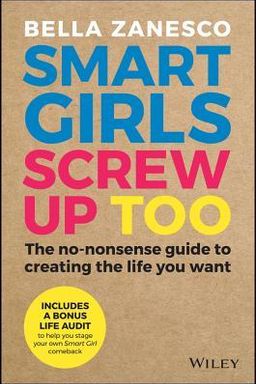
Smart Girls Screw Up Too cover

Smart Girls Screw Up Too

by Bella Zanesco

Smart Girls Screw Up Too is an empowering guide for turning your life around. Learn practical advice, tools, and exercises to boost self-esteem, improve mental health, and find career fulfillment by aligning passions with work. Embrace a supportive community and creative pursuits to achieve your desired life.

Building Your Own Upside: Transforming the Downside of Life

Ever had a moment where everything you planned—career, relationships, health—cracked wide open? That messy, painful place is exactly where Bella Zanesco begins in Smart Girls Screw Up Too. The author argues that screw-ups aren’t signs of failure but invitations to rebuild your life deliberately. Through what she calls the journey from the downside to the upside, Zanesco contends that turning breakdowns into breakthroughs requires courage, emotional awareness, and the willingness to rebuild yourself from the inside out.

This book is part confessional, part toolkit, and part manifesto for women (and men) who feel stuck, sick, or unsatisfied even as they appear successful. Zanesco fuses real-life stories with neuroscience, psychology, and wisdom traditions—from Maslow’s hierarchy of needs to family systems therapy and yoga—to help readers uncover what truly sustains them.

Understanding the Downside

Zanesco begins in the darkness of the downside: depression, burnout, heartbreak, and self-doubt. Half of the women she calls "Smart Girls" feel bad more often than good, and many don’t know how to fix it. The downside represents autopilot living—driven by fear, social comparison, and the relentless chase for external validation. For Zanesco, this low place triggered change. When her relationship ended in those devastating words, “It’s over,” she found herself unable to function. Yet that collapse became her catalyst for transformation.

The idea is radical but grounding: you must first accept your pain as a teacher. Borrowing the Japanese art of Kintsugi, she suggests using life’s golden glue—the tools of healing and reflection—to remake your shattered pieces into something stronger and more beautiful. Screw-ups aren’t destructive; they reveal what must be rebuilt.

The Foundations of the Upside

The upside, as Zanesco defines it, is a state of vitality, purpose, and self-expression. Getting there isn’t about buying solutions—it’s about earning your way back to authenticity. The process involves three intertwined jobs: the Foundations, the Inside Job, and the Outside Job.

  • The Foundations help you answer the fundamental questions—Who am I? What do I really want? You rebuild emotional resilience through self-knowledge, meeting your basic needs, and reframing limiting beliefs.
  • The Inside Job concerns your physical, mental, and spiritual health—the practices that keep your body and mind thriving. Yoga, meditation, gut health, and hormonal balance become tools for stability.
  • The Outside Job translates that inner strength into external confidence. You change your environment, tribe, work, and relationships so your outer world aligns with your inner truth.

The Role of Courage and Clarity

Zanesco’s model relies on radical clarity—the courage to look at yourself without flinching. She calls her readers to become “Smart Girls,” not because they know everything but because they’re brave enough to learn from failure. Facing frustration honestly is the first step toward self-led purpose. This involves identifying core wounds—what she calls Source Wounds—that drive your lifelong patterns of overachievement and people-pleasing. Once you locate the moment your inner child interpreted love as conditional, you can stop recreating scenarios that confirm that belief.

Why This Matters Today

Modern women, Zanesco notes, are simultaneously empowered and exhausted. Depression and anxiety are epidemics, often hidden beneath social media gloss and success metrics. Her mission is to normalize screwing up—and to use setbacks as a map to authenticity. The book matters because it dismantles the myth of perfection. It reminds you that clarity, connection, and confidence can coexist with imperfection when guided by self-compassion.

Golden Glue Principle

Like the golden threads in repaired Kintsugi pottery, the systems of self-awareness, health, and human connection you build to mend a broken life make it not just whole—but luminous.

Ultimately, Smart Girls Screw Up Too is a holistic guide. It’s about learning to feel what hurts, heal what haunts, and rebuild what matters—one piece at a time. Zanesco offers the tools, questions, and stories to help you transform mistakes into meaning, teaching that your most broken moments can forge your most beautiful life.


Meeting Your Needs and Healing the Source Wound

At the beginning of the healing journey, Zanesco insists you start with something deceptively simple: meeting your own needs. In the aftermath of losing her relationship and career stability, she found herself unable to get out of bed. Her friend Alexis, a therapist, gave her essential advice: 'Be a needy person and listen to your needs like you're the most important person in the world.' That moment flipped her mindset—from shame over dependency to pride in self-care.

Maslow’s Blueprint for Emotional Survival

Using Maslow’s Hierarchy of Needs as a framework, Zanesco rebuilt her life, one foundational layer at a time. Instead of chasing achievement, she focused on basics: food, rest, movement, emotional safety. Each small act—making the bed, walking by the sea, drinking a green juice—restored fragments of normality. She learned that until your basic needs are met, neither love nor purpose can flourish. This grounding principle echoes Tony Robbins’ human needs psychology and Brené Brown’s lessons on vulnerability: without basic stability, deeper transformation remains impossible.

Setting Boundaries: Electric Fencing 101

As she regained strength, Zanesco encountered a familiar antagonist: the inner voice that scolds and shames. To silence this 'verbally incontinent b**ch', she developed fierce boundaries—what she calls Electric Fencing 101. These boundaries protect emotional energy, limiting people’s access to her time and attention. She learned to say “no” as a complete sentence. (In comparison, Cloud and Townsend’s Boundaries offers a similar psychological model: emotional fences don’t isolate; they preserve integrity.)

Discovering the Source Wound

The most transformative concept in this section is the Source Wound—the first deep emotional hurt in childhood that shapes adult patterns. For Zanesco, her parents’ separation taught her that people she love will abandon her, leading her to leave others first or overperform to earn approval. You likely have your own variation: a wound of rejection, neglect, or betrayal. Recognizing it is the cornerstone of emotional maturity. Through therapy, journaling, or self-inquiry, rewriting that story releases energy trapped in lifelong compensations. Once she reframed her wound through forgiveness rather than blame, vitality returned.

Forgiveness and Energy Freedom

Healing the Source Wound doesn’t mean forgetting it; it means reframing it. Zanesco realized that blaming her parents kept her heavy and stuck. Forgiveness, instead, lightened her spirit and freed energy for growth. It’s the pivot point: by replacing resentment with compassion, your nervous system moves out of survival mode and into a creative state. Neuroscientist Antonio Damasio would agree—emotions govern behavior more than thought. When you feel good internally, the outside world starts reflecting that peace.

The takeaway: your prolonged sadness isn’t random. It signals unmet needs and unhealed wounds asking for attention. Activating simple acts of self-care, protecting your boundaries, and forgiving your original hurts form the first layer of the Upside. Everything else—purpose, health, love—rests on this golden foundation.


Aligned Decision-Making Through Touchstones

Once needs are met, Zanesco turns to rebuilding life vision through what she calls touchstones—the emotional words that define your unique essence. She connects this concept to rediscovering your childlike self, the version of you that was curious, fearless, and authentic before social conditioning set in. As a child, Bella ran toward waves without fear. In adulthood, that free spirit became buried under ambition and burnout. Touchstones act as compass points that guide choices back to that authentic joy.

Rediscover Your Inner Child

Reconnecting with childhood passions reveals what really energizes you. Zanesco asks her mother to recount stories from her youth—how she once splashed fearlessly in the sea. These memories uncover your innate characteristics: adventure, freedom, creativity. Journaling these memories identifies patterns of meaning that often get lost in adulthood. The author treats this exercise like archeological excavation: unearthing past selves to guide present decisions.

Defining Touchstones and Decision Alignment

Touchstones are emotional states that serve as decision benchmarks—words like adventure, curiosity, compassion, freedom. When Zanesco faced choices—whether to take a corporate promotion or a sailing trip—she asked, “Will this inspire feelings I desire?” If the answer was no, she declined. This method turns intuition into a practical decision-making tool, similar to Danielle LaPorte’s Desire Map, which replaces goal lists with desired feelings. Living in alignment with touchstones prevents burnout and ensures resonance between what you do and how you feel.

Smash and Grab Inspirations

Zanesco develops her identity through admired figures—the 'smash and grab' technique. She borrows traits from inspirational people like Sebastian Terry (who built a life around a bucket-list mission) or Camilla Franks (who merged creativity and business). These role models amplify courage. Choose those who embody your core touchstones and observe what aligns with your values. This helps you design a life mosaic made from attributes of people who remind you who you want to be.

If you’ve ever wondered why your decisions lead to dissatisfaction, Zanesco’s answer is simple: you’ve been ignoring your touchstones. Aligning choices with core motivations brings inner peace and outer success into harmony. It’s not magic; it’s integrity in action.


Rewiring Beliefs and Confidence with Neuroscience

Belief reconstruction forms the intellectual backbone of Zanesco’s framework. She claims that to truly transform, you must rewire how you think. Borrowing insights from neuroscience, she explains that beliefs become behaviors, and behaviors become reality. Changing core limiting beliefs—a cycle she diagrams through her 'cycle of sabotage'—requires self-awareness, patience, and new actions that contradict old mental patterns.

Identify and Neutralize Core Limiting Beliefs

At a Bali retreat, Zanesco identified her deepest internal script: “I don’t deserve love or success.” Most readers will have a version of this subconscious story rooted in the earlier Source Wound. Once identified, you can begin disrupting it through small evidence-based steps. She invites readers to speak their limiting beliefs aloud, record them, and gradually replace them with affirming alternatives. (John Arden’s Rewire Your Brain and CBT therapy support this principle; repetition and action retrain neural pathways.)

Thought Levels and Physiological Connection

Zanesco categorizes thought into four levels: destructive, nonproductive, productive, and affirming. Productive thoughts drive effective action; affirming thoughts generate emotional health. Since the gut produces 95% of serotonin, thought quality directly impacts physiology. Negative thinking elevates adrenaline and inflammation; positive thinking activates the parasympathetic calm response. She cites researchers like Steve Cole and David Perlmutter to show epigenetic and metabolic effects of emotional states—your mental habits literally alter your genetic expression.

Practical Neural Reprogramming

Reprogramming beliefs means practicing new thoughts and backing them with actions. Zanesco advises starting with micro-experiments—selling products outside your job, volunteering, or shifting your daily routine—to create evidence contradicting old self-doubt. Over time, new neural connections dominate and belief shifts become permanent. The outcome isn’t blind optimism but realistic self-trust—what she calls becoming a “positive realist.”

By treating your brain as an adaptable organ, you stop defining yourself by old identities. It’s self-science for emotional freedom: the perfect fusion of psychology and practicality that makes self-belief a skill, not a mystery.


Creating Vision and Purpose That Can Weather Storms

In Part I’s final stage, Zanesco shifts from inner clarity to outer direction: designing a life vision. She defines vision not as fantasy but as a blueprint for action that survives challenges. The chapter “What the hell am I even building here?” begins with a poignant story—the death of a 12-year-old girl, Florence, during Bella’s photography work in Nairobi’s Kibera slum. That tragedy awakened her to the fragility of life and the urgency of purpose.

Life is Short: Serve or Distract?

After Florence’s death, Zanesco oscillated between hedonism (“Hey, life is short—buy that sports car”) and service (“Die with memories, not dreams”). Eventually, she realized service—not consumption—creates lasting joy. Her insight mirrors Viktor Frankl’s Man’s Search for Meaning: fulfillment emerges from contributing beyond oneself. The lesson is timely—pleasure distracts; purpose sustains.

Three Methods to Uncover Vision

  • Time Travel: revisit childhood curiosities and moments of awe to rediscover innate drives.
  • Create Your 'Hell-No' Basket: list what you refuse to regret—echoing Bronnie Ware’s five regrets of the dying.
  • Write Your Eulogy: imagine what you want said at your funeral and reverse-engineer your life accordingly. This exercise forces clarity about legacy and priorities.

Your Vision House

Zanesco introduces a tool called the Vision House—six rooms plus a roof representing facets of meaningful life: play, study, body care, contribution, generosity, and home. The roof symbolizes legacy—what we leave behind. Each room defines domain goals, transforming abstract dreams into structure. Instead of idealistic perfection, she advocates small consistent action: 'Lay one brick every day.'

Chasing Your Tennis Balls

Inspired by Dropbox founder Drew Houston, “tennis balls” are your curiosities—the pursuits you chase effortlessly because they light you up. Identify them, follow them experimentally, and let impact evolve organically. Vision builds through curiosity, not static plans.

The moral: A meaningful life requires deliberate architecture. You don’t need millions; you need clarity. When your action serves others and aligns with your soul, you’ll not only survive heartbreaks—you’ll transform them into legacy.


Healing the Body and Mind: Yoga, Meditation, and Gut Health

Part II, “The Inside Job,” pivots into practical healing. Zanesco’s toolkit unites holistic health with psychology, reminding readers that vitality underpins emotional stability. Through yoga, meditation, and gut restoration, she learned her body holds both trauma and transformation.

Yoga as Physical and Emotional Union

After years of back pain and burnout, she reluctantly tried yoga. What began as physical rehab became spiritual renewal. Yoga mirrored her life: if she rushed on the mat, she rushed in life. Strength and flexibility became metaphors for patience and acceptance. Somatic experts like Ana Forrest and Tiffany Cruikshank echo her claim: releasing tension in fascia releases stored emotional pain. The mat becomes a mirror and medicine.

Meditation as Mental Reboot

Meditation, she writes, silences the 'verbal tyrant' in your head. Her stories—from a New York satsang to India’s Kumbh Mela—reveal that stillness isn’t luxury; it’s survival. Neuroscientist Sara Lazar’s research proves meditation thickens the hippocampus and shrinks the amygdala, altering stress physiology. Zanesco reframes meditation as rebellion against digital busyness: ‘Smart Girls stop scrolling and start breathing.’

Gut Health and the Second Brain

The most visceral insight comes from her battle with IBS. She calls the gut your 'second brain,' producing serotonin and guiding intuition. Fix your digestion, she insists, and your anxiety will fade. By cleaning up diet—more greens, probiotics, less alcohol—she discovered energy flows with microbial balance. It’s microbiome meets mindfulness. (Dr. David Perlmutter’s Brain Maker supports her observations on gut-brain synergy.)

Together, these practices embody the book’s core philosophy: emotional healing is physical healing. Feeling well in body resets clarity in mind. You can’t think your way to happiness—you have to breathe, move, and nourish your way there.


Confidence in the World: Home, Tribe, and Meaningful Work

Part III, “The Outside Job,” translates inner transformation into worldly confidence. This section connects your healed inner foundation to relationships, work, and environment—everything visible from the outside. The thesis: outer radiance reflects inner stability.

Curating Your Environment

Bella’s 'cockroach story'—finding literal cockroach droppings in her bowl—served as metaphor for toxic surroundings. Cleaning her home mirrored cleansing her psyche. She embraced minimalism, gratitude rituals, and digital detoxes to reduce anxiety. The lesson: what your eyes see, your soul absorbs. Curate space to support emotional wellbeing, not status display.

Building Your Tribe

In Friendships and Support Networks, Zanesco outlines the six archetypes of essential friendships—the Catalyst, Player, Nurturer, Inspirer, Challenger, and Lover—plus the 'Maker' (life partner). Drawing on Robin Dunbar’s research, she categorizes social circles into concentric rings up to 150 people. Choosing a tribe consciously means you evolve surrounded by those who uplift you, not drain you. She prompts readers to audit their relationships: keep, seek, or ditch.

Reimagining Work and Finances

Her “Smart Girl Career Q&A” busts myths about passion versus practicality. Over half of women she studied dislike their jobs; many stay for money despite misery. Zanesco offers realism: trade passion experiments for security if necessary, but plan transition strategically. Build side hustles to test meaning, negotiate sabbaticals, consider entrepreneurship only when prepared. She categorizes personalities—Risk Taker, Pragmatist, Juggler, Missionary—to help choose suitable paths. The goal isn’t fantasy freedom but balanced fulfillment.

Confidence, in Zanesco’s view, means unapologetically inhabiting your life—home decluttered, friends selected, work aligned. When your internal stability shines outward, others notice, not because you’re perfect but because you’re authentic.


Love, Family, and the Courage to Choose Real Relationships

In the final chapters on relationships, Zanesco addresses the 'L word' and dismantles Hollywood myths. Many Smart Girls, she notes, are exhausted by dating and tempted to settle. Her view: healthy love requires inner wholeness first. The four-step process to attracting committed relationships mirrors the book’s structure—heal yourself, then engage others.

Step 1: Date Yourself

Stop swiping and start self-romancing. Learn to enjoy your own company—movies alone, solo travel, reawakening passions. This builds non-needy confidence. When you love your life, you stop demanding completion from others. Eckhart Tolle’s The Power of Now supports this: relationships exist to raise consciousness, not to fill voids.

Step 2–3: Conscious Dating and Choosing

Bella’s pragmatic dating checklist contrasts fantasy with reality—shared touchstones, emotional availability, trust, aligned vision. She encourages early truth-telling, even about sensitive desires like having children. Choosing consciously means valuing compatibility over chemistry. Commitment, then, becomes mutual growth, not rescue.

Step 4: Sustaining Love Through Conflict

Drawing on therapist Esther Perel’s wisdom, Zanesco lists seven principles for lasting connection: ask clearly, give generously, receive with grace, trust, refuse without drama, and play often. Play, she adds, is love’s secret fuel. The opposite of play is depression—without shared laughter and vulnerability, affection withers.

Choosing Motherhood Consciously

Finally, she guides women through baby decisions without judgment. By reflecting on personal truth, not social expectation, you decide if motherhood aligns with your vision. The process mirrors life design: authentic choices over fear-based ones.

Zanesco closes with grace: love others only after loving yourself. Your relationships—romantic or parental—should amplify your light, not fix your wounds. Wholeness begins within and radiates outward as genuine connection.

Dig Deeper

Get personalized prompts to apply these lessons to your life and deepen your understanding.

Go Deeper

Get the Full Experience

Download Insight Books for AI-powered reflections, quizzes, and more.