
Idea 1
The Power of Saying More with Less
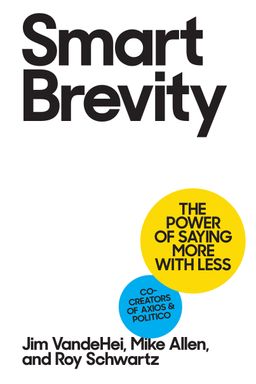
When was the last time you actually finished reading an email before your mind jumped to your next notification? In Smart Brevity: The Power of Saying More with Less, Jim VandeHei, Mike Allen, and Roy Schwartz argue that our words are drowning in a sea of noise. Every day, we scroll, skim, and scan through an avalanche of information—while retaining almost none of it. The authors claim that our modern communication habits are broken, yet most of us still write like it’s 1980: overstuffed prose, pointless jargon, and wordy habits that waste precious attention. The antidote, they say, is Smart Brevity—a simple but powerful system for saying more while using fewer words.
The core argument of the book is that brevity signals confidence, while length betrays insecurity. It’s not about writing short for short’s sake; it’s about editing ruthlessly to deliver the most value in the least time. In a world where the average person spends only 26 seconds reading a piece of content, brevity isn’t a luxury—it’s survival. By mastering Smart Brevity, you can clarify your thinking, communicate effectively, save time, and actually be heard again.
Why Smart Brevity Matters Now
We live in what the authors call the “fog of words”: a nonstop swell of messages, meetings, memos, and emails that eclipse genuine understanding. Eye-tracking studies reveal that most readers spend less than fifteen seconds on a webpage and decide whether they like content in a mere 17 milliseconds. Leaders, teachers, and students face the same problem—people no longer read or listen deeply. Instead, they skim for the new and the useful. The web and our smartphones have hijacked our attention with infinite stimuli battling for our dopamine-driven clicks.
Against this backdrop, VandeHei and his coauthors propose a radically audience-first mindset. They remind us that the old equation—longer equals smarter—no longer holds. As Mark Twain famously quipped, “I didn’t have time to write a short letter, so I wrote a long one.” Smart Brevity flips that: by investing thought upfront, you respect your audience’s time and earn their trust. It’s not that our brains have been rewired; it’s that we’re exposed to unprecedented volumes of distraction. The value of clarity, then, has never been higher.
The Anatomy of Smart Brevity
At the core of Smart Brevity lies what the authors call the Core Four—a communication formula that can be applied to emails, newsletters, reports, or speeches:
- 1. The Tease: A short, muscular headline—six words or fewer—that grabs attention.
- 2. The First Sentence (“the Lede”): Begin with something your reader doesn’t know but should, stated directly and sharply.
- 3. The “Why It Matters”: Context that clarifies the significance of what you just said, told in one or two sentences.
- 4. The “Go Deeper”: Optional depth—bullets, links, or extra details—for those who want to explore further.
This architecture, perfected at Axios (the authors’ media startup), transformed dull information into fast, addictive reading for busy professionals. The point isn’t to dumb things down but to distill wisdom. As they put it: “Short, not shallow.” The result is communication that’s structured like a great conversation—tease, engage, explain, invite.
From Newsrooms to the CIA
One of the book’s most vivid examples comes from the CIA. Analysts were drowning in verbose reports that hid crucial intelligence behind walls of text. When the agency applied Smart Brevity principles, its warnings turned from bureaucratic mush into sharp, actionable insights—transforming their President’s Daily Briefs into attention-grabbing one-pagers. The same shift has occurred at companies like BP, the NFL, and Roku, which have used Axios software to transform how they communicate internally.
Smart Brevity’s flexibility is a key strength. It’s music theory, not a rigid rulebook: once you learn the structure, you can improvise like jazz. The key is always clarity, simplicity, and service to the audience. Whether in a corporate memo or classroom update, the format forces you to think clearly before you type—and forces readers to actually absorb what matters.
The Movement Beyond Words
Smart Brevity isn’t just about writing—it’s about rethinking how you work and live. When you get to the point faster, meetings shrink, strategies clarify, and culture strengthens. The book illustrates how internal newsletters, feedback, and speeches can all be retooled to deliver information more effectively. The result: more productive teams, sharper leadership, and reduced burnout from “word clutter.”
In that sense, Smart Brevity stands in conversation with other clarity-focused thinkers like Strunk and White (The Elements of Style) or Cal Newport (Deep Work). But it’s updated for the age of screens and Slack—where attention is scarce and trust is earned sentence by sentence.
The Big Promise
By embracing Smart Brevity, you reclaim power in a distracted world. You become the person whose emails people actually read, whose meetings end early, whose arguments stick. The method isn’t about writing less—it’s about thinking more clearly so you can make every word count.
Over the next sections, you’ll learn how to think audience-first, craft killer teases, pick the right words, and use everything from emojis to visuals without annoying your reader. You’ll see how Smart Brevity works in newsletters, speeches, and company culture—and why mastering it is a superpower for the modern workplace.