
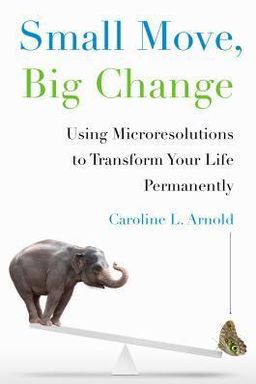
Small Move, Big Change cover

Small Move, Big Change

by Caroline L Arnold

Caroline L. Arnold''s ''Small Move, Big Change'' reveals the secret to lasting self-improvement: microresolutions. By focusing on small, manageable commitments, readers learn how to achieve big results without overwhelming themselves. Discover how to harness the power of these tiny resolutions to transform your habits and your life.

Transforming Life Through Microresolutions

Have you ever made a New Year’s resolution—promising to lose weight, get fit, or be more organized—only to watch it crumble within weeks? In Small Move, Big Change, Caroline L. Arnold offers a bold alternative to this all-too-familiar pattern. She argues that grand resolutions fail because they depend too much on willpower and not enough on specific, doable habits. Her central claim: meaningful transformation comes from small, targeted actions—what she calls “microresolutions”—that you can actually keep.

Arnold contends that the traditional resolution process sets us up for failure. We commit to sweeping promises (“I’ll be healthy,” “I’ll be organized,” “I’ll stop procrastinating”) that require changing dozens of unconscious behaviors overnight. Because these habits run on what she calls our autopilot—the unconscious patterns that manage daily life—trying to reform them all at once leads to exhaustion and relapse. Her solution is deceptively simple: focus on one specific, measurable habit that can be drilled until it becomes automatic.

Why Big Resolutions Fail

Arnold’s opening chapters dissect why New Year’s resolutions collapse. They’re usually too broad (“be organized”) and depend on motivation instead of structure. They also provoke decision fatigue—a concept studied by psychologist Roy Baumeister—which reveals that every choice we make drains the same mental resource used for self-control. Instead of deciding every day whether to go to the gym, she recommends creating one action, like “I will walk to work every Monday morning.” Because the resolution is explicit, limited, and easy to measure, success becomes inevitable.

The Power of Autopilot and Habit

The book’s foundation rests on a single insight: most of what we do is what we do most of the time. We live on autopilot—making decisions and repeating behaviors without conscious thought. This automaticity conserves mental energy but also keeps us stuck in destructive routines. Arnold’s microresolutions work by reprogramming this autopilot in microscopic steps. Once a small habit is encoded (like hanging up your coat or turning off the screen before bed), it proceeds effortlessly, freeing you to build others.

From Wall Street to Habit Science

Arnold, a Wall Street executive, admits that despite her rigorous professional discipline, she repeatedly failed at personal goals—losing weight, staying organized, getting fit. Her breakthrough came when she resolved to keep all her notes in one notebook at work. That tiny change eliminated chaos, revealed how much resistance she faced from old habits, and taught her to focus relentlessly on one behavior at a time. This experiment became the prototype for her microresolution method, tested later by friends, colleagues, and readers.

Seven Rules for Permanent Change

Arnold’s framework unfolds through seven rules: make resolutions easy, actionable, measurable, personal, resonant, cued, and practiced two at a time. Together, these rules replace vague aspirations with behavioral architecture. Each microresolution adheres to principles of habit research (as studied by Wendy Wood and David Neal): link behavior to a cue, repeat it until automaticity forms, and build from where you are. The transformation doesn’t emerge from heroism—it emerges from repetition.

Applying Microresolutions to Daily Life

Part II of the book shows microresolutions in action across major life domains: sleep, fitness, diet, clutter, relationships, spending, punctuality, and organization. Each area includes stories of real people—professionals, parents, athletes—who reform their habits through manageable steps. For instance, one woman gets fit by climbing stairs at work; another improves punctuality by preparing clothes the night before; another stops overeating by savoring her meals slowly.

Arnold’s broader message is both pragmatic and profound: when you learn to honor small promises to yourself, you reclaim integrity and power. Microresolutions teach you to treat commitments to yourself as seriously as those to others. Each success fosters confidence, producing a compounding effect—your habits, mindset, and even identity evolve together, one small move at a time.

Core Idea

Lasting personal transformation doesn’t come from force or fantasy—it comes from precision. By linking each new action to a clear cue and repeating it until it sticks, you rewire your life from the inside out. A single microresolution, Arnold shows, can transform your relationship with yourself and ignite a chain of continuous self-improvement.

Ultimately, Small Move, Big Change reveals that improvement is less about ambition and more about design. You don’t need more willpower—you need smarter habits. The book is not a motivational pep talk but a manual for behavioral engineering. And once you master this art, you can change anything—from fitness to finances—with graceful, sustainable momentum.


The Anatomy of Microresolutions

At the heart of Caroline Arnold’s system is the anatomy of a single microresolution—a compact commitment designed for guaranteed success. A microresolution is easy, limited, and measurable, anchored in daily life and practiced until it becomes part of your unconscious routine. Unlike vast goals that collapse under their own weight, microresolutions aim small to grow big. Their success depends on structure, not willpower.

Rule 1: Keep It Easy

Arnold insists that the first rule of microresolutions—“make it easy”—is the foundation of permanent change. If your resolution is too ambitious, you’ll end up bargaining with yourself. “Walk every morning” becomes “maybe three times a week,” which devolves into never. Instead, she suggests pledging something absurdly manageable, like walking to work once a week. This modest start builds consistency and confidence; you can always expand later.

Rule 2: Define an Action, Not an Ideal

Every microresolution focuses on doing, not being. “Be organized” is useless; “file receipts every Friday afternoon” changes behavior immediately. Arnold recalls her own breakthrough when she replaced the abstract goal of being organized with one explicit action—put all notes in one notebook. The structure provides clarity, prevents procrastination, and eliminates negotiation (“Should I do it today?”). In cognitive terms, specific actions reduce decision fatigue (similar findings appear in Charles Duhigg’s The Power of Habit).

Rule 3: Pursue Immediate Gratification

You shouldn’t wait for transformation months down the road. Each microresolution is designed to deliver instant rewards. Make the bed every morning, and your bedroom looks better—today. Skip the conference-room cookie, and you feel satisfied instead of sluggish. This immediate feedback loop reinforces motivation. It replaces delayed gratification (“be slim by summer”) with a daily sense of victory that sustains momentum.

Rule 4: Make It Personal

There’s no one-size-fits-all in self-improvement. Every resolution must fit like a glove—your circumstances, your psychology, your patterns. Arnold illustrates this through punctuality challenges. For one person, lateness stems from oversleeping; for another, from morning chaos; for another, from dawdling over hair drying. Each needs a personalized fix. You build habits that solve your bottleneck, not someone else’s.

Rule 5: Frame It Positively

Language matters. A resolution phrased as denial (“stop snacking”) feels punitive, while an affirmative message (“I enjoy dinner more when I’m hungry for it”) encourages better choices. Arnold calls this “giving your resolution some spin”—infusing it with positive energy and values. When your resolution excites rather than restricts you, you’re more likely to stick with it. She also introduces “zero-tolerance framing” for small, high-risk behaviors—those that spiral out of control if indulged, like bedtime screen checking or leaving clutter on a counter.

Rule 6: Fire on Cue

Habits run on cues—specific triggers that prompt a response. You brush your teeth after a meal, pack lunch after breakfast, check your phone when it buzzes. Microresolutions link a new behavior to an existing cue (“I’ll drink a glass of water every time I wash my hands”). The pairing builds automaticity through repetition. Arnold borrows from behavioral science showing that strong associations between cue and action hardwire habits permanently.

Rule 7: Practice, Not Perfection

Finally, she warns against spreading yourself thin. Make no more than two microresolutions at a time. It takes four to eight weeks for each to embed into autopilot, depending on complexity. Once steadied, add another. The magic isn’t in speed but consistency. Over a year, twenty microresolutions can transform your life, because success compounds—each new habit strengthens your capacity to build the next.

Momentum Through Simplicity

Arnold teaches that discipline isn’t born from effort but design. When you make your resolutions easy, specific, and cued, success becomes automatic. The brilliance of microresolutions is that they turn self-improvement into a system—simple steps, practiced relentlessly, that reshape who you are.


Testing, Tuning, and Thriving

Your first microresolution almost never goes perfectly. Caroline Arnold devotes an entire chapter to what she calls the “test drive” period—the first two weeks where you discover obstacles and tune your resolution for real life. As with any new routine, reality tests theory. The key isn’t to abandon your commitment but to refine it until it fits seamlessly into your days.

Learning from the Test Drive

Arnold compares microresolutions to new cars: they start smooth but show quirks once on the highway. You may find the schedule wrong, the cue misplaced, or the action too cumbersome. Fine-tuning these elements transforms the resolution from wishful thinking into habit engineering. When Linda’s resolution to skip bread at lunch failed because she switched restaurants, she reframed it more generally as “choose flourless lunches.” The adjustment—small but clever—made the habit sustainable everywhere.

Solving Systemic Obstacles

Sometimes your resolution uncovers a deeper system flaw. Arnold tells the story of trying to hang up her coat instantly after walking in—but failing because her closet was packed tight. The problem wasn’t the resolution; it was her environment. After clearing space and adding hangers, success followed effortlessly. Each new habit exposes friction points—physical, emotional, or procedural—that have quietly hindered progress for years.

Scaling and Smart Adjustments

Arnold emphasizes that tweaking doesn’t mean cheating. Scaling back your resolution when needed is smarter than quitting. If “go to the gym three nights a week” proves unrealistic, change it to one. Success breeds motivation; failure breeds despair. Once the smaller version sticks, it will organically expand. This iterative learning mirrors Kaizen, the Japanese principle of continuous improvement through small refinements.

The Magic Rose Geranium Effect

Arnold closes the chapter with a metaphor from a childhood story, “The Magic Rose Geranium.” A woman transforms her shabby house piece by piece after placing a bright flower on the table. Each improvement inspires another until her home—and herself—becomes renewed. Likewise, each successful microresolution boosts confidence and triggers more improvement. Momentum fuels transformation: one clean countertop leads to a cleaner kitchen, a calmer mind, and a stronger sense of agency.

Growth Through Refinement

A microresolution doesn’t succeed because it’s perfect at first—it succeeds because you keep adjusting until it becomes second nature. Each tweak uncovers insights about your behavior and your environment, making continuous improvement inevitable.

Arnold’s test-drive principle turns frustration into progress. Instead of quitting when a resolution falters, you use the failure as data. In this way, every obstacle becomes an opportunity for precision—proof that growth is not about toughness but design optimization.


Reclaiming Sleep and Energy

Sleep may be the most underrated self-improvement tool of all, and Caroline Arnold’s chapter on it is both eye-opening and persuasive. She argues that nothing sabotages willpower and habit formation more than exhaustion. To build new behaviors, you must first restore your energy reserves—the mental and physiological resources from which self-control draws. Without adequate sleep, every resolution struggles.

The Science of Fatigue

Arnold cites Roy Baumeister’s research showing that self-control operates like a battery that depletes throughout the day. Sleep recharges it; lack of sleep drains it. That’s why temptations—junk food, irritability, impulsive spending—spike late at night. She connects sleep deprivation to overeating, noting that tired people crave carbohydrates not from hunger but from fatigue. The solution isn’t stricter dieting—it’s more rest.

Microresolutions for Better Sleep

Arnold shares her own battle with late-night exhaustion. She used to snooze on the couch rather than face her elaborate bedtime routine. Her breakthrough came from a simple microresolution: prepare for bed right after putting her daughter to sleep. By completing all nighttime rituals early, she could tumble into bed when tired instead of reviving herself with television or sugar. Later, she added a second resolution: zero tolerance for recreational computer use after 10 p.m., protecting her rest from digital temptation.

Sleeping to Succeed

Arnold emphasizes that good sleep amplifies success in every domain—fitness, weight control, emotional stability, and mood. Studies she cites from Stanford show that athletes who increased sleep to ten hours a night improved reaction time, accuracy, and motivation. Similarly, better-rested people make smarter financial and interpersonal decisions. Fatigue, she insists, is not a badge of honor—it’s a self-sabotaging habit.

Rethinking “Leisure Time”

Many delay bedtime to squeeze in “me time,” but Arnold reframes this entirely: your best leisure moments happen when you’re not exhausted. She shares stories like Neil’s, who resolved to stop snacking to stay awake. His discovery—that sugar cravings were just tiredness in disguise—helped him sleep earlier and lose weight. Another tip from Deborah: watch only prerecorded TV shows to avoid being trapped by late-night programming. Each strategy converts awareness into rest, proving that sleep hygiene is as behavioral as diet.

Sleep as Self-Improvement

Arnold’s insight is radical in its simplicity: if you want more discipline, creativity, or calm, start with sleep. Rest is not indulgence—it’s infrastructure. Like charging your phone, you must recharge your brain to function effectively.

By treating sleep as the cornerstone of habit formation, Arnold gives readers permission to slow down. Her microresolutions show that self-care fuels self-discipline, turning rest into a strategic advantage. Sleep, she writes, is "the secret sauce of waking life."


Fitness Through Tiny Moves

Most fitness revolutions fail because they start too big. Caroline Arnold dismantles the myth that transformation begins with the gym membership. Instead, she prescribes “microfitness”—small moves that interrupt long hours of sitting and gradually build stamina. The goal isn’t to train like an athlete—it’s to cultivate movement as a mindset.

Movement vs. Motivation

Arnold opens with research showing that excessive sitting is lethal, citing studies where sedentary behavior increased mortality by up to 40%. No workout can undo 10 hours at a desk—Dr. James Levine compared it to a smoker running to "undo lung damage" after a day of cigarettes. But here’s the good news: micro-movements—standing, walking, climbing stairs—protect health and metabolism. A two-minute stroll every twenty minutes stabilizes blood sugar and boosts longevity.

Microresolution Examples

Arnold tells vivid stories. Marissa, who worked on the fourteenth floor, made a resolution to take the stairs to the cafeteria daily. She lost four pounds and improved stamina within weeks. Hannah, after years of inactivity, resolved to jog in place for four minutes every morning. Those minutes evolved into a 30-minute beach run and a 40-pound weight loss. Orin, an academic with athletic past, rebuilt fitness by taking long dog walks once a week—a habit that enriched his life intellectually and emotionally.

Showing Up Beats Intensity

One of Arnold’s most relatable examples is Lindsay, who reinvented gym attendance by resolving only to “show up on Mondays and row for fifteen minutes.” This microresolution shifted her focus from working out to simply arriving. Once attending became habit, she expanded naturally, eventually transforming into a “gym rat” without pressure. The act of showing up broke the inertia that had defeated her previous all-or-nothing resolutions.

The Philosophy of Small Fitness

Arnold concludes: stop waiting to become an athlete. Begin with movement at the margin—standing while commuting, carrying groceries, playing catch with your kids. These everyday choices reprogram both body and mind. Over time, strength becomes its own pleasure. Arnold herself rediscovered joy in physical vitality after starting with thirty-minute weekly sessions with a trainer. She began exercising for power, not thinness—and discovered the deeper delight of feeling strong.

Microfitness Mindset

Fitness isn’t a program—it’s a mindset. Every movement, no matter how small, strengthens life. You don’t need ambition; you need consistency. Arnold’s mantra: “Work the margin.”

Through small moves, big change becomes inevitable. The body adapts, energy rises, and exercise shifts from obligation to instinct. Movement, Arnold proves, is the most powerful medicine—and it begins with a single flight of stairs.


Eating for Pleasure and Control

Dieting, according to Caroline Arnold, fails not because people don’t know how to lose weight but because they can’t sustain the behaviors that do. Her approach transforms eating into a lifelong relationship built on pleasure, mindfulness, and moderation. Rather than counting calories, she encourages you to reform specific autopilot habits that determine how, when, and why you eat.

Reprogramming the Eating Engine

Arnold likens the body to an engine that runs efficiently only when fed nutrient-rich fuel, well-rested, and active. Poor sleep, sedentary life, and processed food clog its system. Her goal is to “get the engine humming” before cutting intake. The first microresolution might be to add vegetables or fruits daily—upgrading nutrition before subtraction. When Richard replaced a hurried muffin with oatmeal at home, his energy stabilized until lunch and his overall snacking declined.

Mindful and Enjoyable Eating

Arnold’s approach is built on mindfulness: enjoy every bite or stop eating. This simple but powerful rule transforms dieting into delight. She recounts how savoring food slowly helped her lose 15 pounds by improving satisfaction. Like mindfulness teacher Thich Nhat Hanh’s lesson in conscious eating, Arnold’s practice reprograms autopilot eating by connecting awareness to taste. “If it isn’t delicious,” she writes, “don’t waste calories on it.”

Microresolutions That Work

Examples abound: Kathy’s resolution to eat salad alongside lunch gradually reshaped her appetite. Theresa’s rule to “keep a water bottle at work” fixed chronic dehydration. Robert, who snacked heavily before dinner, resolved to limit his pre-meal snack to fifty calories—saving thousands yearly. Keith brought planned treats to work instead of scavenging coworker candy jars, eliminating mindless office munching. Each small change occurs at the margin yet snowballs into transformation.

The Mathematics of the Margin

Arnold reinforces this with scientific precision: shaving 10 calories a day permanently can result in roughly a pound lost every three years, according to NIH researcher Dr. Kevin Hall. The battle for weight control, she explains, happens at the margin—those snacks, bites, and habits on autopilot. By reforming these, you win permanently. A cookie skipped daily isn’t deprivation; it’s stability.

Satisfaction Over Sacrifice

Arnold teaches that you must become “satisfied with less.” When you experience full pleasure in your meals, your appetite stabilizes. Eating becomes joyful—and control effortless.

Her method doesn’t restrict—it retrains. By cultivating mindful eating, hydration, and timing, you develop a sustainable relationship with food. Success isn’t about willpower—it’s about savoring.


Time, Trust, and Relationships

Relationships are emotional autopilot systems: we repeat the same reactions, arguments, and patterns without realizing it. Caroline Arnold shows how microresolutions can transform interactions with partners, parents, children, friends, and colleagues. By focusing on one behavioral pattern at a time—apologizing, listening, complaining—you change the dynamics of connection from within.

Breaking Emotional Habits

Arnold’s own marriage revealed how ingrained responses shape conflict. She noticed she apologized reflexively whenever her husband reminded her of something she missed, even when unnecessary. Her resolution: stop apologizing when she didn’t mean it. This single change dissolved resentment and improved authenticity. The same logic applies to any relationship—the moment you alter your side of a recurring pattern, both parties shift.

Parenting and Emotional Tone

In parenting, Arnold recounts lowering her voice during confrontations with her teenage daughter. Speaking softly, paradoxically, increased authority and calm. Strong reactions cue escalation; measured ones cue reflection. Each resolution rewires emotional triggers the way behavioral cues rewire habits—they teach your relationships a new rhythm.

Professional Relationships

At work, small behavioral shifts redefine leadership. Christine improved communication with an impatient boss by sending brief notes before meetings—eliminating interruptions and tension. Simon rebuilt trust in a struggling team by ending meetings with the question, “What can I do better?” His example inspired reciprocal feedback, creating a culture of openness. Greta cured her habit of complaining first at work—discovering she was the source of negativity she had blamed on office culture.

Presence and Attention

Arnold emphasizes attention as love’s currency. Whether listening to a spouse describe a movie or chatting with a friend, paying full attention communicates respect and belonging. This echoes Stella Adler’s advice to actors: love is paying attention. Fran’s resolution to listen fully when her husband talked about films enriched their bond more than any grand gesture. Attention transforms quality time into connection.

Microresolutions for Empathy

The beauty of Arnold’s model is its humility. You don’t change people; you change yourself. Respect replaces defensiveness, listening replaces arguing, and small shifts compound into trust.

In the end, Arnold reminds us that character arises from action, echoing Aristotle: “You become just by performing just actions.” Each microresolution practiced in relationships teaches grace—one conversation at a time.


Redesigning Time and Organization

Clutter and disorder aren’t just physical problems—they reveal deeper cognitive habits. Caroline Arnold’s chapters on organization and neatness offer microresolutions that bring sanity to chaos. Her insight: neatness operates on autopilot too. You don’t “decide” to be tidy; you train small behaviors that keep things orderly without conscious effort.

From Mess to System

Arnold shares how her simple coat-hanging resolution spilled into broader neatness habits—towels straightened, counters cleared, drawers closed. Each new behavior upgraded her preference for order: soon mess “looked wrong.” She illustrates this through stories like Brian and Dorrie, who transformed their chaotic home by resolving to keep briefcases out of the living room. Their “oasis of order” became contagious.

Microorganization at Work

Organization at work runs on similar principles. Zach’s resolution to add every new caller to his contact list immediately saved hours of frustration. Elaine conquered paper piles with “sort mail before entering the apartment.” Katherine tackled fear-driven procrastination by making her scariest call first each morning—reclaiming focus. Each example shows how microresolutions streamline decision-making, preserving mental energy for creativity.

Redefining the Hour

Cindy, overwhelmed by back-to-back meetings, redefined time itself: she scheduled hour-long meetings for fifty minutes, freeing ten-minute buffers between tasks. This single habit improved productivity and calm. Arnold’s daughter Helen applied the same logic to homework: print assignments as she finished them, not at midnight before bed. Tiny fixes create spaciousness, reducing stress exponentially.

Nanoresolutions and Big Projects

For larger tasks like organizing closets or taxes, Arnold recommends “nanoresolutions”—10-minute projects that yield immediate benefits. Sort one drawer, fix one hinge, repot one plant. Each microtask builds psychological momentum. The point isn’t perfection—it’s friction reduction. By shrinking tasks to match mental bandwidth, you convert overwhelm into satisfaction.

Order as a Mindset

Arnold teaches that neatness isn’t moral or cosmetic—it’s psychological. Each bit of order clarifies thought. Once you experience calm space, you hardly revert to clutter. As her friend Maria put it, “Once you get used to order, there’s no going back.”

By turning organization into a set of microresolutions, Arnold redefines productivity as alignment, not busyness. The secret: make each routine effortless so your environment supports, rather than drains, your focus.


Financial Discipline at the Margin

Arnold expands her microresolution method into the financial realm, exploring how spending habits mirror mental habits. “Convenience is expensive,” she writes—our autopilot purchases erode resources quietly. Through tiny spending resolutions, you can plug these leaks, regain awareness, and align money with your values.

Microresolutions for Spending

Yolanda and Jan saved hundreds monthly by quitting bottled drinks—not through budgeting spreadsheets but by removing one habitual purchase. Arnold herself vowed zero tolerance for ATM fees, walking extra blocks to avoid them. These microresolutions replace vague “spend less” commands with surgical strikes against waste.

Convenience and Passive Consumption

Arnold critiques the illusion of efficiency: the taxi ride, the last-minute booking, the expensive grocery store next door. “Laziness is expensive.” She also warns against passive consumerism—accepting automatic payments and subscriptions without review. Simple recurring checks or scheduled bill audits reclaim thousands yearly. As her friend Adam’s frugal parents taught him, “A penny saved is more than a penny earned—you’ve already paid tax on it.”

Curbing Impulsiveness

Like Charles Duhigg’s notion of habit loops, Arnold explains retail’s manipulation of cues—discounts, displays, one-click buys. She recounts curbing her own late-night online shopping with the resolution “no personal purchases after 9:30 p.m.” The simplicity rescued her wallet and her sleep. Each microresolution interrupts the autopilot of instant gratification.

Changing Psychology Around Money

Arnold’s friend Rachel reframed emotional spending by repeating the mantra, “It’s okay to disappoint the salesperson.” This mindset message broke the need to impress others through purchases. Arnold adds her own mantra: “Security is the greatest luxury.” These reframed microresolutions transform spending from reaction to reflection, creating financial serenity.

Financial Freedom in Small Steps

You don’t need complex investment strategies to feel secure. You need awareness, simplicity, and consistency. Each microresolution—reviewing bills, pausing before buying, minimizing waste—compounds like interest.

Arnold redefines financial discipline as a function of attention rather than denial. Money, she reminds us, is just a mirror of habits. Fix the habits, and the accounts follow naturally.


From Habits to Identity

In her afterword, Caroline Arnold provides the deepest insight of all: habits don't just change behavior—they change identity. Once your new behaviors stabilize, your preferences shift to match, and then your self-concept realigns. You no longer force yourself to act differently; you naturally want to. Transformation becomes self-sustaining.

Preference and Practice

Arnold explains how repetition creates liking. The child forced to brush her teeth every night eventually grows to prefer clean ones. Her father, who once resisted flossing, became addicted to the feeling of polished teeth. Practice shapes desire. As habits embed, they evolve from discipline to preference—what once felt foreign becomes natural and pleasurable.

Identity Evolution

With sustained microresolutions, you transform from doing differently to being different. Arnold experienced this with fitness: she stopped chasing thinness and began craving strength. The self-image slowly adjusts to align with new behaviors—so your identity updates like software. Even resistance to change (the nostalgia for old habits) fades when new preferences dominate.

The Ripple Effect

Arnold notes that families, colleagues, and friends may resist these changes at first—they’re used to your old autopilot. But as your consistency persists, your integrity inspires them. You radiate transformation. Over time, others begin to calibrate to your new standard, just as her coat-hanging habit influenced everyone around her.

The Philosophy of Endless Growth

Arnold concludes with an empowering idea drawn from George Eliot: “It’s never too late to be who we might have been.” Continuous self-improvement, like saving small sums or learning small skills, compounds forever. She equates it with youthfulness—the vitality that comes from being adaptable and curious. Self-improvement, she writes, isn’t about perfection but persistence.

Becoming Your Future Self

Each microresolution teaches you to believe your behavior—and then your identity—into existence. You don’t act disciplined because you are disciplined; you become disciplined because you act that way consistently.

This final insight transforms Small Move, Big Change from a book about habits into a philosophy of becoming. Your destiny, Arnold suggests, is simply the accumulation of your daily microresolutions, practiced with love and awareness.

Dig Deeper

Get personalized prompts to apply these lessons to your life and deepen your understanding.

Go Deeper

Get the Full Experience

Download Insight Books for AI-powered reflections, quizzes, and more.