
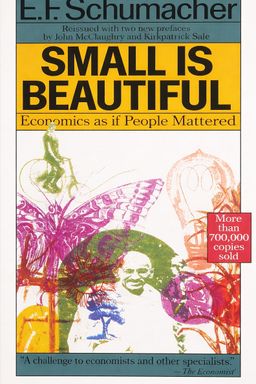
Small is Beautiful cover

Small is Beautiful

by Ernst F. Schumacher

E. F. Schumacher''s ''Small is Beautiful'' offers a groundbreaking critique of Western economics, advocating for a system that prioritizes people and planet over profit. Through compelling essays, Schumacher challenges the notion of unchecked growth, urging sustainable practices and ethical education to build a more equitable and meaningful world.

Economics as if People Mattered

What would our world look like if we built an economy around people rather than profit, compassion rather than consumption, and wisdom rather than unchecked growth? This is the central question driving E. F. Schumacher’s Small Is Beautiful: A Study of Economics as if People Mattered. Written in 1973, Schumacher’s work remains a powerful critique of modern industrial society, arguing that the way we define progress—and the scale at which we pursue it—has led us toward ecological destruction, spiritual emptiness, and alienation.

Schumacher, trained as an economist but deeply rooted in humanistic and spiritual traditions, contends that mainstream economics treats people and nature merely as resources to be exploited. He urges readers to replace this mechanistic worldview with one based on wisdom, sustainability, and human dignity. His provocative thesis is simple: the pursuit of perpetual economic growth on a finite planet is suicidal. The only sustainable economy is one designed for permanence—one that respects natural limits, nourishes community, and values meaningful work over material consumption.

The Illusion of Limitless Growth

At the heart of Schumacher’s argument lies his attack on the modern belief that production can grow endlessly. He notes that industrial societies act as if the earth’s resources were income—renewable and inexhaustible—when in fact they are capital that, once spent, is gone forever. Fossil fuels, fertile soil, and biodiversity are not mere commodities; they are life-support systems. By consuming them as if they were infinite, we are, as Schumacher warns, “remodelling the Alhambra with a steam shovel.” It’s impressive, perhaps, but ultimately destructive.

He calls this neglect of natural capital “one of the most fateful errors of our age.” Our economies, he argues, live on borrowed time—eating into the substance of the planet, and mistaking this liquidation for income. This illusion of progress, measured narrowly by Gross National Product (GNP), blinds us to the reality that the quality of human life and the health of our ecosystems are degrading beneath the façade of expansion. Schumacher insists that “the problem of production has not been solved,” because producing more by destroying our natural foundations is not mastery—it’s madness.

Technology with a Human Face

Schumacher doesn’t reject technology; rather, he redefines its purpose. He coins the term “appropriate technology,” or “technology with a human face.” Modern machinery, he argues, too often dehumanizes workers, concentrates power, and fosters dependency. Instead, he envisions small-scale, affordable, and ecologically sensitive technologies that enhance human creativity rather than replace it (an idea later echoed by the “appropriate technology movement” and modern sustainability initiatives).

Such technology aligns with Gandhi’s vision of “production by the masses” rather than mass production, encouraging decentralization and community resilience. By empowering people to work creatively with their hands and minds, Schumacher’s model restores dignity to labor and harmony between humanity and nature.

The Moral Foundations of Economics

Schumacher challenges the moral neutrality of economics itself. Modern economists, he writes, treat questions of value and purpose as irrelevant—reducing decisions to what is “economic,” meaning what yields monetary profit. Yet this abstraction strips economics of humanity and turns wisdom into mere cleverness. True economics, Schumacher insists, must answer—a moral question: not just how to produce, but why and for whom.

“Man is far too clever to be able to survive without wisdom.”

Drawing from Christian, Buddhist, and humanist traditions, Schumacher argues that wisdom must guide technology and economics. He introduces the concept of “Buddhist economics”: an approach where work is not a necessary evil but a form of spiritual and social nourishment. Unlike Western economics, which seeks to maximize consumption, Buddhist economics seeks to maximize well-being through simplicity, non-violence, and right livelihood. It measures success not by wealth but by inner peace and ecological balance.

Smallness, Peace, and Permanence

For Schumacher, “small is beautiful” is not a rejection of progress but a call for proportion, humility, and permanence. He sees the idolatry of gigantism—be it industrial mega-corporations or sprawling cities—as deeply destructive. The larger the system, the less human and manageable it becomes. Genuine peace and prosperity cannot be built atop violent technologies, ecological degradation, and spiritual emptiness. A viable future demands smaller, self-sufficient communities, renewed reverence for nature, and technologies that work in harmony with natural cycles.

Ultimately, Small Is Beautiful is both an economic treatise and a moral call to arms. Schumacher reminds us that the wealth of nations cannot be separated from the health of their souls. Economics, he insists, must once again become “a branch of wisdom,” teaching us how to live well within the limits of a finite world. Half a century later, in an age of climate crisis and overconsumption, his message feels not quaint—but prophetic.


The Problem of Production

Schumacher opens his book by dismantling a modern myth: that humanity has solved the “problem of production.” Economists, policymakers, and industrialists of his time—much like ours—believed that modern technology and science had conquered scarcity. He calls this faith a “fateful error.” Behind the apparent abundance of industrial economies lies the quiet depletion of their very foundations: fossil fuels, fertile soils, human health, and moral integrity.

Consuming Capital as if It Were Income

One of Schumacher’s most important insights is the distinction between capital and income. Businesses that eat into their capital cannot last—but industrial civilization acts as though its natural capital (oil, coal, soil fertility) were unlimited income. Fossil fuels, he reminds us, are irreplaceable “capital goods”; once burned, they’re gone forever. If business leaders would never liquidate their firms to fund short-term growth, why, he asks, do nations liquidate their natural inheritance in pursuit of endless consumption?

He urges a policy of conservation and reinvestment: the wealth extracted from the earth should be used to develop renewable energy and sustainable lifestyles. Yet modern economies, driven by what he calls “education for leisure” and “the transfer of technology,” remain on a collision course with nature’s limits.

The Battle Against Nature

Modern industrialism views nature as something to conquer. But, Schumacher cautions, in “winning this battle,” humanity ensures its own defeat. Our fossil fuel addiction, pollution, and synthetic chemicals have overwhelmed the planet’s ability to repair itself. He compares nature’s defenses against new man-made substances to “aborigines attacked by machine guns.” These technologies, unknown to nature, accumulate poisonously in ecosystems, leading to unpredictable and potentially irreversible damage.

This industrial success, he writes, is the “manifestation of our greatest failures.” Each new technological victory deepens ecological imbalance, raising the question of whether humanity can balance power with wisdom. His critique would later influence environmental economists like Herman Daly and movements such as the concept of “steady-state economics.”

The Human Substance

For Schumacher, the third form of capital we squander is ourselves—our “human substance.” Industry may produce affluence, but it also produces alienation, crime, and spiritual despair. A society that treats people merely as economic units erodes their dignity. Real wealth, he insists, resides not just in material goods but in human well-being: meaningful work, self-respect, and community. A “viable future,” then, demands a new lifestyle—one built not on consumption but on permanence, peace, and partnership with nature.


Peace and Permanence

If humanity is to survive, Schumacher argues, we must design an “economics of permanence.” Modern societies, both capitalist and socialist, base their confidence on achieving universal prosperity through material growth. But this, he shows, is a mirage. Unlimited growth in a finite world inevitably collides with limits—both environmental and moral.

The Limits of Growth and Greed

Schumacher challenges one of economics’ central dogmas: that prosperity leads to peace. John Maynard Keynes had written that humanity must worship “avarice and usury” for a little while longer until abundance frees us to be virtuous. Schumacher replies that this bargain is bankrupt. A society that cultivates greed and envy cannot hope to become virtuous later; it will decay before it awakens. In following Keynes’s advice, the modern world has allowed “foul to be useful and fair to be not.”

For real peace, Schumacher says, we must seek moderation and wisdom, not wealth. Greed and envy destroy intelligence—they blind nations to the consequences of their actions. “Man is far too clever,” he warns, “to be able to survive without wisdom.”

Technology with Peace in Mind

“The economics of permanence,” Schumacher writes, requires “a revolution in technology”—but not the kind imagined by futurists. He imagines machines that are small enough to be accessible, simple enough to be used by everyone, and gentle enough to cooperate with nature rather than dominate it. These principles form the genesis of what he calls “intermediate technology”—tools that balance efficiency with humanity. Gandhi’s spinning wheel embodied this idea: tools that serve people, not enslave them.

Schumacher envisioned a world where work once again became a path to creativity rather than drudgery. Quoting Aldous Huxley and the papal encyclicals, he warns against automation that “improves dead matter while men come out corrupted.” The right kind of technology, by contrast, restores freedom and peace by giving people control over their livelihoods and reconnecting them to the natural rhythms of life.


The Role of Economics and Its Metaphysics

Schumacher dissects the heart of modern economic theory to reveal a startling truth: economics is not value-neutral but morally blind. The economist’s key question—“Is it economic?”—reduces all choices to money and efficiency, suppressing questions of right and wrong. This creates what Schumacher calls “the institutionalization of individualism and non-responsibility.” Buyers and sellers meet in the marketplace without caring for how goods are made or their impact on society.

Meta-Economics: The Forgotten Foundation

In Schumacher’s view, economics is a “derived science” that depends on something deeper: meta-economics, the study of man and nature. Without understanding human purpose and natural limits, all economic equations are incomplete. He points out that economics ignores essential distinctions—between renewable and nonrenewable goods, between man-made and natural capital, between primary and secondary goods. This blindness allows destructive exploitation to appear “profitable.”

He highlights cost-benefit analysis as a prime example of absurdity: how can you put a price on clean air or human dignity? By trying to “measure the immeasurable,” economists enshrine money as the highest of all values. In doing so, they make economics “a most effective barrier” against understanding the world’s real problems—pollution, inequality, and alienation.

Restoring Ethics to Economics

Schumacher proposes returning wisdom to economic reasoning. Economics, he insists, must again be guided by moral philosophy, rooted in humility before both human and natural realities. “The exclusion of wisdom from economics,” he warns, “was something we could get away with while we were unsuccessful; now that we have become successful, the problem moves into the central position.” True progress demands that we replace cleverness with conscience—a theme echoed decades later in Kate Raworth’s Doughnut Economics.


Buddhist Economics and Right Livelihood

In perhaps the book’s most famous and radical chapter, Schumacher introduces “Buddhist Economics.” Drawing on the Buddha’s teaching of Right Livelihood, he contrasts the Western obsession with wealth and consumption against an Eastern, spiritual vision of harmony and sufficiency.

Work as Spiritual Nourishment

In modern economics, work is viewed as a “disutility,” a sacrifice to be minimized. The ideal is to get income without employment—automation without labor. For the Buddhist, this thinking is absurd. Work serves three purposes: (1) to use and develop one’s faculties; (2) to overcome egocentricity by cooperation; and (3) to produce goods necessary for dignified living. Work nourishes the soul as food nourishes the body. Mechanization that strips work of meaning is not progress—it’s spiritual decay.

Simplicity, Non-Violence, and Local Production

Schumacher highlights simplicity as the key to Buddhist economics: “wealth” lies in achieving well-being with minimal consumption. A low “rate of consumption” compatible with inner satisfaction is far superior to frantic production. Production for local needs using local resources—“small-scale production for local use”—builds peace and self-reliance. Energy should come from renewable, “non-violent” sources like water and sunlight, not from depleting the earth’s stored capital.

He concludes that any civilization that bases its life on non-renewable fuels is parasitic and temporary. The Buddhist model, by contrast, seeks permanence through non-violence toward nature—a lesson even more urgent in the era of climate change.


The Question of Size

Schumacher’s famous phrase “small is beautiful” emerges most clearly in his reflections on size. He points out that the modern world worships bigness—giant corporations, sprawling cities, world governments—believing that bigger means better. But nature, he observes, operates through small units in balance. Human happiness and democracy thrive only where scale matches our capacity to relate.

The Idolatry of Gigantism

Gigantism, he argues, breeds alienation, bureaucracy, and ecological breakdown. Big organizations promise efficiency but end up creating inertia and power concentration. The cure, Schumacher writes, is not total fragmentation nor total unification but the harmony of small within large: large systems built of many autonomous, self-reliant units. He compares bad governance to enormous ships steered from afar; real action happens locally, where people can act responsibly and creatively.

Production by the Masses

Schumacher echoes Gandhi’s call for “production by the masses, not mass production.” He imagines an economy of countless small units—cottage industries, cooperative farms, regional enterprises—each tailored to local needs. Such a vision decentralizes both economic and political power, restoring face-to-face community and moral responsibility.

As he warns, “The richer a society, the more impossible it becomes to do worthwhile things without immediate pay-off.” A society of smaller, human-scale structures can do what giant systems cannot: cultivate meaning, craftsmanship, and connection.


Education for Wisdom and Wholeness

In the section “The Greatest Resource—Education,” Schumacher argues that no civilization can outgrow the quality of its education. Yet modern education, he laments, has produced brilliant engineers and economists who do not know how to live wisely. Our crisis, he writes, “is not economic but metaphysical.”

The Need for Metaphysical Reconstruction

Education has divorced knowledge from values. We teach “know-how” but not “know-why.” Schumacher identifies the six great ideas dominating modern thought—evolution, competition, Marxism, Freudianism, relativism, and positivism—and shows how all reduce the higher to the lower. Man becomes “nothing but” atoms or instincts; morality becomes “bunk.” This metaphysical disease, he warns, leads to meaninglessness and despair. The only cure is a restoration of wisdom—what he calls a “metaphysical reconstruction.”

Education as Transmission of Values

True education must transmit ideas of value that help people make sense of the world and live well within it. It must reconnect students to the center—to metaphysics, ethics, and the hierarchy of being. Quoting Confucius, Schumacher reminds us that knowledge means knowing what you know and what you don’t. The purpose of education, then, is not to produce specialists who “know the price of everything and the value of nothing,” but to form whole human beings guided by goodness, truth, and beauty.


Intermediate Technology and Development

Schumacher applies his philosophy to the problem of global poverty. In the “developing world,” he observes, foreign aid and industrial modernity have created a “dual economy”—a modern urban elite surrounded by vast rural poverty. The poor live in what he calls “hopeless decay,” not because they lack capital, but because they lack appropriate technology.

The Case for Intermediate Technology

The West’s capital-intensive machinery doesn’t fit societies rich in labor but poor in money. When imported, such technology destroys local jobs faster than it creates new ones. The solution, Schumacher proposes, is “intermediate technology”—tools that cost perhaps £100 per workplace rather than £5,000, accessible, maintainable, and labor-using. These technologies allow millions to work productively where they live, preventing the mass migration, unemployment, and despair caused by industrial gigantism.

He envisions regional, small-scale enterprises tied to local resources—what he later helped promote through his Intermediate Technology Development Group (now Practical Action). As he succinctly puts it: “It is more important that everybody should produce something than that a few produce much.”

Human-Scale Progress

For Schumacher, true development means empowering people to help themselves. Wealth without dignity is not prosperity. The poor need “gifts of useful knowledge,” not dependency on imported capital. His vision anticipates today’s focus on sustainable development, appropriate technology, and social enterprise—a model of “economics as if people mattered.”


Technology with a Human Face

In “Technology with a Human Face,” Schumacher diagnoses three crises—human, environmental, and resource-based—all linked to technology divorced from wisdom. Technology, he argues, should serve life, not turn it into a machine. But modern systems have made people “machine minders” rather than creators.

Work, Meaning, and Joy

Modern technology has succeeded in reducing manual labor—but also meaning. In industrial societies, less than 5% of “social time” is spent on real, productive work. The result is alienation and the endless pursuit of leisure to fill the void. Restoring joy to work means bringing production back to the human scale and letting people see their impact.

This, he says, would create a society where people “know the difference between work and leisure no longer”—because work itself becomes creative expression. Jobs would no longer destroy the worker’s spirit but renew it.

The Homecomers vs. the Forward Stampede

Schumacher contrasts two forces: the “forward stampede,” which insists that ever-bigger, faster, and more destructive technologies are inevitable, and the “homecomers,” who seek to return to a life in harmony with nature and human scale. The homecomers, guided by humility and love, follow the wisdom of the Beatitudes: blessed are the poor in spirit, the gentle, the peacemakers. Their revolution begins not with politics but with conscience, rebuilding technology and economics as tools for peace.


Smallness, Ownership, and the Future of Society

In his final chapters, Schumacher turns to the question of ownership and organization. Vast bureaucracies—corporate and governmental—crush individuality. True democracy and creative work require decentralization. He champions small, autonomous units within larger structures, guided by principles like subsidiarity (decisions made at the lowest possible level) and moral accountability.

Rethinking Property and Profit

Private property, he argues, can be just or unjust depending on whether it serves creative work or passive exploitation. Ownership divorced from work—like absentee shareholders—creates injustice and alienation. He celebrates experiments like the Scott Bader Commonwealth, a worker-owned cooperative blending democratic governance with profitability. For Schumacher, ownership should reflect participation, not parasitism.

An Economics of Human Purpose

Ultimately, Schumacher calls for a “metaphysical reconstruction”—a return to the virtues of prudence, justice, fortitude, and temperance. Economics must once again serve moral development and ecological balance. As he reminds us in the book’s final lines, “Modern man has built a society that mutilates nature and man.” The remedy is not more growth, but more wisdom—an economics rooted in reverence for life and restraint.

Dig Deeper

Get personalized prompts to apply these lessons to your life and deepen your understanding.

Go Deeper

Get the Full Experience

Download Insight Books for AI-powered reflections, quizzes, and more.