
Idea 1
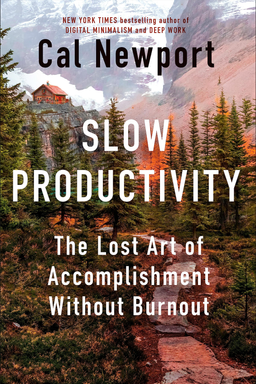
Slow Productivity: Redefining Accomplishment Without Burnout
What if real productivity had nothing to do with being busy? In Slow Productivity, Cal Newport challenges the modern obsession with busyness and proposes a radically different philosophy of work — one where accomplishment flows from depth, sustainability, and quality rather than frantic activity. Newport argues that modern knowledge workers aren't suffering from laziness or inefficiency; they are trapped in a flawed system that equates visible activity with value. The cost of this pseudo-productivity is burnout, fragmentation, and the erosion of meaningful achievement.
The Roots of a Crisis
Newport begins with an arresting contrast. In 1966, journalist John McPhee lay motionless on a picnic table for two weeks, staring into the leaves above, paralyzed by the challenge of structuring a long article about New Jersey’s Pine Barrens. His unhurried pause led to a breakthrough, launching one of the finest pieces of narrative journalism of the century. McPhee’s work, Newport notes, epitomizes accomplishment without frenzy — a rhythm of creativity now nearly extinct in the knowledge economy. Today, workers are tethered to email, chats, and meetings, forced to perform busyness in an endless digital panopticon. Newport calls this state pseudo-productivity: the reliance on visible activity as a proxy for meaningful output.
When the pandemic struck, millions of knowledge workers abruptly realized how unsustainable this system had become. Parents on Zoom calls while homeschooling children and remote employees answering Slack messages at midnight began to ask, “What are we really doing here?” From viral movements like quiet quitting to bestselling critiques such as Do Nothing by Celeste Headlee and Oliver Burkeman’s Four Thousand Weeks, the disillusionment with productivity as endless effort crystallized into a cultural moment. Newport saw in this weariness not laziness, but a desperate hunger for meaning and mastery.
The Birth of Slow Productivity
In response, Newport offers a philosophy he calls Slow Productivity — “the lost art of accomplishment without burnout.” Its foundation rests on three deceptively simple principles:
- Do fewer things: Focus on what truly matters rather than juggling countless trivial commitments.
- Work at a natural pace: Reject relentless urgency and allow work to unfold at the tempo of human creativity.
- Obsess over quality: Aim for excellence, not efficiency — because quality creates leverage, meaning, and freedom.
Slow Productivity, Newport explains, is not about idleness. It’s about restoring sustainability to knowledge work by learning from traditional “slow” models — from Renaissance scientists to twentieth-century artists — who balanced ambition with rhythm and respect for depth. Like The Slow Food movement founded by Carlo Petrini in Italy, which rebelled against the fast-food culture by celebrating regional ingredients and communal meals, Newport’s framework invites professionals to savor their craft again rather than gulping down their work.
Why Slow Productivity Matters
The stakes couldn’t be higher. Productivity, Newport reminds us, was once a clear measure—bushels per acre in farming, cars per hour in manufacturing. But knowledge work defies such easy quantification. Without clear metrics, we default to the proxy of visible busyness — answering emails more quickly, filling calendars with meetings, and confusing motion for progress. This model is collapsing under the weight of its own contradictions. By rethinking what it means to “produce,” Newport aims to replace pseudo-productivity with a human-centered model that prizes creativity and craftsmanship.
Slow productivity matters because it unlocks both sustainability and impact. It recognizes that doing fewer things better often yields greater results than doing more at once. It accepts that peaks of focus must be balanced by troughs of rest — much like the agricultural seasons or artistic cycles that used to govern work before the industrial era. And most of all, it insists that quality, not busyness, is the truest form of productivity.
The Journey Ahead
Across five major parts, Newport excavates how we arrived in this overworked state and presents a roadmap for transformation. First, he traces the evolution from measurable industrial productivity to the vague, performative ethos of knowledge-work busyness. He then draws from cultural movements like Slow Food to show how intentional, humane alternatives can flourish. The second half of the book distills decades of research, stories, and historical evidence into the three guiding principles of slow productivity: austerity (doing fewer things), rhythm (working at a natural pace), and craftsmanship (obsessing over quality).
You’ll meet examples from Jane Austen’s quiet years in Chawton Cottage, where reducing obligations unleashed her creative genius, to scientists like Galileo and Newton, whose unhurried brilliance reshaped human knowledge. You’ll see how Georgia O’Keeffe’s seasonal rhythms at Lake George inspired her prolific output, and how even modern icon Jewel turned down a million-dollar deal to protect her art. Each story grounds Newport’s thesis: lasting accomplishment is produced not by speed, but by slowness with purpose.
Ultimately, Slow Productivity is both a manifesto and a manual. It offers permission to work humanly and a framework for doing so effectively. Newport challenges you to measure your life not by messages sent or hours logged, but by meaning made, problems solved, and creative visions realized over time. In a culture defined by acceleration, he dares you to slow down — not to do less, but to do what matters most.