
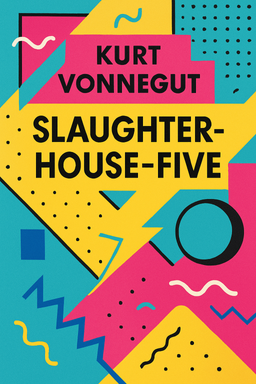
Slaughterhouse-Five cover

Slaughterhouse-Five

by Kurt Vonnegut

Slaughterhouse-Five by Kurt Vonnegut is a groundbreaking novel that follows Billy Pilgrim, a soldier unstuck in time after surviving Dresden''s bombing in WWII. Through a non-linear narrative and dark humor, the book critiques war''s horrors and life''s absurdities, offering profound reflections on fate, free will, and existence.

The Illusion of Free Will in a Chaotic Universe

Have you ever wondered whether your choices truly matter—or if your life is simply unfolding as it must? Kurt Vonnegut’s Slaughterhouse-Five asks this haunting question through the life of Billy Pilgrim, a man who becomes “unstuck in time.” Vonnegut’s novel merges science fiction, autobiography, and black comedy to explore the chaos of war and the illusion of free will. Through Billy’s experiences—from surviving the firebombing of Dresden to being abducted by aliens—the book insists that existence may be predetermined, absurd, and cyclical. Yet, amidst all that senseless destruction, Vonnegut finds moments of strange compassion and humor.

Vonnegut doesn’t just tell Billy’s story; he exposes how storytelling itself attempts to make sense of tragedy. The author directly inserts himself into the narrative, reminding us that he, too, witnessed Dresden’s destruction during World War II. His matter-of-fact refrain, “So it goes,” punctuates every death, echoing the resigned fatalism of the Tralfamadorians—alien philosophers who believe all moments exist simultaneously.

War, Memory, and Time

The central setting and trauma of Slaughterhouse-Five is the 1945 Dresden firebombing, which killed more than 100,000 civilians. Vonnegut’s alter ego insists, “There is nothing intelligent to say about a massacre.” In telling Billy’s fragmented story, Vonnegut refuses the traditional chronological war narrative. Billy’s mind slips through time—from his childhood in Ilium, New York, to his capture in WWII, to his later years as a successful optometrist. He relives his death before it happens. This fluid movement through past, present, and future mirrors how trauma resists order. Events return, collapse, and repeat. For Vonnegut, time isn’t a straight line; it’s a chaotic map of suffering and absurdity.

The notion of being “unstuck in time” becomes a metaphor for post-traumatic stress and memory itself. Like Billy, many veterans return home to find their minds trapped between moments they can’t control. By freeing Billy from linear time, Vonnegut externalizes this psychological fragmentation. Readers must piece together meaning from the fragments—mirroring Billy’s own futile attempt to do the same.

The Tralfamadorian Philosophy

When Billy is abducted by aliens from Tralfamadore, he’s displayed in a zoo alongside a Hollywood actress, Montana Wildhack. The aliens view all time as simultaneous—past, present, and future existing side by side. To them, death doesn’t end life; it’s merely one condition among infinite others. “When a person dies he only appears to die,” they say. “He is still alive in the past.” Their phrase, “So it goes,” becomes Vonnegut’s mantra, mocking humanity’s obsession with meaning while offering an odd comfort. The Tralfamadorians’ indifference to free will terrifies and liberates Billy. If everything is predetermined, there’s no guilt, no responsibility, and no hope—only acceptance.

Vonnegut juxtaposes this otherworldly fatalism with the grim absurdity of human war-making. While generals and ideologues rationalize slaughter, the novel implies they, too, might be trapped in cosmic inevitability. The author’s stark refrain “So it goes” flattens all distinctions between moral outrage and resignation. By repeating it relentlessly—after every death, comic or tragic—Vonnegut denies us catharsis. Yet this phrase also humanizes the narrator’s inability to comprehend mass death—the only sane response to insanity.

Why It Matters Today

For modern readers, Slaughterhouse-Five remains a meditation on the futility of trying to find reason in violence. In an era still haunted by war and trauma, Vonnegut’s blend of humor and horror rings truer than ever. The book anticipates a world of media saturation and desensitization, where tragedy becomes background noise. By twisting time and fusing genres, Vonnegut forces us to confront the way we look at history—not as a noble march of progress but as an endless loop of destruction, denial, and survival. His ultimate argument: we can’t control time or death, but we can choose compassion, humility, and laughter in the face of absurdity.


War as Nonsense and Machinery

Vonnegut begins his novel admitting there’s “nothing intelligent to say about a massacre.” For him, war defies language, logic, and morality. The destruction of Dresden—which Billy Pilgrim experiences as a prisoner of war—embodies this chaotic meaninglessness. Every attempt to describe it becomes absurd. Soldiers die for teapots, generals rationalize genocide, and even the survivors struggle to find purpose afterward. This absurdity infects the entire structure of the book: sentences collapse into repetitive fragments like “So it goes,” and scenes oscillate between dark tragedy and slapstick comedy.

Humans as Machines

Vonnegut portrays humans as mechanical beings conditioned by war and bureaucracy. Soldiers obey orders like parts in a machine, while civilians like Billy’s father-in-law worship technology and material success. The war machine grinds everyone into cogs. This mechanical motif culminates in Billy’s alien captors, the Tralfamadorians, who regard all beings as biological machines without free will. (Note: This mirrors themes from Albert Camus’s The Myth of Sisyphus, where absurd repetition becomes humanity’s defining condition.)

Black Comedy as Resistance

Vonnegut’s humor—often grotesque—acts as defense against horror. He has us laugh when we should cry, revealing how laughter becomes survival. A dying soldier’s body is treated casually; burnt cities are described with detached irony. This stylistic choice both critiques the dehumanization of modern war and offers a coping mechanism. In laughing at the absurd, we acknowledge our shared fragility. The humor doesn’t erase suffering—it makes it bearable enough to face.

By collapsing comedy and catastrophe, Vonnegut shows that war makes sense only as farce. Every machine of war—from bombers to propaganda—perpetuates death with bureaucratic precision, while individuals like Billy drift helplessly through its gears. The lesson: when life becomes mechanized, humanity dissolves. And yet, paradoxically, the only way to remain sane is to joke about our own madness.


Tralfamadore and The Philosophy of Time

The Tralfamadorians offer Vonnegut’s most radical idea: time is not linear but simultaneous. All moments exist eternally. For them, a corpse is merely a person “in bad condition” in one instant but alive elsewhere. This view eliminates moral progress and accountability—everything is simply what it is. Billy Pilgrim adopts their view after his abduction, learning to experience his life as a fixed panorama rather than a sequence. He moves among moments like radio channels: childhood, war, death, alien zoo, and back. Each is equally real and unchangeable.

Freedom Versus Fatalism

This philosophy comforts Billy. It absolves guilt, erases fear, and turns tragedy into inevitability. If everything happens as it must, even massacres lose their sting. Yet Vonnegut undercuts this serenity with irony. The Tralfamadorians’ peace is bought at the price of moral paralysis. They know the Universe will one day be destroyed by one of their test pilots but see no reason to intervene. Their fatalism mirrors Earth’s own apathy toward violence and destruction. As readers, we’re left to question whether acceptance is wisdom or cowardice.

Through this metaphysical lens, Vonnegut transforms time-travel from sci-fi trick to existential metaphor. Like trauma survivors, Billy revisits painful moments endlessly; like philosophical determinists, he lives without illusion of control. The result is both liberation and despair—an unblinking awareness that life’s beauty and brutality coexist permanently, frozen in amber.


Storytelling, Memory, and Trauma

Vonnegut blurs the boundaries between fiction and autobiography, memory and hallucination, truth and invention. In the first chapter, he speaks directly about his own struggle to write about Dresden. The war left him speechless for decades. “This one is a failure,” he confesses, “since it was written by a pillar of salt.” By openly confronting his failure, Vonnegut dramatizes how trauma resists representation. Billy’s fragmented story becomes the only possible way to tell an event beyond comprehension.

Nonlinear Narrative as a Mindscape

The book’s disjointed structure mirrors the workings of memory and trauma. Flashbacks come without warning, looping endlessly. Billy might be in his daughter’s wedding one moment, then back in a POW train the next. This technique models how survivors relive trauma involuntarily. The confusion compels readers to experience the same dislocation Billy feels. It’s not just storytelling—it’s psychological immersion.

Art as Survival

For Vonnegut, storytelling isn’t about explaining war—it’s about surviving it. By writing through laughter, irony, and science fiction, he gives shape to chaos. Art can’t fix history, but it can transform unbearable memory into something humane. Like Billy, Vonnegut “traffics in climaxes and thrills” only to reveal how empty those devices become in the face of real suffering. The fragmented narrative becomes both a memorial and a form of therapy—a way to keep living when nothing makes sense.


The Anti-Heroic Soldier

Billy Pilgrim is the antithesis of a war hero. Tall, awkward, and terrified, he’s a “filthy flamingo” among soldiers. Unlike Hemingway’s proud warriors, Billy lacks courage, strength, or direction. His survival isn’t victory—it’s absurd luck. By centering such a passive protagonist, Vonnegut subverts the glorification of heroism in war fiction. Billy’s helplessness reveals the truth: wars aren’t won by great men—they happen to ordinary ones.

The Children’s Crusade

Vonnegut dedicates the novel to Mary O’Hare, the wife of his wartime friend, who accused him of glorifying war. She protests that soldiers were “just babies.” So he promises to call the book “The Children’s Crusade.” This framing denounces the myth of noble combat. The Dresden soldiers are barely men—teenagers dazed and ill-equipped. By calling attention to their youth, Vonnegut transforms readers’ moral perspective. Every fallen soldier becomes someone’s lost child.

Innocence and Experience

Billy’s name itself—Pilgrim—signals a spiritual journey devoid of triumph. He wanders toward an understanding that nothing heroic comes from killing. His meekness contrasts the cruelty of men like Roland Weary or Paul Lazzaro, whose obsession with revenge fuels endless pain. Billy’s “anti-heroism” thus becomes moral insight. In refusing to fight back, he exposes the futility of violence. If traditional war novels celebrate courage, Slaughterhouse-Five celebrates mercy—and the courage to be absurdly kind.


Humor, Irony, and the Human Condition

Vonnegut’s trademark humor runs through even his bleakest pages. He uses irony not to diminish suffering but to illuminate humanity’s contradictions. Laughter becomes a form of truth-telling when logic fails. The repeated juxtaposition of horror and comedy—like a corpse described with almost cheerful detachment—creates emotional whiplash. This is black humor at its most profound: we laugh because crying would destroy us.

Satire of Modern Society

Outside the war, Vonnegut lampoons American life—its greed, consumerism, and blind faith in progress. Billy, the optometrist, literally “sells vision,” yet remains spiritually blind. His daughter, Barbara, is obsessed with appearances; his world prizes material comfort and technological toys over empathy. Through such satire, Vonnegut links the mindless destruction of war to everyday moral numbness. In both, humanity mistakes busyness for meaning.

Laughter as Compassion

Even amid sarcasm, Vonnegut’s tone remains tender. He laughs not at his characters but with them—acknowledging that we’re all ridiculous creatures craving order in chaos. Against the backdrop of atomic bombs and alien abductions, his humor insists that absurdity is humanity’s only home. Much like Mark Twain or Joseph Heller (Catch-22), Vonnegut uses satire not to preach despair, but to reveal that kindness and irony can coexist. His moral vision: when we stop taking ourselves too seriously, we might finally become humane.


Cycles of Death and Survival

Death saturates Slaughterhouse-Five, yet its tone is curiously serene. The phrase “So it goes” follows every death—from mass bombings to dying dogs to dead friends. Over a hundred times, this refrain appears, transforming death from catastrophe into inevitability. By ritualizing these words, Vonnegut both numbs and awakens us. We accept death’s ubiquity yet feel its hollowness. Life continues—so it goes.

The Destruction of Dresden

The novel’s emotional climax—the Dresden firebombing—is told with chilling simplicity. The city is reduced to “a moonscape.” There’s no melodrama, just quiet astonishment. Billy and other POWs hide in an underground slaughterhouse and emerge to find 135,000 dead. Vonnegut’s understated tone becomes protest through understatement. Words fail, and that failure becomes moral truth.

Resilience and Memory

Even after witnessing apocalypse, Billy goes on—aging, marrying, crying quietly over small absurdities. His endurance mirrors humanity’s: fragile, bewildering, unstoppable. Vonnegut refuses both despair and redemption. Instead, he celebrates survival itself as defiance. Every “So it goes” becomes a whispered prayer of persistence—the insistence that, despite massacre, we still tell stories, still love, and still laugh.


Art, Death, and the Writer’s Duty

In the end, Vonnegut’s self-insertion turns Slaughterhouse-Five into a meta-critique of art’s limitations. The author admits the book cost him “money, anxiety, and time,” yet it failed to make sense of Dresden. He compares himself to Lot’s wife, who looked back and turned into a pillar of salt. Like her, he cannot resist mourning the past. This self-awareness transforms the novel into both confession and elegy—an acknowledgment that art cannot justify death, only testify to it.

The Dance With Death

Vonnegut calls the subtitle “A Duty-Dance with Death,” suggesting that writing about war is both obligation and performance. The author dances clumsily but faithfully, refusing false heroics. His fragmented storytelling becomes a duty fulfilled with humility. In naming the absurd and memorializing the dead, he offers compassion where history offered firestorms.

The Quiet of the Birds

The book closes not with triumph but with silence. After all the chaos, only a bird remains, asking, “Poo-tee-weet?” It’s nonsense—a question without meaning. Yet it’s the only possible response after war’s collapse of language. In that meaningless sound lies the last flicker of life’s continuity. Vonnegut ends where words fail, leaving readers in the hush of survival—the space where mourning turns to mercy.

Dig Deeper

Get personalized prompts to apply these lessons to your life and deepen your understanding.

Go Deeper

Get the Full Experience

Download Insight Books for AI-powered reflections, quizzes, and more.