
Idea 1
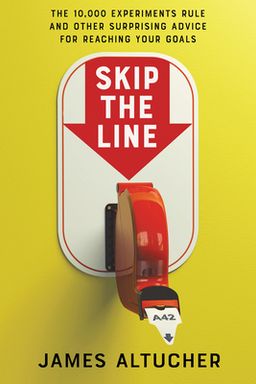
Skip the Line: Redefining Success in a Chaotic World
What if everything you were taught about achieving success—the years of education, gradual promotions, and waiting patiently for your turn—was wrong? In Skip the Line, entrepreneur and author James Altucher argues that the traditional path to mastery and achievement is outdated, especially in a world upended by constant uncertainty. Whether due to technological change or global crises like the Covid-19 pandemic, life today rewards adaptability, experimentation, and fast learning more than credentials or endurance. Altucher contends that the key to reinventing yourself and thriving in any profession is learning how to skip the line—to become exceptionally good, exceptionally fast, by breaking rules that no longer serve you.
Altucher’s core premise challenges decades of conventional wisdom around success. Forget the myth that mastery demands ten thousand hours of deliberate practice (popularized by Malcolm Gladwell and Anders Ericsson). Instead, Altucher proposes the 10,000 Experiments Rule: conducting small, low-risk, high-upside experiments to rapidly learn, adapt, and discover what really works for you. This mindset empowers you to become the scientist of your own life—testing ideas, reinventing yourself when needed, and fully embracing the land of uncertainty. “Skipping the line,” writes Altucher, isn’t about cheating or shortcuts—it’s about playing by better rules.
Living in the Land of Not Knowing
Altucher opens with stories of personal crises—from losing millions after the 2008 crash to restarting his career repeatedly. His message crystallized when he walked into the HBO CEO’s office as a junior employee to pitch an idea—that bold act of disobedience became a metaphor for skipping the invisible lines that hold most people back. He learned that the greatest fear isn’t failure—it’s uncertainty. Our brains crave predictability because evolution rewarded those who ran at the first rustle in the bushes; they survived, while others got eaten. Yet thriving in modern life requires the opposite skill: staying calm in uncertainty and even enjoying it.
The ability to embrace not-knowing is what Altucher calls exercising your “possibility muscle.” You practice seeing opportunity where others see fear. He argues that a pandemic, financial crisis, or personal failure doesn’t destroy life—it resets it, offering a chance for reinvention.
From 10,000 Hours to 10,000 Experiments
The traditional path of mastery—the 10,000-Hour Rule—requires years of deliberate practice under expert supervision. Altucher redefines mastery through experimentation. Whether you are learning comedy, investing, entrepreneurship, or writing, he emphasizes doing tiny experiments daily; each one offers small downside, enormous upside. Failure isn’t tragic—it’s data. Like Galileo dropping two objects from the Leaning Tower of Pisa or Thomas Edison testing thousands of battery cells, your everyday experiments help you skip ahead faster than waiting decades for expertise.
By trying things repeatedly and learning from them, you compound improvement. This is where Altucher introduces the 1 Percent Rule: if you improve just one percent a day, those small gains multiply exponentially, making you nearly forty times better within a year. The compounding of skills works like interest—it starts small but grows into greatness. Taken together, these principles create a roadmap for quick learning and disruptive creativity, replacing patience with curiosity and courage.
Why This Matters
In a world where institutions—from jobs to education—fail to guarantee stability, learning how to skip the line is a survival skill. Altucher’s story is a plea for every person trapped in outdated hierarchies, waiting for permission to act. He describes society as a collection of tribes, each with its hierarchy of alphas and omegas; climbing these hierarchies used to ensure safety, but now, the safest strategy is to step out of line entirely and create something new. This isn’t rebellion for its own sake—it’s about freedom, self-respect, and meaningful success. “Don’t resist the world,” he writes. “Relax and use the forces around you to your advantage.”
Throughout the book, Altucher transforms vulnerability, experimentation, and curiosity into tools of empowerment. He shows that you can start from zero, lose everything, and still rebuild faster than ever by playing with possibilities every day. Instead of clinging to safety, you wobble forward—the Wright brothers learned to fly by embracing imperfection, and Altucher argues that so can you.
Ultimately, Skip the Line is a manifesto for creative reinvention in an unpredictable age. It teaches you how to think independently, move quickly, and redefine success as something you design, not something you inherit. Whether you want to change careers, start a new business, explore art, or simply regain passion for life, the message is clear: stop waiting for permission. Experiment boldly. Let curiosity drive you. And don’t just move forward—skip the line entirely.