
Idea 1
Skin in the Game: Why Fairness and Risk Are Inseparable
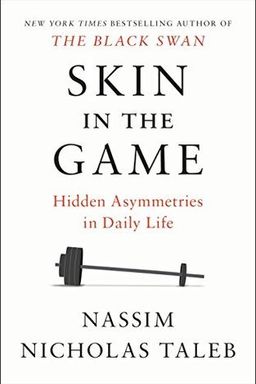
How do you know whose advice to trust—the polished expert in the suit or the person whose own survival depends on being right? In Skin in the Game: Hidden Asymmetries in Daily Life, Nassim Nicholas Taleb asks this provocative question and builds his argument around a timeless principle: if you don’t bear the consequences of your decisions, you shouldn’t make them for others. Taleb contends that fairness, competence, and genuine knowledge all arise from the same source—having one’s own skin, or life, in the game.
Taleb’s core argument is simple but radical. It upends the modern culture of bureaucrats, economists, journalists, and technocrats who give confident advice, impose policies, and make large-scale decisions while detached from the personal risks their choices entail. If you recommend an investment, design a social policy, or build a bridge, your advice is credible only if you’re personally exposed to the downside. Otherwise, as Taleb writes, you’re just running a “Bob Rubin trade”—keeping the upside and making others pay the price when things go wrong.
The Ancient Roots of Symmetry
Taleb traces this idea to Hammurabi’s Code, written nearly four thousand years ago: “If a builder builds a house and it collapses killing the owner, the builder shall be put to death.” From this principle emerged the moral symmetry between reward and risk that sustains civilizations. Across history, from Spartan warriors dying alongside their soldiers to Roman emperors leading from the front, Taleb shows that societies remain just only when leaders share the dangers of their followers. The decay begins when elites insulate themselves from the outcomes of their own decisions.
The Logic of Real Rationality
Rationality, for Taleb, isn’t a matter of abstract calculation or academic models. It’s rooted in survival. True rational actions are those that keep the individual—and humanity—alive over time. This makes him a fierce critic of economists and psychologists who think risk-taking can be measured by static probabilities or “cost-benefit analysis.” When ruin—complete and irreversible loss—is possible, averages and long-term forecasts become meaningless. His famous metaphor of not crossing a river “that is on average four feet deep” captures the flaw in reasoning that ignores lifetime exposure to risk.
The Hidden Asymmetries of Modern Life
Modern societies, Taleb argues, are plagued by hidden asymmetries that make life unjust and fragile. Politicians don’t pay for failed wars; bankers keep their bonuses after financial crashes; journalists spread falsehoods without personal accountability. These distortions between upside and downside create moral hazard—the foundation of inequality and systemic collapse. The only cure is exposure: tying action to consequence. Taleb applies this logic to all areas of life—ethics, business, medicine, governance, and even friendship—showing how skin in the game restores reciprocity and truth.
The Structure of the Book
In exploring this theme, Taleb moves from ancient ethics to modern complexity science. He starts with fairness and equality in uncertainty, then examines agency problems (where decision-makers are insulated from risk), the role of courage in risk-taking, and the irrationality of rationalism divorced from reality. Through examples drawn from real trade, philosophy, and history—from Fat Tony, his streetwise alter ego, to the absurdities of bureaucratic academia—Taleb teaches that wisdom arises not from theory but from contact with the real world.
Why It Matters Now
Taleb’s ideas matter because they expose the ethical and practical failures of the systems we trust most. We are ruled by people who forecast without risk, legislate without consequences, and moralize without sacrifice. In contrast, those with skin in the game—entrepreneurs, soldiers, artisans, and authentic thinkers—forge resilient systems precisely because they risk something real. For Taleb, skin in the game is not just a rule of fairness; it’s the key to human evolution, survival, and integrity. It reminds you that truth only reveals itself to those who have something to lose.