
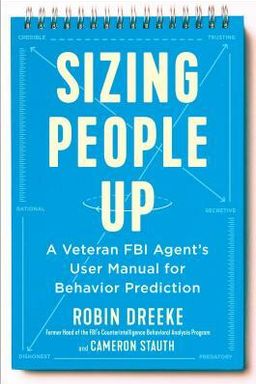
Sizing People Up cover

Sizing People Up

by Robin Dreeke and Cameron Stauth

Sizing People Up reveals the hidden behavioral cues that reveal true intentions, teaching you to identify trustworthy individuals and avoid deceit. With insights from a veteran FBI agent, learn to predict behavior and build stronger relationships.

Sizing People Up: The Science of Predicting Behavior

How can you know who to trust in a world filled with manipulation, uncertainty, and emotional chaos? In Sizing People Up, former FBI agent Robin Dreeke argues that trust isn’t about morality—it’s about predictability. Drawing on his decades of experience in counterintelligence and behavioral analysis, Dreeke teaches that anyone can learn to forecast human behavior with precision once they understand the six fundamental signs that reveal what people will do next.

Dreeke contends that sizing people up is not about judging them—it’s about understanding them rationally, objectively, and free from emotion. By studying the psychological patterns that govern decisions, he discovered methods that FBI Behavioral Analysis agents use to make accurate predictions in crises, negotiations, and relationships. These same techniques can help you assess allies and adversaries in your own life.

The Core Idea: Predictability over Morality

At the heart of the book lies Dreeke’s assertion that trust equals predictability. People act according to their self-interests—what they believe will benefit them the most. If you can identify those interests, you can foresee their future actions. This principle, borrowed from both social science and espionage strategy, replaces gut instinct with observation and logic. Dreeke invites readers to abandon naïve optimism and moral judgment in favor of data-driven behavioral prediction.

For Dreeke, the ultimate goal is not to label people as good or bad but to recognize how reliably they pursue their goals. The essence of trust emerges when individuals are transparent, competent, and consistent. A person might not share your values, but if their actions follow a rational pattern, they become trustworthy in the sense that their behavior is foreseeable.

From Espionage to Everyday Life

Dreeke’s perspective is rooted in high-stakes counterintelligence—from chasing double agents like Robert Hanssen to building alliances with Russian informants after 9/11. Yet he demonstrates that the same analytical techniques apply to marriages, friendships, and workplaces. Regardless of context, the principles are constant: understand motives, observe actions, and interpret language and emotional stability through clear behavioral cues.

For example, when Dreeke helped a Russian source named Leo rebuild trust after the 9/11 attacks, he relied on subtle tells—body language, consistency of communication, and mutual vested interests—to measure Leo’s reliability. Similarly, when mentoring agents like Jesse Thorne or Linda, Dreeke found that prediction depended less on charisma and more on detecting emotional signals such as fear, humility, and reasonableness.

The Six Signs for Behavioral Prediction

The book unfolds through six interconnected signs designed to help readers size people up: Vesting—whether someone benefits from your success; Longevity—whether they expect the relationship to last; Reliability—their competence and diligence; Actions—their consistent behavioral patterns; Language—the style and honesty of their communication; and Stability—their emotional maturity and rationality. Each sign builds upon the others, creating a holistic framework for predicting behavior.

Through these six lenses, Dreeke walks readers step by step through the FBI’s analytical thinking process: gather objective evidence, avoid emotional hijacking, and verify trust by observing rather than assuming. This system moves beyond intuition toward structured behavioral intelligence.

Why This Matters

Dreeke’s system matters because modern relationships, workplaces, and institutions function in a perpetual fog of uncertainty. Emotional reactions, biases, and gut feelings often mislead us in negotiations, hiring decisions, or even friendships. Dreeke invites you to think like an FBI behavioral analyst—to approach trust with reason and discipline.

By applying these methods, you can predict others’ choices, build bulletproof alliances, and navigate an unpredictable world with calm rationality. Ultimately, Dreeke’s message is empowering: you don’t need perfect intuition or years in counterintelligence to see inside people—you only need the courage to replace fear with logic. Once you embrace that, you’ll not only size people up effectively but also reshape how you see yourself and the world around you.


Vesting: Building Bulletproof Alliances

The first sign in Dreeke’s system—Vesting—asks a deceptively simple question: does this person believe they’ll benefit from your success? When someone invests their time, effort, or reputation in your achievements, their behavior becomes more predictable. Vesting creates alignment, a shared purpose where your interests and theirs intertwine.

Mutual Benefit as the Foundation of Trust

According to Dreeke, self-interest rules human behavior. He learned this early working with informants like Leo, a Russian double agent. When Leo realized that Dreeke’s success meant safety for his family, cooperation became natural. Their alliance wasn’t sentimental; it was transactional—but that transaction produced loyalty and reliability. This is why Dreeke calls vesting “the most powerful animator of teamwork.” (Comparable to Adam Grant’s reciprocity principle in Give and Take.)

Positive and Negative Tells of Vesting

Vesting reveals itself through behavioral tells—signals that indicate mutual commitment. Positive tells include people working at your tempo, celebrating your wins, and calling in their own favors to support you. Negative tells emerge when people exclude you from meetings, exaggerate your mistakes, or fail to mention your success. Dreeke reminds you that these cues are not personal insults—they’re data for predicting future cooperation.

“People who consistently create a positive brand for you are pure gold.”

To Dreeke, those who champion your success publicly prove their own stability. Mutual vesting creates loyalty that transcends momentary projects and reaches into identity and purpose.

How to Use Vesting in Life

You can apply vesting in any relationship. In business, invest in your team’s goals so they’ll naturally invest in yours. In family life, express gratitude that signals shared fate. When others recognize that supporting you supports them, their trust deepens without persuasion. Dreeke advises: offer help first. When you become a resource for others’ success, you invite them to do the same—it’s psychological reciprocity at work.

Ultimately, vesting transforms strangers into allies. It’s less about charisma and more about consistency—demonstrating that your interests align. When people tie their destiny to yours, prediction becomes easy: they’ll act to protect, promote, and preserve what benefits both of you.


Longevity: Time as a Predictor of Trust

The second sign, Longevity, focuses on whether someone believes the relationship will last. Dreeke’s insight is brutally pragmatic: people treat you better when they expect to deal with you for a long time. This expectation creates accountability and encourages cooperation, because the consequences of betrayal grow with time.

Accelerating Trust Through Relativity

While building long-term bonds normally takes time, Dreeke shows you how to accelerate the process. Borrowing from Einstein’s principle of relativity, he teaches that time feels longer when experiences are intense or intimate. You can create this “fast-forward effect” through shared challenges, rituals, honesty, and emotional validation. These “relationship hacks” help people feel as though they’ve known you for years—an illusion that breeds predictability.

The Code of Trust

Dreeke integrates his earlier system called the Code of Trust: suspend your ego, validate others, avoid judgment, be reasonable, and be generous. When you embody these principles, others instinctively imagine a longer future with you. The perception of longevity turns ordinary interactions into ongoing alliances. (Parallel idea: Stephen Covey’s “emotional bank account” builds trust through consistent deposits.)

Positive and Negative Tells

Signs that someone expects longevity include invitations to be part of their goals, enthusiasm about your inclusion, and using “we” instead of “I.” Negative tells show detachment: forgetting your name, excluding you, staying impersonal, or never asking about your future plans. When you notice these cues, Dreeke advises objectivity—don’t take rejection personally; let it guide your expectations.

In Dreeke’s story of his friendship with Annan, a source who helped prevent nuclear conflict, longevity emerged through shared rituals and gratitude that lasted seventeen years. Longevity signals emotional investment—and when it exists, you can confidently trust and predict behavior, knowing the person is thinking beyond today.


Reliability: Competence and Diligence

The third sign—Reliability—asks whether a person can and will do what they say. Dreeke defines reliability as the intersection of competence and diligence. Competence measures skill; diligence measures perseverance. Without both, promises mean nothing. “You can love someone with all your heart and still not rely on them,” he writes.

The Competence-Diligence Equation

Competence ensures ability, diligence ensures effort. Dreeke recounts his frustrating partnership with “George,” a drone task force leader who had technical brilliance but poor people skills. George’s competence couldn’t compensate for his lack of diligence and communication. In contrast, Dreeke’s mentor, Doug Wellborne, excelled because his reliability made him indispensable—he combined mastery with motivation.

How Reliable People Behave

Reliable people are calm under pressure, transparent about mistakes, inquisitive, and fast-paced. They accept blame, prioritize productivity, and maintain positive nonverbals even in stress. Unreliable people micromanage, hide errors, procrastinate, and dress sloppily—symbols of internal disorganization. Dreeke points out that physical cues reflect mental reliability more than words do.

“Reliability is virtually synonymous with trust.”

This consistency forms the backbone of any alliance in espionage, business, or marriage. Without reliability, longevity and vesting collapse.

Reliability reveals character through measurable performance—how people handle time, stress, and accountability. Dreeke recommends tracking patterns rather than isolated events. When you notice steady competence and diligence, you can safely predict the person will act rationally in their own best interests—and possibly in yours.

For leaders, reliability is about empowering others. As Dreeke puts it, leadership grows fastest when you release control and trust diligently competent teammates. In doing so, you foster a culture of predictable excellence—the kind every organization craves.


Actions: The Dealbreakers of Character

The fourth sign—Actions—turns Dreeke’s mantra into a rule: words can lie, actions cannot. What people do, when observed objectively, offers irrefutable evidence of their character. Dreeke learned this through missions involving Russian diplomats, where patterns of action revealed loyalty or treachery more clearly than speech.

Patterns Define Character

Actions repeated over time create a behavioral fingerprint. Honest individuals show consistency across contexts; manipulators shift with circumstance. Dreeke’s operation with a former marine colonel and a Russian general demonstrated that loyalty persists through adversity—an act rooted in character. Even failure, he found, could confirm integrity when followed by accountability.

Positive and Negative Tells

Positive action tells include consistency, loyalty under criticism, factual transparency, and avoidance of gossip. Negative tells include blaming others, erratic behavior, secrecy about previous colleagues, or treating subordinates differently from superiors. Dreeke connects these patterns to the “power paradox”: people insulated by power or wealth often behave worse because they feel immune from consequences.

“For good or ill, it’s your actions that define you.”

Dreeke’s investigations taught him that even noble words collapse under inconsistent deeds. Character is measured not by ideals but by habits.

To apply this principle, Dreeke advises watching real-time reactions—how people act when stressed, rejected, or criticized. Emotional self-control and responsibility predict reliability much better than confidence or charm. In essence, actions turn trust from a theory into data.

When you focus on actions over promises, you see people as they are, not as they wish to appear. This shift—from moral judgment to behavioral observation—is liberating: it enables you to manage expectations, protect yourself from deceit, and choose trustworthy allies based on proof, not perception.


Language: The Reveal of Character

Language—the fifth sign—is Dreeke’s favorite. “Because the whole aim of language is to tell someone something, it is one long tell,” he says. The words people use reveal how they think. The language of trust is a dialect of empowerment, reason, and humility. When you master it, you can hear sincerity and deception instantly.

The Language of Trust

Trustworthy speakers use inclusive pronouns (“we”), validate others’ opinions, and ask questions before making statements. They focus on similarities instead of differences, talk less about themselves, and remain calm during disagreement. Their words carry clarity, compassion, and reason. Dreeke calls these patterns “nonjudgmental validating statements that empower people with choice.”

Detecting Distrust Through Words

Language also exposes manipulation. Negative tells include bragging, defensiveness, absolutism (“always,” “never”), debating rather than discussing, and using psychological excuses to justify poor behavior. Dreeke observed CEOs and agents whose eloquence hid arrogance until their body language—tensed brows, forced smiles—betrayed stress. Words and nonverbals must align; when they don’t, deception lurks.

“Complexity conceals; simplicity reveals.”

Clear, direct speech signals sincerity. Overcomplicated phrasing often hides insecurity or manipulation.

Applying the Language of Trust

In Dreeke’s consultancy with a Silicon Valley executive, language determined trustworthiness. The CEO’s scripted, jargon-filled “cold-call” dialogues alienated clients; Dreeke replaced them with genuine questions that centered on the listener. Within hours, communication shifted from manipulation to cooperation. The result? Authentic connections built from rational empathy.

When you speak the language of trust—listening, validating, and offering choice—you not only expose truth but also create it. Language becomes a mirror of character, and through its reflection, you see clearly who deserves your trust.


Stability: Emotional Maturity and the Quiet Mind

The final sign, Stability, is Dreeke’s culmination of wisdom: emotional stability is the key to predicting behavior. Unstable people are impossible to read because fear distorts their rationality. The calm, stable mind—what Dreeke calls the quiet mind—can be trusted; the unstable, fearful noisy mind cannot.

The Quiet vs. Noisy Mind

Drawing from neuroscience, Dreeke explains that love and fear are the brain’s two primal emotions. Fear triggers the reptilian brain, causing defensiveness, manipulation, and volatility. Love activates the forebrain, fostering empathy and rationality. The difference defines emotional stability. People led by fear act erratically; people governed by love act predictably, even under pressure.

Positive and Negative Tells

Stable individuals demonstrate appreciation, rationality, calmness, and flexibility. They respect power without craving it, and they handle change gracefully. Unstable ones exhibit helplessness, blame, entitlement, volatility, and manipulation. Dreeke observed these patterns in cases ranging from political tyrants to ordinary coworkers—the same psychological forces drive both extremes.

“Appreciation is the purest form of love—and love is the strongest antidote to fear.”

In Dreeke’s model, gratitude signals emotional health. People who appreciate others rarely betray them.

Creating Stability in Yourself

Stability is not innate—it’s learned through humility and self-awareness. Dreeke narrates his transformation from an insecure type-A marine into a calm behavioral analyst by mastering stoicism and empathy. Over time, he realized that predicting others first requires understanding oneself. “You don’t have to be better than others to be amazing,” he writes. “You only need to be good enough.”

When you cultivate the quiet mind—through rational thought, compassion, and gratitude—you attract sane, reliable people. Emotional stability becomes your shield against manipulation and chaos. In Dreeke’s world, it is both the starting point and destination of trust.

Dig Deeper

Get personalized prompts to apply these lessons to your life and deepen your understanding.

Go Deeper

Get the Full Experience

Download Insight Books for AI-powered reflections, quizzes, and more.