
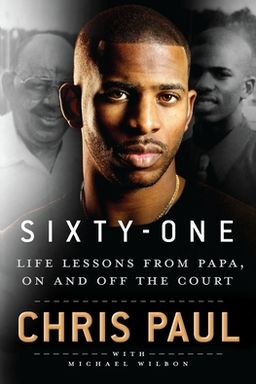
Sixty-one cover

Sixty-one

by Chris Paul With Michael Wilbon

The N.B.A. player details the death of his grandfather, who started and operated the first Black-owned service station in North Carolina.

Family, Faith, and Work: The Engine Behind Greatness

What’s the deepest well you draw from when life blindsides you—family, faith, or the grit to keep showing up? In Sixty-One, Chris Paul argues that all three are the same well, poured into him by one man: his grandfather, Nathaniel “Papa Chilly” Jones. Paul contends that his career—twelve-time NBA All-Star, two-time Olympic gold medalist, NBPA president—sprang less from talent than from Papa’s daily sermons in grease, cash, and generosity at Jones Chevron, the first Black-owned service station in North Carolina. But to see how that blueprint works in your life, you have to understand how family stories, loss, and stubborn work knit together into something you can stand on when everything else shakes.

What the book really argues

Sixty-One isn’t a standard sports memoir. It’s a father-and-son story told through a grandson and a deacon-mechanic who kept a radio tuned to the obituaries and answered, “I’m blessed and highly favored,” every single time someone asked, “How you doing?” Paul’s core claim: greatness is a community project. It’s built by elders who hand you a work ethic, by churches that teach you reverence and belonging, and by a thousand small, unglamorous reps you do long before the arena lights ever find you. It’s also held together by meaning you choose in the face of grief—like the night he scored 61 points, then deliberately threw a free throw out of bounds to freeze the number at his grandfather’s age, and walked off sobbing into his father’s arms.

Why this matters for you

You may never run a pick-and-roll at Madison Square Garden. But you will have to lead under pressure, invest in people who can’t pay you back, face injustice you can’t fix overnight, and keep your soul intact while you chase excellence. Paul’s map shows how: anchor in your roots, set a standard for hard work you can live with at 5:00 a.m. and at 11:59 p.m., and translate pain into purpose. It’s the same territory mapped in other classics about resilient meaning-making (see Viktor Frankl’s Man’s Search for Meaning or Angela Duckworth’s Grit), but Paul’s road signs are Southern, specific, and smudged with motor oil.

What you’ll see in this summary

We’ll start inside Jones Chevron—phone number 723-2232—where a “red rag” in your pocket meant you were on the clock, $19.40 inspections produced 60-cent tips for grape sodas, and two welded bus seats out front hosted the Jones Disciples (including Hall of Famer Clarence “Big House” Gaines). You’ll meet Happy, the Vietnam vet whose laugh taught sympathy; George Durham, the young man Papa trained instead of writing off; and a Winston-Salem defined by tobacco and tight-knit churches like Dreamland Park Baptist. You’ll see how those spaces taught Paul the virtues he still uses: show up early, serve first, give cash without keeping score, and tell the truth about loss without letting it harden you.

How grief forged the standard

When five teenagers beat Papa during a robbery and he died of cardiac arrhythmia at 61, the book becomes a study in how you metabolize injustice. Paul walked into a gym in Parkland High School days later, dropped 61, and then chose ritual over record-chasing. In the years that followed, he carried Papa’s obituary in his hand during the national anthem at Wake Forest, stitched a Chevron logo into his Jordan Brand shoes, and turned his platform into community work—scholarships in Papa’s name, a CP3 foundation, leadership of the NBPA, and public stances from Donald Sterling to the NBA’s 2020 bubble message set (“EQUALITY” on his jersey). The claim is stark: meaning isn’t found; it’s made, the way you’d rebuild an engine—carefully, together, with the right tools.

Leadership, translated off the court

You’ll learn how Coach Skip Prosser at Wake Forest sharpened Paul’s raw home values into a leader’s operating system: “Don’t cheat the Deacs,” “Never delay gratitude,” “The ABCs of life: Academics, Basketball, Character.” You’ll see how pros like Kobe Bryant and mentors like Gilbert Arenas and Jay-Z modeled craft and decision-making, and how Paul built Team CP3 and stewarded younger players (think Reggie Bullock) through an AAU culture he calls both beautiful and compromised. You’ll also see him parent—limiting screens, assigning chores, visiting the old station with his kids—so the next generation understands where the grind comes from.

The big promise

If you build your life the way Papa ran Jones Chevron—own your work, keep your word, open early, close late, bless people freely—you can withstand the worst hit and still become the kind of person others follow. Paul’s life argues this isn’t just character; it’s a competitive advantage. As Coach Monty Williams puts it: “Reps remove doubt.” Paul’s addendum: community removes despair.

By the end, you’ll have a practical framework you can borrow tomorrow morning: anchor yourself in your roots, outwork your excuses, ritualize remembrance, use your platform together with others (not alone), and keep choosing people over performance. That’s the rarest thing Sixty-One offers—a way to win that feels like home.


Papa Chilly’s Grease-Stained Gospel

Chris Paul roots his entire playbook in a man with perma-stained hands and a perma-bright spirit. Nathaniel “Papa Chilly” Jones ran Jones Chevron—after first fighting to own the land under it because he’d been denied that chance at his original Jones Gulf by a white landlord—and turned a three-bay garage into a leadership academy for a neighborhood. When people asked, “How you doing, Jones?” his reflex was one liturgy: “I’m blessed and highly favored.” That wasn’t optimism; it was marching orders.

Ownership before optics

Papa closed his first station and signed a mortgage on his second—a business lesson you can use: equity beats exposure. He didn’t brag; he brought his daughters, Robin and Rhonda, to surprise them under the new “JONES CHEVRON” sign. From then on, everything at 723-2232 ran like a craft—from $19.40 inspections (sixty cents change = grape soda money for young CJ and Chris) to whole-engine swaps, to the full-service pump where the boys learned hospitality and hustle. The red rag in your pocket meant you were on duty. The AM radio buzzed with news, oldies, and—always—the obituaries, so Papa could honor people by name. He said grace with his hands.

Community as waiting room and classroom

Two old bus seats welded into the concrete hosted the Jones Disciples, neighborhood elders who debated Winston-Salem State versus the Bulls, told raw jokes, and wrapped mentorship in laughter. Hall of Fame coach Clarence “Big House” Gaines sat there too and told a teenage Chris, “Your little butt can play.” Papa’s station hired laid-off workers and trained them; he gave out cash to cover light bills, never tallying. And when a rival spread a lie that he “mixed water” in his gas before the Tom Joyner $1-per-tank giveaway, Papa refused to fight dirty; he kept serving, and the line curled a mile down to Ackingna’s blue awning.

Seeing the person, not the problem

Happy, a Vietnam vet, laughed with all thirty-two teeth through heavy PTSD. Sometimes he slept in the bathroom, and Papa told a young Chris, “Let him rest.” George Durham, written off as a “bad kid,” became an all-around tech because Papa saw a son where others saw a case file. This is social responsibility at ground level. (Note: Compare to Bryan Stevenson’s Just Mercy—both insist proximity is what changes people, not policy alone.)

Cash as pedagogy, not status

Papa loved cash because it kept things liquid—tips for the boys, change for customers, visible proof for kids that honest work had weight. He paid family in responsibility: opening and closing the shop; cleaning bathrooms that “smelled like a pile of…”; rotating tires until your palms turned black; stepping into church still in greased work pants but church loafers. He doled out Sunday free gas to family—full suits, bright hats, and full tanks—because provision is a love language. Chris learned his first tax lesson when a post-school paycheck ran short, shockingly, of withholdings. Money was never flex; it was fuel.

Lessons you can steal tomorrow

  • Own the foundation: control what your work rests on (land, IP, schedule) so service can be principled, not panicked.
  • Make your space a porch: create a physical or ritual “bus seat” where stories and standards get transmitted.
  • Teach by showing: a red rag, a ritual, and consistent hours beat a thousand speeches (see James Clear’s Atomic Habits for how environment shapes behavior).

Papa’s mantra

“Get comfortable being uncomfortable” was how Papa nudged boys into men—letting unlicensed grandsons move cars around the lot, or insisting on full-service when it was 100 degrees out. That discomfort matured into Chris Paul’s default setting under playoff pressure. The shop was his first gym.

In short, Papa’s gospel was embodied: open early, help first, take the high road, and let the neighborhood write your résumé. It’s not sentimental. It’s a scalable way to lead when your hands are, and will remain, dirty from the work.


Relentless Is a System, Not a Mood

“You won’t outwork me.” Chris Paul borrows that from Papa’s station and translates it into a career-long operating system. The book makes an important distinction you can use: relentlessness isn’t hype; it’s a set of repeatable choices—what time you wake, what you write on your shoes (“Can’t Give Up Now,” a Mary Mary gospel line he adopted in OKC), who you train with, how you respond when counted out. The point isn’t bravado. It’s building rituals that survive bad news cycles, injuries, and trades.

Start where you’re benched

Paul played JV his freshman and sophomore years, while peers jumped to varsity. He burned, then built: running from one gym to the other to practice with varsity after JV; dominating nights on the tiled, slick floor; preparing so that when elevation came, it stuck. That two-year detour—he argues—built the confidence engine he’d later ride in the NBA. (Compare to Carol Dweck’s growth mindset: setbacks as data, not verdicts.)

Reps remove doubt

Coach Monty Williams’ favorite line became Paul’s creed. In practice, that looked like pre-dawn Olympics lifts where he tried to beat Kobe Bryant to the gym—and often lost, then learned. It looked like offseason work with “Hoops Whisperer” Idan Ravin, running multi-move cone sequences until he could match Gilbert Arenas drill-for-drill—and sometimes surpass him in head-to-heads. It looked like evolving his training with age (strength coach Brett Gunning’s advice in Houston: learn to work with teammates who don’t care as much as you do—leadership is adaptation, not martyrdom).

Remember who’s watching

Relentlessness also has an audience: his kids. Paul limits iPad time, assigns chores, and stages family workouts because “the grind” isn’t a speech—you have to let your children smell the motor oil. He flies home on off days to be present, and he takes them back to the old station so the values attach to a place. It’s how you prevent ambition from floating off its roots (see Ryan Holiday’s The Obstacle Is the Way for the idea that constraints can be fuel).

Play the long game under insult

When analysts gave his Thunder a 0.2% playoff chance, Paul screen-shotted it. When the 2011 trade to the Lakers fell apart, he re-routed into a six-year Clippers renaissance. When uniformed bias met him on LA’s 405, he put hands out the window and narrated every motion—then turned the anger into conversations with his kids about race, and civic work through the NBPA. Relentless people don’t deny frustration; they discipline it.

Turn practice into policy

Relentless grind isn’t just a generator of highlights; it powers institutions. As NBPA president (2013–2021), Paul helped establish a $300M social justice fund, negotiated health benefits for retirees, and pushed for public stances in the 2020 bubble. Force in the gym becomes force in governance when you treat both as reps.

How you can apply this

  • Pick a phrase you’ll carry (on your shoes, desk, or phone lock screen). Tie it to a daily action.
  • Identify your “JV gym” today—the unglamorous arena where you can dominate skills without applause.
  • Decide which insults you’ll archive (screenshots), and which you’ll ignore. Ritualize your reframe.

Relentless isn’t a mood swing; it’s a calendar. Papa worked 7-to-7. Paul still does—only the tool changed from a red rag to a basketball.


Sixty-One: Grief Turned Into Ritual

The beating that killed Papa on November 15, 2002 shattered Paul’s world. The day before, grandfather and grandson had sat side-by-side at a Wake Forest game, riding the high of Chris’s commitment, the smoky scent of Papa’s old Deacs cap still in Chris’s nose. The next night, police lights flooded Moravia Street. Aunt Rhonda screamed, “Who did this?!” The family moved between church basements and casseroles, and Paul tried to breathe. Then came Parkland vs. West Forsyth—the first game of senior year—and the decision every grieving person faces: what do I do with these hands right now?

A game becomes a ceremony

Encouraged by Aunt Rhonda—“He would have wanted you to”—Paul suited up and told backcourt mate David Gelatt, “Tonight is for Papa.” He scored and scored: threes, floaters, step-backs, dunks. The crowd swelled; the numbers climbed; the double- and triple-teams blurred. Coach Laton kept his promise to leave him in. With 90 seconds left, he had 59. He split the lane, hit a floater through contact, and lay there—61. The and-1 could have put him on a collision course with Michael Jordan’s 67-point North Carolina record. Instead, he took a breath, caught the ball, and chucked it out of bounds. Game over. Sixty-one forever.

Why that choice matters

That throw-away free throw reads like a paradox in a sport obsessed with records. But it’s a masterclass in meaning-making you can use. Paul wasn’t anti-ambition; he was pro-allegiance. He used the scoreboard to make grief visible, to pin Papa’s age to the kind of night only the two of them would have fully understood. Then he walked into his father’s arms and cried—a son and a grandson at once. (Compare to rituals in grief frameworks by psychologists like William Worden: actions that “reinvest” in life while continuing a bond with the deceased.)

Continuing bonds, not closure

Paul didn’t “get over” Papa. He laminated the obituary and held it during the national anthem at every Wake game. He wears a Chevron logo on his signature Jordans. He kept Papa’s Twist-O-Flex gold-tone watch. He named scholarships and foundation work after him, and he rerouted victory laps into service. Even his hands tell the story—scarred by four surgeries, “evidence of the work,” like a mechanic’s.

Grief’s long shadow and hard questions

Nearly twenty years later, hearings reopened the case (via the North Carolina Innocence Inquiry Commission), and a key witness recanted. The relived trauma forced Paul to weigh anger against his belief in redemption, especially for defendants who were 14 and 15. He landed in a complex place many will recognize: he wants accountability and also hates a system that cages kids for life. In 2022 a three-judge panel upheld the convictions, giving the family a sense of closure—tempered, not triumphant.

Make your own “sixty-one”

  • Choose a number, phrase, or ritual that links your work to your people. Bake remembrance into performance.
  • Let ceremony correct comparison: sometimes honoring someone matters more than climbing the leaderboard.

The night of sixty-one is the book’s beating heart. It teaches you to convert loss into a standard rather than a scar, to pick meaning over headlines, and to let tears coexist with excellence.


Dreamland: Where Character Gets Carried

Paul’s backbone wasn’t built in gyms first; it was born in church pews upholstered in ocean-blue at Dreamland Park Baptist Church. Both sides of his family worshiped there; both grandfathers were deacons. Sundays ran long—Sunday school, service, choir anniversaries—often 10:00 a.m. to 5:30 p.m. If you grew up Black and Southern, you know the cadence: the ushers’ gloves, the altar call, the frying pans waiting at home. Dreamland wasn’t just worship; it was a neighborhood manufacturer of manners, resilience, and belonging.

Respect as a daily drill

“Yes, ma’am.” “Yes, sir.” Shake every hand when you enter a room, eyes up. Chris’s father, Charles (CP1), enforced it the way coaches enforce backdoor cuts. It felt small then; it pays off big now. People follow leaders who move with built-in deference. (John Wooden, the archetypal coach, did the same—sock folding, shoe lacing, details first.)

A village around the game

Church schedules bent around YMCA games. If tips-off overlapped with service, half the congregation migrated to the gym. The Pauls’ community baked the message early: we show up for each other. That made later NBA-community actions feel natural, not performative—from banning Donald Sterling to aligning messages in the bubble (“SAY HER NAME,” “EQUALITY”) to cross-sport collaboration with MLS.

Race talk at home—not later, now

Paul and Jada watched the full George Floyd video with their children. Cam cried, terrified for her brother. Later, after an LA traffic stop where Paul announced each hand movement to an officer, they talked about how a jersey doesn’t protect a Black body once you step off the court. When classmates touched Cam’s braids in fascination, her parents named it and normalized her difference. These aren’t abstractions; they’re household scripts many families need but avoid. (See Ta-Nehisi Coates, Between the World and Me, for a parallel parental voice.)

Going back to the source

Paul took his kids to the old station—no pumps now, repurposed as a car wash—and walked the concrete, told stories of Uncle Hubert guarding the black change box, and of Happy’s laugh. He made them breathe the air so the values had texture. He balanced their privileges (boxes of Jordans that “just show up”) with stories of saving tips to buy navy 13s—and the sickening day they were stolen from his middle school locker.

Fatherhood as an everyday ethic

Chores before screens. Weekends as a reward, not an entitlement. Family workouts when one-on-one training frayed the relationship. Eggos in the oven “on broil” (Dad’s signature) before Sunday school. Being a “girl dad” without shorting your son on accountability. The point is flow: faith → family → habits → leadership. The church aisle met the sideline and made a single path.

Borrow this liturgy

  • Build a weekly anchor (faith, volunteering, a meal) where elders and kids mingle and values get overheard, not lectured.
  • Name race, class, and safety now, with age-appropriate honesty. It’s safer than silence.

Dreamland taught Paul that character is communal, not individual—and that the best leaders are deacons in disguise: they see what needs doing and do it.


Built at Wake: Coach Prosser’s Playbook

Wake Forest didn’t just hone Paul’s crossover; it refined his compass. Head coach Skip Prosser—a biography-reading, Emerson-quoting former Merchant Marine—recruited Paul with old-school care: ruler-straight handwritten letters, a Marriott suite covered in CP3 gear, dinner at Village Tavern with a custom menu (CP3 Pot Stickers), and a jersey lighting up the rafters: PAUL #3. UNC finally called on his 17th birthday, late. Paul signed with the coach who was already raising him up: “Don’t cheat the Deacs.”

Defense, diction, and the ABCs

Prosser nagged postgame: “You ever gonna play some defense?” He corrected grammar: “You are well, Chris.” He chiseled a life hierarchy—A for Academics, B for Basketball, C for Character—and meant it. Seniors graduated at a 100% clip. He had freshmen run 6:30 miles at 6:00 a.m. in the cold while he watched, shivering with hot chocolate. This wasn’t hazing; it was identity.

Earning the starting job twice

When junior PG Taron Downey got appendicitis, Paul started the opener at Madison Square Garden, beat Memphis, and never looked back—until he learned the other half of leadership in Philadelphia. He and roommate Eric “Big E” Williams overslept a pregame departure because Dragon Ball Z lulled them to sleep. Prosser didn’t yell; he benched them. Wake won anyway, thanks to Trent Strickland’s spark. Lesson: you’re a leader when your team wins without you because you taught them how.

Never delay gratitude

Prosser died of a heart attack in 2007, found on his office couch after a jog. Paul was in New York, at a labor meeting, when the call came from assistant Jeff Battle. At the funeral—packed with Wake and Xavier alums—Paul spoke, thanked, and remembered how Prosser loved Pittsburgh so much that Steelers coach Bill Cowher’s presence would have thrilled him. Paul still repeats his coach’s maxims to AAU kids and pros alike. (Note: Daniel Coyle’s The Culture Code echoes this—great cultures are built with simple, enforced behaviors.)

A standard bigger than one season

Prosser’s wake shaped Paul’s executive future: the NBPA presidency, player health care wins, and principled stances in hard moments (Sterling scandal, 2020 bubble). The throughline from Papa to Prosser is clear: leaders set tempos and enforce small rules so big moments aren’t improvisations; they’re the next rep.

Try Coach P’s three rules this month

  • Put A before B before C on your calendar (core learning > craft > reputation).
  • Pick one grammar (or detail) you’ll correct everywhere. Precision breeds pride.
  • Say thanks now. Don’t assume you’ll get to later.

If Papa taught Paul to open the shop, Prosser taught him to run the enterprise. Together, they made a leader who knows how to win—and how to deserve to.


From AAU to NBPA: Building a Bigger Table

Paul treats teams like family businesses. Team CP3—the AAU program he and his parents run—borrows Papa’s org chart: Mom (Robin) does the books and logistics, Dad mentors and coaches, CJ scouts and guides, and alumni return to pour into the next class. The mission isn’t hype; it’s human formation: “mold good humans with high character and strong work ethics,” get kids educated, and prepare them for a world that will not always love them back.

AAU, in full

Paul loves the beauty of wide circuits and hates the business creep—first graders “ranked,” social media turning kids into content. So Team CP3 fights to be different: tough conditioning, parent education, and soft-skill coaching (how to shake hands, speak, be coached). The first alum to make the NBA was Reggie Bullock, whose resilience after losing two sisters to violence turned him into a community leader. Many others found pro careers or college scholarships. The metric isn’t just draft picks; it’s the orbit of lives steadying.

Mentorship up and down the ladder

Veterans once carved time out to lift Paul—Gilbert Arenas showed up to grind with him in front of Bucks scouts; Idan Ravin engineered brutal pre-draft labs; David West modeled quiet leadership in New Orleans; PJ Brown shared diet and finance wisdom. Paul pays it forward: when Idan texted about Villanova’s Josh Hart, Paul said, “Let’s make it 6:00 a.m.” and beat sunrise to UCLA. This is how professions stay healthy—elders arrive.

The NBPA years: from locker room to legislature

As union president, Paul helped create the Social Justice Coalition and steer $300M to community initiatives, expand retiree health protections, and coordinate 2020 bubble messaging. He worked cross-league with MLS, tapped Russell Westbrook’s Honor the Gift to design unity gear, and curated back-of-jersey statements (“I chose EQUALITY to speak to housing, education, and policing at once”). He’d learned from the Sterling crisis and from collective action around Jacob Blake: if you want to go far, go together. (African proverb cited in the book.)

HBCUs as both past and future

Though a Wake alum, Paul finished his communications degree at Winston-Salem State (WSSU) to stitch his story back into HBCU fabric. He funds HBCU programming, pushes top AAU talent to consider them, and literally carries his WSSU ID. The play is cultural and strategic: redistribute attention and resources so more kids get pathways, not just platforms.

Your takeaway

Be a bridge person. Turn your network into other people’s net worth—flights booked, intros made, standards enforced. And when you get a platform, widen it, don’t wall it off.

Paul’s thesis keeps repeating: it’s not enough to be great. You have to make greatness easier for the ones coming behind you.


Justice, Mercy, and Strategic Giving Back

The book’s final movement wrestles with heavy paradoxes: a murdered grandfather; alleged teenage perpetrators; a reopened case; and a system that harms and protects in uneven measure. Paul refuses easy answers. He wants justice for Papa—and he also resists a world where 14- and 15-year-olds disappear into cages for life without redemption. That tension doesn’t resolve cleanly; it disciplines how he gives and leads.

Aftermath and accountability

In 2020, a key witness recanted, saying police pressure shaped her testimony. New suspects surfaced. The family relived the violence on Zoom screens in the pandemic. In 2022, a three-judge panel upheld the convictions, and the Pauls exhaled—relief braided with residue. Through it all, Chris kept circling Papa’s ethos: give chances, like he did with George Durham; and tell the truth about harm.

Strategy over sentiment

Paul puts money and muscle where stories live. The Nathaniel Jones Scholarship at Wake Forest prioritizes local kids (West Forsyth and WS-Forsyth County grads). The CP3 Partnership routes funds to Habitat for Humanity, Make-A-Wish, and Feed the Children. He supports WSSU, and his mother is spearheading a park to honor Peter Oliver, their ancestor who bought his freedom in 1800 by outsmarting the system (note the echo: own the foundation).

Career choices as family policy

Leaving the Clippers was brutal—his son read the ESPN ticker and cried. Paul consulted Jay-Z in the 4:44 studio: “An extra fifty million won’t change your life; your happiness will.” He weighed community roots against on-court fit (Houston, then OKC, then Phoenix, now San Antonio). He’s honest that balance is a myth—so he flies home on off days, and, for the first time, kept his family in LA when he moved to OKC to gift his kids the consistency he had as a child. You likely face the same calculus: vocation vs. presence. Do it eyes open, with counsel, not alone.

Mentor like you were mentored

Paul’s pre-draft training under Idan Ravin (Alexandria; National Cathedral gym; half-court three-dribble wars with Gilbert Arenas) and early years with vets (PJ Brown, David West) set a template: when Idan texted about Josh Hart, Paul didn’t send a quote—he showed up at 6:00 a.m. That’s policy, not posture. (Compare to Adam Grant’s Give and Take—givers who structure their giving avoid burnout and create compounding returns.)

A personal action plan

  • Pick a named fund or person you’ll support this year. Tie dollars to stories, not vague intentions.
  • Create a mentoring slot on your calendar (e.g., two 6:00 a.m. sessions a month). Show up in person.
  • For a hard decision, build a council (your “Jay-Z”). Talk it out before you lock it in.

In Paul’s world, mercy isn’t mushy and justice isn’t punitive for its own sake. Both are strategic. Both look like Papa: sleeves rolled up, cigarette dangling, cash in pocket, eyes kind, standards high.

Dig Deeper

Get personalized prompts to apply these lessons to your life and deepen your understanding.

Go Deeper

Get the Full Experience

Download Insight Books for AI-powered reflections, quizzes, and more.