
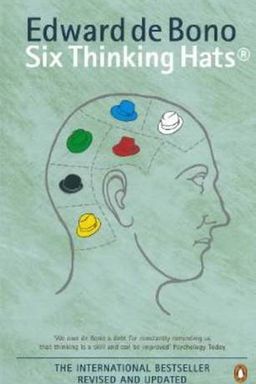
Six Thinking Hats cover

Six Thinking Hats

by Edward de Bono

Six Thinking Hats by Edward de Bono provides a groundbreaking approach to enhancing group discussions and decision-making. By using color-coded hats to compartmentalize different thinking styles, this method streamlines decision-making, fosters creativity, and boosts team efficiency, transforming how individuals and groups tackle complex problems.

Thinking Made Visible: Edward de Bono’s Revolutionary Approach to Thought

How often have you left a meeting feeling drained, frustrated, and unsure what—if anything—was achieved? In Six Thinking Hats, Edward de Bono offers a deceptively simple answer to this everyday chaos: stop arguing, start thinking together. He argues that the traditional Western approach to thinking—built on argument, analysis, and judgment—is outdated and inefficient in a world that changes by the hour. Instead, he proposes what he calls parallel thinking, a method designed to replace confrontation with cooperation, confusion with clarity, and endless debate with decisive action.

At the heart of this new approach are the six metaphorical ‘thinking hats,’ each representing a different mode of thought. By putting on one hat at a time, individuals—and groups—can focus on one kind of thinking without distraction: facts under the White Hat, feelings under the Red Hat, caution under the Black Hat, optimism under the Yellow Hat, creativity under the Green Hat, and oversight under the Blue Hat. This separation of modes allows for cleaner, faster, and more productive thinking.

From Argument to Parallel Thinking

De Bono opens with a critique of how most people—especially in Western cultures—approach thinking as a form of argument. Like the ancient Greeks, we treat thinking as a competitive sport, trying to prove others wrong rather than find the best solution together. This adversarial mindset—rooted in Socratic and Aristotelian logic—has shaped education, business, and politics for centuries. The outcome, de Bono says, is often intellectual deadlock: people spend more time defending ideas than improving them.

Parallel thinking, by contrast, has everyone ‘facing the same direction’ at the same time. It’s not about being right; it’s about moving forward. Imagine a group examining a house from different sides. In a traditional argument, each person insists their view is the only correct one. In parallel thinking, everyone agrees to walk around the house together, exploring each perspective in turn. The Six Hats system provides the structure for this journey.

Why Meetings Fail—and How the Hats Fix Them

In most meetings, multiple cognitive modes collide—facts battle feelings, creativity meets caution, optimism clashes with logic. This ‘thinking stew,’ as de Bono calls it, creates confusion and slows decisions. His solution is both radical and obvious: isolate each mode into a distinct phase, much like color printing applies one color at a time. When everyone wears the same hat together, the discussion becomes organized, synergistic, and dramatically faster. Real-world examples—from Optus finishing a meeting in forty-five minutes instead of four hours, to Statoil solving a $100,000-a-day problem in twelve minutes—show just how powerful this structure can be.

The Six Thinking Roles

Each of the six hats represents a different direction of thinking:

  • White Hat: focuses on data, facts, and information gaps—like a computer reporting inputs without judgment.
  • Red Hat: legitimizes feelings, hunches, and intuitions, allowing emotion to surface honestly without requiring justification.
  • Black Hat: exercises caution and critical judgment, identifying potential problems and flaws logically and unemotionally.
  • Yellow Hat: seeks value, feasibility, and positive outcomes—looking for what can work.
  • Green Hat: releases creativity—new ideas, fresh options, changes in perspective.
  • Blue Hat: manages the process itself—defining the focus, organizing sequences, summarizing thinking, and maintaining discipline.

By consciously moving through these hats—sometimes in preset sequences, sometimes fluidly—groups achieve depth without confusion. Everyone contributes to each phase, so no one is locked into a single role (“the creative one,” “the critic,” or “the data guy”).

The Human Side of Thinking

De Bono’s method is not just mechanical—it’s deeply human. He points out that ego is one of the biggest barriers to effective thought. People use debate to show off intellect and to win. The Six Hats separate thinking from identity: you can take off one hat and put on another without threatening who you are. This psychological safety turns thinking into a collaborative game rather than a battle. Like Confucius’s focus on right behavior over personality analysis, de Bono shifts the goal from inner transformation to outward discipline. You don’t have to become a different person; you just have to play by the rules of the game.

A Practical Revolution

The Six Thinking Hats is now a staple in boardrooms at IBM, Apple, and British Airways, and in classrooms from Australia to Africa. It works because it transforms how people communicate. Instead of defending positions, thinkers explore possibilities. Instead of talking over each other, they build sequentially. De Bono often notes that thinking is humanity’s greatest resource—but one we never learned to manage. The Six Hats method gives us that management system: simple enough to teach a child, powerful enough to cut billion-dollar decision times in half.

By the end of this exploration, you’ll learn not just what each hat means, but how to wear it deliberately—to spot when you’re stuck in argument thinking, and to shift into parallel thinking that builds, rather than breaks. The hats, de Bono insists, aren’t just a metaphor; they’re a mind technology that changes how ideas are created, explored, and decided.


Parallel Thinking: A New Cognitive Framework

De Bono’s concept of parallel thinking is the foundation of his system. Instead of opposing viewpoints clashing like wrestlers in a debate, parallel thinking asks everyone to explore the same perspective at the same time. It’s a shift from argument to design—from ‘who’s right’ to ‘what works.’

From Greek Logic to Constructive Design

Traditional Western thinking, according to de Bono, was shaped by the “Greek gang of three”: Socrates, Plato, and Aristotle. They prized critical judgment and logical argument as the path to truth. Socrates questioned errors, Plato sought ideal forms, and Aristotle categorized knowledge into boxes of inclusion and exclusion. This history left us brilliant tools for analysis—but poor tools for creation. We can dissect the past, but stumble when designing the future.

Parallel thinking introduces a second dimension: imagining what can be, rather than debating what is. It’s an approach better suited to an era of rapid change, where yesterday’s “standard boxes” may no longer fit today’s problems.

Everyone Facing the Same Way

The metaphor de Bono uses is powerful: picture people standing around a house. In argument mode, each insists theirs is the true view. In parallel mode, everyone looks at the front together, then the sides, then the back. Each vantage point gets its turn. The result is not conflict, but completion. This structure eliminates ego battles—since you’re not defending ‘your’ viewpoint—and leads to deeper shared understanding.

The Brain’s Need for Direction

De Bono grounds this method in cognitive science. Just as an antelope can’t focus on danger and grazing at the same time, the human brain can’t optimize multiple directions of thinking simultaneously. We can’t be highly emotional, logical, and creative all at once. By focusing thinking one direction at a time, parallel thinking harnesses the brain’s natural efficiency instead of fighting it.

In practice, parallel thinking requires discipline: everyone in the group must wear the same hat at once. When one person insists on playing “the skeptic” throughout, the process breaks down. But when the rules are followed, meetings become fast, focused, and egoless—more like science than politics.

This disciplined cooperation, de Bono argues, is the missing ingredient in modern decision-making. Argument looks backward; parallel thinking builds forward. It is, in his words, “the opposite of confrontation—a design for collective insight.”


The White Hat: Objectivity and Clarity

Think of yourself as a computer, says de Bono. When you wear the White Hat, your job is not to argue, judge, or infer—just to present data clearly. The White Hat covers facts, figures, evidence, and questions of evidence. It strips thinking down to pure information: what do we know, what do we not know, and what do we need to know?

First-Class and Second-Class Facts

De Bono distinguishes between two kinds of facts. First-class facts are verified and checked. Second-class facts are believed but not confirmed (“I think the Russian merchant fleet carries a large share of world trade”). Both are useful if properly labeled—but confusion arises when beliefs dress up as data.

This separation forces you to acknowledge uncertainty without paralysis. A “believed” fact can guide inquiry, but only a “checked” fact should guide action. By using this discipline, teams avoid drowning in data dumps or, worse, mistaking assumptions for reality.

Asking the Right Questions

White hat thinking is as much about asking as answering. It sharpens focus with targeted questions: “What data are missing?” “What do we need to verify before deciding?” It’s not about proving a case—unlike lawyers in a courtroom—but about “making the map” before choosing the route.

De Bono uses an example from Japanese meetings to show this mode in action. Instead of debating proposals, participants share pieces of information neutrally. Over time, the collective map becomes clear enough that the right decision almost emerges by itself. In short: input first, judgment later.

Truth Versus Usefulness

De Bono warns philosophers confuse themselves chasing pure “truths.” Thinking, he says, should prefer usefulness over purity. The world runs on “by and large”: by and large, swans are white; by and large, customers choose convenience. Thought becomes practical when it records likelihoods rather than absolutes. White Hat thinking thrives on this pragmatic mindset—clear, neutral, and grounded, but never paralyzed by perfectionism.

If you struggle with vague opinions or data overload, the White Hat is your antidote. It builds a factual foundation from which creativity, caution, and decision-making can safely grow.


The Red Hat: Making Feelings Legitimate

Under the Red Hat, feelings, intuition, and hunches take the stage. In most workplaces, emotions hide behind rational masks—often distorting reasoning in the shadows. De Bono’s insight is to bring them into the open. By giving emotion a formal role, the Red Hat drains it of manipulative power and turns it into information.

Feelings Without Justification

A key Red Hat rule: feelings don’t need to be justified. When you say “I don’t like this deal” or “my gut says we should wait,” no one asks why. The goal is expression, not defense. This honesty saves time and avoids pseudo-logic where feelings pretend to be facts. It’s the most direct way to map the emotional terrain of a decision.

From Emotion to Intuition

De Bono expands emotion to include intuition—the subtle judgments formed from experience. A veteran entrepreneur’s hunch (“this pitch feels off”) can be as valuable as a spreadsheet. Scientists and generals rely on such pattern-recognition. The Red Hat gives those feelings a safe space to be voiced without embarrassment or over-analysis.

As de Bono notes, even Albert Einstein’s “gut feeling” once led him astray when he resisted quantum uncertainty. Intuition must be treated as a clue, not a command. It belongs on the thinking map, not above it.

The Social Power of Emotional Transparency

When everyone puts on the Red Hat, hidden conflicts surface in seconds. De Bono recounts meetings where beginning with a Red Hat round (“how do you feel about this merger?”) cleared the air, turning resentment into raw data. Emotions lose their sting once acknowledged. They stop whispering sabotage in the background and join the conversation.

In summary, the Red Hat doesn’t make thinking emotional; it makes emotion thoughtful. By admitting that logic alone doesn’t rule decisions, you make room for sincerity—and that creates better collaboration and faster consensus.


The Black Hat: Discipline of Caution

The Black Hat is the hat of survival. It channels the cautious, skeptical voice in your head that asks, “What could go wrong?”—but within boundaries. It is not cynicism or negativity for its own sake; it is constructive caution.

The Logic of Guardrails

Every idea, says de Bono, needs guardrails as much as gasoline. The Black Hat examines fit and feasibility: does this align with our policy, resources, ethics, or experience? It asks what might make an idea fail—so the group can fix those weaknesses early, not later when it’s expensive. Black Hat thinking transforms “Yes, but…” from an obstacle into a tool for refinement.

Avoiding Overuse

De Bono warns that many people wear the Black Hat permanently. They equate intelligence with criticism. But constant caution stifles creativity and morale. The solution is timing: Black Hat thinking has its turn, then stops. Like pasta at every meal, too much ruins the appetite.

When the hat is worn properly, however, even habitual critics find freedom—they can unleash their doubt entirely during their moment of analysis, then set it aside to explore benefits or innovations later. This sequencing is what gives Six Hats meetings their speed and balance.

Risk Management for the Future

Black Hat thinking shines brightest in forecasting. It asks: what risks lie ahead, what might go off track, how will competitors react? De Bono likens it to a flight-check system for ideas. Flight itself belongs to the Green and Yellow Hats—but the Black Hat ensures it doesn’t crash.

Used responsibly, the Black Hat doesn’t kill ideas—it protects them. It makes optimism credible, because it ensures every bright notion has survived a reality test before being launched.


The Yellow Hat: Optimism as Method

Under the Yellow Hat, you deliberately search for value and benefit. This isn’t naïve cheerfulness or wishful thinking—it’s disciplined optimism. De Bono calls it the ‘speculative-positive’ hat: looking ahead to what could go right, and why.

From Hope to Logic

Yellow Hat thinking looks for reasons to justify hope. It’s not “I feel great about this idea” (that’s Red Hat); it’s “this could work because…” Logical optimism replaces wild dreaming. For instance, a company evaluating a risky product idea might note: “Health-conscious consumers are growing by 20% yearly. That trend supports us.” This structured search for value balances the Black Hat’s caution.

Constructive and Speculative Thinking

The Yellow Hat not only judges; it builds. It creates concrete proposals and develops ways to make ideas work. If the Black Hat says “this may fail because customers won’t understand it,” the Yellow Hat replies, “Then let’s add clearer instructions.” Optimism becomes operational—it fuels forward design.

Yellow thinking also gladly speculates. It imagines “the best possible scenario” to measure potential payoff, then scales down by realism. It’s the stance of an entrepreneur or innovator who says, “If everything went right, what would happen?” Vision precedes verification.

Value Sensitivity

De Bono introduces the concept of value sensitivity—learning to detect what’s good as instinctively as we detect what’s risky. Most people are over-trained in critical thinking (Black Hat) but under-trained in recognizing opportunity. The Yellow Hat redresses that balance. It teaches your brain to spotlight value wherever it hides, like a sunlight beam cutting through clouds.

In practice, the Yellow Hat makes thinkers more effective, not just more positive. It converts optimism into structured progress—the foundation for innovation, entrepreneurship, and human advancement.


The Green Hat: Creativity on Command

Creativity, often seen as mysterious or spontaneous, becomes practical under the Green Hat. This hat gives you permission to create—deliberately. It’s where you generate new ideas, alternatives, perceptions, and possibilities. Instead of waiting for inspiration, you decide to be creative, a radical idea in itself.

Lateral Thinking: The Engine of Change

De Bono’s trademark concept, lateral thinking, is a key driver under the Green Hat. Where logic moves along established patterns, lateral thinking cuts across them to find new ones. It uses techniques like provocation (using the word “po” to suspend judgment) and movement—using one idea as a stepping stone to the next. For example, “po, everyone pays to leave the store” might inspire loyalty programs or cashback systems.

Creativity here is not chaos. It’s governed by an attitude of exploration: suspend judgment, follow possibilities, and nurture odd ideas before crushing them with reason. Like seedlings, ideas need protection before they face weather.

The Creative Pause

De Bono introduces the notion of a deliberate “creative pause.” Even when all is running smoothly, a thinker stops to ask, “Is there a better way?” This habit, he argues, separates innovators from maintainers. You don’t wait for problems to innovate; you make creation a recurring checkpoint.

Harvesting and Shaping Ideas

Generating ideas is only half the task; harvesting them is equally critical. De Bono proposes the role of a “concept manager”—someone who collects, refines, and sells ideas internally. Ideas need tailoring: they must fit organizational realities and the emotional climate of those who must act on them. Creativity, therefore, is as much about design as imagination.

The Green Hat proves creativity isn’t magic—it’s management. It treats innovation as a disciplined skill, open to everyone willing to wear the hat, pause, and play.


The Blue Hat: Managing the Orchestra of Thought

If the other hats are instruments, the Blue Hat is the conductor. It manages the thinking process itself—organizing, sequencing, and summarizing. Wearing the Blue Hat, you step out of the content and think about the thinking.

Setting Focus and Discipline

The Blue Hat defines focus (“What exactly are we thinking about?”) and maintains it. It prevents meetings from drifting into tangents and ensures hats are used properly. The facilitator, though often wearing the Blue Hat permanently, can invite everyone to don it: “Let’s all step back—what have we achieved so far?”

This role includes setting the sequence—perhaps starting with a Red Hat to release tensions, then a White Hat to establish facts, followed by Yellow and Black Hats to weigh pros and cons. De Bono calls this choreography a “thinking program.” Like software, it runs structured steps so human minds don’t crash into confusion.

Summaries, Conclusions, and Monitoring

The Blue Hat provides overviews, draws conclusions, and ensures balance among modes. It can interrupt arguments (“We have two views; let’s note both and move on”) and enforces discipline gently but firmly. Importantly, it saves time. When everyone trusts there’ll be a proper ‘turn’ for their perspective, they stop interrupting prematurely.

In the end, the Blue Hat produces the “map” of the discussion—what was explored, what remains, and what decision follows. Under it, thinking ceases to be drift or debate and becomes a designed process.

The Blue Hat ensures not just that we think—but that we think about thinking itself. With it, meetings evolve from chaos to choreography, from noise to music.


The Practical Power and Global Impact of Six Hats

In global boardrooms, classrooms, and even courtrooms, Edward de Bono’s Six Thinking Hats have proven transformative. After adopting the method, organizations as diverse as IBM, Microsoft, NASA, and the governments of Norway and Australia reported massive reductions in meeting time—up to 75%—and better decisions. Why? Because the Six Hats do something deceptively profound: they replace human ego with structure.

Removing Ego, Encouraging Performance

In traditional meetings, the loudest or most senior person often dominates. The Six Hats neutralize this power imbalance. Since everyone wears the same hat at once, contributions are evaluated for their content, not their source. This creates intellectual democracy—everyone’s expertise counts.

Furthermore, de Bono points out, ego doesn’t disappear—it gets redirected. People still “show off,” but now by demonstrating sharp thinking under each hat. Performance replaces persuasion as the measure of respect.

Speed and Clarity

The method’s time-saving effect is measurable. Because there’s no constant back-and-forth argument, each perspective is explored fully in its turn. Optus in Australia reduced a four-hour session to forty-five minutes. ABB reported cutting project meetings to one-fifteenth the time. That’s not just efficiency—it’s cognitive liberation.

Teaching Thinking

Perhaps most surprisingly, de Bono’s methods work as well with children as with executives. Schools in New Zealand and Africa teach Six Hats as early as age four, proving that thinking can be taught like reading or math. Students learn when to be factual, when to imagine, and when to question—a skill missing from most curricula.

In closing, de Bono reminds us that thinking is humanity’s greatest but least managed resource. Argument, while ancient, is outdated for modern complexity. Parallel thinking, structured through the Six Hats, is his invitation to a wiser, faster, and more harmonious world—one conversation at a time.

Dig Deeper

Get personalized prompts to apply these lessons to your life and deepen your understanding.

Go Deeper

Get the Full Experience

Download Insight Books for AI-powered reflections, quizzes, and more.