
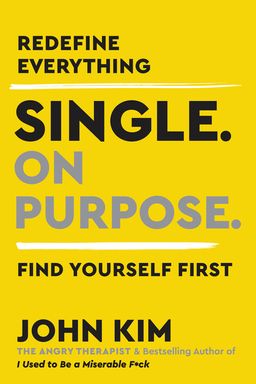
Single On Purpose cover

Single On Purpose

by John Kim

Single on Purpose by John Kim invites you to redefine singleness as a journey of self-discovery and empowerment. Through candid insights, the book encourages you to embrace solitude, nurture self-love, and cultivate a fulfilling life. Discover how redefining your relationship with yourself can lead to genuine happiness and personal growth.

Choosing to Be Single on Purpose

What if being single isn’t a problem to fix but a calling to answer? In Single on Purpose, therapist and author John Kim—known as “The Angry Therapist”—argues that our obsession with finding “the one” often distracts us from building the most important relationship in our lives: the one with ourselves. Kim contends that happiness and fulfillment don’t flow from external love but from self-connection, and that singlehood can be the richest soil for genuine growth if you approach it intentionally—not as a temporary purgatory between relationships but as a transformative state of becoming.

This is not, as Kim emphasizes, an anti-relationship book. It’s a pro-relationship-with-yourself guide. Drawing from his personal experiences with divorce, codependency, and rediscovering identity through therapy, fitness, writing, and motorcycles, Kim redefines singlehood as a conscious, empowering choice. His approach blends no-nonsense realism with emotional vulnerability, inviting readers to stop chasing validation and instead cultivate inner wholeness.

Why This Matters

In a culture that idolizes romance and vilifies solitude, many equate being single with being broken. Media, social norms, and even family conditioning often reinforce the idea that completeness requires a partner. Kim dismantles this narrative. Through clients’ stories—like Christy, who felt lost choosing between a toxic lover and a stable but unexciting partner—he exposes how dependency patterns keep people trapped in cycles of unhealthy love. His refrain, delivered to her and to countless clients, is simple but radical: “You need to be single. On purpose.”

By reframing singlehood as an active practice rather than passive waiting, Kim proposes that time alone is not wasted but sacred. It’s when you examine patterns, rewrite your definitions of love and success, and reconnect to your body, mind, and soul. Whether you’re freshly divorced, perpetually partnered, or terrified of solitude, this message demands that you confront your discomfort with yourself. Growth begins not when you find someone to do life with, but when you learn to do life as yourself.

The Three-Act Journey

Kim structures the book in three acts, mirroring a therapeutic journey. Act I—The Self (Connecting Back to You) explores the loneliness and liberation of being single. The author shares stories of crying in bathroom stalls during his crumbling marriage and rediscovering life through barbells, doughnuts, motorcycles, and writing. These moments illustrate that connection begins with embodiment and self-liking, not just self-love. Act II—Relationship Residue (Letting Go) tackles the work of healing from past relationships. Through clients’ narratives—ranging from humorous to heartbreaking—Kim reveals how we repeat patterns until we take ownership of our wounds. Act III—The New You describes emerging whole, equipped with clarity, purpose, and the courage to build a life that matters with or without a partner.

The Therapist’s Lens

What sets Kim apart from many self-help authors is his raw approachability. He writes like a friend in a coffee shop who happens to be a licensed therapist. No jargon, no pretension—just transparency. He narrates his struggles with codependency, validation-seeking, porn use, and emotional disconnection, modeling vulnerability that invites readers to drop their own armor. In one metaphor, he likens singlehood to soil enriched by past heartbreak: when the ground has been broken, new growth is possible. This blend of psychology and storytelling makes his counsel both pragmatic and soulful.

Throughout the book, Kim integrates themes from modern psychology—attachment theory, mindfulness, and cognitive reframing—with pop-culture realism. (In philosophy, this aligns with the work of authors like Brené Brown on vulnerability or Mark Manson’s The Subtle Art of Not Giving a F*ck, which also challenges external validation.) But Kim’s tone remains distinctly his own—irreverent, heartfelt, and infused with everyday grit.

What You’ll Learn

Through Kim’s lens, you’ll learn to distinguish solitude from loneliness, break your dependency on relationships for identity, and practice radical acceptance of life as it is. You’ll explore how to reconnect to your body, mind, and soul; rewrite old love definitions; reestablish boundaries; and understand that self-care is not indulgence—it’s practice for love itself. Later chapters expand this framework to friendships, life purpose, new love experiences, and even spiritual resurrection through what he calls “living at a higher frequency.”

Ultimately, Kim argues that being single on purpose means being whole on purpose. It’s an act of rewriting the myths we’ve inherited about love, worth, and happiness. The reader is left not with the loneliness of singledom but with a powerful question: What if the person you’ve been waiting for is you?


Loneliness vs. Aloneness

Kim begins self-work where most people hurt the most—loneliness. He doesn’t romanticize it. Loneliness, he says, isn’t cured by chanting mantras about empowerment or pretending you don’t crave connection. You feel lonely because you want love, touch, conversation, and companionship—it’s human biology. But the trap is when you make loneliness an identity instead of a feeling. When you go from feeling lonely to being lonely, your worth becomes tied to relationship status.

The Source of the Belief

From Disney movies to Barbie-and-Ken toys, society wires us to believe that joy begins when you find your other half. No wonder so many successful, intelligent adults still equate singlehood with failure. In his client sessions, Kim sees this belief manifest as anxiety—especially for people in their 30s and 40s who feel that “time is running out.” These pressures become internalized voices whispering, “Something’s wrong with you.”

Radical Acceptance

To reclaim agency, Kim challenges you to face your ultimate fear: What if you never find a partner? That question, he writes, may stop your heart for a second, but accepting that possibility can set you free. Radical acceptance doesn’t mean giving up—it means living fully regardless of outcome. Once you accept that your life is already enough, you stop chasing completion and start creating it. You invest in passions, friendships, travel, fitness, and creativity—turning existence into a joyful exploration rather than an anxious waiting room.

Clients who embraced this mindset transformed dramatically. Some launched businesses, learned new languages, or built stronger communities. Their lives became filled not with absence but abundance. As Kim notes, “Love and relationships are one part of your life, not your entire life.”

“Before asking who’s going with you, ask where you’re going.”

This shift—from needing someone to choosing someone—turns loneliness into intentional solitude. When your world doesn’t collapse without a partner, love stops being rescue and starts being resonance.


Finding Yourself Again

In one of the book’s most personal and vivid sections, Kim recounts how he found himself again “through doughnuts, barbells, and a motorcycle.” After his divorce, he realized that years of chasing validation had made him a stranger to himself. He had become what others wanted. Reconnection, he learned, happens through body, spirit, and soul—the three pistons of the human engine.

Reconnecting Through the Body

Kim’s first step was CrossFit. Despite sounding superficial at first, movement became medicine. It reminded him of being eleven and breakdancing until he lost track of time—those effortless “flow states” where body and mind unite. As he restored connection with his physical self, his confidence grew. The message to readers: Find your own version of movement. Maybe yoga, climbing, or dancing. Your body isn’t just a vessel—it’s the gateway back to aliveness.

Reconnecting Through Spirit

For Kim, the motorcycle reawakened his inner twelve-year-old—the kid who rode a red scooter named “Death Trap” around the block without fear. Riding gave him freedom and consciousness of the present moment. The metaphor extends: your spirit is the fearless, creative child within you that adult life buries under “shoulds.” Reconnecting with that spirit may mean painting again, surfing, traveling, or simply doing something for no other reason than joy.

Reconnecting Through Soul

Finally, writing reconnected Kim to his soul. After years as a failed screenwriter, blogging honestly about his pain became an act of self-rescue. Words became his spiritual practice. Every person, he insists, must find their “soul work”—a form of expression that leads inward, not outward. For one client it was playing guitar; for another, gardening. The point is to engage the part of you that feels like home. When you feed your body, spirit, and soul together, you stop seeking identity in others—you start liking yourself again. As Kim puts it, “Loving yourself can be a checkbox; liking yourself requires a journey.”


Building a Relationship with Yourself

Once you’ve begun to reconnect internally, Kim argues that you must actually date yourself. This isn’t cheesy self-help fluff—it’s behavioral retraining. Most people think they love themselves because they read affirmations or buy spa days. But if you listened to how you talk to yourself, you’d realize you’re in an abusive relationship. Kim’s advice: Treat yourself as well as you treat those you love.

Self-Care as the First Date

In “Self-Care Is Your First Date,” Kim redefines the buzzword. Self-care isn’t bubble baths and brunch—it’s boundaries, sleep, saying no, and carving time for your needs without guilt. He tells the story of running on the beach one day instead of going to CrossFit or writing notes for clients. That impulsive run became therapy; for the first time, he stopped “verbally bashing himself.” True self-care, he found, is doing what your emotional self needs, not sticking to a productive routine.

Mind, Body, and Soul as Pistons

Your relationship with yourself depends on three pistons—body, mind, and soul. Like an engine, if one piston fails, the vehicle stalls. For the body, he teaches acceptance before action; fitness becomes an act of respect, not punishment. For the mind, he leans on cognitive-behavioral principles: notice recurring thoughts, question distortions, and replace self-criticism with curiosity. For the soul, feed it with experiences that make you feel human—art, community, nature, purpose.

Through stories like Anna, a CrossFit athlete who discovered she was disconnected from her body despite physical strength, Kim reminds us that achievement without embodiment leads to emptiness. Healing comes from listening inward, not perfecting outward.

When you start moving with your body, thinking with kindness, and creating from your soul, self-connection shifts from concept to lifestyle. Self-care no longer feels selfish—it feels sacred.


Letting Go of Relationship Residue

Act II, “Relationship Residue,” explores how past relationships shape our self-concept and how to release them. Kim insists that you cannot build a healthy future while dragging an unprocessed past. Every breakup leaves imprints—stories you tell about what love is, what you deserve, and who you are. Healing demands revisiting those stories, not repressing them.

From Sticky Love to Growth

Kim distinguishes between love that grows and “the sticky,” his term for intense, codependent attachment. The sticky feels like fireworks but stems from unmet childhood needs—approval, validation, chaos. He humorously recounts clients whose sex life masked emotional distance (“Boots and Boners”) and how redefining intimacy required facing their past abuse and distorted beliefs. Growth begins when you stop mistaking intensity for intimacy.

Moving Through, Not On

Kim dislikes the phrase “move on.” Healing isn’t a finish line; it’s a process of moving through. Acceptance and ownership are nonnegotiable. For example, Jessica—an Instagram influencer—couldn’t feel sexual desire months after a breakup. Instead of labeling it “broken libido,” Kim helped her realize her body was protecting her from repeating old wounds. Grieving, not distraction, restored her wholeness.

Similarly, Jon, the client who complained “my wife won’t give me blow jobs anymore,” discovered that his fixation masked unresolved pain from a toxic first love and an alcoholic mother. Only after grieving and taking ownership did he stop comparing every woman to his past and become emotionally present. Each story illustrates the same truth: closure doesn’t come from exes’ apologies. It comes when you reclaim authorship of your story.

Letting go, Kim says, isn’t forgetting. It’s integrating—keeping the lessons, releasing the residue. When you’ve done this, you’re finally ready for healthy connection, or for joyful solitude that doesn’t ache.


Creating Healthy Love and Sexual Freedom

After cleaning emotional residue, Kim moves to rebuilding: what does healthy love actually look like? His answer subverts the fairy tale. Real love, he argues, is not lightning in the bottle—it’s daily choice and aligned values. Chemistry fades, but curiosity and respect sustain. At the same time, he gives readers permission to explore sexuality—a topic most self-help books tiptoe around.

Owning Your Sexual Story

Kim candidly shares his own struggles with sexual shame and addiction, linking them to cultural conditioning and early exposure to porn. He teaches that sexuality must be reclaimed as an honest expression of self, not performance or avoidance. Stories like Stacey—who discovered empowerment through dating apps after divorcing a controlling husband—illustrate that sexual exploration can be healing when done consciously, not compulsively.

Exploration without Shame

“Now go fuck somebody,” Kim provocatively writes—but his point isn’t promiscuity. It’s dismantling judgment. Whether exploring threesomes or learning abstinence, the goal is to experience desire from wholeness, not vacancy. He uses humor to unpack moral conditioning, reminding readers that shame and sexy can’t coexist: shame operates on the lowest frequency, while sexuality belongs to vitality itself. Reclaiming it means accepting your desires as part of being human.

The Four Pistons of Sexy

Kim then extends his earlier “engine” metaphor into four pistons: move your body, like yourself, scrap shame, and feed your sexual need. Feeling sexy is not vanity; it’s connection to self. You maintain this engine through daily disciplines—movement, self-care, curiosity, communication with partners. When all four pistons fire, sex becomes less about validation and more about self-expression.

Healthy love, Kim concludes, requires two whole people. Only when you are fully yourself—comfortable in your body and story—can intimacy transcend performance and become presence.


Redefining Success and Happiness

As the journey progresses, Kim shifts from love to life philosophy. Many people, he says, are miserable not because anything is wrong but because their lives are running on outdated blueprints—definitions of success inherited from parents, peers, and social media. The white picket fence, two kids, and matching cars might fit someone else’s truth, but if it’s not yours, you’ll feel trapped even when you “have it all.”

Ripping Up Old Blueprints

Kim reflects on his old Hollywood dream: a wife, script deals, Porsche, and fame. Chasing that blueprint made him anxious and hollow. After his breakdown, he rewrote it: meaning over money, growth over goals. His new blueprint includes helping others, writing honestly, motorcycling through canyons, and being a father with presence. You’re invited to do the same—to ask if your blueprints are honest or just borrowed.

Finding Meaning, Joy, and Engagement

Through stories like Barbara, the therapist who had a perfect home yet felt dead inside, Kim identifies three pillars of a fulfilling life: meaning (doing what matters to you), joy (finding daily nectar in small pleasures), and engagement (showing up fully). When you invest in these rather than external milestones, you experience “having a life” instead of merely existing in one.

Happiness, he concludes, isn’t a destination island called “When I have X.” It’s a daily practice of choosing what lights you up and discarding what doesn’t. It’s generated, not discovered.


Living with Worth and Higher Frequency

In the final act, Kim distills his philosophy into two intertwined ideas: reworth yourself and live at a higher frequency. Both describe energetic shifts from fear to empowerment. Worth, he explains, is not a belief you declare—it's a muscle you build through experience. Frequency, in turn, is the emotional environment that sustains your worth: love, gratitude, curiosity, and courage vibrate higher than resentment, worry, or shame.

Building Worth through Experience

People try to ‘believe in themselves’ through affirmations, but without new experiences, nothing changes. Kim teaches that worth solidifies when you give yourself evidence: tackling fears, creating boundaries, achieving goals that reflect your values. Each new action rewires your self-concept. “Worth,” he writes, “is not something you believe. It’s something you build.”

Raising Your Frequency

Kim describes his own transformation from living in dread to living in gratitude. To maintain high vibration, he notices when he sinks into negativity and uses physical movement, meditation, or social connection to shift his state. He examines inherited attitudes—like his father’s anxiety about money—and replaces them with mindful awareness. Living at a higher frequency is not constant bliss; it’s continuous recalibration.

Ultimately, Kim’s closing reminder, expressed in his “Every. Single. Day.” mantra, ties the journey together: you build worth and raise frequency through daily choices—gratitude, action, integrity, and love. Being single on purpose isn’t about rejecting relationships; it’s about becoming the person who no longer needs saving, only sharing.

Dig Deeper

Get personalized prompts to apply these lessons to your life and deepen your understanding.

Go Deeper

Get the Full Experience

Download Insight Books for AI-powered reflections, quizzes, and more.