
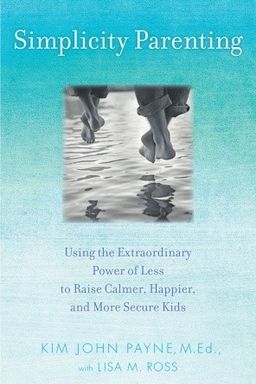
Simplicity Parenting cover

Simplicity Parenting

by Kim John Payne and Lisa M Ross

Simplicity Parenting reveals how reducing stressors and creating a structured, media-limited environment can lead to happier, more secure children. Through practical steps, parents can foster creativity and well-being, ensuring their children''s growth in a complex world.

Reclaiming Childhood in a World of Too Much

How can you restore balance and calm to a world that prizes speed, excess, and stimulation? In Simplicity Parenting, Kim John Payne argues that modern family life is quietly overwhelming children. The culprit, he says, is not a lack of opportunity—but an abundance of it. Too much stuff, choice, information, and hurry have turned childhood into a pressured experience, leaving kids restless, anxious, and disconnected from their natural development. Payne calls this phenomenon “the undeclared war on childhood.”

He introduces a deceptively simple antidote: simplify. By intentionally reducing clutter, choices, and speed, you create space for rhythm, imagination, and resilience to emerge. This process transforms your home into a sanctuary where a child’s nervous system can rest and reset. (The core premise aligns with minimalist psychology and ecological models of stress—less input yields more capacity for self-regulation.)

The Four Pillars of Overload

Payne’s “four pillars of excess” form the structural problem he observes in families worldwide: too much stuff, too many choices, too much information, and too much speed. Each leads to cumulative stress that erodes a child’s emotional baseline, a condition he likens to “soul fever.” Too much stuff clutters both physical and psychic space; too many choices overwhelm focus and autonomy; too much information exposes children to adult worries; and too much speed deprives them of recovery and imagination time. The pattern creates overstimulation that looks like hyperactivity, defiance, or emotional volatility.

His shorthand formula, q + s = d (quirk plus stress equals disorder), captures how ordinary temperament interacts with cumulative overload. A sensitive or intense child is not fragile—until chronic stress amplifies normal quirks into labeled disorders. Simplification reduces that amplification by lowering the ambient stress load of daily life.

Soul Fever and the Therapeutic Pause

Payne’s metaphor of “soul fever” describes emotional overload as vividly as a physical fever. When a child becomes irritable, clingy, or withdrawn, the right response is not discipline or distraction—it is containment, warmth, and rest. You slow the family rhythm, simplify sensory input, and bring the child close. In the book’s examples—like Teresa, who oscillated between silence and outrage—the healing began when parents stopped rushing and restored calm routines. Payne compares this to stopping daily life for an illness: space itself becomes the medicine.

This emotional care mirrors what modern psychology calls “co-regulation”: a parent’s stable nervous system serves as the child’s mirror and anchor. Simplification amplifies that effect by removing environmental noise, allowing subtle signals—posture, tone, appetite—to guide your caregiving instincts again.

Simplification as Preventive and Corrective Therapy

Payne’s most striking claim is that simplification is not sentimental housekeeping—it is evidence-based therapy. In clinical studies within Waldorf schools, simplification protocols—reducing toys, minimizing media, creating predictable routines—produced measurable improvements in children diagnosed with attention or behavioral disorders. After four months, more than two-thirds moved from dysfunctional to functional categories, and cognitive scores rose significantly. This reinforces that much modern “ADD” behavior may be a social artifact of overload rather than a purely internal deficit.

This doesn’t dismiss medication; rather, Payne presents it as scaffolding to stabilize a child while families rebuild healthier structures. But the ultimate goal is environmental repair—simplifying as both prevention and long-term cure.

The Path to Renewal

Simplification begins with vision, not guilt. Payne invites you to recall your dreams for family life: shared meals, laughter, unhurried stories. Those ideals become your compass for change. Start with what’s doable—a toy shelf, a no-TV evening, or a bedtime preview—and let results build momentum. When Sue and Mike halved their children’s toys, sibling fights dissolved almost instantly. When James’s parents removed constant news, his anxiety and sleep improved. Small, brave experiments accumulate into profound transformation.

As you discard excess, restore rhythm, and protect play, you are not withdrawing from life—you are reclaiming the humane tempo that life requires. You build what Payne calls an “emotional ecology” where a child’s capacities—wonder, attention, empathy—can take root again. Balance, not busyness, becomes the new normal. Your home reclaims its role as anchor rather than amplifier in a noisy, speeding world.

When you simplify, you are not depriving your child—you are giving them back the conditions for growth. As Payne writes implicitly through every case story, simplicity is protection, rhythm is medicine, and calm is strength.


Decluttering Space and Attention

Physical environment is emotional weather. When children's rooms overflow with toys and gadgets, their attention fractures and their capacity for imaginative play collapses. Payne's first tangible strategy is environmental simplification: reducing physical excess to restore psychological space. The process is practical, measurable, and surprisingly emotional.

Halving and Halving Again

Payne's rule—'half the toys, then half again'—is both symbolic and effective. You start by pulling everything out, separating broken, overstimulating, or redundant items, and keeping a small set of open-ended toys: blocks, fabric, dolls, and art materials. These objects invite imagination rather than prescribe it. In Marie’s case, a cleared bedroom reopened her capacity for deep play: she replaced aggressive toy skirmishes with hours of fort-building and storytelling.

A Sustainable System

To maintain calm, Payne recommends a 'toy library'—stored sets you can periodically rotate in. The rotation preserves novelty without rekindling chaos. This is not minimalism for its own sake; it is rhythm imposed on material abundance. It teaches children that enough is sufficient and that play emerges from creativity, not consumption.

Sensory Simplicity

Beyond objects, environmental simplification extends to sensory stimuli—lighting, sound, and visual clutter. Dim lights, quieter backgrounds, and neutral scents recalibrate the nervous system. You reintroduce the calm cues that modern environments have drowned out. (Neuroscientific research supports this: lowered sensory input enhances the brain’s executive regulation zones.)

When Sue and Mike simplified their home, their children’s fights fell dramatically. Overstimulation had masqueraded as misbehavior. By reclaiming simplicity, they restored harmony both externally and internally.


Filtering the Adult World

Another pillar of simplification is controlling informational inflow. Payne insists that your role as parent includes shielding your children from adult intensity. They are wired for wonder and imitation, not for the anxious narratives of constant news, advertising, and adult conversation. When that membrane breaks, children lose their sense of proportion and safety.

Screens, Conversations, and Boundaries

Screens are the biggest breach in this boundary. Continuous television or phone chatter exposes children to rapid stimulus and emotional contagion. Payne cites research and international policy—such as France’s ban on programming for under-threes and the AAP’s caution against early screen time—to emphasize that media rewires expectation for constant novelty. Instead, he recommends consolidating devices in adult spaces, removing background television, and creating 'TV holidays.'

Even without screens, adult chatter itself can overload. Parents discussing finances, work stress, or politics in front of children transfers anxiety. Payne offers a simple guide—the “threefold filter”: before you speak, ask if it is true, kind, and necessary. Delaying heavy conversations until after bedtime, as James's parents did, restores safety.

The Emotional Economy of Secrecy

Filtering doesn’t mean censorship; it means stewardship. You protect a child’s developmental economy by letting mystery, trust, and gradual learning unfold. When adults model calm and restraint, children sense competence even without explanation. Payne’s nightly reflection ritual—recalling small good moments before sleep—helps parents replace fear broadcasting with gratitude broadcasting, quietly recalibrating the home’s emotional tone.

By filtering the adult world, you return childhood to the rhythm of discovery rather than defense. The world remains large and fascinating, but the child’s heart experiences it through a manageable lens.


Rhythm as Emotional Architecture

When life feels chaotic, rhythm is your strongest balm. Payne treats rhythm not as a household schedule but as an emotional architecture that turns time into reassurance. Predictable sequences—meals, bedtime stories, morning rituals—build reference points for children. Those anchors say: 'The world is reliable, and you have a place in it.'

Predictability Over Perfection

Even partial rhythm helps. Justin, a child anxious about surprise changes, calmed when his parents began previewing each day the night before (“Tomorrow after breakfast, we’ll take you to school, then Grandma visits”). Predictability reduced his need for control. For families under time stress, nightly 'day previews' are small but high-yield tools.

Family Dinner as Anchor

Dinner, Payne shows, can become rhythm disguised as ordinary habit. Beyond nourishment, it is a fixed point of reunion and narrative cohesion. Studies (like the CASA longitudinal research) link regular family meals to academic, nutritional, and behavioral benefits—not because of menu quality but because of reliability and talking time. Involving kids in preparation—washing peas, stirring soup—builds pride and reduces resistance. Lighting a candle or a short silence at the start declares togetherness in a busy world.

Rhythm as Relationship Credit

Each consistent routine earns what Payne calls “relational credit”—trust stored up for adolescence and storms. A father’s predictable bedtime stories or open workshop door communicates safety beyond words. Rhythm sustains these invisible deposits of connection.

Rhythm doesn’t demand homogeneity; it allows variance. Predictable form gives freedom inside it—just as musical rhythm allows improvisation. The result is a family culture where presence outweighs perfection.


Simplifying Schedules and Reclaiming Boredom

Many families overbook in hopes of enrichment—but abundance of activity can erode growth. Payne reframes the calendar as ecology: it needs planting, rest, and rotation. When you treat time like soil, you realize that relentless planting exhausts it.

Crop Rotation for Time

He proposes a metaphor of crop rotation with three fields: structured activities (the planting), deep play (the nutrient legume), and downtime (the fallow field). All must coexist for mental fertility. Modern children’s schedules, dominated by extracurriculars, deplete fallow time—the source of imagination. Between 1981 and 1997, U.S. children’s free time dropped by almost half, replaced by structured commitments.

The Gift of Boredom

When boredom appears, parents often panic. Payne insists boredom is the doorway to creativity. Resisting the urge to entertain helps children rediscover intrinsic motivation. The 'flatline response'—simply affirming that something to do is nearby—lets children move past emotional inertia. (This echoes Maria Montessori’s insight that concentration arises after brief restlessness.)

Balancing Arousal and Calm

Energy comes in waves. After high-arousal days—a play, sporting event, or big trip—schedule calm interludes. Sarah, for example, offset holidays with quiet dog walks, preventing meltdowns. Naming days as 'A' (active) or 'C' (calm) makes rhythm visible.

Simplifying schedules gives time its natural pulse. It teaches that mastery and joy arise not from endless activity but from alternating effort and renewal.


Food, Sleep, and Daily Recovery

Simplification extends to the body. Payne devotes strong attention to food and sleep as the physiological anchors of rhythm. When mealtimes and bedtimes stabilize, emotional stability follows.

Simplify Food and Power Struggles

Children’s palates, like their emotions, are shaped by exposure. Highly processed “big-hit” foods—engineered for extreme flavor—train taste buds toward overstimulation. By cutting processed snacks and involving children in cooking, you retrain appreciation for real food. The Waldorf “pride of authorship” experiment, where picky eaters tried soup they helped make, proves participation transforms relationship. Repetition matters too: Payne’s “eight tries rule” turns rejected foods into accepted staples through gentle persistence.

Pressure Valves and Sleep

Rest requires decompression beforehand. Payne’s “pressure valves”—predictable outlets for emotion during the day—help children let go at night. Quiet rituals (a candle, snack, or bedtime review like Henry’s “grit sandwich”) externalize stress. Active valves—building, running, roughhousing—balance stress release through the body. Without such outlets, bedtime becomes a battlefield.

Sleep as Biological Simplification

Sleep, like rhythm, is medicine. Payne cites Dr. Avi Sadeh’s research: losing one hour of sleep can drop cognitive function by two grade levels. He advocates fixed bedtimes within twenty-minute windows and consistent wake times. Half of all teens, he warns, are sleep-deprived—a deficit that compoundingly erodes mood and focus.

When you build daily recovery into meals and sleep, you turn biology into ally. Calm digestion, stable sugar levels, and predictable rest collectively lower background stress. The result is a family ecosystem that heals itself nightly.


Stories, Play, and Emotional Healing

Beneath all Payne’s strategies lies a deeper truth: children process life symbolically. Stories and unstructured play are not extras; they are the languages of inner repair. By restoring them, you nourish emotional literacy and resilience.

Stories as Medicine

When Amber struggled with her uncle’s impending death, her mother Lola used fairy-tale metaphors rather than clinical explanations. The tale of being lost and found in a dark forest provided a container for grief. Amber requested it nightly, and through repetition found stability. Stories let children imagine their emotions safely, turning chaos into coherence. (Bruno Bettelheim’s The Uses of Enchantment articulates the same psychological logic.)

Play as the Child’s Laboratory

In free play, children experiment with social rules, empathy, and imagination. Payne contrasts this with early sports specialization, where adult-imposed rules remove negotiation. Free play’s fluidity teaches flexibility; specialization’s uniformity risks burnout and injury. Families can balance passion and rest with simple rules—one 'major' sport, one 'minor,' and one season off.

When you choose stories and play as priorities, you protect the arenas where children metabolize their experiences. These are forms of self-therapy disguised as joy. They teach that life’s hardships can be understood, retold, and survived.

In Payne’s words and examples, simplicity is not a reduction of life’s richness—it is the space that allows its deepest meanings to emerge through rhythm, story, and play.

Dig Deeper

Get personalized prompts to apply these lessons to your life and deepen your understanding.

Go Deeper

Get the Full Experience

Download Insight Books for AI-powered reflections, quizzes, and more.