
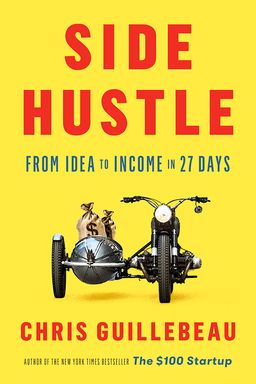
Side Hustle cover

Side Hustle

by Chris Guillebeau

Side Hustle by Chris Guillebeau is a practical guide to generating additional income without quitting your day job. In just 27 days, learn to design and launch a profitable side project using resources at your disposal, ensuring financial stability and entrepreneurial growth without the risks of full-time self-employment.

The 27-Day Path to Financial Independence Through Side Hustles

What would your life look like if you earned an extra $500 this month—without quitting your job or starting a risky business venture? In Side Hustle: From Idea to Income in 27 Days, Chris Guillebeau argues that earning additional income is no longer optional—it’s the new job security. He contends that the ability to create small, profitable projects gives you freedom, confidence, and choice in an unpredictable economy.

This book isn’t another entrepreneurial manifesto about quitting your day job and launching a startup. It’s a playbook for anyone with a regular job who wants to start earning extra income—quickly and safely. Over twenty-seven days, Guillebeau walks readers through a structured system that turns raw ideas into profit. The plan fuses clarity (how to select the right idea) with action (how to price, test, and launch), all built for people with limited time and no business background.

The Core Promise: Freedom Through Practical Creation

Guillebeau’s central assertion is simple but powerful: the side hustle is the new job security. In a world where traditional employment is unstable and retirement benefits are disappearing, depending on only one paycheck is risky. A side hustle doesn’t replace your job—it complements it by giving you control over your financial future. The goal is not necessarily to build a huge business but to create financial breathing room and personal empowerment.

Unlike startup models that require significant capital, networking, or venture funding, side hustles are lightweight, flexible, and fast. They allow anyone to take a skill, hobby, or problem-solving insight and turn it into real money in less than a month. Guillebeau—known for his earlier bestsellers The $100 Startup and Born for This—has distilled his years of research on thousands of entrepreneurs into a clear, replicable system.

Why 27 Days?

The book’s format mirrors a challenge—a sprint toward action. You spend five weeks, roughly twenty-seven days, completing a mix of short lessons and concrete assignments. Each week has a theme: finding ideas, choosing the best one, preparing for launch, testing and selling, and finally refining what works. The goal is progress over perfection. As Guillebeau repeats throughout, “Done is better than perfect.”

Each day also features real-life examples—from average people who built microbusinesses in unexpected industries. We meet Andrea, who created an “Airbnb for dogs” through Rover.com and turned her love of pets into daily income; David and Praj, who began importing cashmere shawls from Nepal; Julia, the caricature artist who went from making $8/hour at an amusement park to earning $250/hour drawing digital portraits; and Tanner Callais, who turned his curiosity about cruises into a niche information website generating thousands per month.

The Philosophy: Action Over Permission

At its heart, Side Hustle promotes an ethos of agency. You don’t need a business degree, a team, or investors. You just need a willingness to act. The book demystifies what entrepreneurship looks like for ordinary people—without the pressure of quitting your job or finding a cofounder. The “hustle” is reframed as creativity in motion: taking something you already know and monetizing it with minimal risk and upfront cost.

“Everyone should have a side hustle—even if you love your job. More income means more options, and more options mean more freedom.”

The Structure of a 27-Day Hustle

The method unfolds in five stages: building ideas, selecting the best one, preparing to launch, executing, and regrouping for growth. Guillebeau combines entrepreneurial principles with accessible exercises: brainstorming “money trees,” ranking opportunities using a Side Hustle Selector tool, forecasting profits with napkin math, designing workflows, and creating quick marketing tests using only $10 and a Facebook ad.

Every chapter includes relatable, actionable case studies. The book’s tone feels like a conversation with a pragmatic coach—part cheerleader, part strategist. Guillebeau dismantles overanalysis (“You don’t need to write a business plan”) and replaces it with experimentation (“Test before you commit”). By the end, you’ve gone from concept to cash, equipped with habits that will serve far beyond the first hustle.

Why This Matters Today

In an era of gig work and economic uncertainty, Side Hustle isn’t just about making extra income—it’s about taking ownership of your career and creativity. For readers overwhelmed by startup culture’s all-or-nothing mentality, Guillebeau offers an antidote: build something small and real, now. The beauty of his system lies in its universality. Whether you’re a teacher, nurse, programmer, or artist, there’s a hustle waiting in your own skills and interests.

So, if you’ve ever thought, “I wish I had more options,” this book is a roadmap from wishing to earning. It’s not about quitting—it’s about reclaiming your agency, planting your own money tree, and watching it grow—one day, one idea, and one payable invoice at a time.


Finding Profitable Ideas Everywhere

According to Guillebeau, side hustling starts with learning to see opportunities everywhere. In Week 1 of the program, you build what he calls an “arsenal of ideas.” The goal is quantity first, quality later. The right idea isn’t a billion-dollar startup—it’s a small but feasible, profitable, and persuasive project you can start immediately with the resources you already have.

Feasible, Profitable, and Persuasive

A good hustle should pass three filters. Feasibility means you can launch it quickly, often in days, not months or years. Profitability ensures that the idea has a clear way to make money—not someday, but right now. Persuasiveness ensures that people actually want it—it solves a problem or fulfills a desire.

Consider Julia Kelly, the San Diego artist who went from a $8/hour amusement park job drawing caricatures to a $250/hour side hustle. Her path was feasible (she already could draw), profitable (companies paid for live caricatures), and persuasive (she made her service fun by going digital). By upgrading her skills and focusing on value, her side hustle became a six-figure career. (This approach echoes Tim Ferriss’s emphasis in The 4-Hour Workweek on scalable, high-value skills over raw effort.)

Starter Ideas and Next-Level Ideas (NLIs)

Guillebeau distinguishes between “starter ideas” and “next-level ideas.” A starter hustle might involve something simple and immediate, like driving for Uber or selling items you already own. These help you gain momentum and confidence but may plateau quickly. A next-level idea, by contrast, builds a repeatable system or unique service—something that can grow beyond the hours you directly invest.

For instance, Harry Campbell started as a rideshare driver but transitioned to teaching and coaching other Uber drivers through his blog, The Rideshare Guy. That pivot transformed an hourly gig into a business with unlimited upside. The lesson: your best hustle is rarely the first idea you try—it’s the one you level up into.

Becoming a Detective

You also need to research and study competitors. Andrea Hajal, who started an “Airbnb for dogs” on Rover.com, succeeded because she noticed what top hosts were doing—adding dozens of photos, responding quickly, and consistently sending owners photos of their pets. She copied what worked and improved it. The research phase isn’t about imitation; it’s about insight.

In short, great ideas stem from observation. Feasible, profitable, persuasive hustles hide in everyday frustrations, hobbies, and skills. Once you learn to spot them, you realize the world is filled with potential money trees waiting to be planted.


Choosing Your Winning Idea

Once you have a dozen ideas, how do you choose the best one? Guillebeau’s Side Hustle Selector acts like “Tinder for Hustling.” You rank each idea by five criteria: feasibility, profitability, persuasion, efficiency, and motivation. This quick visual decision tool keeps you from overthinking and helps you commit to one project fast.

The Side Hustle Selector in Action

Consider Meredith Floyd-Preston, a Waldorf-method teacher from Oregon. She debated between coaching other teachers or creating downloadable curriculum guides. Using the Selector, she realized the guides scored higher—they were scalable, required little maintenance, and could sell automatically. Her business became a passive income machine.

Each criterion forces clarity. Feasibility asks, “Can I start quickly?” Profitability, “Will it make real money?” Persuasion, “Are people excited about this now?” Efficiency ensures you spend time wisely, and Motivation captures your emotional connection—if you dread working on it, it won’t last.

Analysis Paralysis vs. Action

By comparing ideas side-by-side, you avoid what Guillebeau calls “side hustle paralysis.” Many people brainstorm endlessly but never act. The Selector turns that fog into a focused plan. And if you still can’t decide, he urges you to “just pick what feels right.” A working hustle always beats a hypothetical one.

This step embodies a core truth: clarity comes through action, not analysis. Like entrepreneurship expert Seth Godin’s mantra in The Practice, Guillebeau insists that shipping something imperfect will teach you more than waiting for perfection ever will.


Designing and Testing Your Offer

After choosing your idea, it’s time to transform it into a marketable offer. Guillebeau explains that every offer needs three parts: a promise (the benefit for the customer), a pitch (why they should act now), and a price (what it costs and how to buy).

Guitarist Jake Posko demonstrates this perfectly. Instead of offering generic “guitar lessons,” he promoted “The Most Awesome Guitar Lessons in the Universe”—bold, specific, and irresistible. His strong promise and simple call to action, combined with Google ads, turned his side hustle into a full-time career.

The Psychology of a Great Offer

The promise must make customers’ lives better; the pitch injects urgency (“Offer ends soon”), and the price sets an anchor of value. The language should speak to emotions—safety, fun, relief, confidence—rather than technical details. As Guillebeau puts it, “People don’t buy a drill; they buy the hole.”

Validating With $10 and a Facebook Ad

Before spending serious time or money, test demand cheaply. His $10 Facebook test (detailed in Appendix 2) helps you gauge real-world interest by setting up a simple ad to two audiences. If 10% of viewers click through or sign up, congratulations—you’ve got traction. This quick-feedback loop replaces wishful thinking with data.

For example, Tanner Callais created his cruise advice blog by answering questions no one else addressed (“Can I watch Netflix on a cruise?”). His simple format, SEO optimization, and built-in advertising turned curiosity into consistent revenue—proof that simplicity sells when paired with research.

The takeaway: great hustles aren’t born—they’re tested into existence. Whether you’re offering digital goods, a service, or physical products, real validation comes from people clicking, paying, and returning for more.


Pricing, Profit, and Smart Systems

A side hustle must make money to matter. Guillebeau insists that pricing is not just about covering costs—it’s about creating value and confidence. He uses two simple tools: the cost-plus model for products and the minimum acceptable income formula for services.

Finding Your Profit Sweet Spot

Artist Sara Everett used these principles when pitching her service connecting property developers with local artists. After underpricing her first project at $12,000 flat, she switched to an hourly rate that reflected her time and expertise. Her second client happily paid—and her earnings doubled. Her pricing evolved with her confidence, illustrating Guillebeau’s mantra: “Money is a measure of value delivered.”

Systems That Multiply Efficiency

Later chapters emphasize creating workflows—step-by-step maps from customer discovery to payment and delivery. Adam White’s “Guest Post Tracker” software, for example, automated a tedious task for marketers. His success grew when he systemized everything: onboarding, updates, and A/B testing for pages. The system worked while he slept.

Adding basic tools like simple CRMs (HubSpot), bookkeeping apps (Wave, FreshBooks), and password managers (LastPass) help you stay organized without hiring staff. The goal is independence, not bureaucracy.

Ultimately, the financial foundation of Side Hustle echoes David Bach’s “pay yourself first” rule: treat your hustle as real income from day one. Separate accounts, track profits, and reinvest wisely—but always take your cut.


Marketing That Feels Human

Guillebeau rejects manipulative sales tactics. Instead, he champions relationship-driven marketing—what he calls “selling like a Girl Scout.” Instead of guilt or pressure, inspire enthusiasm and trust.

Julie Wilder’s astrology calendar hustle demonstrates this approach. Starting with just a small Etsy listing, she sold $5,000 in calendars by reaching out authentically through Facebook groups, influencer gifts, and media mentions. Like Girl Scouts selling cookies, she offered something delightful and authentic—no hard sells required.

Benefits Over Features

A core sales principle here: lead with benefits, support with features. Customers don’t just buy a product—they buy transformation. Julie sold empowerment and beauty, not paper calendars. Similarly, Andrea (Day 7) sold reassurance to dog owners, not just dog-sitting services.

Smart Promotions

In another example, Andrew Church sold $25,000 worth of handcrafted slate plaques by using time-limited discounts. His 20% “holiday flash sale” doubled orders overnight. Scarcity and urgency remain powerful—but Guillebeau warns, “Be honest. End the sale when you say you will.”

Ultimately, relationships beat tactics. When marketing feels like generosity rather than persuasion, customers become fans, and fans become ambassadors. That’s sustainable hustle marketing.


Testing, Tracking, and Growing

Once your hustle is live, you shift from guessing to measuring. Testing—what works or not—is the difference between luck and strategy. Guillebeau makes this accessible with his simple A/B testing method: test one variable at a time, track the data, and adapt.

Data Over Emotions

Pinterest influencer Gabby Orcutt tested posting times, categories, and keywords over months. Her persistence grew her following beyond one million and earned her $40,000 in sponsored campaigns. She didn’t rely on “vibes”—she relied on metrics: engagement, click-throughs, and conversions. (This mirrors Eric Ries’s “validated learning” concept from The Lean Startup.)

Simplify Your Metrics

For most hustlers, you only need to track three things: Profit (income minus expenses), Growth (customers or leads added), and Time (hours worked per week). If profits rise while time decreases, you’re moving in the right direction.

When your idea “sort of” works, refine it. Tim Aton shifted from creating $5 custom résumés to selling templates, turning low-wage service work into passive income. The improvement came from data—he saw high demand but low scalability, so he pivoted. Testing breeds insight, and insight builds systems.

The key is iteration: keep what works, let go of what doesn’t. Every adjustment compounds learning and income.


Expanding and Refining for the Long Game

By Week 5, you’ve launched, tested, and started earning. Now comes refinement: scaling what works, streamlining processes, and identifying new profit streams. Guillebeau calls this “looking under the next rock” for hidden money.

Multiply, Don’t Reinvent

Serial hustler Trevor Mountcastle mastered this through retail arbitrage—buying electronics cheap and reselling them on Amazon. After earning credit card miles, he realized he was also turning consistent profits. Over time, his hustle grew into a six-figure income. His secret? Expand horizontally. He kept flipping but added complementary categories and scaled volume.

Guillebeau also cites language tutors who “remix” their offers—selling advanced courses, add-on products, and personal coaching. Growth often comes faster from improving an existing offer than creating a new one.

Track, Audit, Adjust

Regular self-audits keep you focused: What’s working? What drains time without reward? What can be automated or outsourced? Hustlers are encouraged to reallocate time from “busywork” toward high-profit activities. Practice Guillebeau’s 25-minute daily rule—spend a short, focused block every morning improving something about your hustle.

At maturity, the ideal side hustle becomes what Guillebeau calls a “treehouse business”—earning income even while you sleep, freeing time for the next project or for life itself. As seen in Bob and Barb Bentz’s baseball sweater company, continually improving and expanding can also make your side hustle something joyful—a passion that pays.

Dig Deeper

Get personalized prompts to apply these lessons to your life and deepen your understanding.

Go Deeper

Get the Full Experience

Download Insight Books for AI-powered reflections, quizzes, and more.