
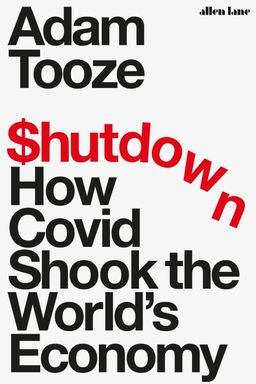
Shutdown cover

Shutdown

by Adam Tooze

Shutdown by Adam Tooze offers an illuminating analysis of the global economic upheaval triggered by COVID-19. From China''s decisive response to the US''s radical measures, Tooze provides insights into how nations navigated the crisis and outlines strategies for future resilience.

Crisis of Interdependence: The 2020 Global Shutdown

How does a pandemic expose the wiring of the modern world? In Shutdown: How Covid Shook the World’s Economy, historian Adam Tooze argues that 2020 was not simply an economic recession—it was a collective pause in global social life, revealing the deep entanglement between health, finance, politics, and technology. You did not just face a virus; humanity made a deliberate choice to halt much of its daily routine.

This book shows that the so-called “shutdown” was both voluntary and compulsory: individuals, firms, and governments acted out of fear, imitation, and regulation. For Tooze, the central lesson is moral and structural: there is no economy separate from the society and the bodies upon which it depends. When commerce requires crowding, contagion becomes economic risk.

A new kind of crisis

The 2020 shock combined biological and financial contagion in a way unseen before. Nearly 95 percent of countries saw GDP fall, three billion people were furloughed or working from home, and 1.6 billion students had education disrupted. In the early months, citizens shut down activity before their governments reacted. Stock markets, transport systems, and schools became signaling devices for collective behavior.

Core idea

You cannot isolate health from economics: once fear of infection spreads, “saving the economy” requires first saving social trust and physical safety.

From Wuhan to Wall Street

In Wuhan, fear and secrecy gave way to massive authoritarian mobilization—building hospitals overnight, sealing borders, and assigning “grid workers” to monitor citizens. China’s success in containment contrasted with early Western complacency. In February, European and U.S. elites treated the virus as distant; by March, Italy’s collapse and the Imperial College report triggered a rapid wave of closures. India issued a national lockdown with only three hours’ notice, trapping tens of millions of migrants—an emblem of how emergency policy collides with social inequality.

Markets seize, states intervene

While cities emptied, markets panicked. The “dash for cash” in March 2020 saw even U.S. Treasuries—the ultimate safe asset—sold off. The Federal Reserve’s massive liquidity injections, rate cuts, and reopening of dollar swap lines stopped a systemic meltdown. The Fed’s intervention blurred the boundary between public welfare and elite protection: it saved markets first, leaving fiscal policy to rescue workers and families.

(Note: Tooze relates this financial choreography to earlier crises—from 2008’s Lehman collapse to World War-era monetary improvisation—but shows that 2020’s scale was even larger.)

Politics under pressure

Democracies and autocracies responded differently but revealed similar strains. In the United States, partisan warfare and misinformation turned public health into culture war. In Europe, emergency fiscal solidarity—exemplified by the NextGeneration EU fund—hinted at deeper integration. In emerging markets, capital flight compounded public health crises. And across the world, inequality widened as central-bank liquidity boosted asset prices while low-income workers bore the brunt of lockdowns.

Revealed vulnerabilities and human choices

Tooze uses the phrase “organized irresponsibility” (after sociologist Ulrich Beck) to describe how the world prepared for pandemics on paper but refused to fund resilience in practice. Underinvested public health systems, fragile supply chains, and underpaid essential workers left nations unprepared. By the time the vaccines arrived—thanks to monumental scientific effort—the politics of distribution and access exposed a new geography of privilege.

Ultimately, the 2020 shutdown was an X-ray of global interdependence. It forced you to admit that resilience is a political choice, not a technical inevitability. The modern economy—financialized, digital, and sped up—is only as strong as the social trust that sustains it. This, Tooze suggests, is the real lesson for the post-Covid era: crises no longer respect the old boundaries between policy domains. They are total social facts, and our survival depends on learning to govern them as such.


The Politics of Preparedness

Tooze begins with a painful truth: the pandemic’s devastation was foreseen but unprepared for. Public health experts had long warned of zoonotic spillover risks, yet budgets, political incentives, and global institutions failed to act accordingly. This mismatch between foresight and follow-through is what Tooze calls organized irresponsibility.

Why it happened

Health protection, unlike military spending, earns no visible political return. The WHO’s budget—about $4.4 billion pre-pandemic—was below that of a large U.S. hospital network. National pandemic plans existed, but maintaining stockpiles, PPE production, or local logistics cost money politicians preferred to save. The structure of global diplomacy also rewarded complacency: no one state wanted to fund commons-based security.

Ethical paradoxes

Behind policy paralysis sat moral discomfort. Economists used the “value of a statistical life” to cost lockdowns versus deaths saved—$3.8 to $10 million per life, depending on the country. But these equations flatten moral dilemmas, implying that an elderly retiree equals a young nurse in monetary value. This abstraction provoked outrage in spring 2020, as politicians attempted to balance “the economy” against human lives.

Lesson

Tooze argues that ignoring moral complexity creates false choices: prevention costs seem high only until catastrophe exposes what inaction truly costs.

Preparedness without power

After SARS, Ebola, and H1N1, governments wrote contingency plans but never built industrial muscle. Supply chains optimized for efficiency couldn’t pivot to emergency production. The result: rich and poor states alike scrambled for masks, swabs, and ventilators. Even advanced democracies such as Italy and the UK learned that they’d traded public capacity for fiscal prudence.

If you take one idea from this, it’s that resilience is political. Societies that treat threats as external surprises will always underfund the systems that save lives. Investing in prevention—public health, social insurance, robust logistics—is the cheapest form of crisis management we have.


Containment and Complacency

In comparing China’s containment to the West’s hesitation, Tooze tracks how governance style shaped outcomes. Wuhan’s lockdown in January 2020 demonstrated political will and bureaucratic reach: constructing hospitals in ten days, deploying 40,000 medical workers, and relying on prior surveillance infrastructure. By March, China contained community spread, while Europe and the U.S. were still debating travel bans.

Why delay proved costly

In February 2020, data on infection rates, transmission, and hospitalizations were already public. Yet Western leaders fixated on electoral and geopolitical distractions—trade wars, Brexit, the U.S. campaign. By the time the Imperial College model warned of millions of deaths under laissez-faire policy, exponential spread had sealed their fate. The “lost month” of February amplified the global emergency.

Policy lessons

Rapid action beats later heroics. Governments that tested, traced, and isolated early (South Korea, Taiwan) managed to avoid blanket lockdowns. Those that hesitated faced chaos once infections rose. India’s abrupt nationwide curfew—with just three hours’ notice—exposed how technocratic decisions can devastate informal workers. The shutdown, Tooze stresses, was not imposed from above alone; it was the emergent product of fear, imitation, and collapsing trust in safety.

The deeper point: pandemics accelerate political truths. China’s command state used coercion for containment and gained legitimacy through success. Western democracies, disorganized by neoliberal fragmentation, stumbled into improvisation. In between lay millions of private actors—businesses, universities, cities—trying to substitute for absent coherence.


Financial Meltdown and Monetary Revolution

Tooze’s mid-book analysis turns to the financial panic of March 2020, when even U.S. government bonds collapsed under selling pressure. The “dash for cash” was the system’s shock test: if the safest asset fails, the global plumbing breaks. Federal Reserve Chair Jerome Powell’s solution was audacious—create dollar liquidity everywhere, for everyone, at once.

How the Fed saved markets

Between March 9 and 23, the Fed launched repo operations, slashed rates to zero, reactivated global swap lines, and unveiled emergency credit facilities (PMCCF, SMCCF, CPFF, MMLF). On March 23 it announced it would buy “as much as needed” in Treasuries—effectively nationalizing liquidity provision. Central banks from Tokyo to Frankfurt replicated this pivot, transforming into market-makers of last resort.

Fiscal fusion

Governments matched monetary action with enormous fiscal packages. The U.S. CARES Act, worth $2.2 trillion, funneled direct payments to households, grants to firms, and unemployment subsidies. Europe’s €750 billion NextGenerationEU plan blended grants and debt mutualization—unthinkable a decade earlier. By year’s end, global fiscal firepower totaled roughly $12–14 trillion.

Insight

The central banks' intervention prevented collapse—but widened the social divide. Asset prices soared while wages and small enterprises lagged, embedding new inequalities in recovery.

For Tooze, 2020’s response represents a de facto merger of monetary and fiscal policy. Central banks bought sovereign debt en masse to keep yields low, monetizing deficits by stealth. Policymakers called it “fiscal QE” or pandemic exceptionalism. But the precedent lingers: once crisis tools rescue markets, withdrawing them threatens turbulence.

The long-term question is democratic: how much market stabilization can technocrats perform without political sanction? Monetary power in 2020 was both the instrument of salvation and a mirror of inequality.


Emerging Economies and Unequal Safety Nets

Beyond the G7, the pandemic exposed stark asymmetries in financial resilience. Emerging economies faced a quadruple hit: collapsing exports, capital outflows, weaker currencies, and constrained fiscal space. Between January and May 2020, investors withdrew over $100 billion—the largest exodus on record.

Improvised tools

To avoid collapse, central banks in Indonesia, Brazil, and South Africa sold reserves and even purchased local government debt—once taboo behavior. The IMF and G20 created temporary buffers: the Debt Service Suspension Initiative (DSSI) deferred payments for the poorest states, and currency swap lines extended limited dollar access to select partners like Mexico and Brazil. But this patchwork favored financially connected states, leaving many low-income countries behind.

Debt and dependency

Tooze highlights China’s dual role—as both creditor and growth engine. Chinese policy banks, now the primary bilateral lenders across Africa and Asia, complicated traditional Paris Club arrangements. Meanwhile, U.S. resistance to a large IMF SDR allocation under Trump deprived poorer nations of vital liquidity until late 2021.

Key takeaway

You can stabilize finance without stabilizing lives. Emerging markets avoided total collapse, but millions of households endured hunger and joblessness—proof that markets' health and social welfare diverge sharply under stress.

The 2020 crisis thus created what Tooze calls a “two-tier globalization”: dollar liquidity flowed smoothly among investors and high-rated states, while contagion—in both disease and debt—burdened those least able to bear it.


China’s Dual Strategy

China weathered 2020 with both political control and economic ambition. Tooze sees a deliberate pattern: using crisis to deepen the fusion of state, capital, and legitimacy. Beijing not only contained Covid but leveraged recovery to reassert strategic dominance across technology, finance, and trade.

State capitalism in motion

Projects like the Greater Bay Area—integrating Hong Kong, Macau, and Guangdong—demonstrate how economic growth and political consolidation intertwine. After imposing the National Security Law in June 2020, Beijing folded Hong Kong’s financial elite deeper into mainland networks. Western disapproval mattered less than access to mainland capital. The Ant Financial IPO halt in November signaled renewed discipline: no private empire stands beyond the Party.

Dual circulation and decoupling

After Washington’s sanctions on Huawei and chip producers like SMIC, Xi Jinping announced “dual circulation”—a strategy combining external trade with domestic technological self-reliance. A $1.4 trillion state-led tech program targeted AI, 5G, and data infrastructure. These policies aimed to ensure that American export controls could not throttle China’s growth path.

Financial magnetism

Paradoxically, while geopolitical tension rose, global investors poured money into Chinese bonds. With higher yields and a stable yuan, China became a quasi-safe haven. By late 2020, foreign ownership of Chinese government debt neared 10 percent, and Wall Street heavyweights—BlackRock, Goldman Sachs, JPMorgan—expanded local operations. Safety, Tooze notes, had migrated eastward.

Interpretation

Beijing used economic openness selectively to reinforce political authority. The lesson: integration without liberalization is entirely possible under twenty-first-century capitalism.

Coupled with its leadership in RCEP—the massive trade pact uniting China, Japan, and South Korea—China’s political economy in 2020 embodied Tooze’s global thesis: the pandemic compressed power shifts that were already underway, affirming that capitalism now operates under multiple, competing rule systems.


Science, Solidarity, and the Limits of Cooperation

Tooze closes with the vaccine race and the broader moral of 2020: scientific brilliance cannot substitute for collective governance. Operation Warp Speed in the U.S., European subsidies to BioNTech, and unprecedented public–private coordination delivered multiple vaccines within a year—a triumph of modern science. Yet the politics of access revealed new forms of inequality.

Speed meets scarcity

COVAX, designed to distribute vaccines equitably, enrolled 189 states but secured too few doses. When India, home to the Serum Institute, paused exports to manage domestic outbreaks, shipments to Africa and Latin America stalled. Production bottlenecks—lipid nanoparticles, cold-chain logistics—proved as decisive as patents. The result: countries with financial leverage vaccinated months, even years, earlier.

Vaccines as geopolitics

China and Russia turned vaccines into instruments of diplomacy: Sinopharm, Sinovac, and Sputnik V flowed to partners in need. Western debates over patent waivers at the WTO, led by India and South Africa, faltered against pharmaceutical lobbying. What emerged was a fragmented moral economy of public health, where sovereignty dictated survival.

Final message

Scientific collaboration achieved miracles—but without political solidarity, innovation deepens divides. The capacity to produce and distribute life-saving goods remains the truest measure of global power.

By the book’s close, Tooze positions 2020 not as an aberration but as prelude. Pandemics, climate disasters, and financial fires are collective-action problems that intertwine the global system. The world’s shutdown illuminated a truth you cannot ignore: interdependence without coordination breeds systemic fragility. Survival now demands a politics as interconnected as the crises we face.

Dig Deeper

Get personalized prompts to apply these lessons to your life and deepen your understanding.

Go Deeper

Get the Full Experience

Download Insight Books for AI-powered reflections, quizzes, and more.