
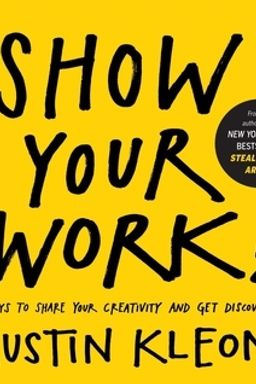
Show Your Work! cover

Show Your Work!

by Austin Kleon

Show Your Work! by Austin Kleon offers a transformative approach to creativity, encouraging artists to openly share their process. By leveraging collaboration and storytelling, this book provides actionable insights to help creatives expand their reach and build meaningful connections.

Show Your Work: A New Way of Sharing Creativity

What if building an audience wasn’t about self-promotion or marketing, but simply about being open and generous with the things you create and love? In Show Your Work!, Austin Kleon argues that in today’s hyperconnected world, creative success depends less on being a genius and more on being an engaged learner who shares their process openly. His central claim is liberating: you don’t have to be a genius, you just have to be findable. The book is a friendly, illustrated manual for anyone—artists, entrepreneurs, teachers, or hobbyists—who wants to sustain creativity while attracting genuine attention.

Kleon believes that in an era of digital transparency, creativity thrives when you allow others to see behind the curtain. Instead of hoarding your work until it’s "perfect," you can invite people into your process, share small progress updates regularly, and make generosity your superpower. The result isn’t just exposure—it’s connection, collaboration, and long-term sustainability.

From Lone Genius to Collaborative Scenius

Kleon begins by dismantling the myth of the "lone genius"—those heroic figures like Picasso or Mozart who appear to invent brilliance from thin air. He instead champions what musician Brian Eno called “scenius,” a collective form of genius that emerges from communities of people sharing, exchanging, and challenging each other.

Creativity, Kleon argues, is inherently social. Online platforms—blogs, social media, communities—allow anyone to join these creative ecosystems and contribute. Great ideas emerge when you make things with others rather than in isolation. In this light, even amateurs have a vital role. Their enthusiasm and willingness to learn publicly can ignite others, just as Bernard Sumner was inspired to start a band after seeing the technically flawed but passionate Sex Pistols perform.

Process Over Product

Whereas the old model focused on hiding your work until it was finished, Kleon flips that model entirely. The key, he says, is to “think process, not product.” Show your working methods, your learning, your questions, even your mistakes—the human story behind the creation is what draws people in. He points to astronaut Chris Hadfield as an example: while commanding the International Space Station, Hadfield shared photos, music, and videos of everyday astronaut life, turning routine tasks like nail clipping and tooth brushing into viral moments that rekindled global fascination with space travel.

By embracing transparency, Hadfield transformed distant, specialized work into shared wonder. Kleon argues that your own creative process—no matter how ordinary—has the power to do the same.

Share, Teach, Connect

Much of Show Your Work! revolves around small, generous actions: sharing one piece of your process every day, opening your “cabinet of curiosities” to reveal your influences, and teaching others what you know. Rather than marketing your projects, you’re building relationships by helping people understand your world. This approach feels especially relevant in the age of social media, where attention is fleeting but authenticity resonates.

For Kleon, teaching is the ultimate sharing act. Like barbecue master Aaron Franklin, who freely posts videos of his smoking techniques, people who give away their knowledge actually enhance their credibility and deepen public appreciation for their craft.

Dealing With Criticism and Staying Grounded

Of course, when you make your process public, not everyone will cheer. Kleon devotes chapters to “learning to take a punch”—his term for growing a thicker skin against trolls, critics, and the inner voice that whispers you're not good enough. He advises creators to protect their most vulnerable work until they’re ready, but to stay open enough to learn from feedback. The goal isn’t to become impervious but resilient.

Grounding yourself in your community—family, friends, fellow makers—keeps you from confusing your work with your identity. The book constantly returns to the theme that creativity is about contribution, not confession.

Earning a Living Without Selling Out

Kleon rejects the myth of the starving artist. Money, he insists, doesn’t corrupt art—it sustains it. The challenge is to balance generosity with fair compensation. He encourages creators to ask for support—through donations, sales, or crowdfunding—once they’ve earned trust through open sharing. But he cautions against chasing every opportunity; what matters is aligning your sources of income with your creative values. “Be as generous as you can,” he quotes Neil Gaiman, “but selfish enough to get your work done.”

Longevity Through Reinvention

Finally, Kleon argues that lasting creative careers depend on sticking around, not striking it rich overnight. The artists who endure—like Woody Allen, Joni Mitchell, or George Carlin—are those who keep working, reinventing, experimenting, and learning. His principle of “chain-smoking” suggests that you should use the spark from one finished project to ignite the next. And when burnout strikes, take a sabbatical—whether a year off like designer Stefan Sagmeister or a daily walk in nature—to recharge your inner curiosity.

Ultimately, Show Your Work! reframes creative visibility as a lifelong practice of generosity and attention. You don’t need to shout louder; you just need to share more genuinely. When you let others see your process, you invite them into the story—and that’s how true discovery happens.


Forget the Lone Genius, Join the Scenius

Austin Kleon opens the book by confronting one of creativity’s most persistent myths: the idea of the “lone genius.” This romantic image of a visionary artist toiling in isolation doesn’t hold up under scrutiny. History shows that creative breakthroughs—from the Renaissance workshops to Silicon Valley startups—are born from collaboration and conversation. In place of this myth, Kleon introduces scenius, a concept coined by musician Brian Eno to describe an ecosystem of creative individuals who learn from one another and push ideas forward together.

The Power of Creative Communities

In a scenius, everyone contributes something valuable: an idea, a critique, a connection, or simply enthusiasm. This environment allows ideas to cross-pollinate and evolve in ways they never could in isolation. Kleon likens the internet to a massive network of overlapping sceniuses—virtual spaces where artists, writers, scientists, and makers share projects, comment on each other’s work, and discover unexpected collaborations.

You don’t have to be brilliant to join a scenius; you just have to show up, share what you love, and engage sincerely. The reward is not fame but belonging—a sense that your work participates in something larger than yourself.

The Advantage of the Amateur

Kleon urges readers to embrace the label of “amateur.” The amateur, derived from the Latin word for “lover,” is someone who creates out of passion, not obligation. Amateurs are fearless experimenters—they make mistakes publicly, learn openly, and in doing so, often discover new paths professionals overlook. As Zen teacher Shunryu Suzuki said, “In the beginner’s mind, there are many possibilities; in the expert’s mind, there are few.”

By learning in public, you help others learn too. C. S. Lewis once noted that students can often explain things to their peers better than teachers can because they recently struggled with the same problem. In this way, Kleon argues, amateurs perform a vital pedagogical role in the creative ecosystem.

Find Your Voice by Using It

The surest way to find your voice, Kleon says, is not through waiting but through usage. Talk about what fascinates you and your natural voice will emerge. He offers the poignant example of film critic Roger Ebert, who, after losing his physical voice to cancer, turned to blogging and tweeting. His online writing became his way of existing, proving that sharing one’s thoughts and curiosities is what keeps the creative voice alive.

The chapter closes with a memento mori: remember that you will die. Reading obituaries, Kleon confesses, keeps him focused on what matters—living fully by sharing one’s gifts, however modest. In your scenius, your work becomes your legacy, and showing it ensures it’s part of the ongoing conversation long after you’re gone.


Think Process, Not Product

In a culture obsessed with final results, Austin Kleon invites you to do the opposite: focus on your process, not your finished product. Creativity, he insists, is not a mystery to be protected but a journey to be shared. By showing the messy, human side of making things, you not only engage others but also deepen your own understanding of your craft.

The Magic of Transparency

Kleon notes that, traditionally, artists were taught to keep their creative process secret until unveiling a masterpiece. In today’s digital world, that model no longer serves us. The internet rewards openness. You can share sketches, notes, inspirations, even failures on platforms like Instagram, blogs, or YouTube—inviting others into your learning process.

He highlights astronaut Chris Hadfield as an example of this radical transparency. During his mission aboard the International Space Station, Hadfield turned his daily life—brushing teeth in zero gravity, taking photos of Earth—into viral lessons on wonder and science. People connected to the humanity in his journey, proving that even highly technical work can capture imaginations when it’s shared openly.

Be a Documentarian of What You Do

Kleon encourages every creator to become their own documentarian. Keep work journals, take photos of your progress, record your voice memos, or film snippets of your daily routine. This isn’t about performing your life for others but paying closer attention to what you do. Over time, these small notes accumulate into a rich body of material you can later shape into stories, posts, or projects.

Even if you never publish this documentation, the process helps you think more clearly about your work. As journalist David Carr famously told his students, “No one gives a damn about your résumé; they want to see what you’ve made with your own little fingers.”

In a world flooded with polished highlight reels, authenticity has its own gravitational pull. By pulling back the curtain on your process, you invite people into your story—and remind them that creativity is not divine lightning but disciplined curiosity.


Share Something Small Every Day

Kleon argues that frequent, consistent sharing—not perfection—is the real engine of creative growth. The internet rewards presence, and what matters most is developing the habit of showing up daily with something genuine, however small. Think of yourself not as a marketer, but as a curator of your own unfolding story.

The Rhythm of Daily Work

“The day,” Kleon writes, “is the only unit of time I can really get my head around.” Forget yearly plans—focus on today. After finishing your day’s creative work, select one thing to share: an insight, sketch, quote, or photo of your work-in-progress. This daily dispatch becomes living proof of your progress, more compelling than any résumé or portfolio. Artist Ze Frank once said he values what people made last weekend more than what they made in school; Kleon echoes that sentiment.

Flow vs. Stock

Borrowing a metaphor from writer Robin Sloan, Kleon distinguishes between “flow” (the ongoing stream of posts, tweets, and updates) and “stock” (the lasting, substantial projects that grow out of that stream). The trick is to maintain your flow publicly while developing your stock privately. Most of his own books, Kleon notes, began as blog posts or tweets that later coalesced into bigger works—a testament to how small daily efforts can compound over time.

Own Your Digital Space

Finally, Kleon reminds readers: never build your creative identity on platforms you don’t control. Social media sites come and go, but your personal website is your permanent headquarters—your living portfolio and archive. Investing in www.yourname.com isn’t vanity; it’s stewardship of your creative identity.

The habit of daily sharing creates momentum, accountability, and connection. You stop waiting for your big break because you’re already building it—one post, one day, one audience member at a time.


Tell Good Stories

How you talk about your work shapes how people experience it. Kleon devotes a full chapter to storytelling because he believes your story is your value translation mechanism. No matter how good your work is, people connect to stories, not just to products.

Story as Context and Connection

Drawing from Paul Bloom’s psychology experiments, Kleon notes that people enjoy and value things more when they know the story behind them. In one study, adding fictional backstories to thrift-store trinkets multiplied their resale value several times over. Likewise, your work gains depth when you explain where it comes from and what it means to you.

“My work speaks for itself” is, he insists, a lie. Humans crave narrative. A good story answers: What inspired this? What struggle did it involve? What did I learn by doing it?

The Classic Three-Act Pitch

Kleon borrows story structures from Aristotle and Pixar: a good story has a beginning, middle, and end—or, put simply, a problem, struggle, and resolution. When pitching yourself or your project, he recommends a three-act formula: past (how you got here), present (what you’re working on now), and future (where you’re going and what help you need). This approach turns your listener into a protagonist who can affect the outcome.

Making Bio and Self-Description Simple

A crucial aspect of storytelling is learning to talk about yourself without pretension. Drop the jargon, Kleon urges. If you take photos, you’re a photographer—not an “aspiring” one. Tell the truth plainly. You don’t need to be clever, just clear. Your authenticity is far more compelling than self-flattery.

Through storytelling, you don’t just describe your work—you give others a reason to care about it. A good story doesn’t exaggerate your importance; it magnifies your humanity.


Teach What You Know

One of the most empowering ideas in Show Your Work! is Kleon’s call to shift from hoarding knowledge to sharing it. “Anything you do not give freely and abundantly becomes lost to you,” he quotes Annie Dillard. Teaching, rather than competing, accelerates creativity—for you and for others.

The Barbecue Wisdom

Kleon’s favorite example is Aaron Franklin of Franklin Barbecue in Austin. Franklin has achieved almost mythical status in the food world, yet he freely shares his secrets—how to choose wood, build a fire, and smoke a brisket. His openness doesn’t destroy his business; it strengthens it. People understand the mastery and dedication behind his craft, and they respect him more for it.

Teaching as Generous Marketing

When you teach, you build trust. People see your competence and character. Jason Fried and David Heinemeier Hansson, authors of Rework, urge businesses to act like chefs—publish cookbooks that reveal their operations, thereby attracting loyal followers. Kleon echoes this, advising creators to post tutorials, reading lists, and how-tos. Sharing your methods doesn’t devalue your work; it makes your audience care more deeply about it.

Teaching also turns the world into your classroom. Readers, listeners, and students become your collaborators, constantly sending feedback and fresh ideas. As writer Christopher Hitchens once said, having your work in the world brings “a free education that goes on for a lifetime.”

When you give knowledge away, you don’t lose it—you multiply its impact. Teaching is not charity; it’s creative evolution.


Don’t Turn Into Human Spam

The digital world tempts us to broadcast rather than engage, but Austin Kleon warns against becoming what he calls “human spam.” These are people who talk endlessly about themselves but never listen, post constantly but never connect. To grow a genuine following, you must be a participant, not a promoter.

The Value of Attention

Kleon quotes Jeffrey Zeldman: “What you want is to follow and be followed by human beings who care about issues you care about.” The currency of the internet isn’t followers—it’s attention, and attention flows toward people who are interesting because they are interested. Don’t chase numbers; build relationships by showing curiosity and generosity.

Be an Open Node

He tells the story of producer Adrian Younge, who casually tweeted a question comparing two old soul bands. Through a follower’s introduction, he ended up collaborating with The Delfonics’ lead singer—a connection born purely from authentic inquiry. When you share your fascinations openly, opportunities find you naturally.

Kleon also introduces the “Vampire Test”—a simple way to determine who energizes or drains you. Creative work requires vitality, so if someone (or something) leaves you exhausted, you must distance yourself. Protect your energy as fiercely as your time.

The antidote to human spam is old-fashioned citizenship: pay attention, support others, celebrate your peers, and reach beyond the digital veil to meet people in real life. Creativity, Kleon reminds us, is still a human exchange.


Sell Out (the Right Way)

Few topics make creatives more uncomfortable than money. Kleon tackles this head-on in his ninth chapter, “Sell Out.” His message is clear: making money from your art doesn’t corrupt it—if anything, it keeps it alive. The goal isn’t to sell your soul; it’s to sustain your work so you can keep making it.

Money is Not the Enemy

He cites examples ranging from Michelangelo (commissioned by the Pope to paint the Sistine Chapel) to Paul McCartney (“Let’s write a swimming pool,” he’d joke to John Lennon). Art has always been financed by commerce. What matters is how you manage the transaction. Crowdfunding, virtual tip jars, and old-fashioned sales can coexist with integrity—as long as your work remains true to your values.

Build Trust Before You Monetize

The musician Amanda Palmer is Kleon’s prime example. After years of freely sharing her work and personally connecting with fans, she launched a crowdfunding campaign. She asked for $100,000 and received over $1 million in return. This wasn’t luck—it was trust, built brick by brick through generosity.

Whether you’re accepting donations or selling products, Kleon advises honesty about your intentions and fairness in your pricing. He also emphasizes the underrated power of email lists—still the most direct, reliable way to communicate with supporters in a shifting digital landscape.

Say Yes, Then Learn When to Say No

Ambition, Kleon notes, is not a dirty word. Say yes to opportunities that expand your art and your impact. But once success arrives, be selective. Neil Gaiman confessed that replying to email had, for a time, replaced his writing—an irony that forced him to draw boundaries. Be generous to others but selfish enough to protect your creative time.

At its heart, this chapter reframes money-making as a moral act of stewardship. You don’t make money to be rich—you make money to make more work. As Walt Disney said, “We don’t make movies to make money; we make money to make more movies.”


Stick Around and Keep Evolving

Kleon closes Show Your Work! with an exhortation that might be the simplest yet hardest advice of all: don’t quit. Longevity, not virality, is the secret to a meaningful creative career. The people who make it aren’t necessarily the most talented—they’re the ones still standing when everyone else has given up.

Play Until the Ninth Inning

He points to comedian Joan Rivers’ mantra: “You don’t quit because you don’t know where the next job is coming from.” Kleon calls this persistence “chain-smoking”: using the spark from one project to light the next. Woody Allen, for instance, never pauses after finishing a film—he immediately starts writing the next manuscript. This continuity keeps creative momentum alive and shields you from the paralysis of overthinking.

Take Sabbaticals to Recharge

Constant creation, however, will eventually lead to burnout. That’s why Kleon advocates for regular sabbaticals. He cites designer Stefan Sagmeister, who closes his design studio every seven years to take a full year off. While not everyone can afford such luxury, daily or monthly “mini-sabbaticals” (walks, commutes, nature breaks) can replenish your imagination.

Become a Lifelong Amateur Again

Each time you master something, start fresh. As author Alain de Botton notes, “Anyone who isn’t embarrassed of who they were last year probably isn’t learning enough.” Comedian Louis C.K. famously threw out all his old jokes each year to force himself into riskier and more personal territory. Reinvention is the antidote to creative stagnation.

When you think you’ve seen and done it all, go back to the beginner’s mind. Show your new learning. Invite others into the next iteration of your journey. That’s how you build not just a career—but a lifetime of creative growth.

Dig Deeper

Get personalized prompts to apply these lessons to your life and deepen your understanding.

Go Deeper

Get the Full Experience

Download Insight Books for AI-powered reflections, quizzes, and more.