
Idea 1
Surviving Love with a Narcissist
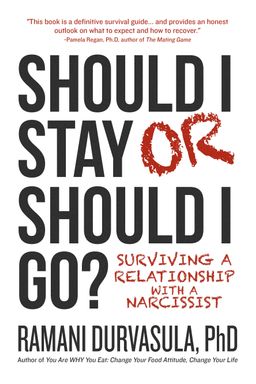
Have you ever wondered why some relationships drain you until you barely recognize yourself? In Should I Stay or Should I Go?, psychologist Dr. Ramani Durvasula reveals the psychological machinery behind one of the most confusing and painful experiences of love—being in a relationship with a narcissist. She argues that these relationships operate like invisible prisons, built from self-doubt, guilt, and the illusion of love’s transformative power. The book’s essential claim is disarmingly simple but emotionally shattering: the narcissist will not change. What must change is your understanding, your behavior, and sometimes your entire life.
Dr. Durvasula explores not only what narcissism is but also the subtle ways it rewires your thinking, erodes your self-esteem, and compels you to stay even when you know you should leave. In this deeply compassionate but unflinching guide, she divides the journey into three stages: recognition, survival, and liberation. You first learn to recognize narcissistic traits and red flags; then you master survival strategies—whether you stay or go; and finally, she offers a handbook for healing and reclaiming your identity.
Understanding Narcissism in Context
Narcissism, as Durvasula describes, is not just self-centeredness. It’s a pervasive disorder of empathy and identity. Narcissists are driven by fragile ego systems that depend on external validation to survive. They are, in her striking metaphor, a bucket with a hole at the bottom—no matter how much love or affirmation you pour in, it drains out. What masquerades as confidence or charm often conceals deep insecurity and emotional fragility.
To make this real, Durvasula opens the book with fictionalized but true-to-life case studies, such as Rachel and John—a classic tale of whirlwind romance turned psychological quicksand. Rachel, a confident professional, falls for John’s charisma and wit, only to realize that the “perfect” partner was a facade. Over years of subtle control, manipulation, and infidelity, her vibrant self becomes hollowed out by his shifting moods and endless entitlement. Like many readers, she stays because she confuses intensity with love, mistaking the scraps of affection for hope.
The Cultural Problem of Narcissism
Dr. Ramani situates this personal tragedy within a broader cultural crisis. The modern world, she argues, is a breeding ground for narcissism—social media platforms, reality TV, and economies celebrating power and beauty over compassion are making self-absorption normal. Citing research from psychologists like Jean Twenge and Keith Campbell (The Narcissism Epidemic), she warns that younger generations are especially vulnerable. In this sense, narcissism is contagious: the more it’s rewarded, the more it spreads. The psychological fallout lands hardest on those closest to narcissists—spouses, partners, and families—who bear the emotional cost of their emptiness.
A Survival Manual, Not a Fairy Tale
Unlike therapy books preaching forgiveness or hope, Should I Stay or Should I Go? presents a stark reality: empathy cannot awaken empathy. Narcissists don’t evolve through love. As Durvasula writes, “You can’t fix someone who doesn’t think they’re broken.” Instead, she focuses on behavioral survival—how you can set boundaries, maintain sanity, and make informed choices. Whether you stay due to family, finances, or fear, or decide to leave altogether, the ultimate goal is the same: recover agency over your mind and your story.
The book’s structure mirrors the psychological journey of recovery. In early chapters, Dr. Ramani explains narcissistic behavior and why people fall for it—charm, grandiosity, the illusion of connection. Later, she steers the reader through emotional fallout: anxiety, shame, self-doubt, and exhaustion. Then come detailed survival tools—how to manage communication (“use the 3-Part Rule”), prepare for narcissistic rage when you leave, and build resilience afterward. Finally, she offers a roadmap to rebuild your life, emphasizing awareness, healing, and empowerment as phases of recovery.
“You cannot rescue a narcissist. You can only rescue yourself.”
This central mantra summarizes the book’s ethos: compassion without self-sacrifice. The real growth lies not in saving them but in reconnecting with your authentic self, the one you silenced to survive.
Why It Matters
The significance of Dr. Ramani’s message extends beyond romance. Narcissistic relationships mirror broader social dynamics—narcissistic bosses, parents, or politicians who exploit others’ empathy to maintain control. Learning to set boundaries with one is learning to set boundaries with all. In a world increasingly dominated by egos, her guide becomes both a therapy manual and a self-defense course for your soul.
By the time readers finish the book, they aren’t just better informed; they’re transformed. They understand that leaving isn’t just physically walking away—it’s the psychological act of reclaiming reality. Whether you choose to stay or go, Dr. Ramani’s message rings with power: you may not change the narcissist—but you can always change the story.