
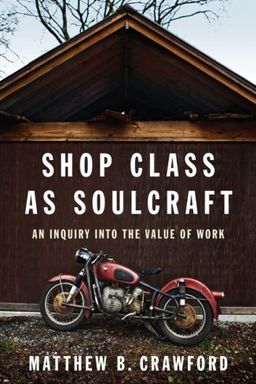
Shop Class as Soulcraft cover

Shop Class as Soulcraft

by Matthew B Crawford

Shop Class as Soulcraft delves into the profound satisfaction of manual work, challenging the societal push towards white-collar jobs. Matthew B. Crawford argues that true fulfillment and stability come from skills-based trades, offering a compelling case for embracing hands-on careers.

The Human Value of Working with Your Hands

When was the last time you fixed something with your own hands—a bike, a broken appliance, maybe a piece of furniture—and felt that jolt of competence and satisfaction? In Shop Class as Soulcraft, Matthew B. Crawford argues that this sense of agency, of making and maintaining tangible things, isn’t just pleasant; it’s a vital part of what makes us human. Through his experiences as a motorcycle mechanic and philosopher, Crawford contends that manual work, long dismissed as low-status in our society, is in fact deeply intellectual, moral, and spiritually nourishing.

The book begins by asking what happens to us when practical know-how disappears from both education and daily life. The answer, Crawford says, is alienation—a kind of estrangement not only from the artifacts around us but from our own ability to act responsibly in the world. Shop class, once a cornerstone of American education, has been dismantled in favor of computer literacy and standardized testing. The result: people who can manipulate symbols but not realities, who are trained to pass tests yet cannot fix a bike chain or a circuit. This loss, Crawford insists, diminishes our autonomy and erodes the “soulcraft” of careful, engaged living.

The Crisis of the Useful Arts

Crawford opens with an observation about the disappearance of tools from schools and homes. In the 1990s, schools sold their machine tools to pay for computer labs, convincing themselves that computer literacy was the new universal skill. But what happened, as shop teacher Tom Hull tells him, is that educators produced students who “can answer questions on standardized tests” but “can’t do anything.” Crawford cites examples from trade educators who struggle to find qualified mechanics or welders, even as college graduates flood a bleak white-collar market. This paradox frames the book’s argument: we have idolized intellectual abstraction while discarding practical intelligence.

The Central Claim: Manual Labor as Intellectual Virtue

Crawford argues that skilled manual work—plumbing, carpentry, electrical work, motorcycle repair—requires constant intellectual engagement. It involves diagnosing problems, making judgments, integrating sensory information, and forming hypotheses—exactly the cognitive tasks celebrated in the sciences. He recounts his own experience as an electrician and later as a motorcycle mechanic, where each repair demanded reasoning about complex systems and hands-on experimentation. “There was more thinking going on in the bike shop,” he writes, “than in my previous job at the think tank.”

At the think tank, intellectual labor was divorced from material reality and had no clear outcome. In the shop, work was governed by objective standards: the lights either turn on or they don’t, the engine either runs smoothly or it doesn’t. These tangible outcomes anchor human dignity—you can point to your work and say, “I did that.” Crawford contrasts this with modern office culture, where success depends on manipulation of appearances and interpersonal “teamwork” that often replaces clear accountability.

Philosophy in the Garage

One of Crawford’s most compelling ideas is that manual work is philosophically rich. Just as Aristotle believed that “all human beings by nature desire to know,” Crawford finds that working with real things offers a direct encounter with truth. You learn reality’s lessons when you strip a bolt, break a drill bit, or face mechanical failure—lessons of humility, perseverance, and respect for the world’s resistance. Unlike abstract reasoning or automated systems, this kind of “real-world rationality” binds humans to their environment and to one another through shared, embodied practices. It is an education in responsibility.

Crawford’s use of philosophy is not ornamental; he draws on Aristotle, Heidegger, Iris Murdoch, and Polanyi to describe how practical engagement cultivates moral perception. To perceive rightly, he says, is a virtue: the mechanic who listens carefully to an engine, or the plumber who anticipates the flow of water, is practicing attentiveness—the ethical opposite of the corporate “idiot” who follows rules without judgment. Manual competence demands what Murdoch calls “unselfing,” the ability to look beyond your own ego and attend to the thing itself.

Why This Matters Today

Crawford’s argument goes beyond nostalgia for old-school shop class. He’s diagnosing a deeper moral and cognitive impoverishment. As we outsource both labor and thinking—to global supply chains, to computers, to experts—we lose touch with the sources of meaning in work. Education that values symbolic manipulation over hands-on mastery produces people estranged from the material world. In contrast, the trades sustain communities of practice, layers of mentorship, and what he calls “a yeoman aristocracy”—craftsmen proud of their competence and independence.

Ultimately, Shop Class as Soulcraft is a call to recover self-reliance, agency, and solidarity through tangible work. Crawford doesn’t romanticize the trades; he acknowledges their frustrations, dangers, and the daily confrontation with failure. But precisely those experiences, he argues, form realistic and humble people capable of judgment and gratitude. In a world obsessed with frictionless “freedom,” manual work reminds us that true freedom—mastery over one’s own stuff—comes from engagement, not escape.

This book invites you not only to reconsider what counts as knowledge but to reflect on how your own work connects you to reality. Whether you fix motorcycles, write code, or teach children, Crawford asks you to see your labor not as a transaction but as an expression of your humanity. Work, he insists, can still be soulcraft.


Thinking Versus Doing

Crawford’s analysis of industrial history begins with the separation of thinking from doing—a division that, he argues, has degraded both manual and intellectual work. In the twentieth century, “scientific management” under Frederick Winslow Taylor explicitly removed brain work from the shop floor, transferring knowledge to planning departments and reducing craftsmen to clerks. This fragmentation of work, Crawford says, is more than economic—it’s epistemological. It changes how we think, and ultimately who we are.

Scientific Management and the Assembly Line

Taylor’s vision was clear: managers should gather all craft knowledge, codify it into formulas, and then dole out minute instructions to unskilled workers. “All possible brain work should be removed from the shop and centered in the planning department,” Taylor wrote. This transition created jobs that could be done by “men of smaller caliber,” cheaper and easier to control. Crawford cites historian Harry Braverman’s Labor and Monopoly Capital to show how this logic turned skilled labor into “abstract labor”—work reduced to motion types studied independently of any human judgment or purpose.

The result was the assembly line, where workers became appendages to machines. The small-scale artistry of wheelwrights, carpenters, and mechanics was replaced by repetitive mechanical motions. Crawford describes how early Ford factory workers revolted against this system—of 963 men hired for every 100 positions in 1913, most quit. Only higher wages kept them at it, and in exchange for the pay, workers surrendered the intellectual pleasures of work. Consumption—fueled by installment debt—became the compensation for alienation.

White-Collar and Knowledge Work

But Crawford observes that the same process of routinization has spread to white-collar jobs. Management consultants and office workers—once thought of as “knowledge workers”—often find their discretion stripped away by standardized processes and “expert systems.” Barbara Garson’s Electronic Sweatshop documented how computer programs were used to transfer decision-making from employees to employers. What was once skilled judgment becomes algorithmic rule-following; the office becomes the new factory.

Even creativity, once sacred, is commoditized. Crawford critiques Richard Florida’s “creative class” ideology, which imagines every Best Buy employee as an innovator “re-conceiving the Vonage display.” He mocks the contradiction of celebrating freedom and imagination while workers earn $8 an hour under surveillance. “Creativity,” he writes, has become a corporate aesthetic—freedom repackaged as flexibility, and flexibility as obedience.

Stoicism and the Trades

Against these illusions, Crawford offers a Stoic ideal. The trades, he says, remain resistant to routinization because their variability demands judgment. A house’s plumbing or a bike’s carburetor always presents unforeseen contingencies that cannot be captured by algorithms. Manual workers, therefore, retain a measure of independence and agency lost in the corporate world. Their freedom is not the utopian dream of self-expression but the pragmatic freedom of mastery—being accountable to real things, not abstract missions.

“Freedom from hope and fear is the Stoic ideal.”

This line captures Crawford’s vision of genuine independence through competence. To live by your own powers, free from the illusions of perpetual ‘self-improvement,’ is a radical act of integrity in the modern economy.

In short, “thinking versus doing” is a false dichotomy. The best work integrates both: the tradesman thinks with his hands, while the philosopher must get his hands dirty with reality. As Crawford reminds you, it’s not whether you work with tools or ideas that shapes your dignity—it’s whether you remain engaged with truth, and answer to real standards that lie beyond the self.


Agency and Self-Reliance

What does it mean to be truly self-reliant? Crawford explores this question through vivid metaphors—like the man who insists on fixing his car himself, or the mechanic confronted with a Mercedes that no longer has a dipstick. He contrasts the sovereign self of consumer culture, which mistakes buying for agency, with a deeper form of self-reliance rooted in understanding and responsibility. Being master of your own stuff, he says, is not isolation—it’s participation in reality.

Freedom and Its Illusions

Crawford observes that modern material culture often offers us freedom by disburdening us of effort. Automatic faucets, self-driving cars, and automation promise liberation from manual involvement. Yet they also infantilize us, because they presuppose irresponsibility. The consumer no longer learns how things work; he waves his hand and waits for water. By outsourcing his attention, he loses his dignity. “With its blanket presumption of irresponsibility,” Crawford writes, “the infrared faucet installs it.”

Using examples from early motorcycles, he shows how demanding machines once educated riders in reality. Riders had to manually adjust spark timing, lubricate engines by hand, and face the consequences of mistakes. Modern machines eliminate these trials, making convenience the ultimate good. But when you no longer contend directly with physical limits, you lose the moral pedagogy of failure—the very friction that teaches humility and mastery.

Things Versus Devices

To clarify this shift, Crawford draws on philosopher Albert Borgmann’s distinction between “things” and “devices.” A thing invites skilled engagement—a musical instrument requires practice, a bike demands maintenance. A device offers instantaneous gratification without understanding. The stereo replaces the guitar; the laptop replaces the workshop. We think we gain autonomy, but in reality, our agency is displaced. “A thing requires practice,” Borgmann wrote, “while a device invites consumption.”

Crawford relates this to advertising, comparing Yamaha’s “Warrior” motorcycle campaign (“Life is what you make it”) to the Betty Crocker cake mix that demanded you add one egg. Both simulate craftsmanship while hiding passive consumption behind claims of personalization. Manufacturers turn agency itself into a brand aesthetic while insulating consumers from the actual mastery of materials.

Embodied Agency

The alternative Crawford offers is embodied agency—the intelligence that arises from doing. Drawing on Anaxagoras (“It is by having hands that man is the most intelligent of animals”) and Heidegger (“handling, using, and taking care of things has its own kind of knowledge”), he argues that our minds are not detached processors but extensions of our hands. To think deeply, you must handle the world. Learning to fix a motor, speak a foreign language, or play music involves submission to something real—rules, materials, and resistances that educate your will.

In other words, genuine self-reliance comes from dependence upon reality. “To live wakefully,” Crawford writes, “is to live in full awareness of our human situation.” We are dependent, but through the disciplined care of things, we can be free. Mastery arises not from autonomy but from sustained attention to what is independent of us.


The Mind of the Mechanic

Every mechanical problem is also a philosophical one. Crawford’s account of his own training as a gearhead—from his teenage Volkswagen struggles to his mentor Chas at Donsco—reveals how manual labor cultivates not only skill but a distinctive moral and psychological disposition. To fix machines well, he explains, you must learn humility, attentiveness, and discernment.

Apprenticeship and Experience

Crawford describes his first job at a Porsche shop in Emeryville, California. Expecting glamour, he instead found himself cleaning parts and discovering that real expertise involves confronting grime and failure. His mentor later became Chas, a machinist and philosopher of metal who taught him to respect material reality. Every bolt, every tolerance, every grade of steel embodies knowledge accumulated through trial and error. In Chas’s world, perfection meant understanding the limits of metal under stress—not just following rules.

Attentiveness Versus Assertion

Crawford contrasts two modes of knowing: attentiveness and assertiveness. The attentive mechanic lets experience and observation shape perception; the assertive thinker imposes abstract theories on reality. He recalls his father, a physicist, explaining that a double knot could always be untied “by pulling one end”—a mathematically elegant but physically false claim. Real shoelaces, like old engines, resist abstraction. The mechanic learns through friction and constraint. Each failed repair cultivates humility, what Iris Murdoch calls “unselfing”—the submission of ego to the true nature of things.

Ethical and Cognitive Virtue

At the moral core of mechanics is attentiveness—the virtue of perceiving rightly. Drawing on Murdoch and Aristotle, Crawford argues that moral and intellectual virtues are intertwined. The good mechanic, like the good artist, sees truthfully and acts justly. He contrasts this with Pirsig’s “idiotic mechanic” in Zen and the Art of Motorcycle Maintenance—a worker who follows procedures without caring about the bike. Idiocy, in its Greek root (idios), means isolation. The true craftsman, by contrast, sees himself as part of a community and accountable to universal standards embodied in the world.

Good mechanics, then, think ethically. Diagnosing a problem requires humility, patience, and imagination—not arrogance. This is what cognitive scientists call “metacognition,” or awareness of one’s own thought process. Crawford reframes it as moral realism: to fix something well, you must pierce the veil of selfish consciousness and join the world as it really is.

The Politics of Attentive Labor

Crawford closes this section with a political insight: degraded forms of work teach carelessness and dependency. Factory systems and scripted service jobs train idiocy by removing responsibility from individuals. In contrast, trades cultivate attentiveness and self-respect. Even paying a local mechanic instead of buying a mass-produced engine can be a civic act—supporting mindful labor over systematized waste. Repair work, like slow farming, resists alienation and affirms a human scale of meaning. “By the mere fact that they stand ready to fix things,” Crawford concludes, “mechanics are an affront to the throwaway society.”


Work, Leisure, and Meaning

Crawford’s final chapters expand his argument beyond the workshop to life itself. What does it mean to live a coherent life, where work and leisure reinforce each other rather than exist as opposites? Through stories of speed shops, motorcycle racing, and even banking, he shows that meaningful work arises when labor serves shared values and visible ends—not just external rewards.

Intrinsic Versus Extrinsic Goods

The gymnast Nadia Comaneci’s perfect 10 inspires Crawford’s question: can paid work ever feel like that? Most jobs are pursued for extrinsic rewards—money, security, recognition—but intrinsic goods like mastery and excellence yield deeper satisfaction. In his speed shop experiences, mechanics worked obsessively not for bonuses but for the love of velocity and engineering. They formed communities of practice where learning and teaching happened organically. This, Crawford says, is what Aristotle meant by telos: activity pursued for its own sake.

Alienated Work and the Collapse of Community

By contrast, much modern labor alienates workers from both craft and community. Crawford’s comparison between early twentieth-century local bankers and twenty-first-century mortgage brokers exposes this transformation. The banker exercised prudence, moral discernment, and solidarity with his town; the broker merely originates loans for distant investors. To do his job, he must suppress his judgment and ignore risk. Alienation, Crawford writes, begins when work requires people to “actively suppress their better judgment.”

Full Engagement and Happiness

Drawing on Aristotle and philosopher Talbot Brewer, Crawford defines happiness as “wholehearted activity.” Pleasure comes not from rewards but from absorption in what is good. When children draw for fun, rewards diminish their joy; when adults turn hobbies into commercial ventures, authenticity fades. Manual work, like motor repair, sustains this wholeheartedness because attention remains on the task itself. The mechanic’s satisfaction mirrors Comaneci’s grace: one loses oneself entirely in excellence.

This perspective redefines what counts as achievement. It’s not climbing Everest or chasing prestige but living a life of engaged activity, responsive to others and to reality. The craftsman participates in a communal pursuit of truth—his work is judged by those competent to recognize effort and excellence. In that recognition lies solidarity, human dignity, and, ultimately, joy.

Dig Deeper

Get personalized prompts to apply these lessons to your life and deepen your understanding.

Go Deeper

Get the Full Experience

Download Insight Books for AI-powered reflections, quizzes, and more.