
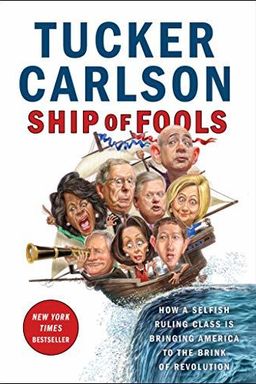
Ship of Fools cover

Ship of Fools

by Tucker Carlson

In ''Ship of Fools,'' Tucker Carlson delivers a scathing critique of America''s elites, accusing them of fostering societal divides and hypocrisy. He explores how their actions contribute to political and cultural instability, offering a provocative perspective on modern American democracy.

America’s Ship of Fools: How the Ruling Class Lost Its Compass

Have you ever felt like the people in charge have no idea what they’re doing? Tucker Carlson’s Ship of Fools begins with that haunting image—a nation adrift, piloted by self-satisfied elites too detached and incompetent to notice the waves closing in. Through political anecdotes, social critique, and cultural analysis, Carlson likens modern America to Plato’s allegorical ship in The Republic: a vessel overtaken by fools who prize self-congratulation over common sense.

The book’s central argument is stark: America’s ruling class—politicians, corporate executives, financiers, and cultural influencers—have “mutinied” against ordinary citizens. Their collective self-interest and ideological blindness are sinking the very system they oversee. Carlson contends that Donald Trump’s election was not a cause of national division but a symptom of it: a desperate signal from voters who realized that the people steering the ship were deaf to their voices and blind to their suffering.

The Breakdown of Trust and Representation

Carlson argues that the greatest failing of America’s ruling elite is their refusal to listen. From Wall Street to Silicon Valley, leaders embrace ideas that feel morally satisfying yet make life worse for ordinary Americans. Economic policies have hollowed out the middle class; cultural policies, obsessed with identity politics, divide people further; and foreign policy adventures have squandered resources while destabilizing entire regions. Voters sense that elections no longer translate to real change—that democracy has become an elaborate performance rather than a mechanism of accountability.

When Trump emerged in 2016, Carlson writes, he wasn’t chosen for his moral decency or detailed policies but because he wasn’t one of “them.” His victory represented a rebellion, not against liberalism or conservatism specifically, but against an entrenched bipartisan establishment that ignored public will. Trump’s rise was a populist outcry—a “middle finger” to elites in both parties.

Decline of the Middle Class and the Rise of Elitism

Central to Carlson’s thesis is the collapse of America’s middle class. He cites economic data showing that since 1970, the middle class’s share of national income has plummeted while wealth at the top has soared. The United States, he warns, now resembles a Latin American oligarchy rather than a democratic republic. Class mobility has stalled; rich and poor live in separate worlds, eat different foods, attend different schools, and even ski on different mountains. The elites’ insulation has bred arrogance and apathy.

Where earlier elites displayed noblesse oblige—a sense of duty toward the less fortunate—today’s ruling class hides behind moral pretense and progressive platitudes. They profess diversity while living in homogenous neighborhoods, preach environmentalism yet fly private jets, and call themselves meritocrats while perpetuating privilege for their offspring. They despise populist sentiment, and their contempt, Carlson insists, is reciprocated by the citizens below deck.

Why These Ideas Matter Now

Carlson’s metaphor of the “ship of fools” doesn’t simply criticize incompetence—it warns of structural failure. Democracies, he claims, cannot survive when inequality and cultural fragmentation reach extremes. When elites manipulate public discourse, suppress dissent through corporate censorship, or distract citizens with symbolic battles over race and gender, they destroy the shared reality that allows democracy to function. The American system becomes increasingly unstable, prone to anger and despair.

Ultimately, Carlson challenges readers—especially those who consider themselves educated or powerful—to rethink what genuine leadership means. Real leaders, he argues, balance wisdom and empathy. They listen, serve, and protect citizens’ dignity. America’s current captains, in contrast, congratulate themselves while ignoring the warning bells. His book is both diagnosis and lament—a call to “right the ship” before the storm consumes everyone aboard.

As you navigate this summary, you’ll explore how elites from both parties converged to serve corporate interests (rather than citizens), how immigration and identity politics deepen inequality, how misguided wars and cultural repression betray democratic values, and how modern society’s obsession with status blinds it to decay. Whether you agree with him or not, Carlson’s message lands with urgency: democracy can survive only if those steering it remember who’s on board—and start listening again.


The Convergence of the Elites

Carlson begins his dissection of America’s elite culture by describing how liberals and conservatives—once divided by fierce ideological debates—gradually fused into a single class. He calls this transformation “The Convergence,” a merging of interests where both parties abandoned economic fairness in favor of corporate globalization and social distraction. This shift, he argues, began in the late 20th century, when Democrats stopped worrying about workers and Republicans stopped worrying about national stability.

From Sincere Liberalism to Corporate Progressivism

Carlson nostalgically recalls the liberals of his childhood—idealists who fretted about pollution, industrial inequality, and corporate abuse. They were whimsical, sometimes naïve, but well-intentioned. Over time, this spirit evaporated. By the tech boom of the 1990s, America’s liberals were cheering for billion-dollar corporations like Apple and Google, not protesting them. Corporate success became a moral badge, and Silicon Valley’s self-presentation as socially conscious masked its exploitation of workers (as seen in Amazon fulfillment centers and gig-economy precarity).

This irony birthed what Carlson calls “corporate progressivism”: CEOs sporting liberal values while crushing unions and collecting enormous profits. Ralph Nader, once the moral conscience of the left, became irrelevant—the price of staying true to anti-corporate convictions. Democrats transformed from champions of labor into patrons of Wall Street, Hollywood, and elite universities.

The Republican Drift and the Death of Empathy

Simultaneously, Republicans morphed into a party of markets without morality. After Reagan, economic success was equated with virtue; poverty was seen as personal failure. Meritocracy—an idea once meant to expand opportunity—turned into secular Calvinism: the rich are rich because they deserve it; the poor are poor because they failed. Carlson invokes thinkers like Patrick Deneen (author of Why Liberalism Failed), noting that modern aristocrats deny their privilege by branding themselves as “progressive change-makers.” They fetishize equality but live as rulers.

The result is an elite class unified not by ideology but by lifestyle: same schools, same neighborhoods, same moral vanity. They believe society’s problems can be solved by “diversity training” or banning plastic straws—symbolic gestures that cost them nothing but signal virtue. Carlson’s biting observation echoes Christopher Lasch’s The Revolt of the Elites, which chronicled similar trends decades earlier.

Why This Matters for You

Carlson’s warning in “The Convergence” isn’t just historical—it’s personal. When all political voices sound the same, voters lose real choice. If you’ve ever wondered why economic policies remain stagnant despite changing presidents, Carlson would say it’s because both sides serve the same masters. The bipartisan consensus—mass immigration, tech monopolies, low wages, foreign wars—protects wealth, not stability. The convergence creates a self-reinforcing system where criticism of elite failure is dismissed as ignorance or bigotry. In short, the rulers have changed costumes, but not their contempt for the ruled.

Carlson closes the chapter with a bitter joke: “Shareholders win, workers lose. Bowing to the diversity agenda is a lot cheaper than raising wages.” This line captures the cynicism at the heart of modern leadership—perform virtue while eroding the nation that makes virtue possible.


Importing a Serf Class

One of Carlson’s sharpest arguments targets bipartisan support for mass immigration. He claims elites promote open borders not from compassion but self-interest—creating cheap labor for employers and submissive voting blocs for politicians. This “imported serf class,” as he provocatively names it, benefits those at the top while undermining both cultural cohesion and economic stability for everyone else.

From Cesar Chavez to Silicon Valley

Carlson revisits historical figures like Cesar Chavez, who opposed illegal immigration for undermining American farmworker wages. He contrasts Chavez’s pragmatism with today’s elites, who celebrate diversity while ignoring its destabilizing effects. Until the late 20th century, Democrats like Jerry Brown and Barbara Jordan argued for controlled immigration to protect workers. Today, Carlson notes, the same party brands such views as racist. Even Republicans joined the chorus under donor pressure for cheap labor, as seen in Paul Ryan’s tenure.

This shift creates what Carlson calls a “strange alignment”: Democrats import voters; corporate Republicans import workers. The losers are citizens—especially the working class—whose wages stagnate and whose communities transform overnight without their consent.

The Cultural and Political Fallout

Beyond economics, Carlson warns of disorientation born of rapid demographic change. A nation that once shared common language and customs now lacks a unifying culture. Elites celebrate diversity without acknowledging that human beings crave stability and identity. When everything changes—neighbors, language, values—people retreat into tribalism. He likens this to historical fractures in Latin America or the fall of Venezuela under Hugo Chávez: inequality plus contempt leads to revolution.

Elites’ Moral Disguise

Mass immigration, Carlson argues, allows affluent Americans to feel virtuous while enjoying cheap domestic labor. He depicts wealthy homeowners with Honduran maids and Pakistani gardeners, congratulating themselves for “giving opportunity” while ignoring that they’ve recreated a servant class. For elites, diversity is anesthetic—a moral drug that masks exploitation. Meanwhile, ordinary citizens endure lower wages, overcrowded schools, and shriveling civic trust.

Carlson’s conclusion is grim but clear: open borders serve oligarchs, not democracy. In his view, importing millions of low-wage workers and redefining citizenship without public consent is less compassionate policy than quiet revolution—the replacement of America's working class with one easier to control.


Foolish Wars and Elite Hubris

War, says Carlson, is the purest expression of elite folly—a realm where arrogance and ignorance combine to ruin lives. In his chapter “Foolish Wars,” he traces how America’s foreign policy establishment, unified across parties, made endless interventions abroad while ignoring decay at home. The result is both moral and strategic rot.

From Antiwar Idealism to Imperial Consensus

Carlson contrasts 1960s liberals who opposed Vietnam with today’s progressives who cheer bombings in the name of humanitarianism. He recounts how the Democratic Party—once skeptical of militarism—embraced intervention during the Clinton years, using moral rhetoric (“human rights,” “democracy”) as cover for power projection. Liberals now justify violence by claiming good intentions, while conservatives defend it through flag-waving patriotism. Either way, the missiles fly.

The Self-Deluding Experts

Figures like Max Boot and Bill Kristol illustrate the moral blindness of the permanent foreign policy class. Carlson documents their repeated advocacy for regime change—from Iraq to Libya to Syria—and their consistent failure to learn from disaster. Boot called for “American Empire” after 9/11; Kristol pushed endless wars, then denounced Trump for opposing them. Their influence persisted because Washington rewards certainty, not accuracy.

In one darkly comedic episode, Carlson notes that even after Iraq devolved into chaos, Kristol claimed, “We won.” This self-delusion defines America's ruling thinkers: they protect their reputations through groupthink and moral bravado, never admitting error. The press, increasingly part of the same class, celebrates their failures as courage.

War’s Domestic Consequences

While elites posture abroad, domestic infrastructure crumbles, veterans die by suicide, and trillions vanish into deserts. Carlson warns that the culture of permanent war erodes democracy itself—centralizing power in unelected bureaucracies, normalizing surveillance, and creating moral numbness. He compares the foreign policy elite’s behavior to dying regimes in history that grew hysterical and repressive as their legitimacy waned.

The lesson, Carlson insists, is timeless: leaders who love war more than country are the gravest danger to democracy. He urges citizens to reclaim skepticism toward global crusades—not out of isolationism, but sanity. After all, real patriotism is fixing Akron, not rebuilding Aleppo.


Silencing Dissent and the Illusion of Freedom

In “Shut Up, They Explained,” Carlson explores a new form of censorship rising among elites—not imposed by government but by culture, corporations, and media. Freedom of speech, he argues, has been quietly replaced by compliance masquerading as tolerance. The story unfolds across universities, tech companies, and newsrooms where dissent is rebranded as hate.

From Berkeley to Silicon Valley

The chapter opens with protests at UC Berkeley—ironically, birthplace of the Free Speech Movement—where activists now riot to silence voices like Milo Yiannopoulos or Ann Coulter. Carlson asks: how did free inquiry become dangerous? The answer lies in moral absolutism. When elites equate disagreement with evil, censorship feels virtuous. Liberal institutions, once champions of debate, became sanctuaries of ideological purity.

Carlson extends this critique to tech giants like Google and Twitter, recounting how employees were fired for questioning diversity doctrine (as in James Damore’s case). These companies position themselves as progressive yet ban users for expressing opinions outside sanctioned narratives. The First Amendment may apply only to government, but Carlson notes that cultural censorship can be equally destructive when corporate monopolies control communication itself.

The New Morality of Fear

He compares modern censorship to medieval religious orthodoxy—where speaking truth outside doctrine invites punishment. Terms like “hate speech” function like blasphemy laws, undefined but potent. Even the ACLU, once a defender of all speech, now cave to political correctness. Carlson laments that people are learning to self-censor in everyday life, trading authenticity for safety.

At universities, free thought is replaced by virtue signaling. Saying the wrong words can end careers, while genuine inquiry disappears. Carlson invokes his own newsroom experiences: when journalists stop asking questions, truth dies. For democracy, silence is fatal.

Why This Threatens You

Carlson urges readers not to mistake comfort for freedom. True liberty demands discomfort—the ability to offend and be offended. When elites suppress dissident ideas, they’re really insulating themselves from accountability. Whether through algorithms, outrage mobs, or bureaucratic intimidation, censorship ensures the ship’s captains never hear the crew’s protest. His final plea resembles George Orwell’s warning: tyranny rarely arrives screaming; it whispers, “Shut up—it’s for your own good.”


The Diversity Diversion

Carlson’s chapter “The Diversity Diversion” examines how elites weaponize identity politics to distract from economic failure. He argues that obsession with race, gender, and sexuality serves as a smokescreen for deeper injustices—wage stagnation, collapsing families, and political corruption. Diversity rhetoric, he claims, replaced solidarity as the ruling class’s favorite moral performance.

Segregation Rebranded as Progress

Carlson points to Harvard’s “Black Commencement” celebration as emblematic of how elites now encourage segregation under the guise of empowerment. Where once integration symbolized progress, separation now signals virtue. University administrators justify racial division as safe space, echoing arguments once made by segregationists. The irony is staggering—and deliberate. Such symbolic conflicts prevent discussion of tangible problems like tuition inflation or administrative bloat.

Virtue Without Cost

For the elite, diversity talk offers moral glamour without sacrifice. They can live in homogeneous enclaves (Carlson cites Hollywood and Ivy League neighborhoods overwhelmingly white) while condemning rural Americans as racist. He profiles figures like Ta-Nehisi Coates, whose identity-centered critiques become rituals of elite guilt. Coates’s popularity, Carlson argues, stems not from revolutionary insight but from providing the wealthy an outlet for racial self-flagellation without demanding change.

This phenomenon mirrors Christopher Lasch’s observation that moral outrage substitutes for empathy. Feeling bad about privilege replaces responsibility to fix inequality. The diversity discourse flatters elites while vilifying working-class whites, turning potential solidarity into hostility.

Tribalism’s Consequences

Carlson warns that “out of one, many” is America’s new unofficial motto. By defining people solely through group identity, elites fragment the nation into competing tribes. Political coalitions become fragile; unity dissolves. He predicts that if identity politics continues unchecked, even whites will form racial grievance movements—a fatal irony for a democracy built on individual equality.

Ultimately, “The Diversity Diversion” argues that equality must rest on shared citizenship, not endless grievance. Race guilt may soothe the powerful’s conscience, but it poisons the ship’s crew. For Carlson, the true diversity worth fighting for is intellectual—listening to voices across class and culture before the vessel breaks apart from within.


Elites Invade the Bedroom

In one of the book’s most personal chapters, Carlson asserts that elite ideology now dictates the most intimate aspects of life—sex, family, and gender. “Elites Invade the Bedroom” critiques modern feminism and transgender politics as tools of cultural engineering that, far from liberating individuals, deepen alienation and unhappiness.

The Failure of Modern Feminism

Carlson revisits Betty Friedan’s The Feminine Mystique as feminism’s noble origin story, aiming to expand women’s choices. Yet he shows how the movement evolved into rigid orthodoxy dictated by unhappy elites. Data from the General Social Survey reveals women are less happy today despite greater freedom—a paradox Carlson attributes to cultural hostility toward family and motherhood. Modern feminists, he says, exalt abortion and careerism while sneering at domestic life, creating moral confusion and loneliness instead of empowerment.

The Transgender Moment and Biology Denial

Carlson links this ideological rigidity to the rise of transgender activism, which he views as the culmination of decades spent denying biological differences. From universities banning The Vagina Monologues to kindergarten teachers forbidding boys from playing with Legos, he describes a cultural environment detached from reality. For him, proclaiming that sex is purely subjective—a matter of identity, not biology—signals moral chaos. He warns that this confusion endangers women’s sports and safety while breeding instability among children pressured to question their nature.

The Vanishing American Father

Even more alarming, Carlson writes, is the disappearance of men. Male happiness, wages, and physical health have all declined; suicide and addiction rates soar. Society sneers at masculinity as “toxic,” leaving millions of men purposeless. Drawing on studies showing fatherless boys’ struggles with discipline and poverty, he argues that stable families—not new gender theories—are the real foundation of equality. His message echoes sociologists like Charles Murray (Coming Apart), who documented similar collapses among working-class men.

For Carlson, elites interfere in bedrooms and classrooms not because they care about liberation, but because moral engineering consolidates power. When families disintegrate, individuals turn to state and corporate systems for meaning—perfect for rulers, disastrous for citizens. The chapter’s conclusion is both cultural and spiritual: society can’t function when its leaders hate men, deny biology, and treat family as optional. Real progress is not androgyny; it’s love rooted in truth.


They Don’t Pick Up Trash Anymore

In the final major chapter, Carlson shifts from politics to morality with “They Don’t Pick Up Trash Anymore.” The phrase is both literal and symbolic. He laments how modern environmentalism, once about protecting nature and promoting responsibility, has mutated into a self-congratulatory faith for rich urbanites. The people who claim to “save the planet” can’t be bothered to clean their own streets.

From Conservation to Abstraction

Carlson evokes vivid memories of the 1970s—when campaigns like the “Crying Indian” ad taught children stewardship and humility. Environmentalism used to mean picking up trash, cleaning rivers, and protecting wildlife. It achieved tangible successes: cleaner air, restored waterways, revived species. But elite activists, he argues, abandoned practical conservation for theoretical crusades like climate apocalypse. The movement drifted from science to moral theater, where concern replaces action.

Hypocrisy of the Green Elite

He skewers modern environmental icons—Leonardo DiCaprio flying private jets to climate awards, Al Gore’s mansion using twenty-one times the power of a typical home, and politicians preaching sustainability while idling motorcades. Beneath their sermons lies what Carlson calls a “new theology of virtue-signaling.” Carbon guilt replaces religious faith; indulgences are purchased through carbon offsets instead of repentance.

Carlson’s critique extends to scientific dogma. He recounts exaggerated climate predictions—from submerged cities to milk at $12.99 a gallon—and warns that science loses credibility when weaponized for politics. He cites scientists like Judith Curry and Roger Pielke, punished for dissent, to show how conformity replaces inquiry. Environmentalism, once empirical, now demands belief.

Environmentalism as Elitist Religion

Ultimately, Carlson portrays the modern green movement as a substitute religion for a secular ruling class. Its rituals—climate summits, hashtags, outrage—provide moral meaning without sacrifice. Meanwhile, American cities rot under homelessness and waste. The elites preach planetary salvation but ignore the suffering visible outside their offices. Carlson’s iconic closing image is simple: park rangers driving past trash while planning videos about climate change. The ship sinks not because of storms, but because its crew stopped caring.

In Carlson’s telling, environmental decay mirrors moral decay. The refusal to “pick up trash”—literally and figuratively—captures elite America’s creed: talking replaces doing. If the book began with an allegory about fools steering the ship, it ends with them staring at screens while the deck piles with garbage. A civilization that forgets basic duties, he warns, can’t survive superior theories.


Righting the Ship: Carlson’s Prescription for Renewal

Carlson closes Ship of Fools with a sober reflection: America can still be saved, but only if its captains remember their passengers. His epilogue, “Righting the Ship,” distills his remedy—neither revolution nor nostalgia but reconnection. Elites must recover empathy; democracy must recover meaning.

Understanding the Cycle of Decline

Carlson reminds readers that civilizations always have ruling classes. Hierarchies are natural. What makes this moment dangerous is inequality inside democracy—a combination history rarely tolerates. When citizens realize that voting cannot alter power, they either despair or revolt. Trump’s election was one such rebellion. If ignored, the next may be fiercer.

Listening Instead of Lecturing

The practical solution, Carlson insists, is humility. Leaders must notice when citizens are dying younger or losing hope. They must treat democracy not as inconvenience but as covenant. He urges elites to heed local voices—whether factory workers, truckers, or parents of opioid victims. “If the majority is worried about something, listen,” he writes, echoing populist thinkers like Andrew Jackson or modern advocates of deliberative democracy. Real progress, he suggests, begins with acknowledging suffering, not mocking it.

Restoring America’s Moral Compass

Carlson’s tone shifts from anger to resolve. The ship can be steered back—if citizens reject ideological tribalism and recover gratitude for their country. He warns against utopian engineering but advocates steady correction: decentralization, national solidarity, and moral seriousness. For Carlson, patriotism is not pride but stewardship—a duty to maintain what generations built.

His final message to you, the reader, is both haunting and hopeful: those pretending wisdom have forgotten service, but that doesn’t mean the voyage must end in wreckage. Democracies survive not by perfection but by empathy. “You can’t force enlightenment by fiat,” Carlson concludes. “In a democracy, you can only persuade. Go slowly. But try.” That sentence, quiet amidst fury, captures the book’s heartbeat: America’s salvation lies not in ideology, but listening to the people who still believe the ship can be saved.

Dig Deeper

Get personalized prompts to apply these lessons to your life and deepen your understanding.

Go Deeper

Get the Full Experience

Download Insight Books for AI-powered reflections, quizzes, and more.