
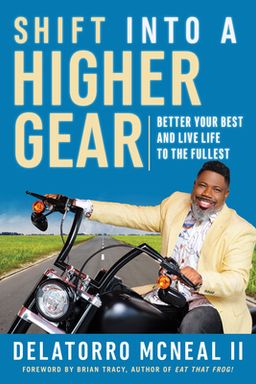
Shift Into a Higher Gear cover

Shift Into a Higher Gear

by Delatorro McNeal II

Shift Into a Higher Gear by Delatorro McNeal II uses the thrilling metaphor of motorcycling to inspire readers to pursue their dreams and achieve self-growth. With actionable strategies for overcoming fears and embracing change, this book empowers you to transform your life both personally and professionally.

Shifting Into a Higher Gear: Living Life Full Throttle

Have you ever felt that you were cruising through life—moving, but not truly accelerating toward your potential? In Shift Into a Higher Gear, Delatorro McNeal II invites you to stop coasting and start riding your life full throttle. Using his passion for motorcycle riding as an extended metaphor, McNeal shows that living to the fullest means shifting constantly—making deliberate changes that take you from limitation to liberation, from average to extraordinary.

At its heart, the book argues that personal growth is not about massive reinventions but about continuous, intentional micro-shifts—small 1% improvements every day that create compounding transformation. Through experiential learning, reflection exercises, and actionable strategies, McNeal offers a roadmap for readers who want to better their best and embrace life with courage, faith, and excellence. He insists that each of us has another gear waiting to be engaged; mediocrity isn’t destiny—it’s just an unshifted reality.

A Motorcycle Mindset for Life

McNeal’s central metaphor—the motorcycle—frames his philosophy. Riding is risky, thrilling, and fully exposed to the elements, just like authentic living. You can’t ride safely with the kickstand down, meaning you can’t move forward while leaning on excuses. To steer effectively, you must lean into the direction you want to go and put your full weight into your journey. And, crucially, motorcycles don’t have a reverse gear; they only move forward, mirroring the mindset that true growth requires forward motion despite fear, pain, or setbacks.

The Power of Small Shifts

The first lesson McNeal gives is deceptively simple: transformation begins with small shifts. Drawing on the Pareto Principle (the 80/20 Rule), he shows that a mere 20% of our efforts create 80% of our results—and that fine-tuning that magic 20% can produce huge breakthroughs. He tells stories of personal changes—from adjusting his nutrition habits and parenting approach to refining professional routines—that reflect how small tweaks lead to immense rewards. Like turning up water’s temperature from 211° to 212°, one degree transforms hot liquid into steam—a power source strong enough to move locomotives.

Living 3-D: Width, Length, and Depth

Beyond small changes, McNeal insists that fullness of life comes from living in three dimensions—wide, long, and deep—not just accumulating years. Many high achievers live long but narrow lives, holding impressive résumés with shallow experiences. Through examples of historic figures like Martin Luther King Jr., Selena, and Bruce Lee—individuals who lived less than forty years but made monumental impact—he demonstrates that depth and width elevate longevity into legacy. Living wide and deep means embracing experience, variety, and emotional richness, paying the price for excellence rather than enduring the cost of mediocrity.

Change, Courage, and the Ride Ahead

The book’s overarching challenge is clear: either you proactively lead change or you will reactively be changed by it. McNeal outlines how courageous living depends on accepting the environment, embracing the winds, and balancing faith and fear. Like a rider who faces weather head-on, you can’t stay encapsulated behind the metaphorical windshield of comfort if you want authentic freedom. He teaches a six-step model for change—from declaring, “It must change,” to celebrating, “I have changed it.” What matters most is taking ownership (“I must change it”), acting on belief (“I can change it”), and practicing resolve (“I will change it”).

Faith Over Fear and Emotional Mastery

In one of the book’s most memorable lessons, McNeal revisits The Karate Kid Part III. He cites Mr. Miyagi’s wisdom to Daniel: “It’s okay to lose to your opponent, but you must not lose to fear.” The quote becomes his rally cry for faith-based living. Fear, he explains, is just your internal safety system doing its job—but left unchecked, it outsizes its purpose and blocks your destiny. Your antidote is action—specifically, what he calls CIA: Consistent Imperfect Action. By taking small, imperfect steps daily, you starve fear and feed faith. Emotional mastery follows naturally: once you control your emotions—the engine of your life—you control your ride.

Shifting Your Posse and Living Forward

McNeal insists that who you ride with matters. Your relationships determine the quality and safety of your journey. Through exercises like the “posse audit,” he pushes readers to evaluate whether their top twenty contacts add or subtract value. Relationships must include mentors (those ahead of you), mates (those beside you), and mentees (those who follow you). He also emphasizes accountability partnerships and mastermind groups for collective acceleration. As he puts it: “If you want to go fast, go alone; if you want to go far, go together.”

Staying in Drive and Becoming a Goal Getter

Ultimately, Shift Into a Higher Gear centers on momentum—keeping your bike in Drive. Whether shifting emotional focus, relationships, or internal mindset, the book’s actionable framework culminates in transforming from goal setter to goal getter. McNeal’s “Eight R’s” for manifestation—room, reasons, resources, road map, rewards, relationships, resolve, and real experience—serve as the blueprint for bringing dreams to life. Life, he reminds readers, isn’t about arriving somewhere called “there,” but traveling in full awareness of the ride itself.

“Failure isn’t an option—it’s a privilege reserved for those who try.”

McNeal’s mantra encapsulates the book’s ethos: you earn mastery by attempting, failing, learning, and persistently shifting upward. If you commit to these shifts—small daily actions, 3-D living, fearless faith, and forward momentum—you can better your best and live life to the fullest.

This book isn’t about motorcycles; it’s about mastery, mindset, and motion. Whether you’ve ever ridden or not, McNeal challenges you to see life like the open road—dangerous but exhilarating. Every day, you can roll the throttle, take ownership of your direction, and shift into a higher gear.


Small Shifts, Big Difference

Delatorro McNeal begins the ride by dismantling one of the deepest myths in personal growth: that success requires massive upheaval. In reality, transformation happens in inches, not miles. He defines a “shift” as a small, deliberate movement that changes momentum and direction. You don’t need to overhaul your life; you need to make micro-adjustments that compound into breakthroughs.

The 1% Principle

McNeal asks you to commit to being just 1% better each day. This small goal sidesteps the pressure of big resolutions. Instead of trying to lose 50 pounds instantly or double your income overnight, focus on consistent 1% improvements—in your health, relationships, and mindset. Over time, this compounding progress creates exponential growth. The idea mirrors concepts from James Clear’s Atomic Habits, where small, sustained actions produce massive results.

The Steam Metaphor

In one of his most memorable examples, McNeal compares water heated to 211° and 212°. At 211°, the water is hot—but at 212°, it produces steam, which powers trains, ships, and industry. That single degree represents the small shift between ordinary and extraordinary. You might be one small behavioral degree away from transformation. It’s a reminder that success often depends on incremental consistency rather than grand gestures.

Better Your Best: Daily Invitations

Life, McNeal insists, gives you one open invitation daily: “Will you be better today than you were yesterday?” Because your “best” is a product of your past, improving today means redefining tomorrow. His philosophy echoes the Japanese principle of kaizen—continuous, never-ending improvement—and Tony Robbins’s concept of CANI (“Constant and Never-ending Improvement”). Both reflect McNeal’s belief that greatness grows through ritual repetition.

Avoiding the Myth of ‘There’

A core insight in this chapter is that there is no “there” there. The end goal—what most people chase—is an illusion. Real fulfillment comes from the process, not the finish line. McNeal uses the example of his own Full Throttle Experience conferences: while the event’s success is gratifying, his most meaningful fulfillment comes from the preparation, teamwork, and transformation he sees along the way. Your happiness doesn’t arrive when you arrive—it’s found along the ride.

“Failure is a privilege reserved exclusively for those who try.”

Small shifts multiply only if you act, fail, and learn. The act of trying moves you forward.

How to Start Shifting Small

  • Identify three areas today—physical health, relationships, productivity—where you can make 1% improvements.
  • Track progress incrementally, not perfectly. Reward consistency, not intensity.
  • Replace overwhelm with optimism. Celebrate effort rather than result.

The essence of McNeal’s opening shift is accessibility: anyone can start today. By doing small things exceptionally well and sustaining them long enough, you move from ordinary heat to transformational steam—and that’s how you shift into a higher gear.


Living 3-D Instead of Coasting

In chapter 2, McNeal challenges one of the quiet epidemics of modern life: coasting. We move through routines but often lose the engine—the purpose behind movement. Coasting means drifting without passion or intention. To counter this, McNeal introduces the idea of “3-D Living,” urging you to experience life not just in its length of years but also its width and depth.

The Three Dimensions of Living

Length, the dimension most celebrated with birthdays, is just how long you exist. But longevity alone doesn’t equal fulfillment. Width is how wide you live—how far you stretch beyond comfort zones, experiment, travel, and build relationships. Depth is how profoundly you engage with emotion, purpose, and connection. Those who live wide and deep create impact that transcends time. McNeal points to Princess Diana, Malcolm X, and Bob Marley—icons who died early but whose legacies endure because they lived 3-D.

The Price vs. Cost Paradox

Living in 3-D isn’t cheap. It costs effort, vulnerability, and courage. But refusing that price incurs a greater cost—regret, emotional emptiness, and spiritual stagnation. You can pay the price for an extraordinary life or suffer the cost of mediocrity. (In similar fashion, Bronnie Ware’s The Top Five Regrets of the Dying echoes this insight: people regret not living widely and deeply.)

Measuring Life in Summers

McNeal applies a startling math equation to make time tangible. With average global life expectancy at around 72.6 years, he calculates his remaining “summers”—the seasons left to truly live. When you realize you may have 20 or 30 summers remaining, life’s urgency crystallizes. It becomes now o’clock. That awareness shifts you from passive existence to intentional adventure.

Examples of 3-D Choices

  • Travel deeply, not just widely—learn languages, stay with locals, absorb culture.
  • Develop emotional depth—listen actively, love harder, forgive faster.
  • Expand intellectual width—read beyond your field, debate, and redesign your beliefs.

“You can live a hundred years—or one year a hundred times.”

McNeal’s quote captures the tragedy of repetition. Most people live loops, not lives; 3-D living breaks the loop.

This concept reframes success as experiential richness rather than longevity. Longevity without depth is existence; width and depth ignite meaning. McNeal’s call is clear: live full throttle, go beyond length, and sculpt your life as a 3-D masterpiece.


Change Demands Leadership

Change is inevitable—but transformation is intentional. In chapter 3, McNeal turns the motorcycle into a classroom for leadership. Riders can’t control the weather; they can only adjust their posture, clothing, and attitude. Likewise, leaders must accept life as it is while steering toward improvement. His mantra: “Either you proactively lead change, or you will reactively be changed by change.”

Three Steps Great Leaders Take

  • See things as they are—be a realist. Acknowledge reality, not appearances. Like McNeal confronting his debt honestly before repairing it.
  • See things as better than they are—be an optimist. Vision energizes transformation.
  • Make things as you see them—be an activist. Actively construct the better future you imagine.

The Nail Story: Comfort vs. Pain

McNeal recounts “The Old Man and the Howling Dog,” a parable about a dog lying on a nail. It howls from pain yet doesn’t move because it doesn’t hurt enough. This image illustrates human complacency. We complain but rarely change until discomfort exceeds tolerance. Shifting doesn’t happen until pain becomes purpose.

The Six Phases of Real Change

  • It must change. Identify the issue.
  • I must change it. Take ownership; become CEO of your evolution.
  • I can change it. Cultivate belief in capacity.
  • I will change it. Commit with resolve; turn intention into will.
  • I am changing it. Celebrate progress even mid-process.
  • I have changed it. Solidify the transformation with gratitude and boundaries.

Change feels like loss because it erodes familiarity. McNeal’s six-phase process helps replace fear of loss with celebration of evolution. As leadership expert John Maxwell also teaches, growth requires surrendering stability for significance. To shift into higher gears of life, you must first take your hands off the nail—and onto the throttle.


Fear to Faith: The Warrior Within

Every rider confronts fear. Chapter 6 explores how fear immobilizes and faith accelerates. McNeal personifies them as two warriors inside you battling for control—and reminds you that the one you feed wins the day. You starve fear by acting; you feed faith through belief and momentum.

Understanding Fear’s Real Job

Fear’s job, taught by his colleague Rhonda Britten, is to keep you safe. It warns, not condemns. But fear often overfunctions—it protects you from success instead of danger. Recognizing fear’s purpose without yielding to its control allows you to redirect that energy toward faith.

Facts vs. Truth

McNeal contrasts fear’s fixation on facts—the observable limitations—with faith’s focus on truth—the unseen potential. You may have only $500 in the bank (fact), but you hold a million-dollar idea (truth). You may be divorced (fact), but you’ve learned lessons that prepare you for deep love (truth). This echo of Wayne Dyer’s teaching—“If you change how you look at things, the things you look at change”—empowers you to reframe limitations as launching points.

The CIA: Consistent Imperfect Action

The cure for fear is movement. McNeal’s acronym, CIA, stands for “Consistent Imperfect Action.” Instead of waiting for perfect readiness, act with imperfect effort daily. Companies release imperfect products constantly—your life deserves the same iterative progress. Like a helicopter adjusting midair, you refine direction while flying.

Faith-Based Living in Practice

McNeal illustrates his principle with three personal experiences. As a child, confronting fear of memorizing long church play lines led him to become a world-class speaker. As a college student, fear of fraternity rejection redirected him toward leadership roles. As an adult, fear of leaving a secure job birthed his entrepreneurial calling. Each story shows transformation through faith-driven leaps.

“It’s okay to lose to your opponent—but you must not lose to fear.”

Fear will always knock; faith decides whether you open the door. Every 24 hours offers you both warriors—choose your rider.

McNeal closes by urging you to call the CIA on your fears—take action and they’ll vanish. Like Daniel in The Karate Kid, your best self is still inside you; roll the throttle and let it out.


Emotional Mastery Over Task Mastery

Most of us are trained to achieve happiness after success. McNeal flips that mindset: don’t achieve to be happy—happily achieve. Chapter 7 reveals that the real engine of life isn’t intellect or workload—it’s emotion. He calls for mastering emotions rather than tasks so that feelings become fuel, not friction.

Emotions Are the Engine

Your emotions, like a motorcycle’s engine, determine momentum. Through anecdotes about his mother—who responded to every greeting with “Aww, child, I’m blessed”—McNeal illustrates how gratitude can override turmoil. Regardless of storms, his mother’s emotional home was thankfulness, and that stability powered her resilience.

Finding Your Emotional Home

Everyone gravitates toward a set of dominant emotions—your “emotional home.” Some live in joy; others in anger or anxiety. Like a GPS app that always brings you back home, you unconsciously return to those states daily. Changing your emotional address requires identifying your current emotional home and deliberately moving to a new one (for example, from resentment to gratitude). Therapist Robert Plutchik’s “Wheel of Emotions” helps visualize this spectrum—where joy and trust create expansion while fear and disgust constrict.

Becoming the Emotion You Want

McNeal encourages personifying desired emotions through daily “I am” declarations: “I am love. I am confident. I am joy.” Instead of chasing emotions as external events, embody them internally. This mirrors Louise Hay’s affirmation work and modern positive psychology—emotional states respond to repetition and belief.

Gratitude: The Ace Emotion

Among all feelings, gratitude carries veto power. It’s nearly impossible to feel jealous, angry, or hateful while sincerely grateful. McNeal prescribes “bookending” each day with gratitude lists—eight things at sunrise, eight at sunset. Gratitude recalibrates your vibration, propelling your internal engine smoothly down life’s road.

“Emotion follows motion.”

Move your body—run, stretch, dance—and your mood shifts. The throttle of life is physical engagement.

By mastering emotions before tasks, you create internal horsepower. Gratitude becomes your fuel, joy your GPS, and love your highway. When emotions drive purpose, motion naturally leads to mastery.


Your Posse Determines Your Pace

McNeal’s eighth chapter centers on relationships—the riders sharing your journey. He reminds you that your posse determines your pace and direction. Since motorcycles react to every passenger movement, who rides with you directly affects stability and speed. The same applies to life: your associations can either balance or break you.

The Posse Audit

Make a list of the twenty people you communicate with most. Rate whether each adds or subtracts value. The exercise, adapted from his workshops, often shocks professionals into realizing that nearly half their circle drains energy rather than contributes. Replace subtraction with addition—choose riders who align with your direction.

Mentors, Mates, and Mentees

Your ideal posse includes three archetypes. Mentors are ahead on the road, who teach lessons and open doors. Mates ride alongside—accountability partners who share the struggle and success. Mentees follow behind, reminding you of progress and purpose. This triad keeps your motorcycle balanced front, middle, and back wheel.

The Mastermind Advantage

For collective acceleration, McNeal recommends “mastermind” groups—peer circles of collaboration introduced by Napoleon Hill in Think and Grow Rich. He outlines seven steps for creating a successful mastermind focused on contribution, accountability, and equal knowledge exchange. These relationships shorten your learning curve and convert isolation into synergy.

“If I gave you $100,000 to start a business, would you hire your closest friends?”

McNeal’s provocative question exposes misplaced loyalty—people often trust unqualified friendships with their futures. Choose friends who deserve your dreams.

By shifting your posse, you shift your power. Surround yourself intentionally—mentors to teach, mates to motivate, mentees to remind you of meaning. On life’s open road, who rides with you is often more important than how fast you ride.


From Goal Setting to Goal Getting

The book’s final acceleration, chapter 12, transforms intention into manifestation. McNeal argues that most people set goals but never get them because they confuse decision with action. He illustrates with a simple riddle: when three birds sit on a branch and one decides to fly away, how many remain? All three—because decision alone doesn’t create movement.

Ten Life Categories

McNeal divides goal design into ten categories—from health and family to wealth and spirituality. Your mission: create ten goals in each category, totaling a hundred. This exercise builds a holistic vision covering body, mind, relationships, and purpose.

The Eight R’s of Manifestation

  • Room: Clear physical, mental, and emotional space for new goals.
  • Reasons: Define your why; motivation sustains the climb.
  • Resources: Gather tools, people, and opportunities.
  • Road Map: Study successful models; trace their steps.
  • Rewards: Celebrate small wins to ignite dopamine-driven progress.
  • Relationships: Leverage networks; one referral can change everything.
  • Resolve: Persevere through setbacks; treat failure as feedback.
  • Real Experience: Immerse yourself in environments that mirror success.

Action Beyond Desire

McNeal’s process mirrors Peter Drucker’s maxim, “The best way to predict the future is to create it.” He emphasizes rolling the throttle daily—taking consistent imperfect action toward each goal. Manifestation becomes predictable when your behavior mirrors belief and your faith fuels frictionless effort.

“Shifting into a higher gear happens when you finish what you start.”

The difference between dreamers and achievers isn’t vision—it’s closure. Each goal finished refuels the next ride.

McNeal ends the book as he began: with motion. Life is a journey, not a garage. Every day invites you to roll the throttle, lean into curves, and shift forward. Becoming a goal getter means honoring the ride more than the arrival.

Dig Deeper

Get personalized prompts to apply these lessons to your life and deepen your understanding.

Go Deeper

Get the Full Experience

Download Insight Books for AI-powered reflections, quizzes, and more.