
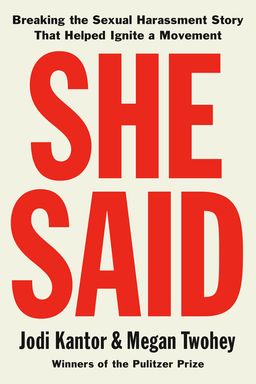
She Said cover

She Said

by Jodi Kantor and Megan Twohey

She Said narrates the groundbreaking investigation by Jodi Kantor and Megan Twohey that exposed Harvey Weinstein''s decades of sexual misconduct. This riveting account details their relentless pursuit of truth, which helped ignite the global #MeToo movement and transform societal conversations around sexual harassment.

How Truth Breaks Through Power

How do you expose long-hidden abuses when money, lawyers, and fear conspire to bury them? In She Said, Jodi Kantor and Megan Twohey show that investigative journalism is not simply about uncovering scandal—it’s about dismantling the structures that protect it. Their reporting on Harvey Weinstein’s misconduct not only changed one man’s fate but ignited a global reckoning around sexual harassment, silence, and accountability. Yet the book goes further: it explains how reporters convert rumor into evidence, victims into witnesses, and one investigation into a social reaction large enough to shift norms.

The Architecture of Concealment

You see that power hides itself through repetition and infrastructure. Weinstein’s alleged pattern—meetings in hotel suites, invitations disguised as business, and intimidation afterward—was reinforced by corporate systems, legal settlements, and public relations campaigns. Confidentiality agreements and destroyed records ensured that behavior repeated undetected for decades. The reporters came to understand that unveiling a secret meant exposing not just one perpetrator but the machinery that sustained him: the lawyers, agents, assistants, and executives who normalized silence.

(Note: This mirrors themes in Ronan Farrow’s Catch and Kill, though Kantor and Twohey focus more on institutional complicity and craft.) Where other journalists might have chased the sensational, they pursued the structural: who paid, who signed, who looked away.

The Journalistic Method

The first chapters reveal the patient choreography behind an exposé. Kantor and Twohey coaxed sources like Rose McGowan, Ashley Judd, and Zelda Perkins to speak by offering purpose, not just publicity: the chance to help protect others. They tailored tone and promises to each woman’s fears—privacy for some, collective solidarity for others. Behind the intimacy of each conversation lies strategic craft: vetting every statement, corroborating with documents and patterns, and giving subjects the legal right of response. Their editors, Rebecca Corbett and Dean Baquet, insisted on fairness without surrendering control.

You learn that investigative reporting is less a confrontation than a process of mutual calibration—one phone call at a time. The reporters never claim certainty without proof. Instead they build it layer by layer: settlements confirmed by lawyers, memos preserved by insiders, and patterns validated across continents. The discipline of corroboration becomes a protection against libel and a condition of trust with readers.

Resistance and Counterattack

Parallel to the reporting unfolds an elaborate defense industry. Weinstein’s team—attorneys like David Boies and Charles Harder, PR strategist Lisa Bloom, and operatives from Black Cube—deployed lawsuits, threats, and espionage. Contract clauses incentivized agents to stop publication; fake interviews and private investigators attempted to entrap or intimidate sources. The New York Times countered by insisting on transparency: every conversation be on the record, every claim documented in writing. When Harder demanded to halt printing under threat of $100 million in damages, lawyer David McCraw replied that discovery would cut both ways—forcing Weinstein to produce his own files.

This standoff illustrates a principle: facts are both defense and weapon. When law is wielded as a tool of suppression, documentation and institutional backing allow truth to prevail. The reporters’ calm professionalism under siege—Baquet’s instruction, “assume you’re being followed; act like every call is recorded”—becomes both tactic and metaphor for modern journalism’s perilous terrain.

From Article to Movement

At 2:05 p.m. on October 5, 2017, the Times published a 3,300-word article listing allegations and at least eight settlements. The effect was seismic. Within days, dozens of women came forward, Weinstein’s board expelled him, and a wave of revelations rippled across industries. Yet the authors show the aftermath is complicated: for every woman celebrated, another received threats, lost work, or endured scrutiny about credibility. The reckoning inspired #MeToo and Time’s Up, but laws and institutions lagged behind. NDAs remained legal; many accused men reemerged. Kantor and Twohey use later chapters—from Christine Blasey Ford’s testimony to the reflective gathering at Gwyneth Paltrow’s home—to show that justice, like journalism, unfolds unevenly.

The Human Core

What makes She Said essential is not simply what it exposes, but how it restores complexity to people within these stories. Ford fears for her children; employees such as Lauren O’Connor and Rowena Chiu risk livelihoods to preserve evidence; editors and lawyers balance empathy with precision. By documenting their inner debates and external risks, the book reveals that systemic change starts from individual moral choice. Each truth-teller contributes a fragment of proof that collective courage can surpass collective denial.

Ultimately, Kantor and Twohey argue that truth emerges not as revelation but as accumulation: through trust carefully earned, documents quietly preserved, and courage shared across lines of class, fame, and geography. If you want to understand how a culture shifts, read this not as a simple exposé but as a manual on how power yields—one verifiable fact at a time.


The Pattern Behind the Predator

Weinstein’s behavior followed a grim blueprint. Across three decades, women described nearly identical scenarios—casting meetings that turned private, bathrobes and massages, offers of career advancement, and subsequent threats. By identifying this repetition, reporters turned isolated accounts into a systematic pattern of abuse. Each detail—bottles of champagne, suite numbers, phrases like 'Friends of Harvey'—functioned as corroboration. The pattern itself became evidence.

The journalists noticed not just personal tactics but institutional accomplices. Assistants were ordered to escort women, receptionists booked rooms, and legal teams managed settlements. The targeting was deliberate: young women new to film or entry-level staff too vulnerable to resist. Company culture reinforced submission; fear of retaliation kept silence uniform.

Why Patterns Convince

As Twohey explains, a single story can be dismissed as misinterpretation, but replication across time and geography disarms disbelief. In evidence terms, you move from anecdote to data. The same dynamics underpinned the reporters’ other inquiries—from O’Reilly to Uber misconduct. Pattern recognition is the hinge between empathy and proof.

Escalation and Impact

Individual consequences were devastating: careers halted, mental health collapses, families strained. Weinstein’s retaliation machinery—smears, blacklisting, and settlements—helped enforce the pattern. Yet those repeated stories also sowed connection; when survivors discovered their experiences mirrored others, fear transformed into power. Recognizing shared architecture was the first step toward breaking it.

If you investigate any form of wrongdoing, this section teaches that the pattern—the recurrence of detail, setting, and response—is what transforms belief into understanding. Abusers act predictably; institutions protect them predictably; journalism works by revealing those patterns to the public eye.


The Machinery of Silence

Weinstein’s power endured because secrecy paid. Settlements and nondisclosure agreements created a commercial ecosystem that rewarded silence. Attorneys mediated quick payouts in exchange for lifetime confidentiality clauses. Victims signed to move on, not foreseeing that their silence would shield others from warning. The reporters traced these agreements like archaeologists following buried clues—duplicate terms, defunct law firms, amounts recurring across decades.

The legal architecture was sophisticated. Settlements required surrender of evidence and sometimes reassignment of attorneys to the opposing side. Agencies like the California Department of Fair Employment compounded secrecy by destroying closed files. Reform efforts often stalled when celebrity lawyers—ironically those representing women in public—opposed bans on confidentiality clauses.

Why People Accepted Them

Victims faced impossible choices. Lawsuits were costly, evidence ephemeral, statutes of limitations restrictive. Immediate settlement offered money, psychological closure, and privacy. For attorneys, quick resolutions meant contingency fees and guaranteed outcomes. The result was a shadow market of payoffs stringing from Hollywood to cable news—a structure as self-sustaining as any corporate business model.

Secrecy as System, Not Symptom

Seen together, these agreements reveal complicity. NDAs did not merely silence individuals; they disabled public institutions’ ability to detect serial predators. Each payment erased history, destroying the dataset society would need to act. Kantor and Twohey’s exposure of that hidden infrastructure reframed NDAs from private matters to public hazards. It’s the book’s legal conscience: information cannot protect if it’s contractually erased.

The reporters urge readers to see confidentiality not as neutral privacy but as instrumental concealment. Transparency, they argue, must be legislated—because justice, left to contract, tends to favor those who can afford the lawyers.


Inside Corporate Complicity

Harvey Weinstein operated within a corporate ecosystem that empowered him. The turning point in the investigation was Lauren O'Connor’s internal memo. Her document catalogued abuses and systemic enablers at The Weinstein Company: assistants forced into 'personal' tasks, HR dismissals of complaints, and board indifference. When Jodi Kantor obtained it through insider Irwin Reiter, private rumors became documented fact. The memo’s existence proved the company knew—and chose to ignore.

Boards and lawyers shaped this complicity. Contracts insulated Weinstein, requiring felony conviction for termination. Star attorneys like David Boies advised both the company and the subject, creating conflicts of loyalty. Even sympathetic insiders like Bob Weinstein alternated between moral awareness and paralysis. Corporate response meetings prioritized liability over safety.

The Ethics of Evidence

Obtaining the memo posed moral questions: could they use internal documents leaked at personal risk to employees? The journalists navigated that by verifying authenticity and redacting sensitive names. Their decision underscores an ethical line—publish not to punish, but to reveal what institutions hid. The O’Connor memo’s passage from private file to public record marks journalism’s highest function: converting suppressed knowledge into collective accountability.

The lesson is that organizations don’t need explicit conspiracies to enable wrongdoing; inertia, secrecy, and misplaced loyalty suffice. Institutional dysfunction is a chain of small silences—and it breaks when someone, somewhere, keeps a copy.


The Counterattack: Lawyers and Spies

Power defends itself with the same sophistication it uses to offend. Once reporters closed in, Weinstein launched a multidimensional counteroffensive. Legal emissaries—David Boies, Lisa Bloom, Lanny Davis, and Charles Harder—pursued delay, denial, and intimidation. Private agencies like Black Cube staged deception operations, sending operatives posing as investors to approach sources like Rose McGowan. Public relations teams prepared statements of half-apology, leveraging celebrity sympathizers to seed doubt.

The investigation became a study in asymmetric warfare: a newsroom armed with facts against an empire funded by millions. What distinguished the reporters was not resources but integrity of process. Corbett and Baquet forbade off-the-record deals; Twohey and Kantor documented every threat. The exposure of Black Cube’s contract—with bonuses for stopping publication—reversed power dynamics, turning Weinstein’s secrecy into further evidence of guilt.

PR, Smear, and Spin

Lisa Bloom’s proposals epitomize the moral corrosion of crisis PR: advise contrition, launch a Weinstein Foundation, plant sympathetic profiles. Simultaneously, operatives circulated photos of smiling actresses beside Weinstein to imply consent. This blend of public performance and quiet coercion shows how disinformation operates in elite spheres: truth diluted by plausible narrative. But public perception turned when audiences recognized the pattern of manipulation itself.

Exposing these tactics teaches you to read media skepticism wisely—malice claims often signal proximity to truth. For journalists and citizens alike, transparency is both shield and counterstrike.


Fear, Cost, and Collective Courage

Victims’ silence wasn’t cowardice; it was calculation. The book details the tangible and emotional costs women weighed before speaking. Ashley Judd lost endorsements; Gwyneth Paltrow feared harm to her staff and brand; assistants like Rowena Chiu risked legal violation by breaking NDAs. Others required therapy or faced online harassment and physical threats. Their choices were constrained not just by contracts but by culture—the disbelief awaiting women who accuse famous men.

Money, shame, and survival intertwined. Settlements offered immediate relief but long-term isolation. Rose McGowan donated hers to charity to defy the binding effect. Laura Madden, facing illness, decided exposure mattered more than outcome. Each decision shows the spectrum between silence for protection and speech for principle.

Solidarity as Transformation

Courage multiplied when shared. Reporters encouraged collective disclosure—group interviews, coordinated timing—to distribute risk. At Paltrow’s 2019 gathering, women including Christine Blasey Ford, Rachel Crooks, and Zelda Perkins reflected on empowerment tempered by loss. Ford still endured death threats; Crooks resented being reduced to 'the accuser.' Yet together they reframed trauma as movement. Rowena Chiu left that meeting ready to speak publicly for the first time.

Courage, the reporters show, is not absence of fear but continuation despite it. Structural change becomes possible only when empathy joins evidence—when individual voices harmonize into proof.


From Exposé to Reckoning

Publication was not an ending but ignition. The Times piece triggered rapid collapse of Weinstein’s empire and cascaded through industries—from television to food to politics. Within weeks, figures like Charlie Rose, Matt Lauer, and Mario Batali faced accountability. Social media amplified momentum under #MeToo, turning private experiences into collective indictment. But the reporters insist this 'reckoning' was neither linear nor complete.

Legal reform lagged: statutes of limitations stayed narrow, confidentiality clauses persisted, and some settlements simply grew more lucrative. Cultural tensions surfaced as well—debates over due process, overcorrection, and the gray areas of consent (illustrated by the Aziz Ansari controversy). The authors portray this complexity without apology: moral clarity does not guarantee legal simplicity.

The Political Aftershock

Christine Blasey Ford’s testimony before the Senate became the movement’s test case. Supported by attorneys Debra Katz and Lisa Banks, she braced for political crossfire and paid dearly in personal peace. Her experience mirrored earlier sources’ dilemmas—truth told at severe personal cost. Kantor and Twohey, who reported the story, treat Ford less as symbol than citizen: an ordinary person confronting extraordinary exposure. Her unresolved outcome revealed democracy’s vulnerability to partisanship even in matters of alleged violence.

In the book’s final portrait—the private reunion of women who had spoken out—you see both weariness and resilience. Change is partial, backlash perennial, but solidarity endures. The investigation’s legacy, the authors argue, lies not only in toppling one producer but in teaching the mechanics of accountability: how truth survives money, how empathy becomes method, and how journalism, at its best, gives society tools to see itself honestly.

Dig Deeper

Get personalized prompts to apply these lessons to your life and deepen your understanding.

Go Deeper

Get the Full Experience

Download Insight Books for AI-powered reflections, quizzes, and more.