
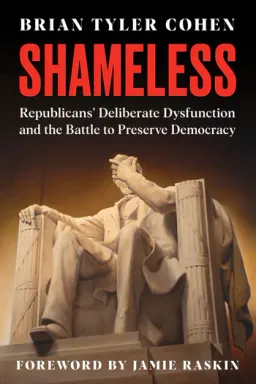
Shameless cover

Shameless

by Brian Tyler Cohen

The YouTube host and podcaster gives his take on the current state of the Republican Party.

How Shameless Politics Erodes Democracy

When was the last time you watched the news and felt more informed than exhausted? In Shameless, Brian Tyler Cohen argues that your fatigue is not an accident—it’s the point. He contends that today’s Republican Party has evolved into a movement where dysfunction isn’t a by-product but the product, and shamelessness is the engine. The book’s core claim is stark: a decades-long conservative project—from Lewis Powell’s 1971 memo to Roger Ailes’s Fox News to MAGA—has normalized anti-democratic tactics, rebranded hypocrisy as strength, and taught a generation to mistake sabotage for governance.

Across eight punchy chapters, Cohen maps how we got here; punctures the GOP’s favorite self-descriptions (family values, fiscal responsibility, states’ rights, pro–law enforcement, guardians of the Constitution); shows how hypocrisy morphed into an authoritarian “post-hypocrisy” politics; dissects the media’s both-sides trap; and makes the case for building an independent, pro-democracy distribution ecosystem. He closes with a call to agency—your agency—captured in voting-rights attorney Marc Elias’s unforgettable image of “poking holes in potatoes” to starve authoritarianism of oxygen.

What’s Really Driving the Chaos

Cohen’s thesis begins with a scene: the near-brawl on the House floor during Kevin McCarthy’s 15-ballot slog to the speakership in early 2023, with Matt Gaetz reveling in the spectacle. That moment wasn’t an aberration; it was the tell. A faction that rewards obstruction over outcomes will reliably produce spectacle over substance. Cohen contrasts that with Nancy Pelosi’s tidy first-ballot speakership two years earlier, arguing that competence is still possible—but only when leaders actually want government to work.

The Long Game That Made It Inevitable

You can’t understand today’s shamelessness without the GOP’s half-century project. Cohen traces a throughline from Powell’s confidential blueprint (“the judiciary may be the most important instrument”) to Pat Buchanan’s “positive polarization,” Reagan’s anti-government gospel, Newt Gingrich’s name-calling-as-governance, and Ailes’s cable ecosystem. Add Project REDMAP’s precision gerrymanders and you get a party that can thrive without majorities—so long as it manufactures distrust and blocks progress (compare Heather Cox Richardson’s historical framing).

Branding vs. Reality

Cohen has a field day exposing the gulf between GOP slogans and behavior. Family values? Meet Trump’s Access Hollywood tape, the E. Jean Carroll verdicts, and the family-separation policy. Fiscal responsibility? Recall the $1.9 trillion Trump tax cut, the $7.8 trillion debt spike, and attempts to defund IRS enforcement aimed at millionaire tax cheats. States’ rights? Texas v. Pennsylvania tried to overturn other states’ votes; after Dobbs, Republicans sprinted to a national abortion ban and sought to nullify Ohio’s abortion referendum. Pro–law enforcement? January 6, “we love you,” and Tommy Tuberville’s months-long blockade of military promotions. Constitutionalists? A president who refused a peaceful transfer of power and mused about “terminating” the Constitution.

From Hypocrisy to Authoritarian Cruelty

It’s not just flip-flopping anymore. Rep. Jamie Raskin tells Cohen that calling this hypocrisy actually flatters it—because it implies violated ideals. In reality, standards are gone; power is the point. That’s how you get Speaker Mike Johnson denouncing “single-party impeachment” in 2019, then leading one in 2023; or Lindsey Graham’s on-video whiplash from “xenophobic religious bigot” to “I like the president.” The goal isn’t coherence; it’s dominance (see also Anne Applebaum’s Twilight of Democracy).

Key Idea

“They’re a rule-or-ruin party.” —Jamie Raskin

Media’s Complicity—and Your Feed

Cohen indicts “both-sides” habits that present bad-faith sabotage as symmetrical debate. Think of 2016’s email obsession versus 2024’s “Is Biden’s age worse than Trump’s indictments?” chyrons. He borrows the wrestling concept of kayfabe: we all know the performance is scripted, but we pretend otherwise because it keeps the show going. In politics, that “show” launders extremist ideas into the mainstream. Meanwhile, Steve Bannon brags about “flooding the zone with s—,” and outlets oblige by elevating manufactured controversies over policy reality.

What You’ll Learn to Do

Cohen doesn’t stop at diagnosis. You’ll learn how Democrats can shrink the message (Al Franken’s “continued on next bumper sticker”), but more importantly, how to fix the distribution gap (Dan Pfeiffer’s core argument in Battling the Big Lie). That means supporting an independent, pro-democracy media ecosystem; rewarding repetition and clarity; and meeting people where they are—on TikTok, YouTube, podcasts, and local radio. It also means crossing information silos smartly, as Pete Buttigieg models when he calmly de-fangs Fox talking points and pivots to practical outcomes.

Why This Matters Now

The stakes aren’t abstract. Republicans openly telegraph that they’ll scuttle border deals to help Trump, impeach without predicates to muddy Trump’s 88 felony counts, or toy with default to extort cuts. That’s why Cohen ends with agency: elections hinge on margins of a few votes per precinct; the “tribune” model (Jen Psaki’s term) can change minds in your own network; and the small act you take today can “poke holes in potatoes” that spoil an authoritarian harvest. If you’ve felt worn down by the chaos, Shameless hands you a map, a megaphone, and a mission.


From Powell to MAGA: The Long Game

Cohen argues you can’t grasp today’s shamelessness without seeing the conservative long game that began in the 1970s. The throughline runs from corporate boardrooms to talk radio to cable news to gerrymandered maps—and ultimately to a movement incentivized to block, not build. The episode list is familiar; the connective tissue is what matters.

The Powell Memo: A Corporate War Plan

In 1971, Lewis F. Powell Jr. wrote a confidential memo for the U.S. Chamber of Commerce warning that “the American economic system is under broad attack.” His solution: a coordinated propaganda and legal strategy—fund chairs on campuses, police textbooks, pressure media, and most crucially, capture the judiciary (“the judiciary may be the most important instrument”). Nixon nominated Powell to the Supreme Court two months later. The lesson for you: elite actors didn’t just resist change—they built an infrastructure to reverse it (compare Jane Mayer’s Dark Money).

Positive Polarization and Anti-Government Gospel

Pat Buchanan sold Republicans on “positive polarization”: fire up your base by painting the opposition as alien. Reagan added a doctrine—“Government is the problem”—that transformed cynicism into identity. If government is bad, breaking it is proof of concept. You still see this whenever sabotage gets reframed as “fiscal conservatism” or “states’ rights.”

Gingrich: Weaponizing Congress

Newt Gingrich industrialized dysfunction: he trained rising Republicans to say Democrats “betray,” “destroy,” “lie,” and “steal,” then used C‑SPAN to turn floor speeches into attack reels. The goal wasn’t persuasion through policy; it was corrosion through scandal-mongering and obstruction. As Heather Cox Richardson tells Cohen, these provocateurs behaved like toddlers who push limits because the guardrails seem unbreakable—until 2016 tested that assumption.

Ailes and Fox: Building the Echo Chamber

Roger Ailes drafted a 1970 plan called “Putting the GOP on TV News.” Two decades later, Fox News executed it, giving the right a 24/7 distribution machine to seed frames (“death tax,” “Clear Skies Initiative”) and launder talking points into “conventional wisdom.” As Jon Stewart joked in 2004, repetition makes things “true”—if they’re said enough. That system made room for Rush Limbaugh’s daily invective and later for Trump to be normalized even as Fox paid $787.5 million over election lies.

Project REDMAP: Engineering Minority Rule

After the Tea Party wave, Republicans poured money into state races ahead of 2010 redistricting. With new mapping software, they cracked and packed voters with surgical precision. Elections lawyer Marc Elias calls it the moment gerrymandering became “weaponized” for partisan ends. The practical effect: you can lose the popular vote and keep power—so long as you prevent policies people like from passing and convince them government can’t help.

The Young Guns and the Monster They Fed

Eric Cantor, Paul Ryan, and Kevin McCarthy toured the country decrying “the establishment,” recruiting hardliners who later devoured them. Cantor lost his seat to a Tea Partier; Ryan fled Congress; McCarthy was dethroned by Gaetz & co. Cohen’s point: once you train voters to hate governance, they’ll hate you when you try to govern.

Trump: The Inevitable Emcee

By 2016, the ecosystem was primed for a reality-television strongman. Trump didn’t invent shamelessness; he monetized it. He mocked a disabled reporter, boasted about sexual assault, and still outperformed prior GOP nominees—with wall-to-wall media oxygen. His message wasn’t policy; it was a vibe: “both parties failed you—only I can fix it.” The conservative long game made space for that pitch—and for the party to fall in line even after he refused the peaceful transfer of power.

(Context: Cohen’s arc echoes Nicole Hemmer’s Messengers of the Right and Rick Perlstein’s Reaganland, which chart the institutionalization of conservative media and polarization.)


Brand vs. Reality: GOP Labels Unmasked

Cohen devotes a full chapter to the GOP’s favorite labels—then methodically shows you how each collapses under evidence. The goal isn’t dunking; it’s discipline. If you’re going to debate this at the dinner table, he arms you with receipts.

“Family Values” vs. Family Harm

Start with Trump’s public record: the Access Hollywood tape; at least 26 allegations of sexual misconduct; the civil verdicts in E. Jean Carroll’s cases; hush-money payments to Stormy Daniels days before an election; and a presidency that included family separation as explicit deterrence. Add anti-LGBTQ+ crusades—from “Don’t Say Gay” to Speaker Mike Johnson’s writings comparing same-sex marriage to bestiality and his admission that he and his son use an “accountability” app to track each other’s porn consumption. Then notice who actually protected families: Democrats codified marriage equality (Respect for Marriage Act), reauthorized and expanded the Violence Against Women Act, and fought for the child tax credit—while most Republicans voted no.

“Fiscal Responsibility” vs. Deficit Politics

Trump promised Bob Woodward he’d erase the national debt in eight years, then signed a $1.9 trillion tax cut that skewed to the top and helped add $7.8 trillion to the debt—without paying for a war. Speaker Mike Johnson’s first big bill “paid for” Israel aid by defunding IRS enforcement against millionaires, which CBO said would reduce revenue and increase deficits. Meanwhile, House Republicans repeatedly threatened default—an economic doomsday device—to force unpopular cuts, counting on Democrats to act like adults and save the economy.

“States’ Rights” vs. Results Nullification

When Biden won, Texas sued to overturn results in four swing states—an obvious violation of federalism that even John Cornyn called incoherent. After Roe fell, Republicans vowed abortion should be left to states—then quickly introduced national bans and tried to strip Ohio courts’ power to interpret the state’s new abortion-rights amendment. The principle isn’t states’ rights; it’s “our rights, wherever we can claim them.”

“Pro–Law Enforcement” vs. January 6 and Beyond

Tuberville’s hold froze 450-plus Pentagon promotions amid two global wars, undermining readiness. Trump called the Joint Chiefs chair “treasonous” and mused about death. January 6 rioters beat police with flagpoles, and Trump told them, “We love you.” House Republicans nearly tanked care for sick veterans until Jon Stewart publicly shamed them into passing the PACT Act. And when Biden’s American Rescue Plan sent $10 billion to help police, every Republican voted no.

“Guardians of the Constitution” vs. Rule of One

The peaceful transfer of power is the constitutional miracle. Trump tried to break it—pressuring Pence, whipping up a mob, then floating “termination” of the Constitution online. Some Republicans condemned him that night; too many later recanted. As Raskin reminds us, originalism means little if you ignore the text you dislike—say, the Electoral Count Act’s purpose or the 14th Amendment’s bar on insurrectionists.

Key Idea

Labels are permission slips. If you accept the brand at face value, you’ll miss the behavior that contradicts it.

(Context: This brand–behavior gap echoes Jonathan Haidt’s moral foundations lens, but Cohen focuses less on moral intuition and more on institutionalized storytelling and media repetition.)


The Post‑Hypocrisy Party

Cohen’s sharpest insight lands here: we’re past hypocrisy. In a post-hypocrisy politics, contradictions are not bugs to hide; they’re signals to your tribe that rules don’t apply to you. That’s why “gotcha” clips rarely move the MAGA base. The abandonment of shame is the feature.

Lindsey, Mitch, and Mike: Case Studies

A Lincoln Project montage captures Lindsey Graham’s sprint from “Tell Donald Trump to go to hell” to “I like the president.” Mitch McConnell’s masterpiece: block Obama’s SCOTUS pick in an election year, then confirm Amy Coney Barrett eight days before Election Day—smiling while explaining, “Oh, we’d fill it.” After January 6, McConnell called Trump “practically and morally responsible,” then still voted to acquit and later endorsed him again. Speaker Mike Johnson insisted the founders warned against single-party impeachment and said, “Let the people decide” 11 months before an election—then launched a party-line impeachment inquiry into Biden exactly 11 months before the next election.

Impeachment Theater and Russian Disinfo

House Republicans promoted an FBI form (a “1023”) as a smoking gun against Biden—only for the source, Alexander Smirnov, to be indicted for lying and linked to Russian intelligence. Jim Jordan shrugged: “It doesn’t change the fundamental facts,” prompting a reporter to reply, “It does change the facts, because they’re no longer facts.” When the Biden gambit faltered, GOP leaders impeached DHS Secretary Alejandro Mayorkas on flimsy constitutional grounds; the case promptly collapsed in the Senate.

Border Bills and the Dog Who Caught the Car

For years, Republicans demanded a tougher border. In 2024, a conservative bipartisan bill finally materialized. Donald Trump told allies not to give Biden a “win,” and suddenly Republicans announced the bill was “dead on arrival.” Sen. James Lankford, the GOP negotiator, admitted a right-wing commentator threatened to “destroy” him before seeing the text—because solving the problem would remove a campaign issue.

Raskin’s Reframe: It’s Not Hypocrisy

Rep. Jamie Raskin tells Cohen that “hypocrisy” mistakenly assumes ideals exist to be betrayed. He argues the movement’s vice is cruelty and domination: “a rule‑or‑ruin party.” That’s why threats of violence and promises of pardons for January 6 rioters aren’t anomalies; they’re instruments of politics. Accept that premise, and you’ll stop expecting shame to “snap back” behavior.

Key Idea

Post-hypocrisy politics inverts accountability: contradiction proves loyalty, not deceit.

(Context: This mirrors Masha Gessen’s observation about autocratic rhetoric: the lie isn’t to convince skeptics but to demonstrate power over reality.)


Flooding the Zone: Both‑Sides Media Failure

If you’ve ever yelled at a headline, you’ll recognize Cohen’s critique: mainstream media’s reflex for symmetry—“both sides”—often launders asymmetry. That’s a force multiplier for shameless politics.

Kayfabe and the Assignment Editor

Cohen borrows pro wrestling’s kayfabe: we all know it’s staged, but we pretend it’s real to keep the show alive. In politics, “the show” is a conveyor belt where right-wing claims become newsroom assignments. 2016 Clinton emails consumed front pages; Ivanka Trump’s email violations barely registered. In 2023, debt-ceiling brinkmanship—GOP hostage-taking—became “fights by both parties.” Even in 2024, headlines asked if Biden’s age was “worse” than Trump’s indictments or NATO abandonment.

Man Bites Dog—Until He Bites It Daily

Mehdi Hasan reminds us: “Man bites dog” is news because it’s rare. Trump annihilated that logic by biting the dog every day: praising dictators, echoing Hitlerish “poisoning the blood,” promising to be a “dictator on day one,” confusing Obama with Biden, and claiming he won all 50 states. The outrageous became ordinary by repetition, and headlines slid from moral clarity to calibration (“Most Republicans agree with ‘poisoning the blood’ language”).

Fox as a Political Actor

Fox sheared its “Fair and Balanced” slogan, let Sean Hannity appear onstage with Trump, and then paid nearly $800 million for knowingly airing election lies. Hannity even tried to rescue Trump on-air—asking if he’d abuse power—twice, only for Trump to insist he’d be a “dictator” (but “only on day one”). The network isn’t just conservative; it’s a participant.

Immigration, Stripped of the Villain

In January 2024, the New York Times framed “Biden’s immigration fight” as threatening his Ukraine agenda without naming the antagonist—Republicans blocking a border compromise to preserve an election issue. Without the agent, the reader gets theater, not truth. Hasan’s verdict on whether the press learned 2016’s lessons: no.

Key Idea

A free press can’t be neutral about democracy’s survival. Neutrality toward sabotage is complicity.

(Compare: Margaret Sullivan’s Ghosting the News and Jay Rosen’s “theater criticism” critique of campaign coverage.)


Messaging vs. Distribution: Build the Megaphone

Cohen’s communications chapter isn’t another plea for a better slogan; it’s a blueprint for getting messages heard. Yes, Democrats can be verbose (Al Franken jokes our “bumper stickers continue on the next bumper sticker”). But the bigger gap is distribution.

Shrink the Message, But Don’t Stop There

Republicans have Frank Luntz’s euphemisms (“death tax,” “Clear Skies”) and Trump’s chants (“Build the wall”). Democrats have complex, popular policies: lower insulin costs, record jobs, climate investment, infrastructure that actually gets built. Jen Psaki’s advice: drop elite language—talk about asthma, not the Paris Agreement; talk about your grandmother’s Medicare savings, not CBO tables. Joe Biden’s strength, she argues, is accessibility over oratory.

Fix the Distribution System

Dan Pfeiffer’s core claim: Democrats overinvest in crafting the “perfect message” and underinvest in how people encounter it. Republicans built their own supply chain—from talk radio to Fox to YouTube—and fund it relentlessly. Stephanie Valencia notes the right bought a South Florida station for $350k while Democrats spent $14 million on ads there in a month. One builds durable reach; the other flashes and fades.

Meet People Where They Scroll

Cohen describes launching his YouTube channel after realizing Facebook was awash in unchecked right-wing video. He teaches a practical loop: use accessible, repeated frames; seed them across TikTok, YouTube, podcasts, and local radio; engage independent creators; and have electeds show up there. The White House embraced this by inviting creators like Cohen and historian Heather Cox Richardson to interview President Biden on the day he nominated Ketanji Brown Jackson—circumventing legacy gatekeepers.

Don’t Confuse Outlets for Allies

You can give the New York Times a pristine policy explainer; it will still get processed through horse-race framing. Better to build and feed your own aligned channels while also crossing silos strategically. When Buttigieg goes on Fox and calmly dismantles a narrative before pivoting to outcomes, he’s not legitimizing disinfo; he’s rescuing Fox viewers who still might be persuadable.

Action to Try

Follow and share three independent pro‑democracy creators this week; send one short clip to a persuadable friend; and repeat next week. Distribution is a habit, not a hail Mary.

(Context: This aligns with Dan Pfeiffer’s Battling the Big Lie and Anand Giridharadas’s The Persuaders on movement-aligned media.)


The Disloyal Opposition in Practice

Cohen revisits a pivotal dinner on inauguration night, 2009. While millions celebrated Barack Obama, top Republicans met at DC’s Caucus Room steakhouse. By evening’s end, they’d settled on a plan: oppose everything. Not spar with a new president in good faith—deny him any bipartisan win. Gingrich called it a “full-court press.” Mitch McConnell had already reached the same conclusion.

The Party of No, Formalized

Obama courted Republicans on the stimulus bill during a global financial crisis; not a single House Republican voted yes. Cohen’s point isn’t nostalgia; it’s mechanics. If your goal is to prove government fails, make it fail—and then campaign on the failure. That DNA reappears in 2024: scuttle a conservative border deal to preserve a talking point; impeach to muddy Trump’s indictments; threaten default to extort cuts.

How to Break Through the Silo

Enter Pete Buttigieg. Asked on Fox if electric vehicles “emasculate” men (a Marjorie Taylor Greene line), he deadpanned, “I literally don’t even understand what that means,” then pivoted to competitiveness: Do you want China leading this industry, or America? Pressed about taking his husband on a military flight to the Invictus Games, he mentioned bipartisan precedent (Trump’s Army secretary, First Ladies) and asked: why is it different when it’s me and my husband? The grace note is the pivot: from performative outrage to policy outcome.

Consensus Exists—Use It

Cohen stresses that majorities support abortion rights, commonsense gun reforms, climate action, unions, and taxing the ultra-wealthy. That’s the dirty secret of polarization: the public agrees on a lot. The barrier is not public opinion; it’s a minority-rule architecture incentivized to block what’s popular.

Key Idea

Don’t try to win the theater. Change the venue. Move the conversation from grievance to outcomes people can feel.

(Compare: Ezra Klein’s Why We’re Polarized on identity sorting; Cohen’s emphasis is institutional incentives and media distribution, not just voter psychology.)


Poke Holes in Potatoes: Your Agency

Cohen’s ending is memorable because it’s tactile. Marc Elias recalls a Jewish American POW in a Nazi stalag who, along with other Jewish prisoners, used bits of razor wire to poke tiny holes in harvested potatoes—so they’d rot before reaching German troops. The image is visceral: repetitive, painful, small acts that cumulatively starve a war machine.

Margins Decide Outcomes

If you think your act won’t matter, look at the math: Wisconsin swung by roughly two votes per precinct in both 2016 and 2020. Arizona’s 2022 attorney general race was decided by 280 votes. A single tied race in Virginia was settled by drawing a name from a bowl—handing chamber control to Republicans. Vice President Harris has cast more tie-breaking Senate votes than anyone since the 1800s. Your precinct, your text, your carpool on Election Day can change law, budgets, and rights.

Become a Tribune, Not a Spectator

Jen Psaki frames the job: equip people to argue back in their own lives. Her sparring with Fox’s Peter Doocy wasn’t to win a clip; it was to give you a sentence to use with Uncle Joe. Cohen shares his own story: after a lifetime of not voting, his mother—overworked, skeptical, convinced “they’re all crooks”—watched his videos and, in 2020, sent him a photo dropping a completed ballot for Biden and Democrats straight down the ticket. One persuasion. One ballot. One precinct margin.

Four Simple Things You Can Do

  • Be the messenger: Share one credible explainer a week with someone outside your bubble. Ask what they think, not what they “should” think.
  • Fund distribution: $10/month to a local outlet or independent creator reaches voters far beyond any single ad buy.
  • Volunteer for margins: Text banks, door knocks, and rides to polls move the two-per-precinct that win states.
  • Protect the process: Support voting-rights litigation (Democracy Docket, Elias Law Group) and serve as a poll worker.

Key Idea

Democracy isn’t a switch you flip; it’s a muscle you train. Small, repeated reps—poking holes—win endurance contests.

(Context: This echoes Timothy Snyder’s On Tyranny—take small actions quickly—and Erica Chenoweth’s research showing the power of engaged minorities.)

Dig Deeper

Get personalized prompts to apply these lessons to your life and deepen your understanding.

Go Deeper

Get the Full Experience

Download Insight Books for AI-powered reflections, quizzes, and more.