
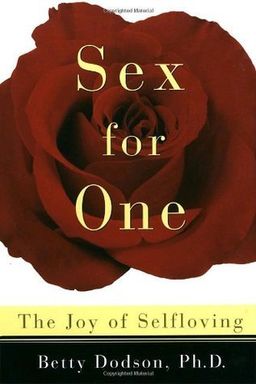
Sex for One cover

Sex for One

by Betty Dodson, PhD

Sex for One by Betty Dodson is a groundbreaking guide that combines memoir and practical advice to challenge societal taboos on masturbation. Discover how embracing self-love can lead to personal liberation, empowerment, and a more fulfilling sexual life. Through empathy and communication, Dodson reveals the path to sexual healing and deeper connections.

Self-Love as Sexual Liberation

When was the last time you felt completely at home in your own body—sensual, alive, and without shame? In Sex for One: The Joy of Selfloving, Betty Dodson, PhD, asks this very question and offers a radical answer: true sexual liberation begins not with a partner, but with yourself. Dodson's central claim is that self-loving, or masturbation, is not just a substitute for sex—it is sex. She argues that loving your own body openly, playfully, and without guilt is the foundation for all sexual happiness, whether alone or with another person.

First published in the 1970s and continually revised, Dodson’s book emerged from decades of feminist awakening and sexual revolution. In an era when female sexuality was constrained by patriarchal ideas of purity and partnership, she dared to hold a mirror—literally—to women’s bodies. She showed that pleasure, self-touch, and orgasm were not dirty secrets but natural rights. Her message remains as revolutionary today as when she first presented slides of women's vulvas at feminist conferences or encouraged women to explore their own genitals during her legendary Bodysex workshops.

From Shame to Self-Empowerment

Dodson argues that our cultural taboo against masturbation is deeply political. Religious and political authorities have long known that shaming individuals for self-pleasure creates docile citizens—people who are easier to control. She sees masturbation as an act of resistance, especially for women. To touch yourself is to claim ownership of your body, your pleasure, and your identity. It’s a refusal to let society dictate how you express desire or define your worth.

Drawing from her own life, Dodson charts her transformation from a repressed Kansas girl to a feminist artist and sexual educator. Her personal awakening—leaving a loveless marriage, embracing masturbation, and creating erotic art—mirrors the larger story of women reclaiming their rights and voices. She writes candidly about shame, guilt, and the difficulty of breaking old conditioning, making her message both personal and political.

Erotic Education and Consciousness Raising

Throughout Sex for One, Dodson reframes masturbation as a key form of sexual education. She insists that sexual skills—like any other skill—must be learned through practice, curiosity, and experimentation. Knowing your body, she says, gives you confidence to communicate better with lovers and frees you from the myth that partnersex is the only valid form of intimacy.

Dodson introduces step-by-step self-love rituals: sensuous baths, mirror exploration, body massage, and erotic breathing, all ending with orgasm not as a goal but as a celebration. Her famous workshops encouraged women to masturbate together in circles, creating a sacred environment where shame transformed into joy. These gatherings, she argued, weren’t “pornographic”—they were political rituals of healing.

A Feminist Philosophy of Pleasure

For Dodson, pleasure is power. She redefines feminism through the lens of erotic autonomy. While other feminists of the 1970s debated pornography or purity, Dodson rooted liberation in the intimate experience of orgasm. She believed that sexual equality begins with body equality: women must learn to love, look at, and honor their own genitals. Her concept of becoming “cunt positive” meant transforming fear, disgust, or embarrassment into aesthetic and spiritual appreciation of female sexuality.

Her approach blends art, politics, and spirituality. Through her drawings and workshops, she integrated sensuality and creativity, showing that sexual energy and artistic energy stem from the same source. She even describes masturbation as meditation—a personal ritual that harmonizes the body and mind, akin to spiritual practice. Like Thich Nhat Hanh teaching mindful breathing, Dodson teaches mindful pleasure.

Why It Matters Now

Though written decades ago, Dodson’s insights anticipate modern conversations about sex positivity, gender equality, and body acceptance. In a digital world saturated with unrealistic sexual imagery, her call to cultivate intimacy with oneself offers grounding and authenticity. She encourages everyone—men, women, and nonbinary folks alike—to approach their bodies with curiosity, kindness, and reverence. The book isn’t just about masturbation; it’s about building a loving relationship with yourself that radiates into every other relationship in your life. By the end of Sex for One, Dodson convinces you that touching yourself can be a political act, a therapeutic encounter, and a spiritual practice all at once.


Liberating Masturbation from Shame

Dodson begins her crusade by tackling the biggest obstacle to self-pleasure: shame. From childhood onward, most of us are taught that touching ourselves is wrong. Religious morality, social norms, and parental scolding shape a deep vein of guilt around self-stimulation. For women, that shame is doubled—society expects them to be sexy but never sexual on their own terms. Dodson argues that this contradiction keeps women dependent on male approval and disconnected from their own bodies.

The Cultural Lie About Self-Pleasure

For centuries, institutions—from the church to the medical establishment—declared masturbation a sin or disease. Whether it was warnings about blindness or moral decay, the message was clear: desire needed control. Dodson recalls her own upbringing in Kansas where masturbation was a “dirty little secret.” Yet her rebellious curiosity never fully died. She discovered that masturbation was a natural act of self-exploration, not a marker of neurosis. When she later trained in sexology, she confirmed what modern therapists like Masters and Johnson also found: masturbation is the foundation of healthy sexual function, not a sign of depravity.

Reclaiming Pleasure as Selfhood

Dodson contends that learning to masturbate without guilt equals learning to live authentically. By touching yourself, you literally make contact with your own aliveness. She writes, “Masturbation is the ongoing love affair we have with ourselves throughout our lifetime.” When you stop apologizing for your pleasure, you reclaim your energy from all the systems that profit from your repression. For Dodson, sexual self-knowledge is political knowledge—it teaches independence and courage.

Her workshops made this message visceral: women gathered in circles, speaking honestly about pleasure and shame, often exploring their bodies in front of mirrors. These encounters revealed to many participants that they weren’t alone in their insecurities. The laughter, tears, and orgasms became acts of communal healing. Dodson’s genius was in combining therapy, art, and play to reframe masturbation as an act of joy, creativity, and self-respect.

“Sexual repression feeds social control. Masturbation is an act of rebellion.”

(This echoes Michel Foucault’s argument in The History of Sexuality—that controlling pleasure is a way of controlling populations. Dodson turns that academic insight into lived feminist practice.)

Beyond the Substitute Myth

Dodson also dismantles the idea that masturbation is a poor alternative to “real” sex. For her, masturbation isn’t practice—it’s pure expression. She demonstrates how self-pleasure can complement partnersex or stand alone as a profound form of love. In one vivid fantasy, she envisions “Orgasms Across America,” a televised collective climax celebrating world peace. That vision humorously captures her belief that when individuals are sexually whole, society becomes less violent and more loving. Reclaiming masturbation, in Dodson’s eyes, isn’t just personal healing—it’s cultural revolution.


The Myths of Romantic Love

Much of Dodson’s work dismantles the romantic myths that set women up for sexual dissatisfaction. Growing up on Hollywood movies filled with longing glances and swelling orchestras, she internalized a fantasy of “true love” that would make sex complete. When reality failed to meet those expectations, dissatisfaction—and guilt—followed. In Sex for One, she exposes how the ideal of romantic monogamy often traps women in emotional dependency and erotic frustration.

The Marriage Trap

Dodson’s own story illustrates this pattern. She waited for her “perfect husband” and married at twenty-nine, only to find a passionless routine where intercourse felt obligatory. Her husband climaxed quickly; she rarely did. Alone afterward, she masturbated under the covers in silence, consumed by guilt. When the marriage dissolved, she realized love taught through dependency could not produce sexual freedom. “Marriage,” she wrote, “was the legal form of prostitution when female bodies had economic value instead of sexual value.” This provocative observation reframed her feminism around autonomy, not romance.

From Romantic Addiction to Erotic Honesty

Dodson coined the term “romantic junkie” to describe her own pattern: addicted to love, devastated by withdrawal. It wasn’t until she found sexual independence through masturbation and self-trust that she broke the cycle. In later relationships, including with a man named Blake, she practiced open communication and mutual self-loving. Their willingness to masturbate together dismantled the myth that lovers must be dependent on each other for pleasure. That shift—from romance to erotic honesty—became a defining principle of her teaching.

She observed that both partners suffered when sex was defined by performance. Men feared losing erections; women feared failing to please. By learning their bodies first, couples could approach sex as shared play rather than duty. In Dodson’s language, romantic sex needed to evolve into erotic love, a meeting of equals who bring their own orgasms to the party.

Redefining Love as Freedom

Ultimately, Dodson proposes a new model of love based on freedom rather than possession. Being able to make love alone, she says, is the foundation of any healthy relationship. When two self-lovers meet, they create connection without control, generosity without dependency. Her message dismantles both patriarchal marriage norms and romantic illusions, suggesting a mature sexuality rooted in choice, respect, and joyful self-sufficiency. In other words: masturbation doesn’t replace love—it prepares you for the real kind.


Erotic Art and the Female Body

Before she became a public sex educator, Dodson was a visual artist. Her erotic drawings served as her first acts of rebellion and healing. Through art, she began to depict bodies—especially women’s bodies—as beautiful, diverse, and worthy of celebration. She calls this work “sex art,” a creative and political tool to reclaim pleasure from shame. By bringing erotic imagery into galleries, she forced viewers to confront their discomfort and question what made sexual expression so taboo.

From Fine Art to Liberation Art

Dodson describes her first erotic exhibition in 1968 as both terrifying and liberating. Her drawings of nude couples making love shocked polite New York society—but also drew crowds. Her next show, with life-sized images of men and women masturbating, was even more controversial. The gallery director tried to censor the pieces; she fought back. Through this conflict, Dodson realized the true enemy wasn’t pornography, but repression itself. She started to see masturbation as both a subject of art and a tool for consciousness-raising.

“Cunt Positivity” and Genital Imagery

A defining moment in her activism came with her slide show, “Creating an Aesthetic for the Female Genitals.” Featuring close-up photos of women’s vulvas, it invited audiences to marvel instead of cringe. At a time when most women had never looked at their own genitals, this project was revolutionary. The show sparked cheering ovations at feminist conferences and inspired women to reclaim the word “cunt” as a symbol of strength and beauty. Her playful taxonomy—“Classical Cunts,” “Baroque Cunts,” “Gothic Cunts”—turned anatomy into art history, proving that difference was beautiful.

Art, Creativity, and Orgasm

Dodson connects sexual energy directly to creativity. To her, orgasm is an art form—the body’s spontaneous expression of joy and energy. Many artists, she notes, use self-pleasure to recharge or clear creative blocks. Her own process combined drawing, writing, and masturbation as cycles of inspiration. By calling sex the “queen of the arts,” she challenges the idea that spirituality and sexuality are separate. In Dodson’s world, to draw the body is to worship it, to touch it is to create, and to orgasm is to affirm life itself.


The Bodysex Revolution

Perhaps Dodson’s greatest real-world contribution was her creation of the Bodysex Workshops—intimate, clothing-optional gatherings where women explored their bodies, discussed orgasms, and learned to masturbate without shame. These workshops, which began in her New York apartment in the early 1970s, became legendary. They weren’t just about technique; they were about community, transformation, and laughter. Over decades, thousands of women attended, and many described their first real orgasm as a turning point in their lives.

A Safe Space for Pleasure

The Bodysex circle began with a ritual of honesty: women sat nude, introducing themselves, sharing their sexual histories, fears, and fantasies. Then came “Genital Show and Tell,” where each woman looked at her vulva in a mirror—often for the first time. These moments dissolved years of internalized shame. As Dodson put it, “We were moving past two thousand years of repression in one afternoon.”

The workshops culminated in the “Guided Masturbation Ritual,” where participants collectively explored self-stimulation using vibrators or their hands. Rather than pornographic spectacle, this was a sacred experience of embodied learning. Many wept or laughed as they reached orgasm for the first time. Dodson acted as both teacher and celebrant, using humor, compassion, and gutsy realism to make the taboo ordinary—and joyful.

Men Join the Movement

Later, she extended the same format to men’s groups, teaching male participants to reconnect with their bodies, explore masturbation without guilt, and understand female pleasure. The sight of men learning tenderness, self-acceptance, and mutual respect often moved her to tears. These workshops broke down gender barriers, promoting empathy between sexes and transforming masturbation from isolation into mindfulness practice.

From Private Shame to Public Celebration

By bringing masturbation out of the shadows and into a communal context, Dodson turned it into a form of consciousness-raising. Every Bodysex graduate carried the message back into their relationships and communities. Through these embodied gatherings, she built not a cult of orgasm but a culture of self-awareness. Her workshops symbolize what feminist scholar Audre Lorde called “the erotic as power”—a source of inner knowledge that sustains freedom and joy.


Orgasm as Meditation and Medicine

One of Dodson’s most striking insights is her conviction that masturbation is a meditation. In one experiment, she combined her practice of Transcendental Meditation with self-pleasure, discovering that her brain entered the same alpha and theta states associated with deep relaxation and creativity. She jokingly called it “Transcendental Masturbation.” Yet behind the humor lies a profound idea: orgasm harmonizes body and mind, offering emotional balance and physical healing.

Science Meets Spirit

When Dodson volunteered for a Rutgers University experiment measuring brain activity during sexual arousal, her EEG showed patterns similar to those of meditation masters: alpha waves during buildup and theta waves just before orgasm. For her, this proved scientifically what she already knew intuitively—that sex energy is life energy. “Each orgasm,” she wrote, “can be a prayer of thanks for being alive.” The study confirmed that self-love can literally change the brain’s chemistry and emotional state.

Masturbation as Healing Practice

Dodson’s approach treats orgasm as natural medicine. Self-pleasure can relieve stress, insomnia, menstrual cramps, and even depression. In one anecdote, she recounts a woman using masturbation to soothe toothache pain until her aspirin kicked in. The body’s natural release of oxytocin and endorphins validates these claims. What’s more, touching oneself with love rewires shame into self-compassion. It’s not just sexual therapy—it’s body therapy.

The Spiritual Dimension

Dodson admired ancient Tantric traditions that merged erotic pleasure with spiritual awakening. To her, tantra wasn’t about exoticism, but about attention: awareness of breath, movement, and connection. She believes masturbation can achieve the same unity of mind and sensation. While she didn’t want to turn sex into religion, she saw every orgasm as a chance to integrate body and soul. In that sense, Sex for One is less a manual and more a manifesto for embodied enlightenment. Loving yourself, in Dodson’s philosophy, is the most sacred meditation of all.


Fantasy, Play, and Erotic Imagination

Dodson insists that fantasy is the playground of sexual creativity. Just as artists need imagination, lovers—alone or partnered—need fantasy. Yet many of us censor our own erotic thoughts, fearing they’re too “kinky” or inappropriate. Dodson’s advice? Stop judging your imagination. She urges readers to explore fantasies as art projects for the psyche—expressions of curiosity, not confessions of guilt.

Beyond Guilt and Correctness

Dodson challenges both puritanical and so-called “politically correct” feminists who shame particular fantasies. Whether you dream of dominance, submission, or cosmic lovemaking, she insists that imagination has no moral hierarchy. “The mind,” she writes, “demands limitless possibilities.” She confesses her own guilty pleasure in power fantasies and explains how acting them out mentally can relieve stress and spark self-understanding. For her, a fantasy isn’t a plan for behavior—it’s theater for the soul.

Porn, Fetish, and Play

Dodson encourages reclaiming erotic media with discernment. Rather than condemning pornography or fetishism, she invites readers to curate what pleases them and ignore what doesn’t. She provides humorous tips on watching X-rated videos, adjusting soundtracks, and experimenting with costumes. Dressing for sex, acting out roles, or using sex toys become forms of creative expression. In her philosophy, masturbation is a form of erotic theater where you play every role—the director, the actor, and the muse.

Imagination as Freedom

By honoring fantasy rather than fearing it, Dodson opens a path to psychological freedom. She likens developing new fantasies to painting new canvases—each one an experiment in desire. Her final message is joyful: when you can fantasize without judgment, you also learn to live without it. Erotic imagination, she says, is not just about sex—it’s about cultivating creative power in every area of your life.

Dig Deeper

Get personalized prompts to apply these lessons to your life and deepen your understanding.

Go Deeper

Get the Full Experience

Download Insight Books for AI-powered reflections, quizzes, and more.