
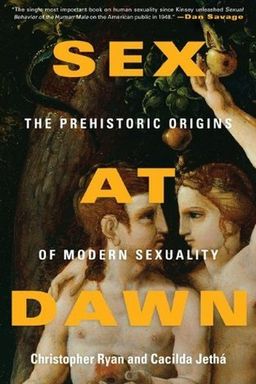
Sex at Dawn cover

Sex at Dawn

by Christopher Ryan and Cacilda Jetha

Sex At Dawn delves into the evolution of human sexuality, revealing how our promiscuous past contrasts with today''s monogamous ideals. By exploring our ancestral sexual behaviors and the impact of agriculture, the authors argue for a more open approach to sex, improving health and happiness in modern relationships.

Rethinking Human Sexual Nature

Why do modern relationships so often struggle against boredom, infidelity, and unmet expectations? Sex at Dawn by Christopher Ryan and Cacilda Jethá invites you to reconsider what it means to be human by rewriting the story of sex, love, and evolution. The book’s central claim is simple but revolutionary: the traditional narrative of human sexuality—built around male competition, female choosiness, and inevitable monogamy—is more cultural myth than biological truth. What we call human nature, they argue, has been distorted by the agricultural revolution and centuries of social control, not revealed by them.

Instead of monogamy as our default, human sexual behavior evolved in small, cooperative foraging bands where sex served not just procreation but also bonding, sharing, and cohesion. The authors use evidence from primatology, anthropology, anatomy, psychology, and archaeology to argue that our ancestors were likely promiscuous, egalitarian, and emotionally intertwined in ways that hardly resemble modern nuclear families.

Unraveling the “Standard Narrative”

The standard narrative—popularized by figures like Darwin’s followers, Desmond Morris, and many evolutionary psychologists—insists that men evolved to spread their genes widely and women to secure resources for child-rearing. Ryan and Jethá call this projection Flintstonization: reading modern property-based relationships back into prehistory. They dismantle this myth by highlighting that, for more than 95% of human existence, people lived as nomadic foragers where shared resources made paternity certainty and strict monogamy largely irrelevant. Romance and sexual jealousy, they contend, are cultural outcomes of private property, not ancient instincts.

Evidence from Our Primate Cousins

To reconstruct our past, the authors compare humans to both chimpanzees and bonobos—our closest genetic relatives. Chimps demonstrate aggression and competition, but bonobos resolve conflict through generosity and sexual play. Bonobos have frequent, nonreproductive sex, female alliances, and use sexual contact as a social glue. Ryan and Jethá argue that humans, who share bonobo traits like concealed ovulation, extended receptivity, and affectionate sexuality, likely evolved under similar conditions of mutual pleasure and cooperation—not rigid pair-bonding and male dominance.

(Context note: Frans de Waal famously summarized this contrast, “Chimps resolve sexual issues with power; bonobos resolve power issues with sex.” That aphorism captures the book’s essence.)

From Foragers to Farmers—and the Great Sexual Shift

The pivot point in the story is the Neolithic revolution. When humans began planting crops and settling land, ownership, inheritance, and population density created pressures never faced before. Property required lineage tracing, and lineage tracing required knowing paternity. Suddenly, controlling female sexuality became a social and economic necessity. Patriarchal institutions—marriage contracts, chastity laws, monogamous norms—emerged as adaptations to this new system, but they reshaped cultural morality more than they reflected natural instincts. Authors like Jared Diamond and Timothy Taylor describe agriculture as a “catastrophe” for equality and sexual freedom: wealth grew, but autonomy and health declined.

Seeing Sexuality as Social Infrastructure

Before this disruption, forager societies like the Aché, Canela, and Mosuo practiced forms of Socio‑Erotic Exchange—sexual relationships that knit communities together. Partible paternity, in which several men were considered fathers to one child, spread responsibility for offspring and reduced jealousy. Sexual exchange encouraged cooperation and generosity instead of property hoarding. These arrangements make sense in a world where the best survival strategy was sharing everything, from meat to affection. The authors insist you stop reading such systems as exotic exceptions and instead see them as the logical baseline from which modern restrictions later deviated.

Jealousy, Culture, and the Modern Mismatch

If jealousy feels universal today, that’s partly because our modern cultural system encourages ownership feelings in love. The book contrasts this with the Canela’s open marriage rituals and Mosuo visiting relationships, where jealousy is mocked as immaturity. In these societies, sex is integrated into life without secrecy or shame. The emotional suffering of modern marriage, the authors suggest, comes from a mismatch between our ancient biology—which expects communal intimacy—and our modern insistence on exclusive lifelong partnering.

Bodies as Evolutionary Records

Anatomy itself supports the book’s evolutionary case. Human males have testicular sizes, ejaculate volume, and penis morphology that fall between bonobo and gorilla levels—consistent with multiple mating and sperm competition, not one‑male monopolies. Even penile shape seems designed for semen displacement. Feminine traits like permanently enlarged breasts, concealed ovulation, and orgasmic responses suggest continuous sexual receptivity and bonding. These physical clues make sense only in a social environment rich in multi-male mating and cooperation.

Modern Consequences and Cultural Lessons

Bringing this story forward, Ryan and Jethá show how modern institutions—from marriage counseling to moral codes—are built on faulty assumptions. They explore the Coolidge effect (where male desire declines with familiarity but revives with novelty), falling sperm counts possibly linked to reduced competition, and long histories of repressing female sexuality—from “hysteria” diagnoses to dangerous surgical interventions. Their goal isn’t to condemn monogamy but to contextualize it: a social invention trying to manage ancient instincts. The takeaway is both sobering and empowering: if monogamy feels difficult, that’s not because people are broken—it’s because culture and biology are speaking different languages. Recognizing that gap, they argue, can help you craft more honest, flexible, and compassionate relationships that align with our real evolutionary heritage.


The Primate Mirror

To understand human sexuality, you must first decide which ape best reflects our past. Sex at Dawn contrasts chimpanzees and bonobos—the two species genetically nearest to us—to reveal the spectrum of possible mating systems. Chimps organize around male dominance, hierarchy, and aggression; bonobos around female coalitions, affection, and erotic cooperation. The human pattern borrows from both but aligns most closely with the bonobo tendency toward frequent, nonreproductive sex used to defuse tension and form bonds.

Bonobo Lessons

Bonobos use sexual contact for negotiation, alliance, and peacekeeping. Females control group stability through mutual support and frequent sexual play with both sexes. Frans de Waal calls them “make-love-not-war” apes because they replace violence with intimacy. Ryan and Jethá underline that humans display several bonobo-like traits—extended sexual receptivity, kissing, and playful affection—all mechanisms for trust-building, not just reproduction.

Chimp Models Revisited

The textbook “killer ape” image drawn from Jane Goodall’s early chimp studies inflated male aggression and paternity competition. Later evidence from Taï Forest and bonobo studies shows this aggression is not universal but context-dependent—often triggered by artificial feeding, crowding, or stress. The authors warn that humans have long generalized from exceptional chimp behavior while ignoring more peaceful ape possibilities. The real lesson isn’t that we’re bonobos or chimps—it’s that both models exist within us, and culture decides which emerges.

Your Takeaway

When you compare humans to our closest kin, anatomical, behavioral, and social parallels point toward an ancient pattern of promiscuous but cooperative sexuality. Bonobos give us a mirror in which sex fosters peace, pleasure, and equality—values deeply human but often suppressed by recent social structures. Recognizing our kinship with these apes isn’t an excuse for promiscuity; it’s a way to see cooperation and compassion as natural parts of desire itself.


Bodies as Evolutionary Evidence

If archaeology leaves few traces of sex, anatomy fills the gap. By measuring testes, breasts, penis length, and other reproductive structures, Ryan and Jethá reconstruct a biological record of our mating past. The evidence points to moderate body dimorphism and large testes relative to body weight—signals of a multimale-multifemale mating system with active sperm competition.

The Sperm Competition Story

Human males produce substantial ejaculates and possess a penis uniquely suited to displacing previous semen, as demonstrated in Gordon Gallup’s laboratory simulations. Comparative data show chimps and bonobos (known for promiscuity) have huge testes—up to five times larger relative to body size than gorillas. Humans fall between, implying that multiple males once competed within each cycle. This internal competition explains traits like high seminal volume, the external scrotum (for temperature regulation), and even biochemical features that hinder rival sperm.

Female Agency and Hidden Fertility

Female bodies also record their evolutionary history. Human ovulation is concealed, breasts are permanent sexual displays, and the female orgasm can help draw semen deeper into the cervix—features that serve social bonding and internal selection rather than mere reproduction. Cryptic female choice, through cervical filtering and immune responses, means that women’s bodies actively choose among sperm at the microscopic level. Combined with visible and auditory cues—such as copulatory vocalizations studied by Stuart Semple—these adaptations suggest a system where women attract multiple mates and influence paternity subtly.

A Story Written in Flesh

Our genitals, hormones, and sensory preferences tell a consistent story: humans evolved for varied partners, shared sexuality, and cooperative parenting. When you look at our bodies through this lens, repression and possessiveness appear as recent overlays on much older physiology designed for mixing, bonding, and exploration.


Foragers, Sharing, and Socio‑Erotic Life

Imagine a world before locks and fences—a small community where everyone’s survival depends on generosity. That world shaped your sexual instincts. Foragers like the Aché, Canela, and Mosuo exemplify societies where sex was part of the social economy: it bonded people, distributed resources, and diminished conflict. Ryan and Jethá call this network of behaviors Socio‑Erotic Exchange—using sex to sustain social health as surely as food sharing sustains physical health.

Adaptive Sharing

Immediate-return hunter-gatherers live within the cognitive limit known as Dunbar’s number (~150 members), where everyone’s behavior is visible. Hoarding creates resentment; sharing secures belonging. In such a system, overlapping sexual bonds ensure that men cooperate rather than compete and that children receive care from multiple adults who believe themselves to be fathers—a practice called partible paternity. Observed among the Aché of Paraguay and several Amazonian groups, this belief strengthened survival odds by spreading paternal responsibility.

Sex as Social Infrastructure

Festival sex rituals among the Canela or the Mosuo’s walking marriages served a purpose beyond pleasure—they ensured egalitarianism and cemented inter-clan ties. Anthropologist Thomas Gregor noted that extramarital relations in such villages actually foster alliance and stability. In evolutionary terms, sex was communal glue, not property exchange.

You can read these examples not as utopian fantasies but as living laboratories showing how intimacy can function cooperatively. Modern problems like jealousy and sexual possessiveness emerge largely because our institutions punish what our genes still expect: social sexual connection as part of daily life.


Agriculture and the Birth of Control

Roughly 10,000 years ago, the rise of agriculture transformed every aspect of human life—from diet to gender relations. Sex at Dawn argues this shift also reengineered our mating systems. Once humans began farming fixed plots of land, resources could be owned, stored, and inherited. Paternity suddenly mattered, because property and bloodlines became linked.

Property, Patriarchy, and Sexual Policing

In forager societies, sharing minimized inequality. With agriculture came hierarchy, armies, and inheritance, spawning new pressures to control women’s reproductive choices. Marriage evolved not to protect love but to secure lineage. Chastity norms, bride prices, and even religious proscriptions against adultery grew from economic calculus, not divine command. As Timothy Taylor observed, early agricultural sexuality became voyeuristic and repressive—a policing of bodies aligned with control of land and wealth.

Cultural Consequences

This agricultural turn explains why jealousy, patriarchal authority, and sexual morality intensify in settled societies. What we treat as natural monogamy is, in this light, a recent social invention designed to match new property economies. Recognizing that fact frees you to see morality and desire not as enemies but as separate layers—culture attempting to discipline instincts that once bound communities freely together.


Jealousy, Emotion, and Cultural Design

Jealousy often feels hardwired, but Ryan and Jethá argue it’s deeply cultural. Classic studies by David Buss found sex differences in jealousy responses, but those studies relied heavily on Western samples. Anthropological counterexamples—like the Canela’s nonmonogamous rituals or the Mosuo’s visiting marriages—prove jealousy can be minimized or even mocked by social norms.

Institutions Shape Emotion

Where property and inheritance matter, anxiety about sexual exclusivity grows. Where community and sharing dominate, jealousy fades into the background. This perspective reframes jealousy not as destiny but as a thermometer for cultural design: it rises when partnership is fused with possession. Recognizing this helps you distinguish between genuine emotional need and socially conditioned ownership.

If love hurts, the authors suggest, it’s often because institutions built for property conflict with bodies built for community. We can’t undo biology, but we can redesign norms to make peaceful coexistence more attainable.


The Loss and Repression of Female Sexuality

Few themes in the book cut as sharply as the repression of female sexuality. Across millennia, women’s erotic agency has been feared, pathologized, and monetized. Before agriculture, women’s sexual expression could be powerful and communal. After property and patriarchy arose, it was transformed into risk, sin, and sickness.

From Witches to “Hysteria”

Historical documents show how female sexual behavior was reinterpreted as demonic or diseased. Medieval inquisitions equated clitoral pleasure with witchcraft—the “devil’s teat.” Centuries later, doctors diagnosed “hysteria” for what we might now call unmet sexual needs. Rachel Maines’s research reveals that the vibrator was invented as a medical device to provoke orgasms in women considered sick with sexual frustration. The irony: medical repression produced the first consumer pleasure machine.

Control and Contradiction

From Kellogg’s anti‑masturbation crusades to clitorectomies justified as therapy, the same pattern repeats—reinforcing a fantasy of female passivity. The deeper lesson is structural: societies that fear women’s pleasure often commercialize it privately while denouncing it publicly. Understanding that history helps you see contemporary sexual double standards as policy artifacts, not natural facts.


Modern Mismatches and The Coolidge Effect

The biological mechanisms that once sustained genetic diversity now collide with social expectations of lifelong monogamy. The Coolidge effect—renewed male arousal after exposure to new partners—is nearly universal across species. In ancestral groups, it prevented incest and maintained variety. In modern marriage, it fuels infidelity and frustration.

The Physiology of Novelty

Experimental studies show married men’s testosterone rises after brief interactions with new attractive women. That hormonal pattern underlies the temporary euphoria of new love and the later drop in desire in long-term pairings. Culturally, we treat that drop as personal failure, but the book reframes it as biology meeting unrealistic social architecture.

Adaptive Alternatives

The authors don’t prescribe universal promiscuity—they advocate authenticity. Some couples sustain commitment through negotiated openness, evolving partnership models, or honest discussion of sexual variety. When you accept novelty as a biological need rather than moral flaw, you can design relationships that embrace transparency over secrecy. The Coolidge effect, seen through compassion, is an invitation to creativity and honesty, not betrayal.


Sex, Environment, and Human Health

The final chapters bring evolution into the modern lab. Human fertility is declining globally—sperm counts dropping, testosterone waning—and the book sees biology and culture jointly at work. Environmental toxins interfere with hormones, but monogamy itself may relax the selective pressures that once maintained male fertility under competitive conditions.

Environmental and Cultural Pressures

Studies cited from Denmark and cross‑cultural analyses report major declines in sperm concentration over decades. Chemical estrogen mimics in plastics, pharmaceuticals like paroxetine, and diets heavy in soy or growth hormones all contribute. At the same time, sexual culture limits the sperm competition that historically favored high fertility. Low‑quality sperm producers once left fewer offspring; now, social systems guarantee reproductive opportunities regardless of fertility level. The result: rapid physiological drift toward impaired reproductive capacity.

The Broader Lesson

Human sexuality is an ecological system, sensitive to chemistry, food, and social structure. When we ignore our evolutionary origins—treating sex as either shameful or disposable—we risk both emotional and biological damage. The cure is not nostalgia for promiscuous pasts but awareness of the living connections between culture, body, and environment. Sustainable sexuality, the authors imply, begins with honesty about what humans have always been: communal, curious, and adaptive.

Dig Deeper

Get personalized prompts to apply these lessons to your life and deepen your understanding.

Go Deeper

Get the Full Experience

Download Insight Books for AI-powered reflections, quizzes, and more.