
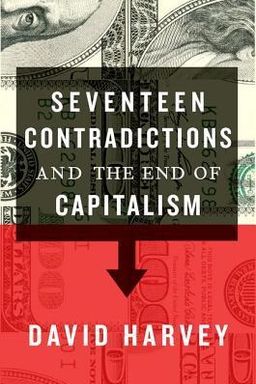
Seventeen Contradictions and the End of Capitalism cover

Seventeen Contradictions and the End of Capitalism

by David Harvey

Seventeen Contradictions and the End of Capitalism by David Harvey exposes capitalism''s inherent contradictions that threaten global economies. Through exploring speculative bubbles, technological alienation, and unsustainable growth, Harvey challenges readers to rethink current economic systems for a more stable and equitable future.

Seeing Through Capital’s Masks

How can you act effectively in a world that constantly disguises its workings? David Harvey’s analysis of capital starts from this question. He argues that capitalism presents itself through compelling appearances—prices, profits, freedoms—but each conceals structural realities rooted in labour, power, and dispossession. Following Karl Marx, Harvey insists that if everything were as it appeared, there would be no need for science. You must dig beneath the glitter of commodities and markets to perceive the machinery that moves them.

Capitalism as a system of appearances

Everyday experience teaches you to see money as power, houses as assets, and prices as neutral facts. But Harvey reveals these as fetishized forms—representations that hide the social labour between people. When you put $100 in a savings account and it becomes $180 twenty years later, it seems money grows autonomously. In truth, that gain depends on production and credit relations. Similarly, when you pay for a shirt, you rarely see the exploited workers in Bangladesh who stitched it. Market prices are masks on social relationships.

The method behind the critique

Harvey’s book teaches a scientific habit: moving from surface to structure. You begin with what appears—commodities, financial instruments, housing markets—and then examine contradictions hidden beneath. This method joins Marx’s analytical tradition with modern examples: property bubbles, central bank bailouts, and ecological crises. The aim is not simply to condemn capitalism morally but to understand its operational contradictions so that meaningful transformation becomes possible.

The web of contradictions

The chapters map fourteen distinct contradictions: use value versus exchange value, money versus representation, private property versus collective needs, labour versus capital, production versus realisation, technology versus employment, nature versus accumulation, freedom versus domination, and the dangerous drive to endless compound growth. Each contradiction explains how capitalism simultaneously creates prosperity and crisis. When exchange value subordinates use value, housing becomes speculation instead of shelter. When credit money floats free of labour, fictitious capital expands until reality forces collapse. When technology replaces workers, the system undermines its own consumers. And when growth compounds indefinitely, ecological and social stresses multiply beyond control.

Where alienation and action connect

Harvey ends by tying analysis to politics. Understanding fetishism and contradiction prepares you to act. Alienation binds each crisis together—the separation of people from nature, from each other, from their own creativity. To overcome it, reforms must aim not only at redistribution but at de-fetishization: reclaiming commons, democratizing money, reorganizing production around human needs rather than profit, and building institutions that foster collective freedom. This is what Marx called the ‘free development of individuals together’. Harvey’s project is both diagnosis and prescription: learn to see through capital’s masks, then construct a world where appearance and reality converge again.

Key insight

Understanding capitalism’s contradictions turns perception into power—you cannot change what you cannot see. Harvey’s call is to unmask appearances, grasp the social dynamics beneath them, and use that vision to reimagine politics, production, and planetary life.


Use and Exchange in Everyday Life

You live in a world where essential goods—homes, education, health—are traded as commodities. Harvey shows that this blurs the difference between use value (what something does for you) and exchange value (what price it fetches). Housing illustrates the conflict perfectly. You buy a house to live in, but its price rises or falls by speculative forces that ignore human need. When exchange value overwhelms use value, shelter becomes an investment vehicle, not a right.

Housing as contradiction

Harvey’s examples range from frontier homesteads and favela self-builds to speculative real estate markets. Each form mixes social labour and monetary exchange differently. Self-help construction thrives on local cooperation; speculative development depends on credit and profit expectation. The 2007–9 housing crash exposed what happens when millions treat homes as assets to flip. Mortgage securitization transformed shelter into global fictitious capital, and when prices fell, both property and social security collapsed.

The neoliberal policy turn

Since the 1970s, neoliberalism replaced social provisioning with market-driven self-help. States privatised housing, education and utilities, encouraged ownership through credit, and withdrew from direct welfare. Exchange value became the measure of success. In the US, Ireland, Spain and across the Global South, such policies built asset bubbles that later destroyed livelihoods. When markets rule basic needs, human life becomes hostage to speculation.

What you can learn from the test case

If you care about fairness, you must fight the dominance of exchange over use. Harvey’s point is practical: resist financialisation by rebuilding public housing, controlling rents, taxing speculative gains, and restoring the idea of shelter as a social right. Only by reclaiming use value in essential goods can societies escape crises driven by price fetishism and detached finance.


Money, Credit and the Double Fetish

Money is the system’s bloodstream—and its illusion. Harvey expands Marx’s idea of fetishism into a ‘double fetish’: money represents labour and then becomes re-represented through numbers, electronic balances and debt. Because modern money is created by political decision rather than gold backing, it can expand limitlessly, yet it remains detached from the social work it claims to measure.

From gold to credit to crisis

Money evolved from metal to paper to electronic forms. Each step increased flexibility but distorted representation. The abandonment of the gold standard in the 1970s let central banks print and lend at will, creating massive credit expansion and ‘fictitious capital’—claims on future value with no labour base. The 2008 meltdown revealed this gap: mortgage-backed securities rated as safe turned toxic when real borrowers defaulted.

Democracy versus central banking

Modern credit money makes the state indispensable. Central banks rescue markets in crises (as the Federal Reserve did in 2008) but seldom rescue people. Harvey’s question—who controls money—cuts deep. The power to issue and value currency anchors class domination. Reforming it requires new institutions: demurrage currencies (Silvio Gesell’s idea of money that depreciates when hoarded), cooperative banks, and monetary commons that prevent private accumulation of social power.

Key insight

Money’s power depends on belief and representation; without democratizing those representations, financial crises will keep repeating and political authority will tilt toward the rentier elite.


State, Property and Power

Private property is not natural; it is a legal creation sustained by the state. Harvey shows that the capitalist state plays a dual role—it protects private property and enforces contracts while also providing regulation and rescue in times of crisis. This dependency forms the state–finance nexus that underwrites capitalism’s durability.

From appropriation to exclusion

Appropriation means using something; private property means owning it even when unused. Colonial enclosures transformed shared land into tradable assets. Modern property law continues this enclosure logic through patents, eminent domain, and intellectual monopolies. None of it functions without state policing, courts, and militarised enforcement.

Global hierarchy

The state–finance nexus operates internationally through monetary sovereignty. The US dollar’s role as reserve currency lets America extract seigniorage and impose fiscal discipline abroad (Greece’s debt crisis exemplifies how bondholders override democratic will). Smaller states often face capital flight if they resist austerity or privatization.

The political alternative

Harvey warns that shrinking the state won’t liberate society. You need a democratized state that dissolves the property–finance nexus, manages commons collectively, and reclaims monetary sovereignty for public purposes. Whether through land reform, cooperative credit or public banking, the goal is to reshape political power so it serves social reproduction rather than rent accumulation.


Labour, Production and Realisation

Capitalists profit by buying labour power and selling products—but Harvey shows that this structure embeds two contradictions. First, labour must create surplus value while remaining cheap enough to maintain profits. Second, the same workers must have enough income to buy the products they make. When production outpaces purchasing power, crises of realisation follow.

How wage dynamics sustain capital

Wages are kept low through global labour reserves—the unemployed, migrants, and informal workers who discipline demands. When automation or offshoring expands, these reserves grow. Yet suppressed wages undermine demand, forcing credit expansion to sustain sales. The post-1970s neoliberal era illustrates this perfectly: inequality rose, debt ballooned, and periodic crises replaced stable growth.

Production and realisation in balance

Harvey connects Marx’s Volumes I and II: production creates surplus, realisation sells it. If you fixate on production (efficiency, wage control) without securing demand (social wages, welfare), accumulation stalls. Keynesian policies once corrected this through state spending; neoliberalism dismantled them, leading to long stagnations and speculative overgrowth.

Moving toward human-centred production

For Harvey, any viable alternative must combine workplace struggles with battles over housing, healthcare, and debt. Production should serve use and social reproduction, not asset inflation. A politics for labour therefore means transforming both factories and households—the entire circuit of life into cooperative social production.


Technology and the Disposability Trap

Technological change promises efficiency but often produces precarity. Harvey, following Brian Arthur and André Gorz, calls this the ‘disposability dilemma’: capital automates to cut costs, yet each innovation erodes employment and thus the market that sustains capitalism itself. Automation turns labour-saving into demand-destroying.

Automation’s paradox

As AI, robotics and digital platforms proliferate, many jobs vanish without replacement. The Ford–Gorz warning applies: fewer workers mean weaker consumption. Harvey notes that if labour ceases to be the source of value, money loses its anchor and speculative power concentrates further in financial elites.

Possible responses

Short-term fixes include retraining and wage protection; long-term ones include redesigning society around post-work life—universal basic income, public goods provision, and democratic control of technology. The challenge is to ensure automation enhances shared well-being rather than oligarchic control.

Facing the future

Harvey’s conclusion is sober but hopeful: technological abundance could free humanity, but only if economic rules stop treating people as disposable. A progressive politics must therefore integrate technological governance with social reproduction reform, ensuring that human creativity—not market profitability—defines innovation’s purpose.


Capital, Nature and the Ecological Limit

Nature is not outside capitalism; it is absorbed into it. Harvey argues, following Neil Smith, that capital produces nature—transforming rivers, genomes and climates into inputs and assets. When accumulation crosses ecological thresholds, crises follow. Yet capital rarely collapses from natural limits; it adapts by commodifying environmental solutions.

From survival to profit

Carbon trading, water privatisation, and genetic patenting show how ecological repair itself becomes business. Even disasters create ‘disaster capitalism’. These adaptations generate new rents while leaving foundational damages untouched. The poorest bear the burden: toxic disposal, climate vulnerability, and habitat loss concentrate on marginalized populations.

Justice and institutional redesign

Harvey insists sustainability must confront property regimes, not just emissions. Climate justice movements in Bolivia and the Maldives model this approach by defending commons and demanding compensation. Real solutions require planetary institutions capable of managing shared resources collectively. Ecological renewal without social renewal, he warns, only reproduces rentier control in green disguise.

Key insight

The environmental crisis is political before it is natural—capital will not end because resources run out but because social legitimacy and ecological balance become irreconcilable under profit imperatives.


Freedom, Domination and Alienation

Freedom is capitalism’s favourite word, but Harvey exposes how economic liberty coexists with authoritarian control. Liberal ideas of property and choice create privileges that depend on domination—states policing workers and markets in the name of security. Karl Polanyi already warned that what looks like universal freedom often becomes freedom for the few.

Rhetoric and reality

Political discourse—from George W. Bush’s ‘liberty’ speeches to market slogans—frames domination as liberation. Wars and surveillance justify themselves as protecting freedom. Foucault’s notion of governmentality helps explain how this operates: citizens internalize self-discipline and market-friendly behaviour, turning procedural freedom into conformity.

Freedom as collective project

Harvey follows Marx and Rousseau in reimagining freedom as co-operative rather than individual. Genuine emancipation requires social and material foundations—education, health, housing—that enable autonomy. Otherwise liberty shrinks to the right to compete. A revolutionary humanism therefore reconstructs society so that individual and collective flourishing align instead of collide.

Seen this way, alienation is the lived experience of domination. Overcoming it demands not just state reform but the creation of solidarities, commons, and cultural shifts that reembed life in shared purpose. Freedom ceases to be a market privilege and becomes the collective capacity to shape history consciously.


Accumulation, Growth and Crisis

Capitalism survives through compounding growth—each round demanding more investment, consumption and resource extraction. Harvey calls this its most dangerous contradiction. Exponential expansion eventually collides with ecological boundaries, social exhaustion and financial instability. Yet the system cannot stop compounding without ceasing to be itself.

The mathematics of pressure

Compound interest demonstrates the logic: small percentages multiply endlessly. Capitalists require continual profits, so aggregate output must expand to absorb surplus capital. When productive investment slows, money chases assets—stocks, property, derivatives—creating fictitious capital and bubbles. The 2008 crash and repeated postwar crises trace this rhythm of excess.

Rentier ascendance

As growth falters, rent extraction replaces production. Finance, land, and intellectual property become main profit sources. Harvey likens this to Ricardo’s fear of land rents overtaking industry: modern hedge funds and tech patents exemplify this transfer. When bonuses exceed billions while wages stagnate, the system shifts from value creation to value capture.

The peril and the possibility

Unchecked compounding generates inequality and ecological strain. But awareness of this inner drive opens space for alternatives: steady-state economies, commons-based production, and post-growth planning. Harvey’s message is clear—you cannot reform capitalism by moderating greed; you must redesign accumulation itself to abolish the exponential imperative.


Alienation and the Human Response

Alienation links all of capitalism’s contradictions. Harvey, echoing Marx, argues that people are divorced from their work, communities and creative selves by systems that turn living labour into abstract value. Consumption, debt and competitive individualism replace meaning. The result is disengagement and political confusion—fertile ground for authoritarian movements and false freedoms.

Forms and feelings of estrangement

Alienation manifests as legal alienation (selling property rights), social alienation (loss of trust) and psychological alienation (resentment or despair). Gallup’s surveys of workplace disengagement show widespread mental withdrawal. You may feel free yet powerless, connected online yet isolated, productive yet purposeless.

Paths of action

Harvey identifies political reactions: right-wing rage seeking authoritarian order and left movements reclaiming public space (Occupy, Tahrir, Syntagma). States respond with surveillance, while elites convert discontent into philanthropy or consumer politics. Real liberation demands organizing for democratic control of production, social provisioning, and cultural renewal.

Healing the alienation

Revolutionary humanism offers a framework: build institutions that reconnect work, community and meaning. Cooperatives, social wages, and commons management can translate moral anger into systemic change. As Harvey concludes, capitalism will not fall on its own—it must be pushed by people who reclaim solidarity, creativity and hope as the foundations of a new social reality.

Dig Deeper

Get personalized prompts to apply these lessons to your life and deepen your understanding.

Go Deeper

Get the Full Experience

Download Insight Books for AI-powered reflections, quizzes, and more.