
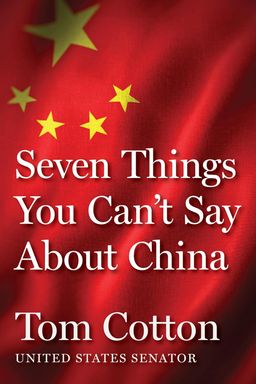
Seven Things You Can't Say About China cover

Seven Things You Can't Say About China

by Tom Cotton

The Republican senator from Arkansas delineates what he perceives as threats from China.

Saying the Seven Unsayables

What if the apps your kids use, the shows you stream, and the medicines you take all connect back to a foreign ruling party that sees you as an adversary? In Seven Things You Can’t Say About China, Senator Tom Cotton argues that the Chinese Communist Party (CCP) is not a normal government pursuing normal national interests; it’s an ideologically driven, globally ambitious regime that lies as a matter of course, coerces as a matter of policy, and punishes critics as a matter of survival. He contends the CCP is an evil empire preparing for war, waging economic world war, infiltrating American society and government, targeting American kids, and—if unopposed—capable of winning strategic supremacy over the United States.

Cotton stakes his case in part on the opening drama of Covid-19. He recounts how early calls to restrict travel from China were denounced as xenophobic, how the term “Wuhan virus” became taboo despite historical naming precedents (West Nile, Zika), and how his advocacy of a lab-leak hypothesis was dismissed as a “conspiracy theory”—only to become a mainstream possibility years later. He uses this episode to demonstrate a pattern: the CCP lies; a powerful chorus of Western apologists amplifies those lies or silences critics; and by the time facts catch up, Beijing has advanced its interests.

The Core Claim

Cotton’s central thesis is blunt: the CCP is the focus of modern geopolitical evil and must be confronted, not accommodated. He argues the Party’s defining traits—Communist ideology, ruthless information control, and a willingness to weaponize economics—now scale globally thanks to the world’s second-largest economy, a vast security apparatus, and the world’s biggest military. This struggle, he insists, is not with the Chinese people (whom he calls the Party’s first and worst victims) but with the ruling party that subjugates them.

Why It Matters Now

Cotton argues the hour is late because the CCP has moved from Deng Xiaoping’s “hide and bide” to Xi Jinping’s “show and tell.” China is simultaneously accelerating its military buildup (especially to force a resolution over Taiwan), prosecuting an economic campaign that hollows out U.S. industry, and leveraging cultural, corporate, academic, and political influence to dull American resistance. He frames Taiwan as the single most consequential flashpoint: lose it, and cascading economic collapse, alliance shock, nuclear proliferation, and a long decline in American power could follow (see also Michael Beckley and Hal Brands, Danger Zone).

How the Book Proves It

Cotton structures the book around seven claims he says elites try to suppress. He starts at home inside China—Mao’s mass murder, Xi’s techno-totalitarian police state, and the persecution of Christians, Falun Gong, Tibetans, and Uyghurs—to show continuity of Communist practice from Mao to Xi (for history, see Jung Chang and Jon Halliday’s Mao and Frank Dikötter’s China After Mao). He then moves outward: the PLA’s one-sided arms race and nuclear surge; China’s record of aggression from Korea and Vietnam to the Senkaku and Spratly Islands; the Party’s economic tactics (currency manipulation, subsidies, coerced joint ventures, IP theft, and Belt and Road debt traps); infiltration of Hollywood, the NBA, newsrooms, universities, corporations, and Wall Street; direct targeting of U.S. military secrets and cultivation of a powerful New China Lobby; and, finally, a chilling chapter on America’s kids—TikTok’s data siphon and manipulation, CCP-shaped K–12 pipelines, and the CCP-enabled fentanyl wave.

A through-line of the book

“China could win—if America lets it.” Cotton’s argument isn’t fatalistic; it’s a call for clarity, deterrence, and decoupling where vital.

What You’ll Learn in This Summary

You’ll see why Cotton labels China an evil empire (and backs it with evidence: Xinjiang camps, Hong Kong’s crushed freedoms, and organ harvesting of Falun Gong prisoners). You’ll learn how China’s military and nuclear forces changed the correlation of power across East Asia, and why Taiwan—MacArthur’s “unsinkable aircraft carrier”—is the keystone of Indo-Pacific strategy. You’ll examine how “green” supply chains, sports leagues, movie scripts, and campus curricula can be bent by Beijing’s leverage, and how elite finance often serves as accelerant (see Erich Schwartzel’s Red Carpet and Bethany Allen’s Beijing Rules for complementary reporting).

Finally, Cotton closes with a short citizen’s playbook: keep China front and center when you vote; delete Chinese apps like TikTok; check labels and try to buy American; push your alma mater, union, and local leaders to cut ties to CCP-linked entities; and teach your kids the difference between Chinese civilization and the Party that rules it. Whether you agree with every policy prescription or not, you’ll leave with a clear, urgent map of the terrain—in which silence, he warns, is a form of complicity.


An Evil Empire at Home

Cotton insists you can’t understand Beijing’s behavior abroad until you see how it governs at home. He argues there’s ideological continuity from Mao to Xi: mass campaigns, cult of the leader, and total social control. Mao’s Great Leap Forward and Cultural Revolution killed tens of millions through famine and terror; Deng’s “reform and opening” preserved one-party rule while expanding market tools; Xi’s era fuses Maoist control with digital surveillance and political purges.

From Mao to Xi: Continuity, Not Moderation

The book pushes back on the “moderate Communist” myth. Deng’s slogan—“Capitalist tools in socialist hands”—signals that market reforms served Party survival, not liberalization. He ordered the Tiananmen Square massacre in 1989. Jiang Zemin kept the Marxist line and intensified CCP loyalty as the USSR fell. Xi Jinping, with a doctorate in Marxism-Leninism, codified “Xi Jinping Thought,” built a cult of personality (the “Little Red App”), removed term limits, and reignited purges—while celebrating Marx’s 200th birthday as tribute to the Party’s ideological spine. (For biographies, see Chun Han Wong’s Party of One and Stefan Aust/Adrian Geiges’ Xi Jinping.)

The Techno-Totalitarian Police State

China runs a vast domestic security complex—a “knife handle,” in Xi’s words—featuring millions of police and private security backed by the People’s Armed Police. More than half the world’s surveillance cameras sit in China, tied to facial-recognition AIs that can ID a face among 1.4 billion people in a second, Cotton notes. Online, China’s “Great Firewall” employs millions of censors; phrases like “I don’t agree” were banned when Xi removed term limits. Private chats on apps like WeChat can be filtered in real time; writers self-censor, describing themselves, in one author’s phrase, as “proactive eunuchs.” Social-credit pilots restrict plane and train tickets for the politically noncompliant.

Persecution Case Studies

Christians: With an estimated 70–100 million believers, China has one of the world’s largest Christian communities—and the world’s most oppressed Christian community. State-sanctioned churches fly national flags, surrender membership rolls, and endure sermon censorship; house churches face fines, raids, and prison. Crosses are torn down; minors are banned from services; Sunday schools shuttered. The Party is even rewriting Scripture—Cotton cites a CCP “translation” of John 8 in which Jesus stones the adulteress—to subordinate faith to state power.

Falun Gong: After a peaceful 1999 protest in Beijing, Jiang Zemin labeled Falun Gong an “evil cult” and launched a campaign to “disintegrate” it. Cotton cites reporting—echoed by the China Tribunal and the Victims of Communism Memorial Foundation—alleging mass detention, torture, and industrial-scale organ harvesting: transplant surges across China that align with the crackdown, and medical evidence that organs are harvested from living prisoners.

Tibet: Mao annexed Tibet; the Dalai Lama fled in 1959. Cotton describes a “slow-motion genocide”: destruction of monasteries, mass jailing, forced labor transfers, and boarding schools that erase language and culture. When the Dalai Lama identified a six-year-old Panchen Lama in 1995, the boy vanished—Beijing named its own. Dozens of Tibetans have self-immolated; the Party deployed police to stop them mid-act and interrogate survivors.

Uyghurs in Xinjiang: Cotton calls this “genocide on fast-forward.” Credible estimates cite 1–3 million Uyghurs interned. He recounts life in the camps: beatings, gang rapes, “reeducation,” forced sterilizations, and birthrates halved in two years. Outside the camps, over three-quarters of mosques are desecrated and families host “Becoming Family” minders—Han Chinese live-in officials who surveil, indoctrinate, and sometimes abuse. Knife ownership is barcoded; large knives are chained to countertops. The point is spiritual capitulation: a recorded pledge Cotton quotes has Uyghurs answer that their “new God” is Xi Jinping. (For chilling detail, see Nury Turkel’s No Escape.)

Hong Kong’s Broken Promise

Under the “one country, two systems” deal, Beijing promised 50 years of autonomy after 1997. Cotton tracks how protest defeated early overreach (2003 security law; 2012 “patriotic education”), but Xi’s 2014 election squeeze triggered the Umbrella Movement. Beijing responded with a sweeping 2020 national-security law that criminalized dissent, closed newsrooms, jailed activists, and even claimed extraterritorial reach (it issued a warrant for a U.S. citizen). Cotton’s point: a regime that reneges on treaties and jails librarians won’t scruple abroad.

(Context: Cotton’s moral framing echoes Ronald Reagan’s “evil empire” speech about the USSR—moral clarity as strategic clarity. Here, it’s applied to 21st-century China, with digital tools Mao could only have dreamed of.)


From Buildup to Brinkmanship

“Hide your strength, bide your time” has given way to “build your strength, test your foes.” Cotton argues that China’s military posture is no longer defensive or focused on internal control; it’s geared to push the U.S. out of the Western Pacific and coerce neighbors—especially Taiwan.

A Bloody Track Record

Cotton compresses a century of PLA action: entering the Korean War against U.S. forces; bombarding Taiwan’s offshore islands in the 1950s; surprise attacks on India (1962 and later); backing Hanoi and the Pathet Lao in Indochina; arming and inspiring Pol Pot’s Khmer Rouge; a failed 1979 invasion of Vietnam that still cost tens of thousands of Chinese casualties; and decades of border frictions with the USSR. This is not a pacific actor suddenly hemmed in by U.S. alliances, he argues; it’s a regime that uses force opportunistically.

A One-Sided Arms Race

The PLA has surged into the world’s largest military. Cotton cites a ~1,000% rise in spending in a quarter century, a ~4 million person force, the world’s largest navy and coast guard, and a rapidly modernizing air force with longer-range missiles than U.S. fighters. Shipyards can outbuild all U.S. yards combined; the Rocket Force fields anti-ship ballistic missiles designed to push carriers back; mine warfare, drones, cyber, and anti-satellite capabilities crowd the Chinese toolkit. The gist: the balance of quantity already favors Beijing while the qualitative gap narrows.

A “Breathtaking” Nuclear Expansion

Cotton highlights the shift from Deng’s “minimum deterrence” to Xi’s sprint: silo fields, a modern triad, hypersonic tests, and a stockpile racing toward 1,500 warheads by 2035—outside treaty constraints. He argues Beijing is abandoning its declaratory “no first use,” noting that a huge first-strike-capable arsenal changes crisis dynamics even if never fired (the last two heads of U.S. Strategic Command have publicly called China’s pace “breathtaking”).

Aggression in Practice

Cotton walks through the pattern: declaring an air-defense zone over the East China Sea that bites into Japanese airspace; around-the-clock intrusions near the Senkaku Islands; dredging and militarizing 3,200 acres of artificial islands in the Spratlys despite a personal assurance to President Obama to the contrary; ramming and water-cannoning Philippine vessels; and a lethal 2020 night fight in the Himalayas. Globally, he notes a “no-limits” partnership with Russia, deepening ties to Iran and North Korea, a spy base in Cuba, a base in Djibouti, and a Cambodian naval outpost—plus a 2023 “weather” balloon that loitered over U.S. ICBM fields.

Why It All Points to Taiwan

Cotton’s through-line: the buildup is designed above all for a blockade-and-invasion scenario against Taiwan. Large-scale exercises that bracket the island, missile shots into waters near Japan, and near-daily air incursions test responses while normalizing escalatory moves. He cites public war games—by RAND, CSIS, and the House Select Committee on the CCP—where even U.S. “wins” cost two carriers, hundreds of aircraft, and thousands of casualties; other scenarios have China landing tens of thousands of troops successfully. The punchline: hoping this won’t happen isn’t a strategy; only visible, credible deterrence is.

(For readers tracking sources, Cotton leans on the Pentagon’s annual China Military Power report and independent war-game series; he also echoes Ian Easton’s The Chinese Invasion Threat on the complexity—but not impossibility—of a Taiwan assault.)


The Taiwan Test

Cotton calls Taiwan “the keystone.” If Beijing takes it, he argues, the geopolitical and economic consequences compound in ways that can tilt the global order. If you’ve ever struggled to find a car or phone part during a chip shortage, imagine that scarcity on a planetary scale—and add a security shock that ripples across alliances and nuclear policies.

Why Taiwan Matters

Geographically, Taiwan is the linchpin of the “first island chain” (Japan–Taiwan–Philippines). MacArthur famously called it “an unsinkable aircraft carrier.” Strategically, it gates China’s blue-water breakout and sits astride sea lanes in the East and South China Seas. Economically, Taiwan manufactures roughly 60% of the world’s semiconductors and 90% of the most advanced chips—inputs that power cars, phones, servers, and weapons systems. Cotton argues that a war—or occupation—would devastate these supply lines. Factories purpose-built for nanometer nodes aren’t easily replicated; even a “bloodless” seizure hands Beijing a global choke point.

What War Looks Like for You

Bloomberg Economics estimates a Taiwan war would vaporize $10 trillion in global wealth; Cotton translates that into erased 401(k)s, soaring unemployment, empty shelves, stalled auto lots, and medication shortages if China cuts pharmaceuticals (a threat state media floated during Covid). He notes 2008’s Great Recession would look mild by comparison; hedge-fund titan Ken Griffin called it “an immediate Great Depression.”

Alliance Shock and Nuclear Knock-On

Lose Taiwan, Cotton argues, and Japan’s energy lifelines through the South China Sea are at China’s mercy. U.S. bases in Japan and the Philippines would be under pressure. Southeast Asian states—from Vietnam to Malaysia—could be pulled into a Chinese sphere not by formal conquest but by economic leverage and military intimidation. He predicts a nuclear cascade: Japan “turns the wrench,” South Korea follows, India expands, Pakistan matches, Iran races to the bomb, and Arab states respond—all while China and Russia add warheads. The more fingers on more triggers, the higher the risk of catastrophe.

The Long Economic Squeeze

Even after the shooting stops, Cotton sees a sustained campaign: preferential trade terms imposed by Beijing; coerced de-dollarization; allied silence for fear of retaliation; and intensified Chinese dumping, IP theft, and raw-material blackmail (rare earths, batteries, and the “green” inputs where China dominates). The result is a slow hollowing—less investment, higher interest rates, and a U.S. reduced, in Li Keqiang’s words to U.S. officials, to a supplier of “raw materials, agricultural products, and energy” to China’s high-end industry (as recounted by H. R. McMaster and Matt Pottinger).

Cotton’s bottom line

Deterring a war for Taiwan is cheaper and safer than fighting one—or living with its aftermath. “The only winning strategy,” he writes, “is to prevent the war from starting.”

(For deeper scenario work, see The Boiling Moat edited by Pottinger and Pacific Forum’s The World After Taiwan’s Fall. Cotton’s contributions synthesize those scholarly warnings for a general audience and place them in a moral frame.)


Economic World War, Not Trade Spat

If you’ve ever wondered why certain products got so cheap so fast—or why your town lost a factory seemingly overnight—Cotton argues it wasn’t “globalization” in the abstract. It was a rigged game designed by a party-state that cheats by rule and punishes by exception. He calls it an “economic world war” that began when China entered the WTO in 2001, supercharged by permanent U.S. “most-favored-nation” status the year before.

Rigging the Field

Cotton catalogs core tactics: currency manipulation that underpriced Chinese exports by 15–25% (even beating lower-wage Bangladesh, as historian Frank Dikötter notes); sprawling state-owned enterprises (SOEs) that act as instruments of policy; subsidies tallied in the hundreds of billions annually; a de facto caste system (hukou) that depresses migrant wages; and deliberate environmental degradation that offloads costs onto the public. The outcome: a flood of steel, cement, ships, rare-earth processing—and a hollowed-out U.S. industrial base. (Former USTR Robert Lighthizer’s No Trade Is Free expands this ledger.)

Gangster Economics

The FBI pegs China as responsible for the majority of U.S. economic espionage cases. Cotton cites mass cyber operations (Operation “CuckooBees” alone stole IP worth trillions), “thousand grains of sand” human spying (engineers recruited on LinkedIn), and coerced joint ventures in which firms like GE, IBM, and GM surrendered crown jewels to access the China market—only to face copycat rivals aided by the state and its courts. Suing in non-Chinese venues can trigger million-dollar weekly fines; raids and retaliatory antitrust actions keep foreign companies compliant.

Green Is the New Red

Cotton stresses that “green” supply chains are now red supply chains. China controls ~80% of solar manufacturing and aims for ~95%; uses forced labor in Xinjiang polysilicon; and evaded tariffs through transshipment when Washington pushed back. In wind, Beijing forced IP transfers and subsidized end-to-end inputs. In EVs, subsidies, tax breaks, and forced joint ventures helped BYD become the world’s largest EV maker—exporting into Western markets at price points U.S. firms can’t match. The risk isn’t just job losses; it’s strategic dependency on a rival for future energy and mobility.

Economic Imperialism

Beyond factories, Cotton describes how Beijing weaponizes access and exports: bans on Norwegian salmon (after a Nobel), Philippine bananas (island dispute), Canadian pork (Huawei arrest), Australian barley and wine (Covid inquiry), and Lithuanian goods (Taiwan office name). He notes coercion in critical inputs: rare earths cut to Japan in 2010, threats to the U.S. oil patch in 2019, and 2023 restrictions on gallium, germanium, and graphite to squeeze chips and EVs. Then there’s Belt and Road: trillion-dollar infrastructure that often can’t pay for itself (Sri Lanka’s Hambantota port lease; a Belgrade–Budapest rail that may need 2,500 years to break even), but reliably buys leverage and funnels contracts and jobs back to Chinese firms.

The Toll at Home

Cotton’s bottom line is personal: millions of manufacturing jobs lost, tens of thousands of factories shut, and Main Streets drained—followed by addiction and despair. He calls granting permanent MFN and WTO entry “the worst geopolitical mistake” in modern U.S. history: it financed the PLA’s buildup and entrenched dependencies that now limit American choices.

(Context: This critique aligns with a bipartisan reassessment. Even free-trade champions now carve out national-security exceptions; the debate has shifted from whether to decouple to how much and how fast.)


Infiltration: Screens, Campuses, Boardrooms, Ballots

Cotton’s most uncomfortable chapters for many readers may be these: how money and access change scripts, shoe deals, headlines, syllabi, and even votes. His claim isn’t that every American institution is “captured,” but that Beijing has amassed enough leverage to chill criticism, reward silence, and punish dissent across key sectors that shape what you watch, read, learn, invest in, and elect.

Culture Industries: Hollywood and Sports

After Disney’s Kundun and Sony’s Seven Years in Tibet angered Beijing (1997), Cotton recounts both studios’ contrition—and a new era of “preemptive obedience.” Examples pile up: Red Dawn’s invaders digitally switched from China to North Korea; World War Z’s virus origin moved out of China; Marvel’s Tibetan character in Doctor Strange was rewritten; Barbie and Abominable nodded to Beijing’s nine-dash line. Disney even filmed Mulan in Xinjiang and thanked local security bureaus operating nearby camps in the credits.

The NBA case is a parable: after GM Daryl Morey tweeted “Stand with Hong Kong,” broadcasts vanished, sponsors fled, and stars scolded Morey. Enes Kanter Freedom’s “Free Tibet” shoes preceded his exile from the league. ESPN issued a reported gag order on China politics while a commentator said the quiet part out loud: “adopt the interests of those you collect a paycheck from.” (For the full entertainment picture, see Erich Schwartzel’s Red Carpet.)

Newsrooms and Narratives

Media parentage matters, Cotton argues. ABC (Disney), NBC (Comcast), CNN (Warner Bros. Discovery), and CBS (Paramount) all have broader China business—tempting self-censorship. He cites Bloomberg: after a 2012 exposé on CCP wealth, the site was blocked and terminals squeezed; the next year, an investigation was pulled and its author fired. China Daily bought “advertorial” space in top U.S. papers (watch for “China Watch”). An AP–Xinhua agreement raises questions about wire service framing. Meanwhile, Beijing has purged independent reporters from the mainland and bought or influenced much of the global Chinese-language press (Clive Hamilton and Mareike Ohlberg, Hidden Hand).

Campuses and Classrooms

Confucius Institutes and “Confucius Classrooms” embedded language and culture programming while avoiding Tibet, Tiananmen, Taiwan, and Xinjiang. The College Board took Hanban money and co-designed AP Chinese (the CEO once said, “Hanban is the sun; we are the moon”). China’s Thousand Talents Plan paid professors to steal IP (prosecutions spanned Harvard, Emory, Texas A&M, and more). University leaders learned that inviting the Dalai Lama could jeopardize Chinese student flows—and full-freight tuition.

Boardrooms and Wall Street

Tech giants helped build the firewall abroad and censored at home: Cisco routers, Microsoft’s censorship tools, Apple’s App Store removals, Zoom and LinkedIn suppressing dissident activity (see Bethany Allen’s Beijing Rules). Brands from Nike to Coca-Cola lobbied to weaken a ban on forced-labor imports after congressional investigators tied their supply chains to Xinjiang. On Wall Street, banks held over a trillion in Chinese stocks and bonds; venture capital poured into Chinese AI and surveillance; and “princelings” were hired to open doors. BlackRock’s Larry Fink praised CCP “leadership”; Charlie Munger lauded Xi’s smackdown of Jack Ma. The upshot: profit-seeking can morph into policy influence when the counterparty is a party-state.

Espionage, Influence, and the New China Lobby

Cotton distinguishes between classic spy cases (FBI busts involving sailors, defense engineers, or even a senator’s driver) and the swamp’s more systemic issue: the New China Lobby. Former officials and staffers sign up to represent CCP-tied firms (e.g., TikTok/ByteDance, Tencent, ZTE). Meanwhile, sister-city programs and governor junkets cultivate local elites; Cotton points to Michigan, Chicago, San Francisco—and his own Arkansas—where promised mega-investments created pressure on federal officials to go soft. A 2020 closure of China’s Houston consulate as a “den of spies” coincided with one Arkansas project’s collapse.

Cotton’s warning to you: influence rarely looks like a movie spy. It looks like a campus grant, a trade mission, a streaming deal, a pension allocation, or a luxury-box invitation that nudges institutions to “see things Beijing’s way.”


Coming for Our Kids

This might be the part you feel most viscerally: Cotton argues the CCP is targeting American children through their screens, their schools, and their street drugs. He anchors the claim with specifics—corporate structures, court cases, curriculum grants, and heartbreaking names.

TikTok: Data Siphon, Dopamine Machine, Propaganda Pipe

TikTok’s parent, ByteDance, is a China-based firm subject to the CCP’s data-access laws and “golden share” controls. Cotton notes a former ByteDance exec described a Party “superuser” credential; CEO Shou Chew—promoted the day after Beijing took that golden share—wouldn’t acknowledge Xinjiang genocide before Congress. A TikTok data scientist later swore Americans’ data was sent to ByteDance biweekly.

For your family, the concern is triple: data extraction (names, biometrics, keystrokes, DMs), algorithmic harm (pornographic, self-harm, and eating-disorder content prioritized within minutes for teen accounts), and information control (Uyghur/Tibet/Tiananmen hashtags depressed vs. Instagram; pro-separatist or anti-allied narratives boosted). Cotton recounts two teen suicides—Chase Nasca and Mason Edens—whose parents say TikTok’s feeds pushed their children toward self-harm. By contrast, China’s domestic app (Douyin) limits use by minors to 40 minutes at night and promotes science and study content. That asymmetry is the point, Cotton argues.

Schools: Confucius Classrooms and Quiet Red Lines

Below the college level, “Confucius Classrooms” spread across hundreds of U.S. K–12 schools, often with university-based Confucius Institutes as hubs. Grants paid for teacher travel to China, classroom materials, and even PR. Cotton cites the National Association of Scholars, the Senate’s Permanent Subcommittee on Investigations, and Parents Defending Education: teachers trained to “steer” away from Tibet, Taiwan, Tiananmen, Xinjiang, and the South China Sea; AP Chinese co-designed with Beijing’s Hanban; and simplified-script focus that limits access to Taiwan/Hong Kong literature. China also sends thousands of full-paying students to elite private schools—and in some cases, Chinese entities have purchased entire schools, including the New York Military Academy. The incentives get everyone used to tiptoeing.

The Reverse Opium War: Fentanyl

Cotton calls China’s role in the fentanyl crisis a grim inversion of the 19th-century Opium Wars. Today, China is the dominant source of fentanyl precursors; Chinese companies sell precursors and pill presses to Mexican cartels; and Chinese money launderers “underwrite” the trade. The House Select Committee on the CCP found direct subsidies, tax rebates, and state ownership/golden shares for some firms exporting these chemicals. Result: more than 100,000 U.S. overdose deaths annually; fentanyl now kills more Americans age 15–19 than any natural cause. Xi has promised three U.S. presidents to crack down; Cotton says each pledge coincided with worse numbers or a simple shift from finished fentanyl to precursor sales.

What you can do today

Delete Chinese apps your kids use; ask your district whether any Confucius-linked money, materials, or teachers are in classrooms; and learn how fentanyl shows up disguised in counterfeit Adderall or Xanax so your teens hear it from you first.

Cotton ends with citizen steps—vote with China in mind, push your institutions to cut CCP entanglements, and teach kids to separate Chinese culture from the Party’s control. Whatever your politics, the family-level guardrails he suggests are immediate and practical.

Dig Deeper

Get personalized prompts to apply these lessons to your life and deepen your understanding.

Go Deeper

Get the Full Experience

Download Insight Books for AI-powered reflections, quizzes, and more.