
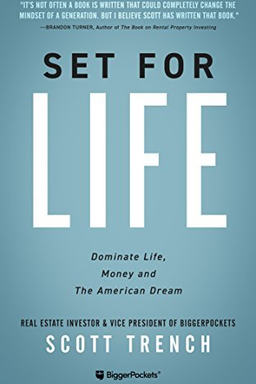
Set for Life cover

Set for Life

by Scott Trench

Set for Life by Scott Trench outlines a strategic roadmap to financial independence, emphasizing frugality, saving, and smart investment. With practical advice on wealth accumulation, particularly through real estate, it empowers readers to achieve financial freedom and retire early, offering them the tools to design their ideal lifestyle.

Set for Life: Redefining the American Dream

How can you break free from the lifelong grind of wage-paying work and achieve financial freedom within a decade? In Set for Life: Dominate Life, Money, and the American Dream, author Scott Trench challenges the conventional formula that has defined success for generations: work forty years, save a small portion of your income, and then hope your retirement fund lasts. Trench contends that this path traps ordinary people in cycles of dependence and missed opportunity. Instead, he lays out a radical yet practical roadmap to becoming financially independent in as little as five to ten years.

Trench’s argument centers on the belief that financial freedom is not about earning more—it starts with saving more. He introduces a systematic process called the Three Stages of Wealth Creation: building the first $25,000 through extreme frugality, leveraging housing and income growth to reach $100,000, and then transitioning to investments and income-producing assets to achieve lifelong financial freedom. The book reframes the American Dream as one of choice, time, and flexibility instead of consumerism and status.

The Problem with the Traditional Dream

Trench begins by critiquing the so-called sensible path of working for decades, buying a home, and retiring on an employer-sponsored plan like a 401(k). Under this model, most people trade away the best years of their lives for job security. Even if they succeed financially, they find themselves worn out and dependent on savings that only become accessible late in life. Trench exposes this approach as both outdated and inefficient in today’s economy.

He asks the reader to imagine a different life—one where you control your time, choose your projects, and laugh off the need to clock in for someone else. This alternative form of the American Dream doesn’t depend on luck or privilege; it’s driven by strategy and mindset. The first key shift, Trench explains, is to redefine “wealth” not as possessions but as freedom from needing wage income.

Three Stages of Financial Freedom

The heart of Set for Life lies in its three-stage framework. Trench presents it as a step-by-step guide for the average full-time worker earning around $50,000 annually.

  • Stage One: Build your first $25,000 through ruthless frugality and efficient living. This phase establishes your first year-long financial runway—the security to survive without a paycheck for twelve months.
  • Stage Two: Convert major expenses into assets, most notably by eliminating housing costs through “house hacking”—buying a duplex or small rental, living in one part, and renting out the other. Simultaneously, you pivot into a career field or entrepreneurial path that can scale your income significantly.
  • Stage Three: With over $100,000 saved, you transition from stability to abundance. Here, the focus shifts toward investing in assets that generate passive income—stocks, real estate, and small businesses—until your income exceeds your expenses indefinitely.

Each stage deliberately compounds the last, enabling exponential progress. The steps are not isolated tactics but connected “financial runways” that buy you time and flexibility—the real ingredients of freedom.

Frugality as Empowerment

Trench’s philosophy diverges sharply from popular financial gurus who emphasize earning more as the solution to money problems. He acknowledges that higher income helps but insists frugality must come first. By minimizing costs early—especially housing, transportation, and food—you gain flexibility to take calculated risks without fear of losing your livelihood. This “freedom to choose” is what separates those stuck in jobs from those capable of pursuing entrepreneurial opportunities.

“Frugality isn’t deprivation—it’s empowerment,” Trench writes. “It’s the key that unlocks opportunity.”

He uses relatable examples like Liz and Adam—two average earners whose overspending traps them in stressful routines—to illustrate how simple decisions, like moving closer to work or sharing housing, can save thousands annually and reclaim hours of time. Over time, these small but strategic changes accelerate wealth far faster than chasing minor raises subject to taxation.

From Saving to Investing

Trench emphasizes wisely deploying savings at each stage. After the initial runway, the next step is investing intentionally in assets that produce true value—he distinguishes “real assets” (income-generating and appreciating) from “false assets” (cars, financed homes, or advanced degrees that drain cash flow). His approach treats money not as something to be stored but as a vehicle to create freedom and future opportunity.

This philosophy aligns with thinkers in the early retirement and FIRE (Financial Independence, Retire Early) movement, such as Vicki Robin (Your Money or Your Life) and Mr. Money Mustache (Peter Adeney). But Trench offers a more tactical roadmap useful for pragmatic middle-class professionals rather than minimalists living off the grid.

Why This Matters

Trench’s vision of the American Dream is radical yet realistic. It doesn’t rely on luck, privilege, or impossible frugality—it relies on informed action. The greatest takeaway is that financial independence isn’t distant or reserved for the ultra-rich. It can be built deliberately by anyone who chooses to think differently about consumption, housing, and career decisions. This book isn’t simply about money; it’s about reclaiming time, autonomy, and meaning during the best years of your life.

By merging simple math with disciplined lifestyle design, Set for Life transforms early financial freedom from a dream into an achievable plan. It’s not about retiring and doing nothing—it’s about using your wealth to do anything.


Frugality: The Foundation of Freedom

Scott Trench insists that true financial progress begins not with higher income, but with frugality—the disciplined act of living far below your means. Chapter 1 of Set for Life lays out why saving is the indispensable first step to escaping the rat race. For wage earners at or near the median American income, Trench argues, frugality unlocks opportunity, flexibility, and ultimately, freedom.

Why Frugality Comes First

Many motivational speakers urge people to “focus on earning more” or adopt a mindset of abundance. Trench calls that advice incomplete. You can’t chase higher earnings without first surviving financially. He contrasts two employees—Liz and Adam—whose fixed expenses determine whether they can take career risks. Liz’s hefty car payment, rent, and subscriptions trap her in her current job; Adam’s frugal habits allow him to leap when new opportunities arise. Saving isn’t about scarcity—it’s about optionality.

Frugality grants the ability to say yes to life-changing chances: a lower-paying startup job with growth potential, a year off to invest in real estate, or even launching your own business. Having cash in the bank buys courage.

The Three Reasons to Embrace Frugality

  • It Enables Opportunity: The frugal saver can afford to take risks and chase high-upside ventures while others cling to safety.
  • It’s Noninvasive: Cutting big fixed expenses—housing, transportation—creates immediate, painless savings compared to small lifestyle sacrifices.
  • It Beats Taxes: Every dollar saved survives taxation, while every dollar earned is shrunk by it. Trench quips: “A penny saved is 1.33 pennies earned.”

This logic dismantles common excuses, especially the idea that cutting back diminishes happiness. Trench argues the opposite—less waste often means more time and energy for relationships and creativity.

Do-It-Yourself Living

Frugality extends beyond budgeting—it’s about self-reliance. Trench encourages you to handle ordinary repairs, cook your own meals, and learn basic skills that save thousands over your lifetime. He criticizes the modern dependence on paid specialists for trivial tasks, reminding readers that “fixing your own sink and changing your own oil” are practical acts of empowerment, not just penny-pinching.

The principle echoes ideas from thinkers like Henry David Thoreau (Walden), who equated simplicity with independence. Trench modernizes that ethic: every skill learned is money kept—and freedom earned.

The Psychology of Frugality

Habits don’t stick without emotional motivation. Trench argues that frugality must be a philosophical choice rooted in a yearning for freedom. When your desire for independence outweighs momentary pleasure, saying “no” to waste becomes easy. He compares it to athletic discipline—champions train daily, not because it’s easy, but because the goal transcends the discomfort.

“You don’t deserve the best. You deserve freedom,” Trench declares. This shift from consumption to autonomy defines his philosophy.

Over time, living frugally isn’t about being cheap—it’s about becoming deliberate. You buy fewer things, but they matter more. You start seeing waste as weakness, debt as vulnerability, and efficiency as power. In Trench’s system, frugality is not the finish line—it’s the sturdy foundation upon which your entire financial life stands.


Lifestyle Design and Efficient Living

In Chapter 2, Trench moves from theory to practice. If frugality lays the foundation, efficient lifestyle design builds the structure. This chapter reveals the key expenses dragging Americans down and demonstrates how to cut spending radically—without sacrificing quality of life. His goal: to help you live well on less than $2000 a month and save over half your income.

Focus on Fixed Expenses

Trench critiques conventional wisdom that urges cutting variable expenses like coffee or nights out. The real financial leaks, he explains, are fixed: housing, transportation, and food. These categories comprise nearly 80 percent of the average American’s budget. By restructuring these “non-negotiables,” you create permanent savings that accumulate effortlessly.

He uses data from the Bureau of Labor Statistics to show that focusing on housing and commute costs yields massive annual returns—often in the five-figure range. Sharing an apartment, moving closer to work, or ditching the car entirely can free thousands per year and hundreds of hours of time.

Housing: The Wealth Killer

Housing tops Trench’s list of transformative changes. He urges renters to pick locations that reduce both rent and commute time. A $550 shared apartment near work beats a $1200 solo apartment downtown not only in rent savings but commuting costs, entertainment temptations, and stress. Living close to work can literally add a decade’s worth of savings over time.

Later, he introduces “house hacking” as the next evolution—turning housing from an expense into an income-producing asset. This concept, central to his plan, transforms the largest budget item into the engine of wealth building.

Kill Your Commute

Americans often overlook how devastating commutes are. Trench cites studies showing long commutes raise stress, blood pressure, and depression. Financially, they drain thousands in gas, maintenance, and wasted hours. He shows the math: even a modest commute costs over $10,000 annually in time and money. This echoes advice from Mr. Money Mustache, another early-retirement advocate, who calls the car commute “modern-day self-sabotage.”

Trench’s solution is simple—live close enough to bike or walk to work. Doing so instantly increases wealth, improves health, and buys back hours of life every day.

Food, Health, and Hidden Savings

Food habits reveal financial health. Americans spend nearly $7000 yearly on food, much of it from restaurants. Trench advocates learning to cook healthy, simple meals—not to punish yourself, but to restore control. He sees cooking as a metaphor: daily effort that compounds into major savings and well-being. Meals shared with family or coworkers substitute entertainment for connection.

Scale the Right Lifestyle, Not the Cheapest

Efficient living isn’t austerity—it’s strategy. Trench tells readers not to sacrifice meaningful recreation or relationships. Keep the happy hours; scrap the bloated rent. Don’t obsess over coupons; focus on structural choices that shape the next decade. By optimizing your living environment, commute, and food habits, you design a lifestyle that saves thousands annually and supports real happiness.

“Don’t sacrifice the little things. Change the big things,” Trench summarizes—a line that encapsulates his practical genius.

The payoff? A 50 percent savings rate that converts into years of financial runway within two years. Freedom isn’t achieved through deprivation—it’s engineered through intelligent design.


Building Your First $25,000

After you’ve trimmed expenses and adopted frugality, Trench guides you through the tangible goal of saving your first $25,000. This milestone, covered in Chapter 3, marks the turning point from survival to empowerment—your first year of financial independence from wages. Trench describes it as “the hardest part,” not because it’s complex, but because it demands consistency.

Three Milestones on the Path

  • Build an emergency fund ($1000–$2000): The first buffer against catastrophe. It eliminates dependence on credit cards and parents, giving peace of mind and dignity.
  • Eliminate bad debts: High-interest debt is treated as an emergency. Trench insists you pay these immediately. He favors either the Debt Snowball (smallest balances first) or highest-interest-first methods but warns not to invest while burdened by toxic debt.
  • Build the one-year runway ($25,000): Save liquid, after-tax wealth you are willing to spend on opportunity—your launchpad for financial freedom.

Emergency Fund: Your First Safety Net

This small reserve transforms your mindset. Trench shares the story of Bobby, a young man reliant on his parents due to chronic overspending and debt. When Bobby finally builds a modest cushion, he gains independence—not just financially, but emotionally. “A few thousand dollars can change your psychology from helplessness to control,” Trench writes.

Good vs. Bad Debt

Trench separates debt into two distinct types. Bad debt carries high interest (credit cards, payday loans) and kills progress. Good debt—low-interest loans used for leverage, like mortgages—can be tolerated strategically but should never dominate your finances. Pay down bad debt aggressively before pursuing investments.

The Runway to Freedom

Once debt is gone, saving accelerates. Trench calls the one-year runway “real wealth”—cash or equivalents that could fund your life without work for twelve months. Unlike home equity or 401(k)s, this money is accessible and powerful. It’s the buffer that allows you to quit toxic jobs, pursue training, or start a business. He gives practical ranges: save $25k on a $50k income by living on $2000/month—a challenge, but achievable within a year.

This first phase isn’t glamorous. It’s a grind. But it builds character and flexibility. Trench’s message: freedom starts with liquidity. Once you reach $25,000, work becomes optional—and options are the currency of independence.


House Hacking: Turning Costs into Income

In Part II of Set for Life, Trench reveals his most powerful wealth-building tool: house hacking. This strategy transforms housing—the largest expense for most Americans—into an income-producing asset. Instead of paying rent or a mortgage, you buy a property that pays you through rent from roommates or tenants. This move accelerates the journey from frugality to freedom.

The Case for House Hacking

Trench shares the story of Average Joe, a typical $50k earner deciding between renting, buying, or house hacking. Through detailed spreadsheets, he compares three options: renting a duplex unit, buying a single-family home, or “hacking” the duplex—living in one side and renting the other. In year one, Joe’s house hack earns him $21,500 more wealth than renting and $16,800 more than buying. Over thirty years, that difference balloons to nearly $1.5 million.

How It Works

  • Buy a small multifamily property or home with extra rooms using low-down-payment financing (like FHA loans at 3.5%).
  • Live in one unit or bedroom, rent the others to cover the mortgage and expenses.
  • Benefit from appreciation, loan paydown, and monthly rental cash flow—all while living free.

House hacking not only eliminates housing costs—it teaches property management and real estate investing skills that scale naturally. Managing tenants next door offers a safe, hands-on education in ownership.

The Financial Impact

Trench points out that ordinary homeownership is a losing deal—it consumes cash flow and inflates lifestyle costs. Renting may seem simpler, but offers no wealth growth. House hacking, conversely, converts liability into equity. In most markets, a median-income earner can live for free or even profit monthly. Over the long term, the appreciation and principal reduction create massive wealth.

“It’s like getting a 200 percent return on your housing decision,” Trench estimates, highlighting the recurring magic of this move.

Why It Works So Well

Psychologically, house hacking blends frugality with ambition. It’s simpler than starting a business yet more powerful than saving rent passively. It transforms your daily life into an investment. You still live comfortably, but every rent check received pushes you closer to financial independence. Compared with speculative stock-picking, this approach gives tangible results under your control.

Trench calls it “the single most important decision” in the journey from $25k to $100k. It’s a lifestyle shift where wealth creation becomes automatic—your tenants literally fund your freedom.


Earning More and Building a Scalable Career

After solidifying savings and housing, Trench teaches readers how to break income plateaus. He argues that increasing earnings isn’t about climbing the corporate ladder—it’s about switching to scalable work. In Chapters 6 and 7, he dissects career structures and explains how to design a job path that rewards performance, not seniority.

The Flaw of Salaried Work

Trench observes that conventional jobs reward tenure rather than output. He charts a typical financial analyst’s career path—decades of slow raises capped by management barriers. Even in the best case, promotions bring marginal increases. This setup suffocates ambition and creativity. “Salary is stability, but it’s also a cage,” he warns.

The Power of Performance Pay

To escape stagnation, Trench recommends moving into roles tied directly to results: sales positions, commission-based work, or entrepreneurial ventures. These offer “infinite upside” but require courage and discipline. Performance pay aligns effort with reward—you earn more only when you deliver value. This principle echoes ideas from authors like Cal Newport (So Good They Can’t Ignore You)—build rare, valuable skills, and opportunities compound.

Synergy and Skill-Building

Trench challenges readers to develop highly sought-after skills that synergize with existing expertise. For a finance worker, that might mean adding sales or tech fluency; for a tradesperson, teaching or management skills. He showcases examples like Clay, who shifted from real estate to software development through bootcamp training—nearly tripling his income in two years. Synergy ensures growth feels natural, not forced.

High-Achieving Environments

In Chapter 7, Trench expands on career scaling through mindset and environment. Surround yourself with driven mentors (he cites his own network at BiggerPockets) and prioritize continual self-education. He urges professionals to read one business book per week—a habit that can place you “in the top 1% of your industry within five years.” Continuous improvement turns competence into mastery.

“Put yourself where achievement is the norm,” Trench advises, “and success stops being optional.”

Ultimately, scaling income means designing work that compounds like investments—by tying success to performance, increasing skills, and surrounding yourself with excellence. When applied consistently, income growth becomes exponential, paving the way to invest aggressively and achieve lifelong freedom.


Investing for Financial Independence

Part III of Set for Life transitions from saving and earning to investing for freedom. Trench defines financial freedom mathematically: when your assets generate passive income exceeding your cost of living. His investing philosophy combines classic wisdom with modern efficiency—avoid speculation, reinvest returns, and focus on assets you control.

The Financial Freedom Equation

Trench introduces the formula Assets × Return ≥ Lifestyle. When assets produce more than your expenses, work becomes optional. He divides people into four levels: cash-flow negative (debt-bound), neutral (paycheck-dependent), positive (high savers), and financially free (living off passive income). The goal is not riches—it’s independence from wage-paying work.

Real vs. False Assets

Trench distinguishes “real assets”—rental properties, stocks, businesses—from “false assets” like financed cars, oversized homes, or graduate degrees that trap cash flow. A financed SUV or fancy degree may symbolize success but erodes autonomy. He repeats: buy freedom, not status. This echoes Robert Kiyosaki’s framework from Rich Dad Poor Dad, but grounded in middle-class realism.

Safe Withdrawal Rate and Strategy

Trench explains the safe withdrawal rate (SWR)—the percentage of assets you can spend annually without depleting them. A 5% SWR suggests you need 20× your annual expenses to retire risk-free ($500k to fund $25k yearly). Frugality again pays off: every $100 cut monthly reduces your target by $24,000. Lifestyle control is wealth creation.

Investment Tenets

Trench lists seven tenets for sound investing: never spend principal, reinvest returns, accumulate capital first, correlate effort with control, invest based on knowledge, distinguish risk from volatility, and tailor investments to your situation. He criticizes stock-picking, calling it “selling bottled water outside the stadium”—immaterial work for small returns.

Real Estate and Index Funds

Trench favors a mix of real estate and index funds. Rentals offer leverage and control—your sweat improves returns. Index funds provide passive, market-average growth with minimal effort. He urges avoiding speculative bets (like gold) and instead automating wealth through consistent investing and reinvestment. Leverage amplifies wealth, but discipline preserves it.

“Investing isn’t gambling—it’s engineering,” Trench reminds readers. “You design perpetual income through discipline, not luck.”

Through consistent saving, strategic investing, and the pursuit of assets you control, freedom becomes inevitable—not hopeful. This concluding phase proves Trench’s thesis: financial independence is not mystical. It’s a math problem solved by patience, knowledge, and purpose.


Habits and Tracking Your Progress

In his final chapters, Trench emphasizes that wealth isn’t maintained passively—it must be tracked, refined, and defended against distraction. You achieve financial freedom not only through smart strategy but through habitual discipline. He outlines two pillars for lifelong success: tracking your progress and protecting your habits.

Tracking Money and Time

“What gets measured gets managed,” Trench asserts. He urges readers to monitor key metrics: real net worth (usable assets), monthly spending, income streams, and daily time. Using modern tools like Mint or Personal Capital instead of fearsome spreadsheets, you can visualize progress instantly. Maintaining awareness prevents drift and reveals opportunities to optimize.

Trench distinguishes between false net worth (home equity, retirement accounts) and real net worth—cash and assets you can deploy immediately. He illustrates this through Sam, a middle-class worker “worth” $236k on paper but deep in debt. Sam feels rich but is trapped. Only usable assets buy freedom.

Time: The True Currency

Financial freedom ultimately transforms into time freedom. Trench advocates tracking days like budgets: morning to evening, identify what advances goals versus wastes energy. He defines productivity without burnout—small, daily steps lead to massive yearly gains. Over time, you measure progress not in dollars saved but hours reclaimed.

Cutting Harmful Habits

Perhaps the most confrontational section lists ten habits to eliminate: excessive TV, sports fandom, luxury living, dining out, social media, background music, nightlife, shopping, snoozing, and trying to do everything at once. Each steals time or money. “Replace these habits with the pursuit of what matters,” Trench commands. Like James Clear’s Atomic Habits, he sees small behavioral shifts as multipliers—not moral reforms.

“You aren’t sacrificing anything by giving these up—you’re buying your future back,” Trench insists.

He invokes psychology and math equally: wasting 3 hours daily on TV or a 2-hour commute equates to years of lost freedom. Discipline is the ultimate asset protection. Wealth leaks through distraction more than poor investing.

The Cycle of Continuous Improvement

Trench concludes that success is iterative. Track progress monthly, reflect quarterly, reset goals annually. Financial freedom is dynamic—it demands clarity and continual adjustment. Like fitness, it requires maintenance and awareness. Knowledge plus habit equals mastery.

In the end, Set for Life isn’t a one-time recipe—it’s a living practice. You act, measure, adapt, and repeat until freedom sustains itself. That discipline turns wealth into wisdom—and a sustainable, liberated life.

Dig Deeper

Get personalized prompts to apply these lessons to your life and deepen your understanding.

Go Deeper

Get the Full Experience

Download Insight Books for AI-powered reflections, quizzes, and more.