
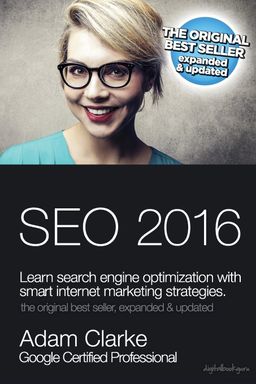
SEO 2016 cover

SEO 2016

by Adam Clarke

SEO 2016 is your essential guide to mastering search engine optimization. Discover strategies to boost your website''s visibility, understand Google''s ranking algorithm, and capitalize on SEO techniques to stay ahead in the digital landscape.

Mastering SEO in a Constantly Changing Digital World

What if you could make your business visible to thousands of potential customers searching online every day? In SEO 2016: Learn Search Engine Optimization with Smart Internet Marketing Strategies, Adam Clarke argues that mastering search engine optimization (SEO) isn’t about hacking Google’s system—it’s about understanding its purpose. Google’s goal is simple: to deliver high-quality, relevant results to users. Your goal as a business owner or marketer is to speak Google’s language by creating trustworthy, relevant, and engaging content that deserves to be found.

Clarke’s book is both an instruction manual and a strategic roadmap for how to make your website thrive in one of the most competitive spaces on the Internet. Originally published after Google’s pivotal algorithm changes—like Penguin, Panda, and Hummingbird—the book was later updated through 2016 to include mobile SEO, HTTPS updates, schema markup, local SEO, and insights into Google’s latest directions. It’s not just a how-to guide; it’s a mindset shift toward sustainable digital success.

Understanding Google’s Logic

Clarke begins by taking readers behind Google’s algorithm curtain. SEO used to be a game of tactics—keyword stuffing, link farms, and directories—but those days are long gone. Google now measures over 200 factors across three central dimensions: trust, authority, and relevance. If you can strengthen all three, you’ll win more traffic. Clarke reminds us that SEO is not a trick; it’s a long-term reputation system. Google rewards what humans value—reliable content and great digital experiences.

The Book’s Big Picture

Across more than twenty chapters, Clarke structures the journey from beginner basics to professional mastery. He covers how to perform keyword research that targets buyers, how to make Google recognize the right keywords, how to design SEO-friendly site structures, and how to build powerful backlinks without triggering penalties. The book intersperses technical knowledge—canonical tags, robots.txt, sitemaps—with practical tips, like using Google Analytics to measure your success, or how to plan profitable AdWords campaigns.

Crucially, Clarke’s writing is conversational, empowering, and highly actionable. He doesn’t assume you’re a coder or marketing veteran. Instead, he simplifies complex systems by using examples anyone can understand. For instance, he likens bad URLs like “example.com/~articlepage21/post321.aspx?q=3” to a confusing street address compared to a clean format like “example.com/football-jerseys.” He takes intimidating concepts like schema.org markup, HTTPS, and site speed optimization, and translates them into straightforward steps and accessible tools.

Why These Concepts Matter

In today’s digital economy, your website’s visibility can literally make or break your business. Clarke shows that SEO isn’t a vanity project—it’s a measurable growth engine. He explains that every small optimization sends signals to Google’s ranking algorithm, building layers of credibility. Whether you’re running a local pizza shop or an international e-commerce brand, these steps compound into long-term traffic that can outperform paid ads.

The book also highlights SEO’s democratizing potential. While large companies may dominate paid advertising, small businesses can still outrank them through genuine quality content and consistent SEO discipline. Clarke himself began by ranking his family’s accounting business, proving that expertise and persistence can overpower budget alone.

From Black-Hat Tricks to Smart Strategy

Clarke’s perspective is firmly rooted in ethical, white-hat SEO—methods that align with Google’s mission. He warns against spammers and short-term tactics that may work temporarily but risk major penalties. Through deep dives into algorithm updates like Penguin (targeting bad links), Panda (content quality), and Hummingbird (semantic intent), he shows exactly how to adapt. The key takeaway: Google is smarter than ever, so focus on value, not manipulation.

In essence, Clarke redefines SEO as a relationship between human value and algorithmic trust. It’s part art, part science, and mostly discipline. His appendices even include practical tools—like Moz, Ahrefs, and Google Webmaster Tools—and walkthroughs for AdWords and analytics, reminding readers that SEO success is both measurable and maintainable.

A Roadmap for Continuous Growth

Ultimately, the book argues that SEO is no longer optional. Consumers live in search engines. If you’re not showing up, you’re invisible. Clarke’s program equips you to structure your site properly, choose the right keywords, and understand analytics, but more importantly, to stay adaptable. Google’s updates will keep coming, but as he puts it, “If your site shows stronger signals to Google than competitors, you will beat them.” That’s not just a technical truth; it’s a business philosophy for the digital age.


Trust, Authority, and Relevance: The Holy Trinity of SEO

One of Adam Clarke’s most valuable contributions is simplifying Google’s complex algorithm into three core principles: trust, authority, and relevance. These three signals form the foundation for how Google decides which websites deserve top rankings. Ignore one, and the entire structure collapses.

Building Digital Trust

Trust means your website feels legitimate, consistent, and safe. Google’s mission is to protect users from scams, spam, and misinformation. You build trust by using secure HTTPS, providing high-quality content, and earning backlinks from established sources. Clarke likens backlinks to professional references—the more credible your referrers, the more Google trusts you. For example, a link from a respected industry blog or a government (.gov) domain signals reliability far better than dozens of low-quality directory links.

Earning Authority

Authority is your online reputation’s strength score. It’s a numbers game—how many people are citing, sharing, and referencing your site. Clarke emphasizes that authority isn’t built overnight; it grows from consistent publishing, active engagement, and longevity. Think of authority like brand clout: CNN has more authority than a small blog, but niche sites can still outrank larger names by maximizing relevance and trust. Tools like Moz’s Domain Authority (DA) and Page Authority (PA) help you measure your site’s progress numerically.

Cultivating Relevance

Relevance connects your content to the user’s intent. This is where keyword choice and placement matter most. Clarke argues that even a tiny local business can outperform giant corporations if its content precisely matches what users search for. For instance, a page optimized for “emergency dentist in Austin” can rank above general dental sites if the page’s words, headings, and links align perfectly with that search.

By combining relevance with trust and authority, you send complete “confidence signals” to Google. This triad explains almost every SEO phenomenon—from why small brands sometimes dominate local searches to why big brands dominate vague keywords like “shoes.” Once you start viewing SEO through these three lenses, every optimization decision becomes simpler and more strategic.


Keywords: The Foundation of Every SEO Strategy

Clarke insists that all successful SEO begins with effective keyword research. Without it, even the best website architecture will flop. He calls keyword research “the most important step of SEO” because it determines whether you’re competing for winnable terms that actually drive customers—not just traffic.

Understanding Keyword Types

Clarke distinguishes between head terms (short, high-volume keywords like “classic movies”) and long-tail keywords (more specific, lower-competition phrases like “classic Akira Kurosawa movies”). He recommends focusing on long-tail, informational, and transactional keywords over head terms, since they attract visitors ready to act. For example, targeting “buy running shoes online” beats “running shoes” because the intent is clearer and less competitive.

Finding Profitable Keywords

Clarke walks readers through practical research techniques using tools like Google AdWords Keyword Planner, Ubersuggest, and Moz’s Keyword Difficulty Tool. He encourages combining human intuition with data. If you own a secondhand bookstore, for instance, “antique books online” may outperform “bookstore” because it targets a niche yet valuable audience. The lesson: find keywords that are relevant, get adequate monthly search traffic, and where you can outrank competition realistically.

Avoiding Keyword Pitfalls

The biggest mistake beginners make is chasing volume over intent. Clarke warns against targeting keywords just because they’re popular—if visitors don’t convert, those clicks are worth nothing. He also condemns keyword stuffing, explaining that Google’s Hummingbird update now understands context through semantic relationships (sometimes called LSI or Latent Semantic Indexing keywords). This means you should focus on writing naturally, weaving variations and related terms into your content rather than repeating the same phrase endlessly.

When done right, keyword research acts like a compass. It tells you where to go, how hard the journey will be, and what rewards await. Clarke shows that audience intent—not just algorithmic tricks—should guide every step of your SEO plan.


Designing a Google-Friendly Website

If Google were a guest visiting your website, would it find everything neatly organized—or a confusing labyrinth? Clarke’s chapter on site structure translates technical web design into common sense. Google wants sites that are easy for users and crawlers to navigate. Clean design equals better discoverability and higher rankings.

Clean URLs and Logical Navigation

SEO-friendly URLs should look simple, descriptive, and human-readable. Clarke emphasizes enabling “clean URLs” in your CMS settings and using plain text links for menus instead of images. Internal linking from your homepage to important subpages accelerates how Google’s spiders understand your site’s hierarchy. The rule of thumb: simplicity helps both people and bots.

Speed, Security, and Accessibility

Google’s ranking factors increasingly reward user experience. Clarke discusses site speed as “Google magic dust,” citing data that each second shaved off page load time can raise conversions by 7%. Tools like Google PageSpeed Insights and Pingdom provide diagnostics. He also advises embracing HTTPS security since even a minor ranking boost can compound into serious traffic gains over time. Accessibility—ensuring your site adapts to mobile, tablet, and desktop screens—is another fundamental SEO requirement after Google’s 2015 mobile update.

The Role of Readability and Usability

SEO isn’t just bots reading code; it’s humans reading words. Clarke introduces readability as an underutilized ranking factor—search engines favor easy-to-read content (roughly middle school to high school level, according to the Flesch score). Likewise, “usability” means designing intuitive layouts, avoiding intrusive ads, fixing broken links, and providing consistent performance. He reminds us that every technical improvement doubles as a better experience for real users, and that’s exactly what Google rewards.

Taken together, these principles transform SEO from a mysterious algorithm chase into basic hospitality: make your visitors—human or spider—feel welcome, comfortable, and safe.


Smart Link Building Without the Spam

In the golden age of SEO, links were everything. Then came abuse—massive link farms, paid backlinks, and anchor text manipulation. Clarke clarifies what still works and what will ruin your rankings.

Quality Over Quantity

Today, building thousands of low-quality backlinks is a red flag. Clarke’s rule: focus on high-quality, relevant, authoritative links. A single backlink from a reputable site in your niche may outweigh 100 spammy ones. He proposes starting with legitimate business directories (like Yelp or LinkedIn Company Pages), followed by guest posts and earned media mentions. Relevance matters as much as authority—a yoga studio linked by a fitness blog scores higher than one listed on a tech site.

Anchor Text Balance

Over-optimizing anchor text, meaning repeating the exact same keyword across links, can trigger Google’s Penguin penalties. Clarke’s optimal ratio: targeted anchors should make up less than 30% of your backlink text. He demonstrates that natural link profiles mix branded terms (like “Acme Yoga”), generic text (“website” or “click here”), and diverse variations of your keyword.

Advanced Link Building Strategies

For those ready to go beyond basics, Clarke offers creative tactics: building relationships with other bloggers, curating round-up posts that attract reciprocal links, using “broken link building” (finding and replacing dead resources), and “link bait”—valuable content designed to be shared widely. His examples include infographics and “top 10” expert lists that naturally earn backlinks. He also warns that buying links or spamming comments will eventually backfire.

By seeing links as votes of confidence instead of shortcuts, you’ll approach SEO as a reputation system rather than a numbers game. Clarke’s pragmatic advice helps transform link building into ethical networking—authentic relationships with measurable rewards.


Content That Earns Rankings and Customers

Clarke believes one of the most overlooked yet potent SEO strategies is adding fresh, valuable content regularly. Google loves momentum. Each new page sends signals of relevance and activity. This is why blogs and news sites dominate search rankings—they continuously feed the algorithm with new material to index.

The Power of Consistency

Posting sporadically kills momentum. Clarke insists on creating a schedule and sticking to it. He even suggests hiring ghostwriters or freelance contributors if bandwidth is limited. Quality articles don’t need to be long, but they must be unique, original, and audience-focused. Services like Textbroker or ProBlogger Job Board can help source consistent content affordably.

Optimizing and Promoting Content

SEO doesn’t end when the post is published. Clarke encourages sharing new content across all social networks, linking it with relevant internal pages, and submitting it to blog directories like Technorati or AllTop for backlinks. This amplifies reach and signals to Google that your content is both useful and popular. He also recommends using related keywords and multimedia (images, video, infographics) for more comprehensive relevance.

Why Freshness Matters

Google’s algorithm favors timely updates—it assumes that up-to-date information is more trustworthy, especially in fast-moving industries. Clarke describes this as a compounding effect: more content means more entry points into your site, more visitors, and higher authority over time. The habit of consistent publishing becomes your most powerful SEO multiplier.

This chapter reads like a blueprint for long-term SEO health: publish regularly, interlink intelligently, and promote socially. If you treat content like an engine instead of decoration, you’ll never run out of organic growth fuel.


Local SEO: Winning Your Neighborhood Online

For small businesses, Clarke highlights local SEO as a game changer. It’s how your shop, restaurant, or service gets discovered by nearby customers searching phrases like “plumber near me” or “best pizza in Boston.” This version of SEO uses separate Google systems (Google My Business and map listings), meaning even modest players can compete against big brands on proximity and relevance.

Citations and Reviews

Google measures a local business’s credibility using “citations”—mentions of its name, address, and phone (NAP) across directories like Yelp, Whitepages, or Yellow Pages. Clarke explains that consistency is critical; even small formatting differences (like “St.” versus “Street”) can cause mismatches. Reviews are equally vital. Encourage customers to leave authentic Google reviews by providing links in email signatures, receipts, or follow-up messages. Never buy fake reviews; Google can detect this manipulation easily.

Optimizing Your Google My Business Profile

Clarke guides readers through setting up a rich Google+ My Business (now Google Business Profile) listing—complete with photos, categories, and accurate hours. He emphasizes selecting the most specific category for your service (“Italian restaurant” beats “food services”) and updating details frequently. Verified listings rank higher, and adding local keywords in the description improves relevance further.

Why Local Signals Matter

Clarke cites Moz’s Local Ranking Factors study showing that Google prioritizes businesses located closest to users’ search locations, with a special emphasis on verified NAP citations and customer engagement. The message is hopeful: even if your site doesn’t dominate national keywords, you can still own visibility in your zip code.

Local SEO, as Clarke frames it, is digital word of mouth—the highest-converting customer base you could ask for. When neighbors search, they’re not casually browsing; they’re about to buy. Winning those searches can immediately translate into real revenue.


AdWords and Pay-Per-Click: The Fast Lane to Traffic

While SEO builds momentum slowly, Clarke’s bonus AdWords section introduces a faster—but costlier—alternative: pay-per-click (PPC) marketing. He calls it the “quick and dirty” way to bring visitors instantly while you wait for organic rankings to grow.

Setting Strategic Goals

Before spending a dime, define campaign objectives: Do you want sales, leads, or awareness? Clarke gives clear math-based examples. If your product costs $100 with a 20% margin, you can’t spend more than $20 acquiring each customer and remain profitable. Start small, treat campaigns as experiments, and calculate cost-per-acquisition to stay within budget.

Choosing Keywords and Bids

He breaks down match types—broad, phrase, exact, and negative keywords—with examples like “tennis shoes” versus [tennis shoes]. Using negative keywords (for example, “-free” or “-manual”) prevents irrelevant clicks that waste money. Clarke also introduces the concept of Google’s Quality Score: higher ad relevance and click-through rate can actually reduce your cost-per-click, rewarding smart advertisers over high bidders.

Continuous Optimization

You don’t “set and forget” an AdWords campaign. Clarke stresses constant optimization—testing different headlines, pausing poor performers, and adjusting bids. He also recommends using conversion tracking in Google Analytics to see which ads drive real sales, not just visits. Over time, this data-driven feedback loop sharpens both your paid and organic marketing strategies.

In essence, PPC complements SEO. One builds trust long-term; the other drives immediate action. Together, they create a well-rounded digital marketing engine that balances patience with quick wins.

Dig Deeper

Get personalized prompts to apply these lessons to your life and deepen your understanding.

Go Deeper

Get the Full Experience

Download Insight Books for AI-powered reflections, quizzes, and more.