
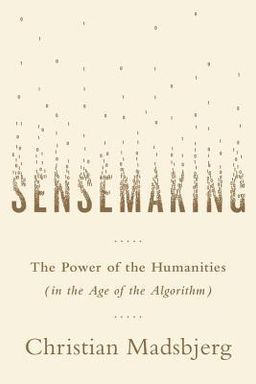
Sensemaking cover

Sensemaking

by Christian Madsbjerg

Sensemaking by Christian Madsbjerg advocates for a return to humanities-based thinking in an age dominated by algorithms. Discover how cultural interpretation and thick data can lead to innovative ideas and a competitive edge, challenging the limitations of data-centric views.

Sensemaking: Reclaiming the Human Ability to Understand a Complex World

How do you make sense of a world increasingly ruled by data, algorithms, and automation? In Sensemaking: The Power of the Humanities in the Age of the Algorithm, Christian Madsbjerg argues that in our race to quantify everything, we have lost touch with the very thing that helps humans understand and navigate complexity: our cultural intelligence. We tend to think that big data, machine learning, and efficiency models can explain everything—including people—but Madsbjerg contends that true understanding arises from human interpretation, empathy, and context.

The book is a manifesto for rediscovering how to think critically in an algorithmic age. Drawing on philosophy, social science, and real-world consulting work, Madsbjerg proposes a way of reasoning he calls sensemaking—a rigorous, humanistic approach to understanding cultures, organizations, and behaviors. It’s not about prediction through spreadsheets or algorithms, but about immersion into the messy, lived reality of human experience.

Why the Humanities Matter Again

Madsbjerg opens by noting a global crisis of leadership and understanding. CEOs and policymakers are drowning in analytics but starved for insight. From Ford’s Mark Fields to European bureaucrats, decision-makers are increasingly detached from the world their institutions serve. They operate on metrics divorced from real human life. To counter this, Madsbjerg argues for a revival of the humanities—not as nostalgic or decorative disciplines, but as the practical foundation for cultural and strategic intelligence.

The humanities, he writes, teach us to interpret meaning, to see patterns through stories, art, and philosophy, and to understand “what it’s like” to live in another world. This ability to imagine and describe human life—what anthropologists call “thick description”—is what machines can’t replicate. Algorithms can process quantities, but only humans can perceive meaning.

From Algorithms to Understanding

Modern organizations worship data as an oracle. Silicon Valley executives dream of “the clearest model of everything there is to know in the world.” Yet the more data we collect, the less we seem to understand. Big data identifies correlations but not causes—it shows patterns, not meaning. For example, Google’s Flu Trends could predict flu activity from search terms until it overestimated nearly every season, proving that information without interpretation is useless.

Sensemaking offers an antidote by combining rigor with empathy. Like an anthropologist in the field or a literary critic analyzing a novel, a sensemaker observes human experience in context: the offices, homes, and conversations where meaning takes shape. It’s the difference between watching lions hunt on the savannah (real life) versus examining them in a zoo (models and metrics).

The Five Principles of Sensemaking

Madsbjerg structures the book around five principles that together define the sensemaking method:

  • Culture, not individuals: Understanding a society requires seeing shared meanings, not isolated choices.
  • Thick data, not just thin data: Numbers alone cannot reveal the significance of experience.
  • The savannah, not the zoo: Study people in their natural worlds, not through abstractions.
  • Creativity, not manufacturing: Insights come from openness and grace, not mechanical processes.
  • The North Star, not the GPS: Use guiding principles to navigate complexity rather than relying on exact formulas.

Through each principle, Madsbjerg shows how humanities-based reasoning—drawing from philosophy, art, and ethnography—enables leaders to interpret their environment as living culture rather than as data to be mined. He illustrates these ideas through compelling case studies from Ford, Coca-Cola, Scandinavian pension firms, and European supermarkets, where businesses used sensemaking to reconnect with real people and dramatically improve results.

A Call to Recenter the Human

At its heart, the book asks: What are people for? As automation transforms industries, Madsbjerg reminds us that algorithms cannot care. People are for caring, imagining, and making meaning. He argues that humanists—historians, philosophers, poets, executives who care deeply about human life—hold the keys to thriving in the modern world. Mastery in any domain, whether politics or business, comes from empathy, context, and courage—the ability to make sense of the world when machines cannot.

Through stories of master musicians, investors, caregivers, and architects, Madsbjerg paints a vivid vision of what human intelligence still offers: the power to see beyond statistics and into truth. Sensemaking is not an intellectual luxury—it’s the new competitive advantage in a world drowning in information but starving for meaning.


Culture, Not Individuals

We often think human behavior comes down to individual choice—our personal beliefs, preferences, and psychology. But Christian Madsbjerg argues that most of what we do is shaped not by independent decision-making but by the shared worlds we inhabit. Borrowing from philosophers Martin Heidegger and Pierre Bourdieu, he suggests that people live in social worlds—systems of meaning that invisibly guide what we see as possible or desirable.

Understanding Worlds, Not People

In one of the book’s most striking examples, Ford executives struggled to understand why their Lincoln luxury cars had lost appeal. Numbers told them only that sales were dropping. Madsbjerg’s firm, ReD Associates, led them away from spreadsheets and into the lives of drivers. What they discovered redefined luxury completely—not speed or status, but emotional experiences like privacy, connection, or creativity within the car. These findings came not from asking what drivers thought, but from seeing what driving meant in their daily worlds: a sanctuary, an office, or a space for bonding.

Similarly, understanding the world of a Scandinavian pension company revealed that its aging customers were not “low engagement users.” They were facing existential questions about aging and purpose. When the company reframed its products around these realities—helping clients make sense of life transitions rather than selling financial tools—it reduced customer attrition by 80 percent in two years.

Heidegger’s Radical Shift

Heidegger challenged Descartes’s idea that humans are detached thinkers. Instead, he said we are being-in-the-world: we act and think through social contexts that define what’s meaningful. For example, a medieval knight understood life through God and feudal duty, while a modern urbanite sees career independence as central. These structures change over time, shaping everything we perceive.

Madsbjerg shows how this philosophical idea becomes practical. If you’re a policymaker, marketer, or leader, you must look beyond what individuals say to grasp the background structures guiding their actions—their language, rituals, aspirations, and constraints. Without this, you misread reality. As he writes, “When we get humanity wrong, we get everything wrong.”

Culture Is the True Data

Culture provides the invisible context that makes behaviors intelligible. Without studying it, companies chase symptoms while missing systems. This principle transforms how we do research, strategy, and leadership. Instead of isolating “users” and “customers,” sensemaking treats them as participants in living cultures. And instead of viewing an economy as numbers and markets, it views it as a conversation—one that constantly evolves.

By learning to observe, listen, and empathize within these worlds, you stop reacting to individual data and start perceiving patterns of meaning. It’s this shift—from people to worlds—that turns insight into wisdom. Madsbjerg calls it the move from analysis to understanding, from abstraction to life as it’s actually lived.


Thick Data, Not Thin Data

If big data is about quantity—tracking behavior through clicks, transactions, and algorithms—then thick data is about meaning. Drawing from anthropologist Clifford Geertz’s idea of “thick description,” Madsbjerg defines thick data as richly contextual information that explains why people act as they do. It’s about entering the real, lived world to discover texture—the emotions, habits, and cultural codes that numbers miss entirely.

The Soros Story: Synthesizing All Knowledge

The chapter opens with George Soros in 1992, betting against the British pound in what became known as “Black Wednesday.” Soros didn’t rely on pure math. Instead, he read the social and political context: German central bankers’ pride, British politicians’ fear of inflation, the mood of European markets. His thick data came from stories, conversations, and his embodied sense of change. He used philosophical insights from Karl Popper—especially falsifiability—to constantly test his own assumptions. This was sensemaking in action.

By blending objective data (rates, models) with subjective, shared, and sensory forms of knowing, Soros operated from what Madsbjerg calls the “full palette of human knowledge.” His embodied intuition—sometimes literally his back pain—warned him of danger in the market. Far from superstition, this sensitivity emerged from decades of immersion in how markets and people actually behaved.

The Four Types of Knowledge

Madsbjerg classifies knowledge into four kinds:

  • Objective knowledge: Facts measurable by science—correct but shallow.
  • Subjective knowledge: Inner feelings and personal experience—true for a moment, but limited.
  • Shared knowledge: The cultural meanings we live within—what Heidegger called “worlds.”
  • Sensory knowledge: Understanding through the body—intuition, physical cues, “feeling” the truth.

It is only when all four converge—when logic meets embodiment—that true wisdom appears. Quantitative analysis without cultural immersion leads to blind spots. As Madsbjerg puts it, “Models are clean; life is not.”

Thick Data as Strategy

Whether in finance, health care, or design, organizations that rely purely on thin data—numbers stripped of context—make disastrous decisions. Lehman Brothers had impeccable analytics before its collapse; what it lacked was a sense of reality. Sensemaking reintroduces that realism. Thick data, gathered through ethnography, observation, and empathy, reveals the “why” behind behavior and turns information into genuine insight.

As Isaiah Berlin once wrote, great judgment comes from “sensuous contact with reality.” Madsbjerg’s message echoes that truth: if you want to understand people, step away from dashboards and walk into their world. The wisdom you gain will be too complex for an algorithm—and that’s exactly why it matters.


The Savannah, Not the Zoo

To study people, you must leave the cage of abstraction and return to their natural habitats. This is the lesson Madsbjerg draws from phenomenology, the philosophical method of Edmund Husserl and Martin Heidegger. Phenomenology means “the science of phenomena”—a disciplined way of describing how life is experienced, not how it should be theorized. Madsbjerg calls it the difference between observing lions hunting on the savannah and watching them in a zoo eating from a bowl.

Going to the “Thing Itself”

Through stories of Sartre and Beauvoir learning Husserl’s idea in a Paris café—symbolized by the “apricot cocktail”—the book explains how phenomenology teaches us to look directly at real experience. Instead of debating whether the cocktail “exists,” phenomenologists describe what it’s like to taste, smell, and encounter it. The goal is descriptive truth, not scientific correctness. This method becomes the foundation of sensemaking: immersing in the world as it is lived.

Escaping Corporate Cages

Madsbjerg contrasts the phenomenologist’s commitment to field observation with the “zoo cages” of modern offices—conference rooms full of spreadsheets and mission statements. In these sterile spaces, leaders confuse maps for the terrain. To rediscover reality, you must venture back into the wild, where people live, work, and struggle. Only there can you uncover the truths that resonate as “That’s so true,” not merely “That’s correct.”

Real-World Sensemaking: Aging and Shopping

Two case studies show this vividly. In one, a Scandinavian pension company discovered its biggest customer losses came from people around age 55. By immersing in their daily lives, researchers learned that this age group wasn’t disengaged—they were reorganizing life after children, work, and identity shifts. By acknowledging the human meaning of aging instead of treating clients as data points, the company cut churn by 80%.

In another, a European supermarket reframed its challenge from “How to increase revenue per visit?” to “How do people experience cooking?” Ethnographic research revealed moods like the ‘evening rush’ and ‘inspiration shopping.’ The result: new store designs centered on moods and moments instead of demographics, transforming the chain’s profitability.

Phenomenology, Madsbjerg concludes, is the grounding practice of all sensemaking. It’s how we escape managerial abstraction and rediscover the pulse of real life. When you go back to “the thing itself,” meaning replaces metrics, and organizations remember what—and whom—they exist for.


Creativity, Not Manufacturing

In an age obsessed with process and productivity, Christian Madsbjerg reminds us that creativity isn’t manufactured—it’s revealed. Drawing on poets, philosophers, and designers, he explains that real creativity requires grace, not willpower. We don’t produce ideas by force; we receive them through engagement with the world.

Grace: When Ideas Flow Through Us

Madsbjerg begins with T. S. Eliot and Henry Ford—two very different innovators who both sensed their era’s mood. Eliot captured modernity’s paralysis in verse; Ford transformed mobility into a democratic dream. Both, like master craftspeople or artists, saw what others could not because they were attuned to their culture’s shifting meaning. Their ideas came not from them but through them—what the philosopher Heidegger called phainesthai, a state where one is neither fully active nor fully passive, but open to revelation.

Will: The Illusion of “Design Thinking”

In contrast, Madsbjerg critiques the mechanical mindset that dominates business creativity today—what he calls “the bullshit tornado” of design thinking. Agencies like IDEO preach empathy and innovation, yet treat ideas as interchangeable products. They reduce understanding to sticky-note syntax and rehearse creativity as theater: brainstorms, warm words, and post-it walls that lack truth or context. Innovation without immersion, Madsbjerg argues, is just decoration. True ideas grow out of lived worlds, not corporate workshops.

The Phenomenology of Insight

Real creativity happens when the mind is steeped in a context and then allowed to breathe. Madsbjerg’s colleagues describe insights arriving after full immersion—on walks, during runs, or in exhaustion after struggle. Philosopher Charles Peirce called this abductive reasoning: the leap that makes sense of messy, unsolved phenomena. It’s messy, uncertain, and deeply human—far from the eight-step innovation model. This creative process demands receptivity, not control.

Architect Bjarke Ingels embodies it. When designing a museum for Audemars Piguet, inspiration struck not at a desk but while watching a watchmaker’s hands. Seeing the spiral mainspring gave him the “click”—the form that tied precision, craft, and heritage together. Ingels’ designs are never imposed; they emerge from the site’s story, proving that insight is grace meeting mastery.

In sensemaking, creativity is not a deliverable but a dialogue with the world. When you cultivate focus, immersion, and humility, ideas reveal themselves. Innovation, then, is not about power—it’s about presence.


The North Star, Not the GPS

When complexity overwhelms us, we crave certainty. We reach for models, algorithms, or roadmaps—our modern “GPS.” But Madsbjerg argues that leadership and wisdom don’t come from fixed directions; they come from navigation guided by principles, intuition, and perspective. Like sailors reading stars, sensemakers learn to interpret data through understanding, not obedience.

Masters of Interpretation

Madsbjerg profiles four masters who exemplify sensemaking in action. Harvard professor Sheila Heen reads rooms with emotional precision, turning moments of tension into insights by sensing the mood behind words. EU commissioner Margrethe Vestager combines legal rules with empathy, weighing the human consequences of antitrust policy. FBI negotiator Chris Voss listens into the meaning behind kidnappers’ words, turning conflict into collaboration. And winemaker Cathy Corison interprets her Napa Valley soil as a living conversation, caring enough to let her craft express its truth.

Caring and Context

What these people share is perspective. They’re not following formulas; they’re guided by what Heidegger called Sorge—care. They genuinely give a damn. This allows them to sense meaningful differences: when timing is right, when a conversation turns, when a wine is “alive.” Algorithms may optimize correctness, but only humans perceive truth—the harmony between context, value, and action.

Navigation over Calculation

Madsbjerg likens modern organizations to captains lost at sea with a broken GPS. You can have perfect data and still go astray if you don’t understand where you are. Instead, leaders must cultivate the art of navigation—knowing which signals matter and when to adjust course. This form of judgment, what Aristotle called phronesis, is hands-on, interpretive, and ethical. It cannot be coded, only practiced.

Sensemaking’s ultimate promise is not efficiency but wisdom. When you stop chasing perfect models and start attuning to the world’s patterns, you rediscover direction. Your North Star is not an algorithmic output—it’s your humanity, refined by care, context, and courage.


People Are for Caring

In the book’s final chapter, Madsbjerg circles back to a moral question: What are people for? Against the background of automation and dehumanized efficiency, he answers simply: People are for caring. Caring, empathy, and contextual intelligence—these are the irreducibly human capacities that make society, business, and art worth preserving.

Care as Competence

Through the story of Randall, a dementia patient, and his caregiver Barbara, Madsbjerg illustrates how deep care outperforms rote efficiency. Barbara calms Randall during chaotic shift changes by drawing on knowledge of his life as a teacher. Her adaptations—singing songs, changing tone, offering tactile comfort—aren’t scalable algorithms, but contextual insights. The results? More peace, fewer accidents, lower costs. True efficiency, paradoxically, comes from empathy.

He shows similar wisdom in caring professions worldwide, where algorithms can assist but never replace the human ability to read moods, histories, and relationships. Machines can execute, but only people can understand what’s worth doing in the first place.

Breaking the Spell of Optimization

Madsbjerg warns that we’ve fallen under a cultural spell—worshipping data and technology as saviors. Like philosopher Wendell Berry before him, he calls on readers to break that spell by remembering that meaning doesn’t come from optimization, but from interpretation. The humanities—literature, philosophy, art—train us not to automate but to wonder.

He invites leaders, parents, and citizens to see technology as a partner, not a master. Algorithms may map reality, but only humans can ask, “What should we do with it?” This return to meaning is not nostalgic—it’s necessary for a humane future.

In the end, sensemaking is a moral craft. It teaches you to care enough to look closely, think deeply, and act wisely. Machines can predict, but only you can make sense. That, Madsbjerg concludes, is what people are for.

Dig Deeper

Get personalized prompts to apply these lessons to your life and deepen your understanding.

Go Deeper

Get the Full Experience

Download Insight Books for AI-powered reflections, quizzes, and more.